A college in Pune once expelled a student over a plagiarism complaint. Sadly, he got no hearing, and no chance to explain. All he received was just a notice pinned to the board.
The student went to court, and the judge struck down the expulsion. But why? The court stepped in not because the student was innocent, but because nobody had bothered to ask for his side of the story.
That’s the principle of natural justice in one story. It doesn’t ask whether a decision was correct. It asks whether it was made fairly.
At TheLegalGuides, we are here to explain the concept of natural justice simply, without a case-law dump or any jargon wall. Just a plain explanation of what this actually means and why it keeps showing up everywhere.
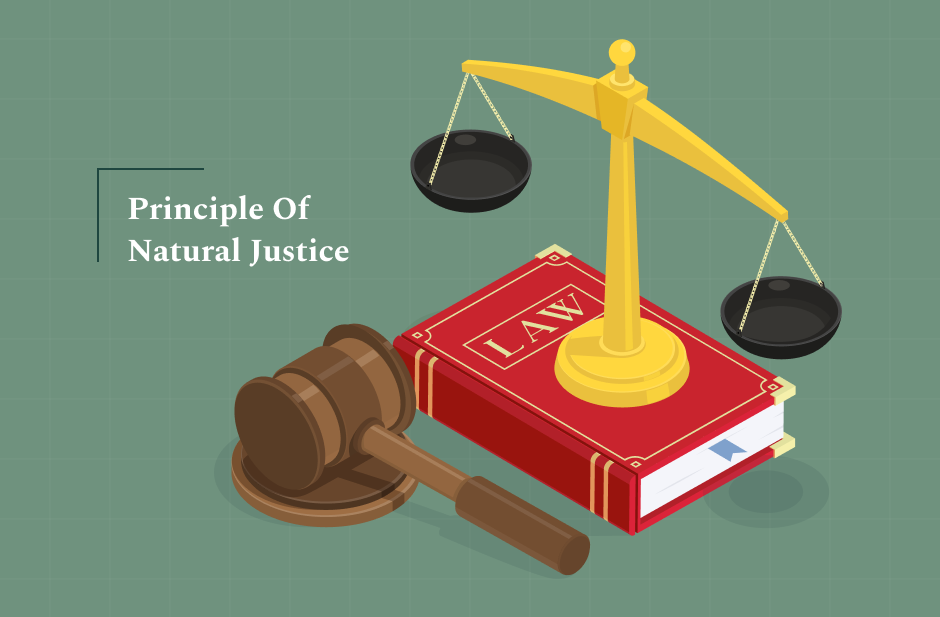
What Is The Principle Of Natural Justice?
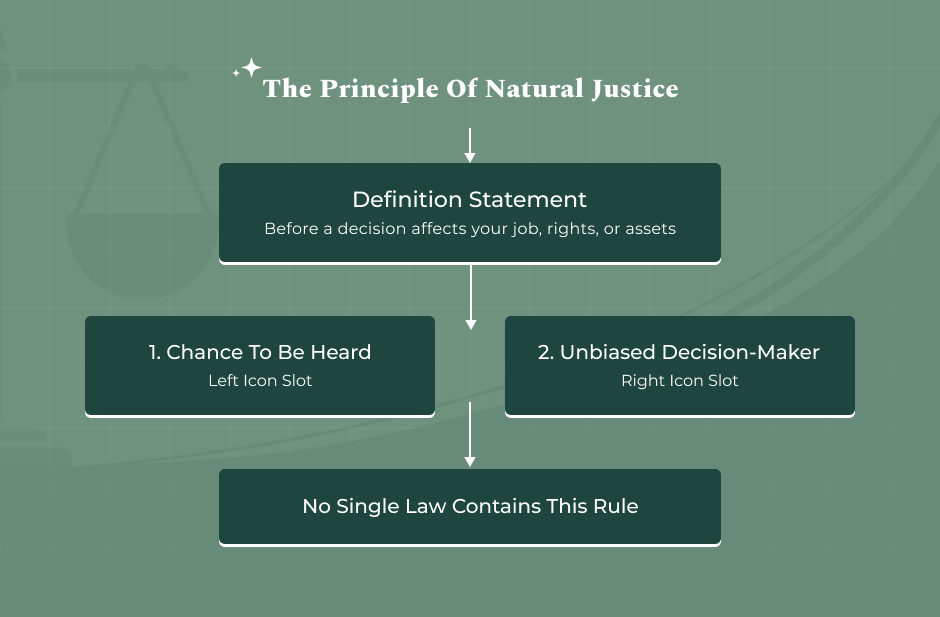
The principle of natural justice is a legal principle. It says that before making a decision regarding your job, rights, assets, or accounts, you have to provide that person with a fair chance at trial. To clarify, the person deserves these specific opportunities:
- A chance to be heard
- And a decision-maker who isn’t biased.
That’s it. No single statute contains this rule. It predates most of India’s written laws, draws directly from English common law, and Indian courts treat it as something so basic that it needs no rulebook to exist.
Here’s the legal-textbook version, for context: natural justice is an unwritten set of procedural safeguards that courts read into almost every law affecting individual rights, unless that law clearly and validly excludes them.
You’ll notice the difference between the two versions above. The first is what it means. The second is how a judgment would phrase it. Both are correct; one’s just written for humans.
Why Does This Rule Even Exist?
Because power, left unchecked, tends to skip the boring parts. Committees often rush. Officers usually assume. Above all, institutions protect themselves before they protect the person in front of them.
In the same vein, natural justice exists to slow that down just enough so that decisions aren’t made about a person without that person having a say.
It isn’t about being lenient. A student who genuinely cheated can still be expelled. An employee who genuinely stole can still be dismissed.
Natural justice doesn’t protect the guilty from consequences. On the contrary, it protects everyone from decisions made without a fair process, which is a very different thing.
The Two Core Rules
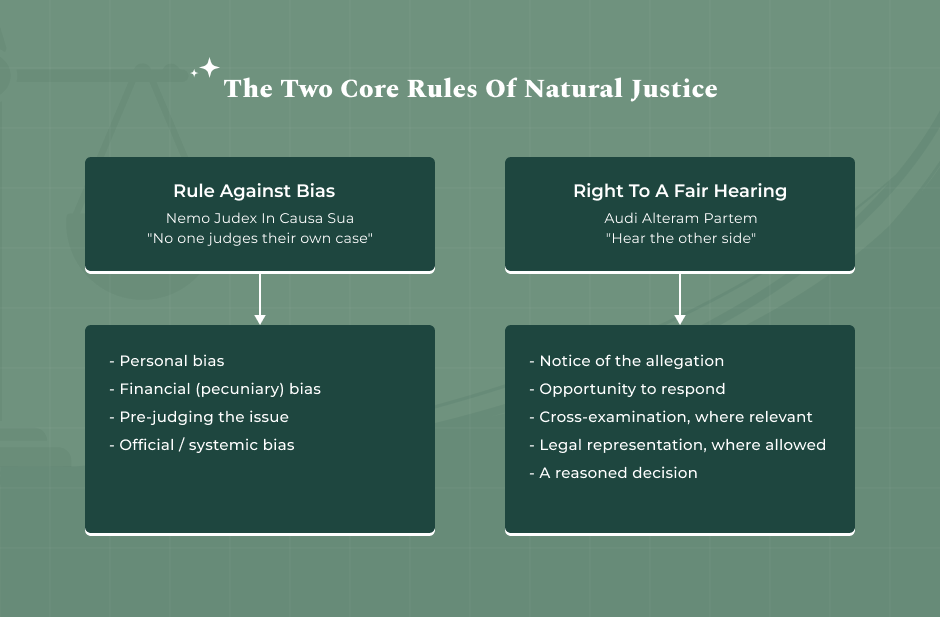
There are two Latin phrases that define the principle of natural justice:
Rule Against Bias: Nemo Judex In Causa Sua
This principle states that you can’t make the rules when you are going to use them to play. If someone has the authority to curb your power, position, and influence, that person should be neutral.
Now that person may make a fair call by chance. However, that is still a product of the rigged process. Here are the kinds of biases that the court will look into:
- The Personal Stuff: They know you. Maybe they hate you, or maybe they just have a deep, emotional connection to how things turn out.
- The Money Part (Pecuniary): Purely financial. If their bank account grows or shrinks based on their decisions, it’s a conflict.
- Pre-judging the Issue: This happens when an official mouth-offs and takes a massive public stance on your exact issue before you even get a chance to speak.
- The Systemic Role (Official): This isn’t personal malice. It’s just that their actual job description or institutional goals force them to be biased.
Let us take the example of a promotion board in an organization. Here, someone from the voting panel might be competing internally for the same or similar posts in the company.
Meanwhile, that’s what has actually happened in India, more than once.
Right To A Fair Hearing: Audi Alteram Partem
This one means “hear the other side.” It sounds obvious until you notice how often it’s skipped. A fair hearing usually includes:
- Notice: you’re told, clearly and in advance, what the allegation or issue actually is.
- Opportunity to present your case: you can respond, submit evidence, or explain your side.
- Cross-examination, where relevant: you can question evidence or witnesses used against you.
- Legal representation, where the rules allow it: you’re not forced to defend yourself alone in a serious matter.
- A reasoned decision: you’re told why the decision went the way it did, not just what the outcome was.
Picture a government employee accused of misconduct.
If the department dismisses them based on an anonymous complaint, without showing them the complaint or allowing them to respond, that’s a textbook audi alteram partem violation. Regardless of whether the complaint was true.
The Quiet Third Rule: Speaking Orders
Indian courts have increasingly treated a third requirement as part of the same family. To clarify, the duty to give a reasoned decision is sometimes called a “speaking order.”
A decision that simply says “rejected” or “terminated” without explanation is hard to challenge and easy to abuse.
A reasoned order forces the decision-maker to actually justify the outcome on the record. Again, that, as a side effect, makes bad decisions much harder to hide.
It’s a small requirement with a big effect. Once a decision has to explain itself, sloppy or unfair reasoning tends to become visible on the face of the order itself.
To clarify, it is the same way a written contract makes its own terms hard to argue around later.
Where This Actually Hits The Real World
You don’t have to be standing in front of a High Court judge to run into this. It plays out in everyday life way more than people realize.
- Campus Trouble: If a college wants to suspend or kick a student out, they can’t just drop the axe. Even private universities have to give the kid a heads-up and a chance to explain their side first.
- The Government Gig: If you work for the state and they want to fire you, hold back a promotion, or suspend you after an inquiry, they have to follow a clean process. This single issue keeps Indian administrative courts busier than almost anything else.
- Corporate Firings: Private companies have a lot more freedom in their contracts, sure. But if they’re sacking an employee for serious misconduct, especially in mid- to large-sized companies, judges still expect a proper internal inquiry, not an overnight firing.
- Run-ins with Tax Officers: When the Income Tax department or a financial regulator decides to slap you with a penalty or cancel a registration, they can’t just spring it on you. You get a “show-cause” notice first, giving you a window to fight back before they lock in a final order.
- Consumer Complaints & Bad Licenses: Whether you’re fighting a brand in a consumer forum or the state is trying to strip away your driving license, trade permit, or professional registration, the rule remains the same: they have to let you speak before they shut you down.
The Constitution Connection
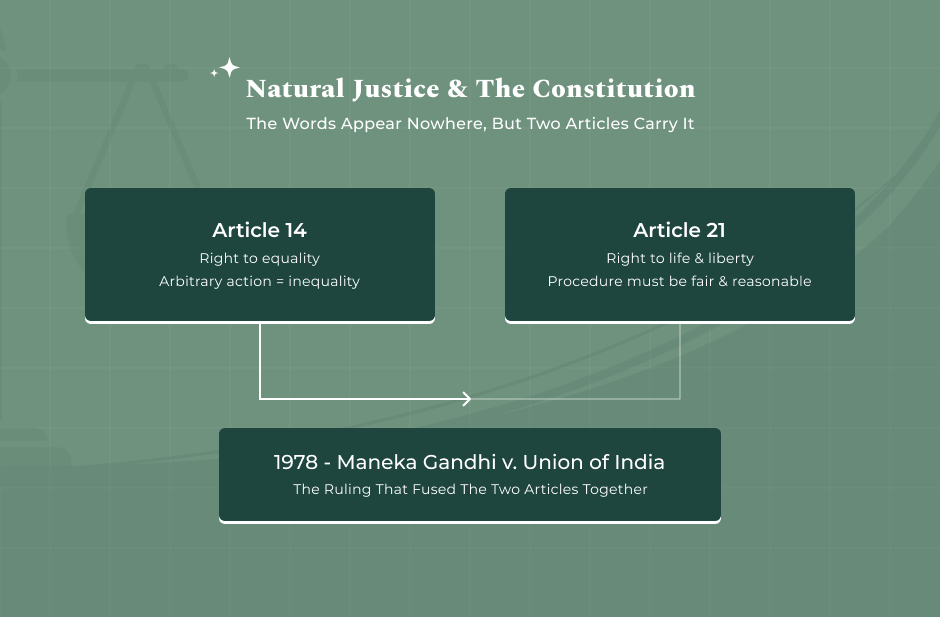
If you flip through the Indian Constitution, you won’t find the words “natural justice” anywhere in the index. But judges have basically tattooed the concept onto two massive clauses anyway.
First up is Article 14, which is supposed to guarantee equality. The courts figured out that if the state acts on pure whim without giving reasons, it’s inherently unequal. Basically, randomness is the enemy of fairness.
Then there’s the heavyweight: Article 21. It says the government can’t touch your life or liberty except through a “procedure established by law.”
For a long time, that just meant the state needed a written rule on paper, even a terrible one.
But in 1978, the Supreme Court flipped the script. They ruled that the procedure can’t just exist; it has to be fair, just, and completely reasonable.
That one pivot changed everything. It took a dry legal phrase and turned it into a massive shield against unfair decisions.
Landmark Cases Under The Principle Of Natural Justice Explained
You don’t need to memorize citations to understand these. On the contrary, you need to understand what changed because of them.
| Case | Year | What It Actually Changed |
| A.K. Kraipak v. Union of India | 1969 | A forest officer sat on the very selection board deciding his own promotion. The Supreme Court held that natural justice applies to administrative decisions as well as judicial ones. Thus, closing a loophole officials had relied on for years. |
| Maneka Gandhi v. Union of India | 1978 | The government impounded a passport without a hearing. The Court ruled that “procedure established by law” under Article 21 must be fair and reasonable. Thus, effectively fusing natural justice into the Constitution’s due process guarantee. |
| Ridge v. Baldwin (UK) | 1963/1964 | A police chief was dismissed without a hearing. English courts had drawn an artificial line between “judicial” and “administrative” bodies for natural-justice purposes; this case dismantled that line and heavily influenced Indian courts afterward. |
| Mohinder Singh Gill v. Chief Election Commissioner | 1977–78 | The Election Commission canceled the results of an entire constituency after violence broke out, without first hearing the leading candidate. The Court held that even the Election Commission isn’t above natural justice when its decision has serious “civil consequences”. Though it also allowed for a flexible, even after-the-fact, hearing where speed genuinely matters. |
| Swadeshi Cotton Mills v. Union of India | 1981 | The government took over management of a company without prior notice. The Court held that even emergency economic action generally requires at least a summary hearing unless the law clearly says otherwise. |
Notice a pattern? That single pattern proves that judges value accountability far more than administrative speed. To sum up, courts have never treated convenience as a substitute for fairness.
When Can Natural Justice Be Skipped?
It isn’t absolute. Courts recognize a handful of situations where a full hearing can be limited, delayed, or excluded:
- Genuine emergencies, where immediate action is needed to prevent serious harm. For example, public safety, urgent economic disruption, and similar situations.
- Clear statutory exclusion, where a law validly and specifically removes the requirement. Though courts read such exclusions narrowly and will still expect basic fairness where the Constitution demands it.
- Confidential or sensitive matters, such as certain security clearances, where disclosing full details would defeat the purpose of the decision.
- National security, where courts generally give the government wider latitude, though not unlimited latitude.
Even in these situations, Indian courts have leaned toward some form of fairness. For instance, a summary hearing, a post-decision explanation, or a right to be represented later.
Rather than none at all. The exclusion is narrow by design, not a blanket exit.
Natural Justice vs Due Process vs Procedural Fairness
These three terms are used almost interchangeably, which causes real confusion.
| Term | Where It’s Used | Core Idea |
| Natural justice | India, UK, most Commonwealth countries | An unwritten, judge-developed doctrine built mainly on the “no bias” and “fair hearing” rules. |
| Due process | United States (and now, informally, India via Article 21) | A constitutional guarantee that both the procedure and the substance of a law must be fair, not just its process. |
| Procedural fairness | Australia, and increasingly used as a neutral umbrella term | Certain jurisdictions prefer this phrase over “natural justice” to avoid the archaic, quasi-religious ring of “natural law,” even though it covers essentially the same content. |
In practice, especially after the Maneka Gandhi ruling, Indian courts have largely merged natural justice and due process.
The labels differ. However, the underlying expectation of fairness before a decision doesn’t.
What Counts As A Violation?
Some patterns show up again and again in the cases:
- A decision made by someone with a personal or financial stake in the outcome.
- No notice given before an adverse action.
- A hearing that exists on paper but is a formality. To clarify, evidence is never actually considered.
- Denial of the right to see the material used against you.
- An unreasoned order that simply states the outcome.
- Refusal to allow legal representation where the stakes and rules call for it.
Again, that is really what constitutes legal malpractice when it results from a lawyer’s negligence rather than the client’s bad luck.
How Courts Actually Decide These Cases
Judges don’t apply a fixed checklist. They tend to weigh:
- What was at stake. A parking fine and a job termination don’t call for the same level of process.
- Whether the law required a hearing, expressly or by implication.
- Did the affected person actually suffer prejudice: some courts now ask whether a hearing would have changed anything at all, though this is debated.
- Whether any hearing given was real or just a formality.
- Could urgency genuinely justify skipping or shortening the process?
A lawyer’s impact isn’t just about knowing the rules. On the contrary, it’s about how they advocate for you.
Legal history often points to the “seven lamps of advocacy“: honesty, courage, hard work, wit, eloquence, judgment, and fellowship. But if you strip away the old-fashioned phrasing, it really boils down to what makes a legal hearing actually matter:
- Preparation: Doing the homework.
- Honesty: Being upfront about weak points.
- Listening: Real engagement, not just reciting a script.
Ultimately, a lawyer who is prepared and direct will always get a fairer hearing than one who just goes through the motions.
Frequently Asked Questions (FAQs):
Look at a Pune college that expelled a student for plagiarism by just pinning a notice on the board. The court threw it out.
Not because he was innocent, but because they never let him explain. That is natural justice. It ignores whether the final decision was right or wrong and focuses purely on whether the process was fair.
Without it, institutions would constantly steamroll individuals to save time.
In India, this single concept has overturned everything from university expulsions to rigged elections and sudden government dismissals. If it popped up in your court order, law syllabus, or UPSC prep, it is the ultimate shield against unchecked power.
At TheLegalGuides, we skip the boring case-law dumps and dense academic jargon. This is a straight-to-the-point breakdown of what the rule means, how it works in real life, and why it keeps upending the legal system.
Key Takeaways
- Natural justice is about fair process, not correct outcome.
- It rests on two core rules: no bias, and a genuine right to be heard, plus an emerging third, the duty to give reasons.
- It applies far beyond courtrooms: colleges, employers, tax authorities, licensing bodies, and regulators are all bound by it in varying degrees.
- Indian courts have folded this principle into Articles 14 and 21, effectively creating a constitutional guarantee in substance, even though the text never names it.
- It can be limited in genuine emergencies or by clear law, but Indian courts consistently favor some form of fairness over none.
The Simple Truth Behind The Legal Machinery
Most people only encounter this principle of natural justice at the worst possible moment. For instance, a job loss, an expulsion, a tax notice, an election dispute.
People probably explain this principle badly most of the time because nobody remains calm when they actually need it.
But the idea underneath all the Latin is almost embarrassingly simple. Before a decision changes your life, someone should have to look you in the eye.
Before a decision changes your life, an authority should look you in the eye, state the allegations clearly, and actually listen to your side of the story. The legal system builds everything else in this article simply to ensure that happens.
Disclaimer: This article explains general legal principles for informational purposes and reflects publicly available case law and constitutional provisions.

It isn't a substitute for advice from a lawyer who has reviewed your specific facts and the law that actually governs your situation.