To be really honest, not all marriages last. Divorce is pretty common, and it’s very normal to wonder just how much timing matters in this context.
Should you file first? Or is it just better to wait for your spouse to make the first move? Does it matter who files for divorce first?
Frankly, many people actually think that filing first gives them a major advantage, at least legally. Moreover, family and friends can even tell you it’s the smarter thing to do.
If you go to Reddit or other online platforms, you will be surprised to find so many stories on how, if you file first, you can win the case.
But the reality is starkly different and definitely less dramatic.
In a majority of cases, filing first doesn’t actually make you the winner – it doesn’t mean you will get alimony, more property, or even win custody rights. These are decisions that entirely rely on two things:
- The objective facts of the case.
- The laws of the state where the divorce is happening.
That doesn’t mean filing first is meaningless.
So, filing first will offer you some strategic advantages but only in specific situations. For instance, it can give you more time to prepare yourself, or help you to request temporary court orders if there’s some issue that needs immediate attention from the court.
As a result, you need this clarity – getting an advantage and winning the case aren’t the same things.
In this legal guide, we will break down when filing first can help you and how it makes little difference in most cases. Also, we will touch upon why preparation is more important than being the first to reach the courthouse.
Stay tuned.
The Short Answer: Does It Matter Who Files For Divorce First?
Unfortunately, there is no objective ‘yes’ or ‘no’ for this question.
At times, it does matter who files first. But probably not for the reasons you’ve heard. Filing first can influence certain parts of the divorce process.
It usually does not determine the final outcome.
Of course, a court of law will never favor someone because they filed for divorce first. Instead, the court will evaluate all the facts related to the case. And these include everything – from child custody and support to property division and even spousal support.
Moreover, the final decision entirely depends on the evidence presented to the court and the laws of the state.
Naturally, filing first is more like choosing who will start the conversation first. But it is true that when you file first, you get more time to prepare – you get to control the timing.
However, it does not let you choose when or how the conversation ends.
And this is perhaps the most important distinction, considering it confuses so many people about the difference between starting the case and winning it.
Why This Question Comes Up So Often?
Of course, a divorce can be super stressful and exhausting. Plus, it’s very normal to experience all sorts of uncertainties and insecurities when your marriage is falling apart.
Wanting to improve your situation and seeking an immediate ‘out’ seems like the only option.
Naturally, it is easy to understand why the idea of filing first has become so popular. The moment you act and file for a divorce before your partner can act on it, it feels like you are gaining an advantage.
Moreover, in some situations it can even be partly true.
For instance, if you file first, you will have more time to prepare your documents, get in touch with a lawyer for an understanding of your situation, and avoid making any impulsive decisions.
Those are real benefits. But they are strategic benefits, not guaranteed legal victories.
The outcome of a divorce still depends on many other factors, including your finances, your parenting arrangements, the evidence available, and the laws that apply in your state.
Legal Advantage Vs Strategic Advantage:
This is where many divorce articles create confusion.
They treat every advantage as though it carries the same weight. It doesn’t. Frankly, there’s an important difference between a legal advantage and a strategic advantage.
Once you understand that distinction, the rest of the divorce process becomes much easier to evaluate.
A Legal Advantage Changes Your Rights:
A legal advantage affects how the court applies the law.
For example, if filing first automatically meant receiving more marital property, that would be a legal advantage.
In most divorces, that simply isn’t how the system works. The judge doesn’t award assets because someone filed first.
Likewise, filing first doesn’t automatically give one parent custody or eliminate the other parent’s legal rights.
At the end of the day, any court of law will make a decision based on facts related to the case. So, whether you filed first or your spouse does so, the law stays the same.
A Strategic Advantage Changes Your Preparation:
To be honest, this is exactly where filing for divorce first can make a major difference. So, imagine you are already aware that your marriage is ending.
Instead of reacting to unexpected divorce papers, you spend several weeks preparing:
- You organize financial records.
- You make copies of important documents.
- And even meet an attorney if needed.
Eventually, when you file, you are making decisions after preparing yourself instead of acting out impulsively.
And that’s your only real advantage if you file first.
What Filing First Can Change?
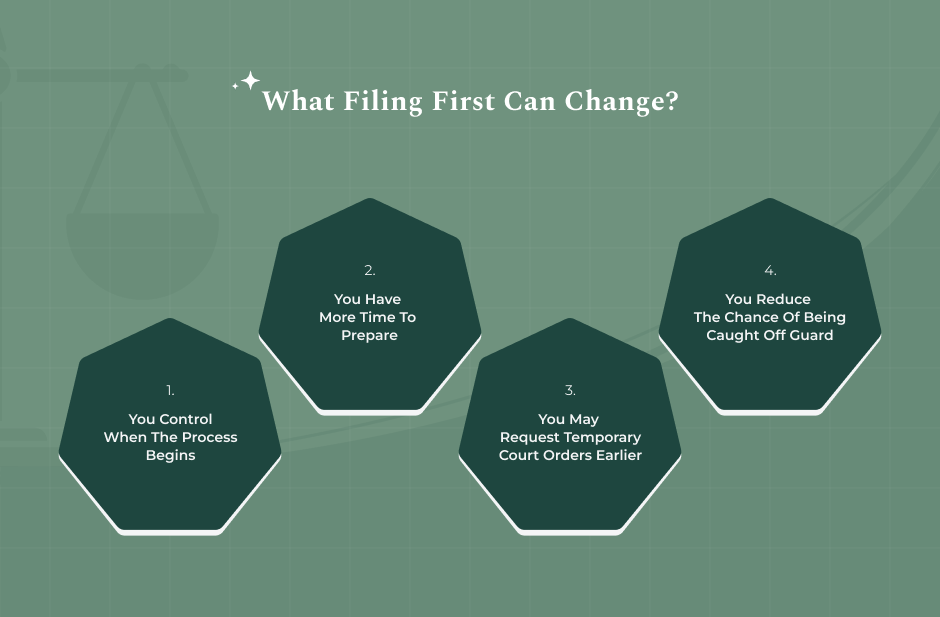
While filing first hardly matters in the long run, it can influence how the divorce procedure will unfold.
On that note, here are some ways in which it matters.
You Control When The Process Begins:
Of course, timing is important. But understand that it only gives you the power to decide ‘when’ the case officially starts.
And that can be vital if you are waiting to get hold of financial documents, finish some important professional commitments, or even arrange a living situation for yourself – and your kids, if you have children.
So, it’s just that the timeline is yours – and not that of your spouse.
You Have More Time To Prepare:
Preparation is one of the biggest advantages of filing first. Rather than rushing after receiving divorce papers, you can:
- Gather financial records.
- Review bank statements.
- Organize tax returns.
- Make copies of property records.
- Create a list of all marital assets and debts.
- Consult an attorney before taking legal action.
You May Request Temporary Court Orders Earlier:
Many divorces involve issues that can’t wait until the final judgment.
For instance, this includes:
- Temporary child custody.
- Parenting schedules.
- Child support.
- Spousal support.
- Exclusive use of the family home.
- Responsibility for certain household bills.
Depending on your state’s procedures, filing first may allow you to ask the court to address these issues sooner rather than later.
These temporary orders don’t necessarily predict the final outcome. They simply provide structure while the divorce is ongoing.
You Reduce The Chance Of Being Caught Off Guard:
To receive divorce papers randomly can get quite overwhelming, to be honest!
Honestly, it’s difficult to make important decisions when you are struggling emotionally – your marriage is ending. You cannot just be fine – it takes time. However, when you are the one initiating the case, you are less likely to be surprised.
Moreover, you already will get the time to prepare – and that too financially, legally, and emotionally.
That doesn’t eliminate stress. But it can reduce unnecessary pressure during the early stages of the divorce.
Filing First Doesn’t Mean Filing In Anger:
One common misunderstanding is that filing first requires acting quickly. It doesn’t. In fact, rushing simply to become the petitioner can create new problems.
The strongest position usually comes from careful planning, not speed.
Also, if you need extra time to consult with an attorney or gather some much-needed information, then using this time to prepare wisely can turn out to be more valuable.
And that is precisely why any experienced attorney will always focus less on who filed first and prioritize whether their client is actually ready before the procedure starts.
What Filing First Doesn’t Change?
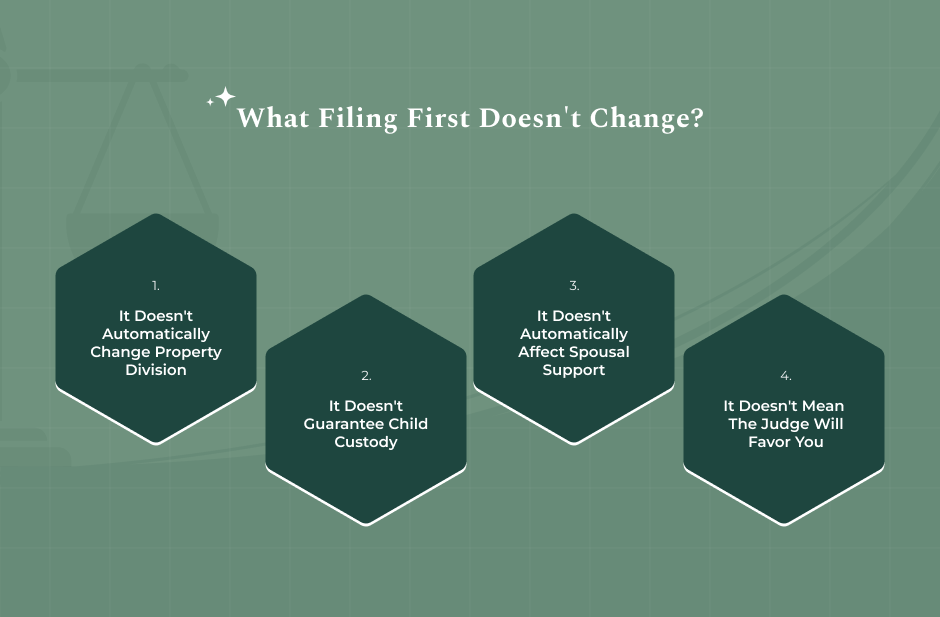
By now, it’s clear that filing first can offer practical advantages. But it’s just as important to understand its limits.
Many people assume that filing first gives them a stronger legal position throughout the divorce.
In most cases, it doesn’t.
The court doesn’t decide who should receive a larger share of the marital estate simply because they filed the petition first. It doesn’t automatically award custody to the parent who started the case. It doesn’t punish the spouse who files second.
Those decisions are based on the facts, the evidence, and the laws in your state. Let’s look at what filing first usually doesn’t change.
1. It Doesn’t Automatically Change Property Division:
One of the biggest myths about divorce is that the first person to file gets a better financial outcome.
That’s rarely true.
When courts divide marital property, they focus on the applicable state law.
In community property states, marital assets are generally divided according to community property rules.
In equitable distribution states, courts aim for a division they consider fair, which isn’t always a perfectly equal split.
Neither system rewards someone simply for filing first. So, if your spouse files before you, it doesn’t mean you’ve lost your claim to marital assets.
2. It Doesn’t Guarantee Child Custody:
Parents often worry that waiting to file will hurt their custody case. In reality, judges focus on the child’s best interests.
They consider factors such as:
- Each parent’s involvement in the child’s life.
- The child’s needs.
- Stability.
- Safety.
- The ability of each parent to provide ongoing care.
Also, the date someone filed for divorce isn’t usually one of those factors. A parent who files second can receive primary custody if the evidence supports that outcome.
3. It Doesn’t Automatically Affect Spousal Support:
Some people believe filing first increases their chances of receiving or avoiding alimony. Again, that’s generally a misconception.
Courts usually examine issues such as:
- The length of the marriage.
- Each spouse’s income.
- Earning capacity.
- Financial need.
- Contributions made during the marriage.
Those facts matter far more than who submitted the paperwork first.
4. It Doesn’t Mean The Judge Will Favor You:
Judges are expected to remain impartial.
Their role is to apply the law fairly to both parties. Whether you’re the petitioner or the respondent, you’ll still need to support your requests with evidence.
Also, filing first doesn’t give your arguments extra weight – but good preparation does.
When Filing First Can Be A Smart Move?
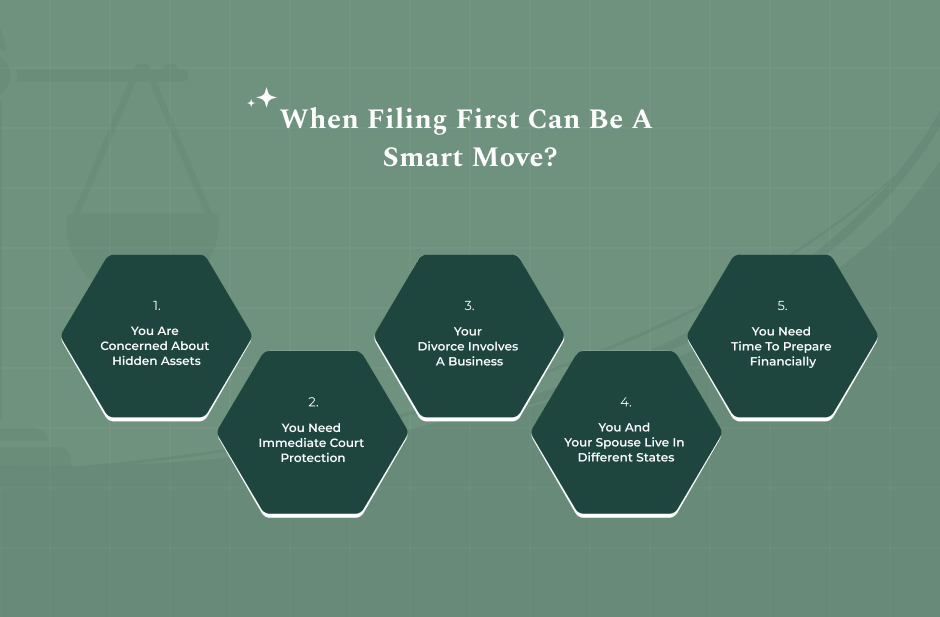
Although filing first doesn’t guarantee a better outcome, there are situations where it can provide meaningful advantages.
Here are some examples.
1. You Are Concerned About Hidden Assets:
If you believe your spouse may move money, transfer property, or hide financial information, speaking with an attorney before filing can be especially important.
Moreover, acting early may help preserve financial records and allow you to request appropriate court orders if necessary.
The goal isn’t to gain an unfair advantage. Instead, it’s to protect the integrity of the divorce process.
2. You Need Immediate Court Protection:
Some situations can’t wait.
For example, you may need temporary orders involving:
- Child custody.
- Parenting time.
- Child support.
- Spousal support.
- Exclusive use of the family home.
- Protection from harassment or abuse.
Also, filing first may allow you to ask the court to address these urgent issues sooner.
3. Your Divorce Involves a Business:
Business ownership often makes divorce more complicated.
Questions about valuation, ownership interests, and future operations may require careful planning before the case begins.
Moreover, filing first doesn’t determine who keeps the business.
However, having time to organize financial records and consult professionals can make the process more manageable.
4. You And Your Spouse Live In Different States:
When spouses live in different states, timing can sometimes influence where the divorce is filed.
Different states have different residency requirements and divorce laws.
In some situations, filing first may determine which court hears the case.
Because jurisdiction can affect important legal issues, it’s worth discussing this with an attorney before taking action.
5. You Need Time To Prepare Financially:
Divorce often changes a family’s financial picture overnight. Before filing, you may want to:
- Review household expenses.
- Open individual bank accounts where appropriate.
- Gather tax returns.
- Document assets and debts.
- Understand your monthly budget.
Preparation doesn’t guarantee a better outcome. Also, it does reduce the chances of making important decisions without the information you need.
5 Common Myths About Filing for Divorce First
Divorce advice spreads quickly. Unfortunately, not all of it is accurate. On that note, let’s separate a few common myths from reality.
| Myth | Description |
| Filing First Means You Will Win the Divorce | There’s no legal prize for being first. The outcome depends on the evidence, the law, and the circumstances of your case. |
| The Person Who Files First Gets More Property | Property division follows state law. Courts don’t reward speed. Whether property is divided equally or equitably depends on the legal rules that apply, not who filed the petition. |
| Filing First Guarantees Custody | Child custody decisions focus on the child’s best interests. The filing date is rarely a deciding factor. |
| The Judge Will Automatically Believe The Petitioner | Every claim made during a divorce can be challenged. The judge hears evidence from both spouses before making decisions. |
| You should always rush to file | This may be the most harmful myth of all. Rushing into a divorce before understanding your finances, gathering documents, or seeking legal advice can create unnecessary problems. |
Sometimes filing first is the right move. Sometimes taking a little more time leads to better decisions. The goal isn’t simply to be first. Instead, the goal is to be prepared.
Preparation Is Often the Real Advantage
By now, a pattern should be emerging. The strongest advantage usually isn’t filing first. It’s knowing what you’re doing before the case begins.
Someone who spends several weeks organizing financial records, understanding their legal rights, and planning for life after divorce may be in a much stronger position than someone who rushed to file simply because they were afraid of being second.
That’s why many experienced family law attorneys focus on preparation rather than speed. A well-prepared case often matters far more than an early filing date.