
Alimony rules in India constitute a body of rules that govern how financial support can be provided between the partners even after the dissolution of the marital relationship.
They help in providing the necessary provisions to the financially dependent partner without putting him/her through any financial crisis due to the separation.
In the year 2026, it becomes important for the court to take strict action against the partners who try to hide their properties.
The purpose of alimony is to continue with the same standard of living as before the separation in both mutual and litigated divorces.
There are currently some significant cases being fought out in the Supreme Court that challenge the “25% of net income” rule. This entails intricate deliberations regarding digital properties and international properties. In this article, we will talk about the following points.
- The various categories of maintenance and permanent alimony in India.
- The 2026 judicial benchmarks for calculating monthly and lump-sum payments.
- A comparative analysis of US spousal support laws and Indian statutes.
- Recent celebrity alimony cases and their impact on public legal perception.
The Classification Of Financial Support In Indian Law
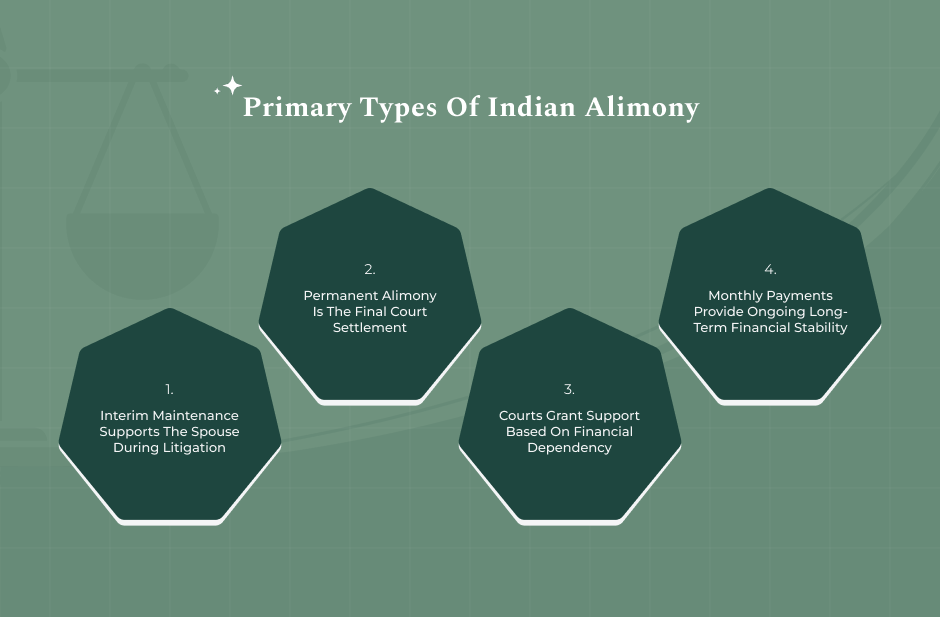
The alimony rules in India classify alimony payments into two broad categories – interim maintenance and permanent alimony.
Legal procedures ensure that both spouses’ basic requirements are taken care of from the very beginning.
Interim Maintenance As Per Section 24
Interim maintenance pertains to meeting the basic necessities of the dependent spouse until the time of divorce.
According to the alimony laws in India, legal expenses are also included in the category. This prevents the richer party from starving out the other spouse during the lengthy litigation period.
Permanent Alimony As Per Section 25
Permanent alimony relates to the amount finally awarded after divorce. It may be paid either on a one-off basis or monthly.
This provision comes under Section 25 of the Hindu Marriage Act, according to which either spouse may receive alimony in case he/she is unable to meet his/her needs independently.
How Are Alimony Rules In India Calculated Today?
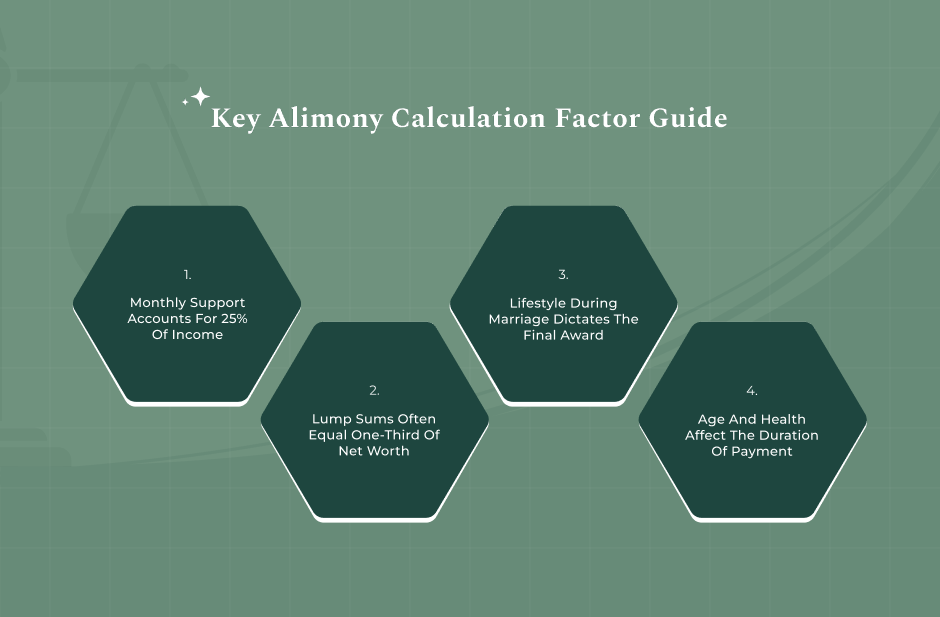
Although there are no concrete formulas for computing alimony, 2026 guidelines exist. The earning capacity and net worth of the spouses have to be considered by judges to come up with a proper alimony payment.
25% Net Income Rule
In cases of monthly alimony, the Supreme Court normally proposes that the amount payable should be about 25% of the husband’s net salary income. It varies according to the number of dependents and the earnings of the spouse.
The new Indian alimony laws place more emphasis on the self-respect of the recipient than merely on subsistence alimony.
The 25% Maintenance Standard – Case Law
The Indian court considers certain benchmarks in fixing maintenance allowances in order to provide the spouse with a dignified lifestyle. In this case, the key judgments that formed such standards will be discussed below.
Kalyan Dey Chowdhury V. Rita Dey Chowdhury (April 19, 2017)
This landmark judgment in the Civil Appeal Case No. 5369 of 2017 introduced an important financial threshold. The court stated that the sum of 25% of the husband’s net income should be paid monthly to the former wife.
As a result, such a percentage becomes the key criterion for determining the “fair and balanced” payment that the man must transfer to the woman regularly. This approach made it possible to eliminate the chaotic nature of trial court decisions during the divorce process.
Rajnesh V. Neha (November 04, 2020)
Another groundbreaking decision in Criminal Appeal Case No. 730 of 2020 transformed the way financial information was provided in court proceedings. Both sides were obliged to provide the required documents, including their sworn declaration of wealth.
All owned property and debts must be included in the declarations to prevent concealment of assets and reduce the final payment. This step helps apply the new rules of alimony to all cases honestly.
Recent Rulings On Alimony And Asset Protection
Most modern cases deal with complex assets as well as non-compliant payers. Recent decisions allow courts to have sufficient means at hand to enforce the newly implemented divorce alimony laws in India.
Prabhavathi v. Lakshmeesha M.C. (August 20, 2024)
This decision rendered in 2024 by the Supreme Court (Civil Appeal No. 9005 of 2024) warned that the “irretrievable breakdown” can be misused.
Thus, it should not be considered in case only one spouse is fully to blame for such an irreparable situation.
Thus, a “faulty” party will not be able to use a quick track process to avoid making maintenance payments to the spouse and thus will protect their interests under new alimony rules in India.
Supreme Court Order On Direct Salary Deduction (March 05, 2026)
This extremely recent interim decision from 2026 was rendered in case of non-payment. The Supreme Court ruled that in case of non-payment, an employer is obliged to make salary deduction in favor of the wife and kids.
This “direct deduction” approach is now the most common solution to the problem of non-payment within new alimony laws in India and provides for regular payments made by RTGS.
Calculating Final Alimony Payouts
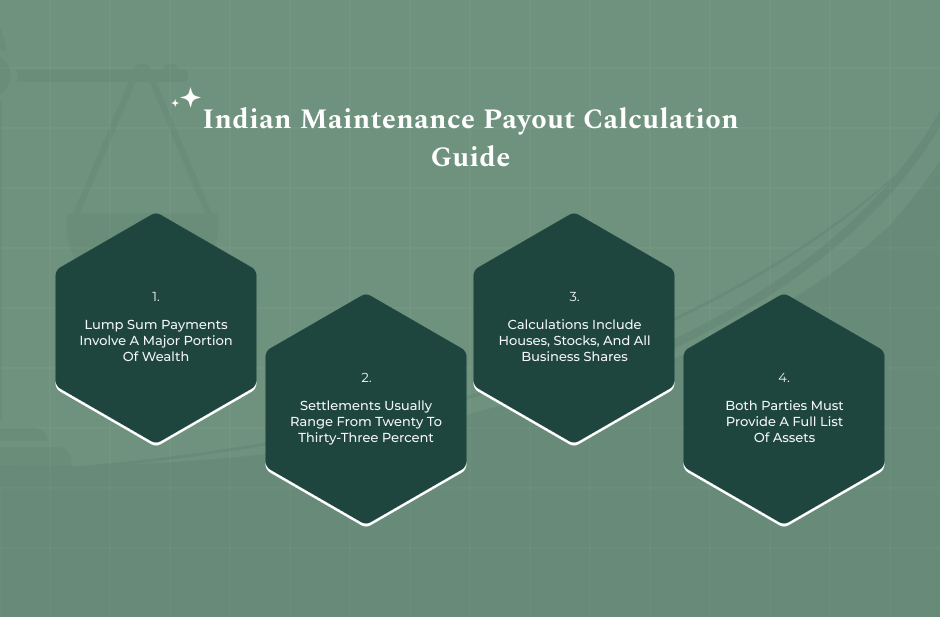
The calculation will be different if the spouses agree that it should be a one-time payment instead of monthly payments. In most cases, the total figure will depend on the financial standing of the party who will pay spousal support.
In cases where the court decides that a single sum should be paid, the figure will normally range from 20 to 33 percent of the net worth of the individual paying the sum.
All types of assets need to be considered in making such a calculation, which will include tangible real estate property, cash, and stocks in privately owned companies. The new law in India concerning alimony states that this needs to be done in detail.
“25% Of Husband’s Net Salary Just & Proper To Be Awarded As Maintenance To Wife: SC” (Source – Live Law)
Alimony In The USA
As far as Indian nationals residing outside India are concerned, it becomes important to understand alimony regulations in India vis-a-vis those existing in the USA. In the USA, alimony falls under the ambit of the individual states rather than the Federal Government.
Approach Of The USA States
In the US, Florida, for example, has adopted laws that discontinue “permanent alimony.” In its place, they have adopted either durational or rehabilitative alimony as compared to the concept of permanent alimony prevalent in India.
Each US state has its own laws regarding what should constitute fair alimony.
Taxation Under the TCJA
Whereas the determination of fair alimony rests with the state governments, the US federal laws govern how alimony is taxed by the Internal Revenue Service (IRS).
Since 2019, alimony payments do not qualify as deductible income at the federal government level. On the other hand, in India, alimony payments are considered capital receipts. (Source: Taxes For Expats)
Changes To Alimony Rules In India That Will Come In 2026
Legal provisions in 2026 have been made that help in closing gaps exploited by affluent individuals for avoiding responsibility towards their ex-spouses.
Some examples of such new alimony rules in India are mentioned below.
Disclosure Requirements On Digital Property
Courts are now making it mandatory for spouses to divulge information on their digital currencies, along with revenues earned from businesses on the internet.
Modern times have necessitated changes to the alimony rules in India to take into account sources of income besides the conventional bank savings.
Maintenance Even When Marriage Is Short Lived
An order has been passed by a court recently in 2026 requiring payment of a considerable amount per month even when the marriage lasted for merely 13 months.
It should be noted here that the income levels of the ex-husband were considered an important criterion rather than the duration of the relationship. (Source: Best Divorce Lawyer)
Celebrity Alimony Cases In Recent News
High-profile celebrity divorce cases in different countries also reveal how the divorce alimony rules are applied by taking into consideration the high level of wealth of a person.
Hardik Pandya And Natasa Stankovic (India)
A rumored 70% property transfer became news headlines while they were divorcing.
Even though the alimony rules in India do not consider such a large percentage as mandatory to be paid, this case demonstrated how the Indian divorce alimony rules take into consideration the interests of the children.
Dhanush And Aishwaryaa Rajinikanth (India)
Mutual consent divorce in this high-profile couple revealed how people manage their financial issues without going to court.
As per the alimony rules in India, if there is a mutual settlement, then the parties can privately settle the matter using a lump sum amount as per their lifestyle.
Hugh Jackman And Deborra-Lee Furness (USA)
This high-profile celebrity couple ended their marriage by dividing their wealth through divorce laws. While alimony rules in India differ from those in the USA, the American divorce alimony rules consider fair division of assets.
This couple was married for almost three decades, which gave rise to millions of dollars being transferred.
Expert Tips For Managing Alimony Claims
Proactively handling a case according to alimony regulations in India necessitates adequate financial preparation. The use of documentation will prove to be the most effective weapon during any maintenance battle.
- Collect all tax forms for three years.
- Keep track of all monthly expenditures via receipts.
- Determine your own and shared assets.
- Seek legal advice from an expert on alimony regulations in India.
Frequently Asked Questions (FAQs):
The complexity involved in alimony rules in India has frequently led people to ask questions about the issue. The following FAQs cover important questions related to citizens and NRIs in India in 2026.
Yes, as long as she is not earning and her earnings cannot take care of her life.
The new alimony laws will let the court consider the amount of rent that may have to be paid in case of loss of household rights.
Hindu Alimony law will be gender-neutral. However, in other communities, only women can get support from Section 125 CrPC.