Most of us don’t read law books. We find tons of acts, sections, and subsections extremely boring. In fact, most things don’t apply to our daily lives. However, laws do apply to what we do every day.
The problem is that we don’t have an awareness of that. If you want to check out how laws apply, you need a session with a lawyer.
Laws don’t only dictate our socio-ethical life but also how we lead our family life and raise our children.
That’s why my goal while writing for TheLegalGuides is to make law simple and decluttered. Especially laws that leaves deep impact on our lives and surroundings.
One such law is the POCSO Act. The POCSO Act full form is Protection of Children from Sexual Offenses Act, 2012.
What is pocso act? Let’s see what the law dictates. At the same time. We will note some landmark cases in which the law has been applied.
What Is The POCSO Act And Why Was It Created?
In 2012, the Indian judiciary recognized a wide, unaddressed gap in the IPC. The contemporary code had no clear pathway to confer decisive POCSO Act punishment in the case of sexual offense against a minor.
That said, the law treated sexual crimes against people under 18 in the same way as those involving adults above the age of consent.
To state clearly, cases involving children and minors are a lot more sensitive and require substantial verdicts. That said, the judiciary realized that the law needs to take into account several other nuances.
After that, the POCSO Act was passed by Parliament in 2012. But what is this act, in reality?
Simply put, the POCSO Act is to safeguard someone under 18 years of age from sexual crime. In this case, the gender of the victim is unnecessary and irrelevant.
So, What Does The Law Mainly Cover?
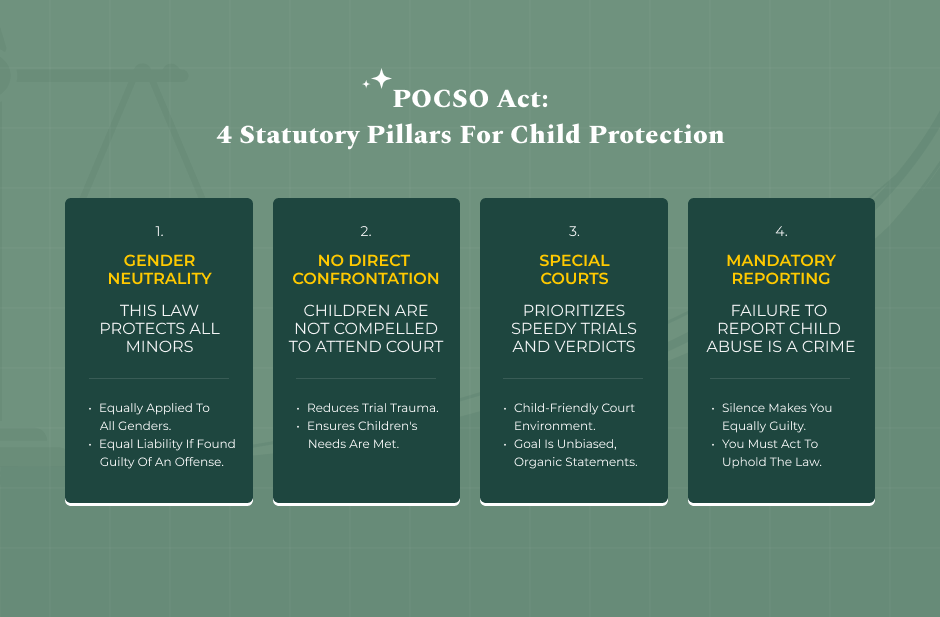
There are 4 statutory pillars that everyone needs to understand. Especially children if they are learning about the law for the first time.
Gender Neutrality:
This law protects both genders. If you are a minor, this law is to protect you. You are equally liable under the POCSO Act if you are a woman and the court finds you guilty of an offense under it.
No Direct Confrontation:
The law has been prepared with the needs and challenges children might face during the trial in mind. That’s why there is a clause that prevents children from being compulsorily present in the court for trials.
Special Courts:
Under the POCSO Act, the judiciary must prioritize speedy trials and verdicts.
The special courts allow children all kinds of flexibility possible. Here, the goal is to secure an organic and unbiased statement from them at any cost.
Mandatory Reporting:
The POCSO Act says that if someone has information about child abuse and still doesn’t report the incident, the person is equally guilty. So, you must not keep quiet and must act with conviction when needed to uphold the rule of law.
The Core Structure: Offenses And Punishments
The POCSO Act categorizes offenses clearly. The harsher the crime, the more severe the punishment. Here is a simplified breakdown of the main offenses under the law:
| Types of sexual harassment | What it Means | Minimum Punishment |
| Sexual Assault | Any non-penetrative sexual contact with a child. | 3 to 5 years in prison, plus a fine. |
| Aggravated Sexual Assault | Abuse by someone in a position of trust, like a teacher, doctor, or police officer. | 5 to 7 years in prison, plus a fine. |
| Penetrative Sexual Assault | Any form of penetrative sexual act committed against a child. | 10 years to life imprisonment, i.e., life without parole |
| Aggravated Penetrative Assault | Penetrative assault by a trusted figure, during natural disasters, or on a child with disabilities. | 20 years to life imprisonment (or even the death penalty in extreme cases). |
| Using Children for Pornography | Recording, storing, or sharing sexually explicit material of a child. | Strict fines and jail terms, especially for failing to delete or report child pornography. |
The Presumption of Guilt: A Massive Legal Twist
In standard criminal law, there is a famous golden rule: “Innocent until proven guilty.” The prosecution must prove beyond a reasonable doubt that the accused did the crime.
Under the POCSO Act, this rule is flipped on its head.
Sections 29 and 30 of the Act introduce a “presumption of guilt”. Once the basic facts of the accusation are established, the court automatically presumes that the accused had a guilty mind and committed the offense.
Earlier, a child victim’s statements were being validated against different parameters. However, the POCSO Act changed the scenario.
If you are under 18 and a victim, you have to bear the burden of proof. But what is that burden? It is the duty of exhibiting something tangible or intangible that can prove your innocence in a specific case.
The burden of proof shifts to the accused, who must prove their own innocence. But why was this importance attached to the version of the child victims?
It was done to ensure that the court hears what the children have to say. At the same time, the child’s own record helps identify criminals and fast-track their conviction process.
However, a lot of attorneys have said that this aspect of proving innocence by children under 18 is debatable.
Real Court Battles: Landmark Judgments Under POCSO
POCSO is a new act. Therefore, we need to examine the court’s interpretations to understand how they play out and affect India’s criminal landscape.
1. The “Skin-To-Skin” Contact Controversy (State Of Maharashtra V. Satish)
Let us focus on this significant 2021 case. In this landmark case, the skin-to-skin touch debate surfaced.
According to the Bombay High Court, the accused groped the victim by clothes. In this case, there was no actual skin-to-skin touch. Based on that, the court argued that such a case cannot be passed as sexual violence.
But the case did not end there. This verdict from the Bombay High Court earned severe backlash from the public. After that, the Supreme Court of India started hearing the case.
Meanwhile, in an interesting turn, the Supreme Court clarified that intent is more important than actions or outcomes, at least in this case. In another landmark judgment, the Supreme Court said that skin-to-skin should not be the ultimate yardstick in judging cases registered under the POCSO Act.
2. The Child Pornography Storage Ruling (Just Rights For Children’s Alliance V. S. Harish)
Earlier, a lower court had observed that a person could not be held guilty merely for downloading or viewing such content unless it was passed on to others.
The Supreme Court took a different position. It said that keeping this material in one’s possession is not a harmless act. The law treats it as an offense when someone stores it, and neither removes it nor alerts the authorities.
The judges also pointed out that every view has consequences. As long as there are people willing to consume such content, the exploitation behind it continues, leaving children to bear the impact long after the abuse itself has occurred.
3. Protection Of Child Identity (Nipun Saxena V. Union Of India)
According to the Supreme Court, it is impossible to identify the victim’s identity. Neither the face nor the name nor other whereabouts.
For instance, the school, address, and photos of the minor. Let’s say the parents give consent to the publication of the particulars. Then what?
Ideally, the lawbook says that even then the media should not take that privilege. As a result, backlash towards the victim based on social prejudices can be avoided.
The Great Debate: Teen Romance Vs. Criminal Exploitation
POCSO Act is not free from controversies. Particularly, adolescent romantic relations, based on mutual consent.
Take this example for better understanding. Say there are 2 guys, aged 16 and 17. They start dating each other.
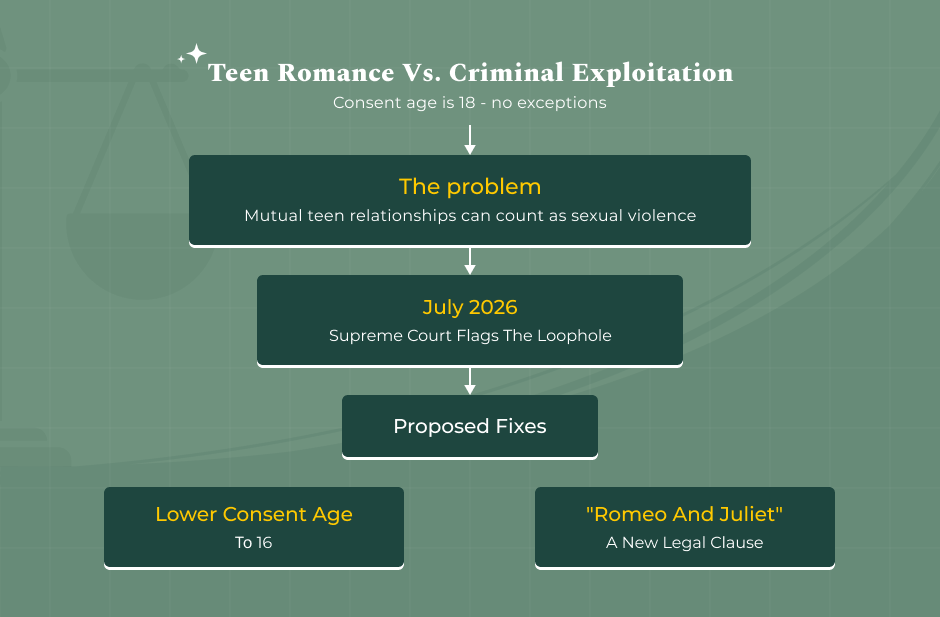
After some months, they decide to get intimate with each other. However POCSO Act says that this is not romance. Rather, this is sexual violence.
But why? As the Act goes, the age of consent is 18. Hence, even if someone gave consent, that would not be considered valid.
In July 2026, the Supreme Court of India called out this loophole in the law. A bench of justices pointed out that parents are weaponizing the law.
The court asked a crucial question: How can the state prevent the elopement of teenagers when teenage is naturally a period of experimentation?
Many High Courts across India, including the Madras High Court, have actively tried to quash criminal cases against young boys where the relationship was clearly mutual and consensual.
Legal experts are currently debating whether India should lower the age of consent to 16 for consensual relationships, or introduce a “Romeo and Juliet” clause to protect teenagers from harsh sex offender labels.
Why Many POCSO Cases End In Acquittals
POCSO Act is really effective, at least on paper. However, the number of people convicted based on the law is not significant.
In fact, many cases are registered under the POCSO Act but end in acquittals. But the real question is: what prompts this?
1. Often the case goes on for a long time. Meanwhile, a lot of external pressure, threat or bribe probes compel them to change their decision.
2. Often, witnesses also face external threats. As a result, they withdrew their stand. As a result, the prosecution cannot prove their point.
3. Often, teenage relations complicate things. Again, in many cases, parents seek the help of the law as they simply disprove their kid’s relations.
4. In some cases, it has been seen that the girl turned 18 amidst the case. Eventually, they admitted that the relationship was based on consent.
5. Especially in rape cases, the absence of a medical testing facility after an incident leads to loss of prime evidence.
Read Also: What Legal Steps Can You Take If Someone Leaks Your Private Photos?
Critical Gaps And Unresolved Controversies
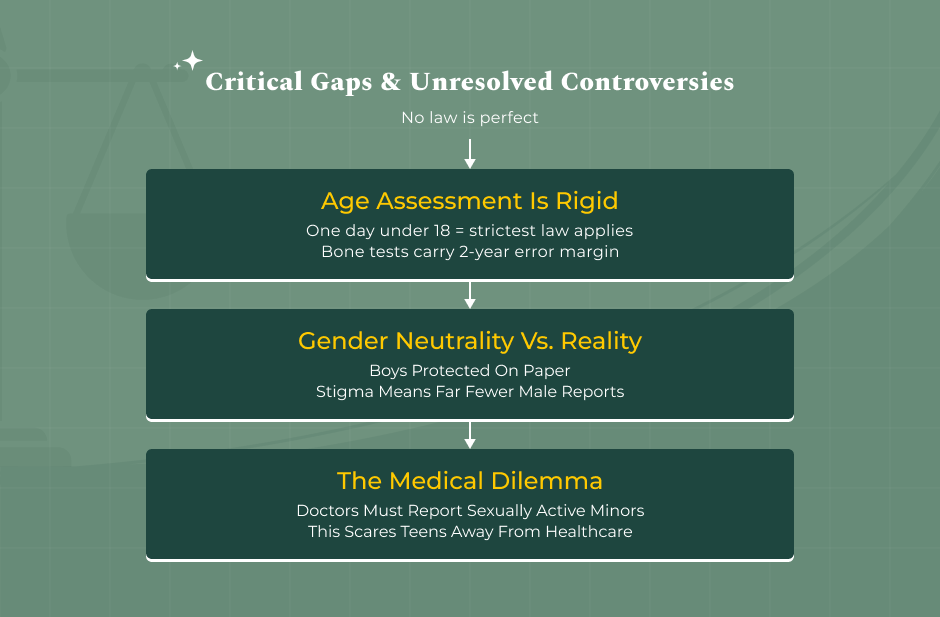
No law is perfect, and the POCSO Act is continually challenged by contemporary realities. Here are the main controversies that lawmakers and society are still trying to resolve:
The Rigidity of Age Assessment
In any POCSO trial, the exact age of the victim is the most important factor. If the victim is even one day under 18, the strict provisions of the POCSO Act apply.
However, determining age is not always easy, especially in impoverished areas where birth certificates are not maintained.
Courts often rely on bone ossification tests (X-rays of bones), but these tests have a margin of error of up to two years. This leaves room for immense debate during trials.
Gender Neutrality Vs. Ground Realities
While the law is written to protect boys and girls equally, some critics argue that the system still struggles to recognize and address the sexual abuse of young boys.
Due to social stigma and lack of awareness, male victims of sexual abuse are far less likely to report these crimes, and police officers are sometimes less trained to handle male victims.
Medical Professional Dilemma
Under Section 19 of the POCSO Act, doctors must report any case where they suspect a minor has been sexually active. If a 17-year-old girl visits a gynecologist for health reasons or pregnancy, the doctor is legally bound to report this to the police.
This creates a massive barrier. It scares young girls away from seeking crucial healthcare, out of fear that the police will get involved in their private lives.
Moving Forward: Balancing Protection And Justice
The POCSO Act is a landmark in the Indian judicial system. After the law was introduced, many previous victims received long-overdue justice. Here, you witnessed how the court interpreted the law in connection with real cases.
But the introduction of the POCSO Act is not the sole answer to every crime against children, conditioned on sexual lines.
One great step is giving voice to the crime survivors. The previous system did not grant such rights. However, the new POCSO Act does.
Lastly, criminal lawyers say that the court must avoid portraying a benign approach towards the accused. If we hold offenders accountable under the POCSO Act, we can take a meaningful step towards reducing sexual crimes against children.
However, I feel that the law needs to be sensitive as well. The idea should not be to restrict teenage romance. Instead, we must act to safeguard them.
If you want to grow awareness about sexual crime or other heinous criminality and learn their resolve, keep an eye on the latest articles on TheLegalGuide.