Nobody likes losing a case – it’s so damn frustrating! And it’s even worse when you just know the court is wrong.
Many people will ask you to think about an appeal seriously. Why? Because an appeal will lead to a bunch of judges who will check out the evidence, hear both sides of the story, and might just reach a different conclusion.
It’s common to make this assumption. But it is also one of the most dramatic misconceptions about appeals and, more importantly, how they work.
For starters, stop looking at an appeal like it’s a trial. So, an appellate judge is not going to hear out new witnesses or check out evidence that was not presented at the trial court. Also, they don’t care about which side of the story seemed more convincing during the original trial.
Instead, they only ask one question: Did the trial court make any legal mistake that ultimately impacted the case’s final outcome?
This is the question that actually shapes how appeals work in appellate courts. Also, it explains why most appeals are unsuccessful, even if someone is convinced that the decision wasn’t genuine.
And this is precisely why knowing what appellate judges look for when they review a case can help you have realistic expectations.
In this legal guide, we will breakdown what appellate judges look for, the kinds of legal errors that matter, and what happens once an appeal reaches the court.
Stay tuned.
The Short Answer: What Appellate Judges Look For When They Review A Case?
An appellate judge will only check whether the trial court made any legal error that impacted the final outcome of the case.
So, the error needs to be a ‘legal’ error and, more importantly, a significant error. Also, it needs to be an error which impacted the final outcome of the case.
It’s not their job to change the outcome because you feel the decision of the trial court was unfair. Rather, it’s their job to find out whether the laws applied to reach the judgement was done correctly or not.
That distinction matters.
A party can lose a case and still have no valid grounds for an appeal.
On the other hand, someone may identify a legal error that justifies further review, even if the facts of the case remain unchanged.
In other words, appellate courts review the legal process much more closely than they review the factual outcome.
Is An Appeal A Second Trial?
Thinking that an appeal is a sort of second trial is perhaps the biggest misconception that most people have.
But in reality, this rarely happens – it’s like a sporting event. When a football match ends, the referee doesn’t ask the team to replay the match again.
Instead, the officials can review specific decisions to find out whether all rules were correctly applied or not.
Appeals work in a similar fashion: an appellate judge never replays the entire trial. Instead, they review the trial to find out whether or not all laws were followed properly. So, an appellate court will check the records created and presented during the trial originally.
This record may include:
- Court transcripts.
- Documents admitted into evidence.
- Trial exhibits.
- Written motions.
- The trial judge’s rulings.
- Legal briefs submitted by both parties.
The judges examine those materials carefully – they don’t care about who to believe. They only care about whether or not the trial court made any legal error that impacted the final outcome.
What Appellate Judges Look For When They Review A Case?
Every appeal is different. But every appeal has the same objective: to find out whether the trial court made any legal error that impacted the case’s final outcome.
And that review usually focuses on certain key questions, which we have discussed in detail below.
Did The Trial Court Apply The Law Correctly?
This is literally the most important question – this is the point of an appeal. The purpose is to review the case and check if all laws were applied correctly.
So, an appellate judge will review whether the trial court accurately interpreted statutes, regulations, and previous judgments.
For instance, they will consider whether:
- The wrong legal standard was applied.
- A statute was interpreted incorrectly.
- The court relied on outdated legal authority.
- The jury received inaccurate legal instructions.
These issues can influence the entire case.
If the appellate court finds out the law wasn’t applied correctly, then the court will try to find out whether any further action is required.
Did The Trial Judge Follow Proper Legal Procedures?
A court always operates under comprehensive rules and regulations. You have to understand that those rules and regulations exist to ensure that both parties get the space to present their side of the story.
During an appeal, the judge will only review the process that the trial court followed and came up with the final outcome.
Questions may include:
- Were important deadlines applied correctly?
- Did both parties receive proper notice?
- Was each side allowed to present relevant evidence?
- Were procedural rights respected?
Not every procedural mistake justifies reversing a decision. But significant violations may affect the fairness of the proceedings.
Was Important Evidence Handled Properly?
During most appeals, the biggest issue is evidence-related, usually.
A trial judge decides which pieces of evidence a jury might consider. Then, those decisions automatically become the focus of an appellate judge.
For example, the appellate court may examine whether:
- Critical evidence was excluded improperly.
- Evidence that should have been kept out was admitted.
- Expert testimony met the required legal standards.
- Constitutional protections were respected during the admission of evidence.
So, understand that evidence rulings don’t automatically lead to a successful appeal. The judges must also determine whether the ruling affected the outcome of the case.
Did Either Party Receive A Fair Trial?
Fairness and justice are not just some opinion – it cannot be subjective.
Most courts evaluate fairness and justice by checking whether all rules were followed and legal rights protected during the trial.
Mostly it depends on the type of case. And depending on that, an appellate judge might consider different questions like
Depending on the type of case, appellate judges may consider questions such as:
- Was a party denied the opportunity to present their case?
- Did judicial conduct create an appearance of bias?
- Were constitutional rights protected?
- Did both sides receive the process required by law?
How Appellate Judges Decide What to Review?
Many assume the judges will examine every part of the case with equal attention. In reality, the level of review depends on the type of issue being challenged.
A legal question receives one kind of review. A factual finding receives another. And a decision left to the trial judge’s discretion is reviewed differently again.
This approach helps appellate courts respect the role of the trial court while still correcting significant legal mistakes.
Understanding The Standard Of Review:
You will often hear lawyers mention the standard of review during an appeal. The phrase sounds technical, but the idea is fairly simple.
A standard of review tells appellate judges how closely they should examine a particular issue.
Think of it like adjusting the zoom on a camera. Some questions require a close-up view. Others are reviewed from a greater distance because the trial judge was in a better position to make the original decision.
As a result, understanding this concept explains why two appeals involving similar facts can have very different outcomes.
A Simple Comparison:
The different standards of review can seem overwhelming at first. So, here’s a simplified way to think about them.
| Issue Being Reviewed | How Closely the Appellate Court Reviews It |
| Questions of law | Very closely. The appellate court makes its own legal determination. |
| Findings of fact | More cautiously. The court usually respects the trial court’s factual findings unless there is a clear basis to disturb them. |
| Discretionary decisions | With significant deference. The court generally intervenes only when the trial judge exceeded the limits of reasonable judgment. |
So, you just need to remember one basic principle – The more the issue depends on legal interpretation, the more closely appellate judges tend to examine it.
Also, the more it depends on factual observations or judicial discretion, the more likely they are to respect the trial court’s decision.
What Appellate Judges Don’t Look For
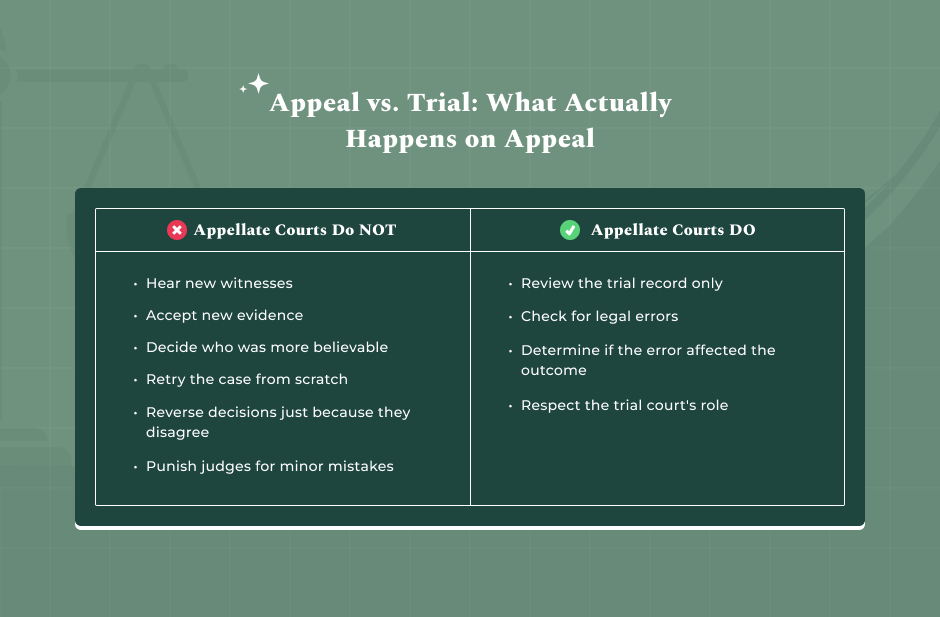
Many people are surprised by what an appellate court usually doesn’t do. Understanding these limits helps explain why appeals are narrower than trials.
In most cases, appellate judges do not:
- Hear testimony from new witnesses.
- Accept new evidence that wasn’t presented during the trial.
- Decide which witness seemed more believable.
- Retry the entire case from the beginning.
- Reverse every decision they personally disagree with.
- Punish the trial judge for making a minor mistake.
Their role isn’t to start over. Their role is to determine whether significant legal errors affected the outcome.
That difference shapes every stage of the appeal.
Read Also: The Role of an Appeals Attorney in Navigating California’s Appellate Courts
Why Legal Errors Matter More Than Disagreement?
This is where many appeals succeed or fail.
Imagine two different situations. In the first, someone loses a lawsuit and believes the judge reached the wrong conclusion.
They disagree with the decision. But they can’t point to any legal mistake that occurred during the trial.
In the second situation, the judge applies the wrong legal standard when deciding the case. That error affects the final judgment.
The second situation is much more likely to attract serious attention from an appellate court. Why? Because appellate judges aren’t reviewing whether they personally agree with the outcome.
They’re reviewing whether the legal process produced that outcome correctly. That’s an important distinction.
The appellate system exists to correct legal errors. It doesn’t exist to give every disappointed party another opportunity to argue the same facts.