
Changing your name isn’t a simple task – and if you thought so, you are in for a shock.
It’s entirely a legal procedure that can impact almost every official documentation related to your identity.
So, whether you are changing your name due to a messy divorce or adopting a new family name, or just because you want to, knowing how the process works is essential – it will save you time, money, and most importantly, delays.
In the state of Colorado, a legal name change is handled through the court system. However, the exact steps usually depend on an individual’s specific circumstances.
Having said that, for the vast majority, changing their names legally in Colorado usually involves three steps:
- Filing a petition for the name change.
- Submitting all necessary documentation.
- Getting a court order before updating all identification and financial data.
While the process is simple in most cases, missing paperwork or overlooking state-specific requirements can cause unnecessary delays.
This guide walks you through every stage of a legal name change in Colorado. You will find out how much the procedure will cost you, how much time it will take, and most importantly, what to do once the court approves your name change.
Also, we have added a complete checklist to help you update your records once the court issues the order.
Stay tuned.
What Is A Legal Name Change?
A legal name change is simply changing your name legally for the world to know – of course, you can have multiple nicknames.
But officially, you have one name – a first name and last name. Sometimes, even a middle name.
And this is the name you have everywhere, including all government-issued identification, financial records, employee data, and any other official document.
While anyone can have a nickname or some name they use socially, financial institutions or even government agencies will need legal proof before they update the same name on your official records.
In Colorado, most adult name changes are processed through the district court in the county where you live.
So, the court will review your petition carefully and find out whether your request for a name change is legally acceptable or not.
Also, the court will review whether you have any intention of committing fraud or evading some form of criminal liability, like avoiding your creditors.
When Do You Need A Court-Ordered Name Change?
Not every name change requires a court petition. Some life events allow you to update your name using existing legal documents.
For instance, you will not have to go for a court-approved legal name change if you are getting married and decide to take his last name once you are married.
Similarly, if you get divorced and decide to take your maiden name, you can do so without seeking approval from a court.
Also, if you have minor spelling or grammatical errors on your official documents, you can get it changed easily via local government-backed agencies.
However, in all other cases, you will have to go to the court to get approval for your new name. In such cases, the most common reasons include:
- Wanting a new first or last name.
- To get rid of a middle name.
- A name change is needed for cultural or religious reasons.
- To affirm gender identity.
- Wanting the legal name to match the social name that has been used for years.
- Someone is changing their child’s name outside of divorce proceedings or adoption.
Regardless of what your reason is, the point is you have to convince the court that you are requesting a name chane in good faith.
Who Can Apply for A Legal Name Change in Colorado?
In Colorado, you can legally change your name irrespective of whether you are an adult or a minor. However, the requirements depend specifically on the age and the circumstances of an applicant.
Adults:
For an adult, the process is fairly simple. As long as you meet the residency requirements of a state, you can apply for a legal name change.
Also, you need to complete all necessary processes required for changing your name legally.
On that note, as an adult, your criteria for a legal name change include:
- Being at least 18.
- Resident of Colorado.
- Filing the petition in the correct district court.
- Providing all supporting documents.
- Proving that the request for name change has no fraudulent purpose.
Frankly, a court doesn’t need any specific reason for a legal name change. However, any judge can deny your petition if there’s any evidence that your request has some kind of illegal intention backing it.
For instance, if the court finds out that you are changing your name to mislead creditors or avoid criminal prosecution, then the court won’t approve your request for a legal name change.
Minors:
Parents or legal guardians may petition to change a child’s legal name. Before approving the request for a legal name change, a court takes into account multiple factors, since the applicant is a minor.
These factors usually include:
- The child’s best interests.
- Whether both parents consent.
- The kind of relationship the child has with each parent.
- Depending on the child’s age and maturity, the preference of the child.
Also, in this context, it is essential to point out that if any parent objects to the changing of their child’s name, then the court can delay its decision-making. And even schedule a hearing.
Before You File: 4 Things to Know

Most people spend so much time ensuring making no mistakes while filing their petition that they often forget about the importance of thorough preparation.
So, if you just spend a little longer checking if everything is fine before filing, then things will be so much smoother.
1. Decide Exactly How Your New Name Will Appear:
This is essential.
You need to double-check the spelling, punctuation, and everything else in your new name – one mistake, even if it’s a typo, will need additional paperwork later. Also, it will delay the process.
2. Understand Why You Want to Change Your Name:
Of course, you don’t need something unique or extraordinary to opt for a new name.
But you should have a logical reason behind doing so – because the court can ask, and you need to explain your reasons properly.
3. Gather Your Supporting Documents Early:
It entirely depends on your circumstances. But in most cases, you will need the following documents:
- Government-issued photo identification.
- Birth certificate.
- Address proof to show you are a resident of Colorado.
- Marriage certificate or divorce decree.
- Court forms required for your petition.
Having everything ready before filing reduces the chance of delays.
4. Plan for More Than the Court Process:
Receiving your court order is only one step. This is super important – don’t just plan your filing. Also, plan for more, such as what you need to do once you get the approval from the court.
Naturally, this includes updating your:
- Social Security record.
- Colorado driver’s license or state ID.
- Passport.
- Employer records.
- Bank accounts.
- Credit cards.
- Insurance policies.
- Voter registration.
- Professional licenses.
- Medical records.
The only reason we felt the need to include this step is that a lot of people end up underestimating this part – they forget just how long it takes to update so many documents.
As a result, it is always safe to have a checklist from before. That way, once you have an approval from the court, you will know what to do.
How To Get A Legal Name Change In Colorado? A Step-By-Step Process
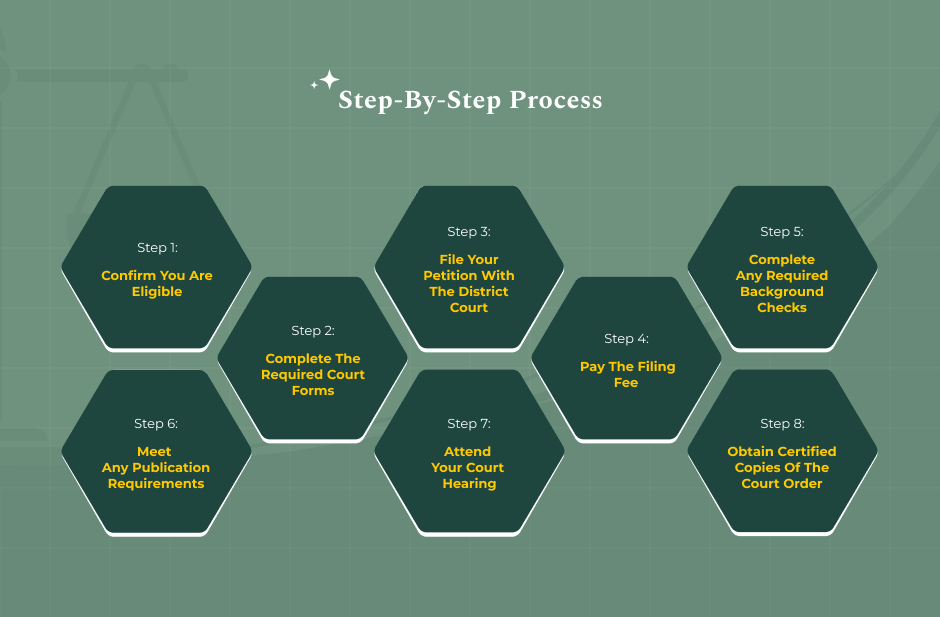
In Colorado, changing your name legally includes more than filling out a bunch of forms.
As we have been mentioning repeatedly, all courts will try to ensure that every request for a name change is legitimate. More importantly, there is no illegal intention behind the request.
While the process itself isn’t super challenging, it is essential to be attentive to details during the entire procedure.
And to simplify matters, we are here to help with our detailed step-by-step guide.
Step 1: Confirm You Are Eligible
This is basic – the process starts with confirming your eligibility for changing your name as a resident of Colorado.
And we have already discussed the eligibility criteria for both adults and minors in earlier sections.
So, if you are eligible to file a petition, you can do so from the district court of the county you reside in.
However, your request must also be made in good faith. Courts will not approve a name change if they believe it’s intended to:
- Avoid paying debts or court judgments
- Escape criminal prosecution
- Mislead government agencies
- Commit fraud or identity theft
If none of these situations apply, you’re unlikely to face issues based solely on your reason for wanting a different name.
Step 2: Complete The Required Court Forms
The next step is preparing your petition.
The Judicial Branch of Colorado is in charge of providing all necessary forms related to changing your name legally. And that too for both minors and adults.
Also, the exact forms that someone will need for changing their name legally usually depend on their specific circumstances.
For instance, something specific like whether you are changing your name or doing it on behalf of your child is one such factor.
Before you submit any document, pause for a while. And in this time, go through every piece of the document, twice if necessary.
Simple mistakes can delay the process, including:
- Misspelled names
- Missing signatures
- Incorrect dates
- Blank sections
- Using an outdated form
It is best to get a printout of all your completed forms before you file the petition. You’ll likely refer back to them when updating your identification and financial accounts.
Step 3: File Your Petition With The District Court
Once you complete all the necessary paperwork, it is time to file your petition with the appropriate district court.
In the court, a clerk will review all your documents and check whether they are complete or not. Then, you have to pay a filing fee, and your case will open officially.
While doing this, it is vital to keep all documents, including receipts the court gives you. Generally, the court will give you a case number that you can use for contacting the court if you want to find out about the status of your petition.
Please note that the court hasn’t approved your application at this stage – the court has simply accepted it for review.
Step 4: Pay The Filing Fee
In Colorado, you have to pay a filing fee for changing your name – and this is applicable exclusively for all adults.
Moreover, it is crucial to understand that the exact amount is subject to change. And additional expenses can apply depending on specific circumstances.
For instance, you might also pay for:
- Certified copies of your final court order
- Fingerprinting or background checks, if required
- Publication costs, when applicable
Naturally, these are smaller expenses that can easily add up.
For example, if you already know you will need multiple certified copies of the court order, then it is easier to request them once your case gets finalized instead of going back to the court later.
Also, if you have any financial problem in paying certain fees, then it is possible to request the court to waive some expenses. But this approval doesn’t appear automatically.
So, in case of getting some costs waived, you need to give the court clarity on your financial situation.
Step 5: Complete Any Required Background Checks
Not every applicant must complete a background check, but some adult name change petitions require additional screening before the court will issue an order.
So, you have to understand that the law does not prohibit legitimate name changes – if you are doing it without any fraudulent intention, the court won’t stop you.
If your case does require a thorough background check, then the court will give you clarity on what is needed before the hearing.
Also, understand that a background check is time-consuming. And if it’s not done properly, then there will be delays.
Step 6: Meet Any Publication Requirements
Depending on your circumstances, Colorado law may require notice of your proposed name change to be published.
Many applicants find this requirement confusing because it doesn’t apply in every case.
If publication is necessary, the court will typically provide instructions explaining:
- Where the notice must appear
- How long it must be published
- What proof you’ll need to submit afterward
If publication isn’t completed correctly, the court may postpone or deny your petition until the requirement is satisfied.
We’ll explain publication rules in detail later because several important exceptions may apply.
Step 7: Attend Your Court Hearing
Some name change petitions require a hearing before a judge.
So, if the court requires you to appear, then you need to bring every piece of document the court has asked you to bring. Also, if possible, arrive early since it can reduce unnecessary stress.
The hearing itself is often brief.
Moreover, the judge may ask questions such as:
- Why do you want to change your name?
- Are you requesting this voluntarily?
- Is anyone forcing you to make this change?
- Are you trying to avoid creditors or criminal liability?
These questions are routine. They’re designed to confirm that your request is lawful and made in good faith.
If everything is in order, the judge may approve your petition during the hearing or shortly afterward.
Step 8: Obtain Certified Copies Of The Court Order
Once the judge signs the order, your legal name change is official. Many people assume they’re finished at this point.
In reality, this is when the administrative work begins.
You’ll need certified copies of the court order to update your records with government agencies, employers, banks, insurance companies, and other organizations.
Although one certified copy may be enough if you’re willing to mail it between agencies, many people order several copies to avoid delays.
How Long Does A Legal Name Change Take In Colorado?
Every case moves at its own pace, but most legal name changes take several weeks to a few months from filing to final approval.
The timeline depends on factors such as:
- The court’s workload
- Whether your paperwork is complete
- Background check processing times
- Publication requirements
- Whether a hearing is necessary
The fastest cases are usually those where applicants submit complete paperwork the first time.
The slowest often involve missing documents, incomplete forms, or waiting for additional information requested by the court.
Rather than trying to speed up the process, focus on getting each step right. A complete application is almost always processed more efficiently than one that requires multiple corrections.
How Much Does A Legal Name Change Cost In Colorado?
One of the first questions people ask is, “How much will this cost?” The answer depends on your situation.
While most people budget for the court filing fee, that isn’t always the only expense. Depending on your case, you may also need certified copies of the court order, fingerprinting services, or other documents before the process is complete.
So, here’s what you should expect.
| Expense | What It Covers |
| Court filing fee | Opening your name change case with the district court |
| Certified copies | Official copies of your signed court order for updating records |
| Background check or fingerprinting | Required in some situations |
| Publication costs | May apply if publication is required |
| Document copies | Printing, notarization, or other administrative expenses |
So, if you’re concerned about costs, don’t let that stop you from exploring your options. Colorado courts may allow eligible applicants to request a fee waiver based on financial hardship.
Also, if approved, certain court costs may be reduced or waived altogether.
Because filing fees and court costs can change, it’s always a good idea to confirm the current amounts before submitting your petition.
Tip: Order multiple certified copies of your court order. Many agencies require an official copy, and having extras can save time later.
5 Mistakes That Commonly Delay A Legal Name Change
Court staff reviews hundreds of petitions every year, and many delays stem from avoidable errors rather than legal complications.
On that note, here are the most common ones.
1. Submitting Incomplete Forms:
Leaving questions unanswered or forgetting to sign a document can stop your petition before it reaches a judge.
2. Using Different Versions Of Your New Name:
Your proposed legal name should be identical across every form and supporting document.
3. Ignoring Court Instructions:
Every county follows the same state law, but filing procedures can vary. Read every instruction carefully before submitting your paperwork
4. Waiting Until After Approval To Gather Documents:
Many agencies require certified copies of your court order. Ordering them early can save several weeks later.
5. Delaying Updates To Your Records:
A court order changes your legal name, but it doesn’t automatically update your identification, bank accounts, payroll records, or passport.
As a result, taking care of these soon after approval helps prevent confusion when your documents no longer match.
Do You Have To Publish Your Name Change In Colorado?
Publication is one of the most misunderstood parts of the legal name change process.
Many people assume every applicant must publish notice of their name change in a newspaper. That’s not always the case.
Whether publication is required depends on the type of name change you’re requesting and your individual circumstances.
If the court determines that publication applies to your case, you’ll receive instructions explaining:
- Where the notice must be published
- How long it must appear
- When proof of publication must be submitted
Missing this step can delay your petition, even if every other document is complete.
Some applicants may qualify for an exception, particularly when publication could create a safety or privacy concern. If you believe publishing your name could place you at risk, raise the issue with the court as early as possible.
Because publication rules can vary depending on the circumstances of your case, it’s important to follow the court’s instructions rather than relying on general advice found online.