The different kinds of fingerprints left behind at the crime scene largely determine the success of the criminal investigation. Forensic experts rely on these fingerprints to identify individuals with nearly perfect accuracy.
Since the early 1900s, the legal system has come to accept this data as the gold standard. Recently, in 2025 and early 2026, new debates were brought up on the privacy of the data collected by the time clocks in the workplace.
Moreover, several appeals cases are being brought up to challenge the way all kinds of fingerprints are being categorized by the state. It is important to understand the importance of the law. In this article, we will elaborate on the following.
- The primary categories of fingerprint patterns.
- How the legal system treats fingerprint evidence.
- Federal and state laws governing biometric data.
- The historical evolution of fingerprinting in US courts.
The Primary Categories And Types Of Fingerprints

Forensic experts identify different types of fingerprints based on ridges and valleys on an individual’s fingertip. These patterns remain constant throughout an individual’s life unless a deep scar forms.
The Breakdown Of The Three Types Of Fingerprints
The majority of the population can be placed into one of three groups: loops, whorls, and arches. All of these have different characteristics that can help narrow down huge databases, such as the FBI’s IAFIS database.
The Dominance of Loop Patterns
Loops comprise 60 to 65 percent of the total number of fingerprints found in the general population.
In this type of pattern, the patterns enter from one side, then curve back, before exiting from the same side.
There are two types of loop patterns- ulnar and radial, depending on the direction in which they point.
Understanding Whorl And Arch Structures
Whorl patterns comprise 30 to 35 percent of the total population. The patterns are usually circular or spiral in shape.
Arch patterns comprise only 5 percent of the total population. They come in from one side, curve, and then go out the other side, forming a wave-like peak in the center of the pattern.
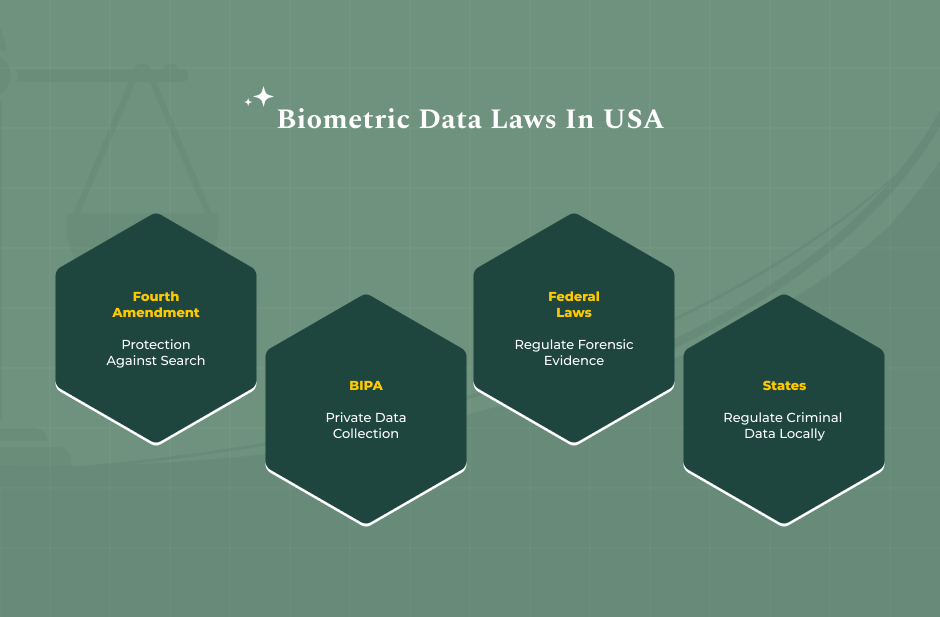
Federal And State Laws Regarding Biometric Data
The United States has laws regarding the collection and storage of different types of fingerprints by law enforcement officials.
The laws are for the protection of public safety and the constitutional right of an individual to have a right of privacy.
The Impact Of The Fourth Amendment
The Fourth Amendment safeguards American citizens from unreasonable searches and seizures. The courts have usually found that the police need probable cause or a warrant to take different types of fingerprints from suspects. However, there are some specific circumstances during a legal arrest or booking of a suspect in jail.
State Specific Statutes Like BIPA
The Illinois Biometric Information Privacy Act (BIPA) is the strongest legislation in the USA regarding data privacy.
Companies need written consent before collecting different types of fingerprints from employees or customers. BIPA has resulted in multi-million dollar settlements in 2025 for companies due to unauthorized use of data.
Federal Rules Of Evidence 702
The Federal courts use Federal Rule of Evidence 702 to ascertain whether the science of identifying different types of fingerprints is reliable enough for a jury to hear. The judges act as gatekeepers to prevent “junk science” from being presented in court.
Historical Case Law And Judicial Precedents
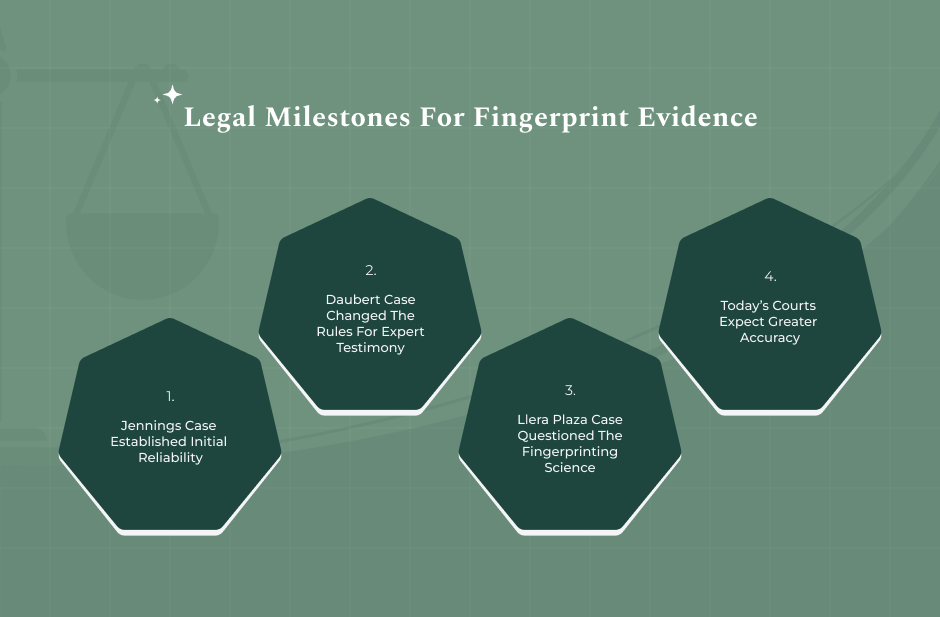
Judicial decisions have significantly influenced our perceptions of different types of fingerprints over the years. A number of landmark cases have been made over the last century regarding fingerprint reliability and unreliability.
People V. Jennings And The Early Days
In 1911, People v. Jennings became the first case in America to admit fingerprint evidence in a murder trial.
The Illinois Supreme Court held that the 3 types of fingerprints were sufficiently unique to identify a criminal. This case marked the beginning of every modern forensic lab in the United States.
The Daubert Standard And Forensic Reliability
However, in 1993, Daubert v. Merrell Dow Pharmaceuticals altered the manner in which judges assess expert witnesses.
Now, those who wish to offer expert testimony about the different types of fingerprints must ensure that their techniques have been tested and reviewed.
United States V. Llera Plaza
In 2002, there was a temporary ruling by a judge that stated that fingerprint experts could not offer an opinion that an identification was absolute.
This caused a panic in the legal community. Although the ruling was eventually overturned, it prompted many forensic labs to improve their training and error rate.
Contemporary Challenges to Automated Matches
The most recent lawsuits in 2024 and 2025 have centered on the error rate of the AI software in scanning all types of fingerprints.
Defense attorneys have argued that machines can make mistakes that even the most expert human could not. This is presently challenging the human-in-the-loop necessity.
Frequently Asked Questions (FAQs):
The way we deal with different types of fingerprints is constantly evolving in the scientific and legal community. The average citizen has a lot of questions about their rights.
Identical twins, despite having the same DNA, have different fingerprints due to their development in the womb.
Most states allow employers to do this for security reasons, but new BIPA laws require your employer to get your consent first.
Using new technology, digital scanners use optical or capacitive technology to read fingerprints without the need for messy ink pads.