Are brass knuckles illegal? Or are they just accessories that people are scared of?
Brass knuckles are small weapons that one can wear over the fingers as accessories. These basically increase the power of a punch.
They have changed from being weapons used in historical wars to characters in modern pop culture. However, their legal status is still a complicated patchwork of regulations.
Since they are only for serious bodily harm, a purpose instrument – unlike tools with domestic utility – legislators in many places have decided to consider them as weapons that are inherently dangerous or offensive.
But is it really?
Currently, the United States does not have a federal ban on brass knuckles at all. So the situation around their use is largely the result of differences at the state level.
For instance, in places like California, New York, and Illinois, having them is a felony, with severe penalties, such as imprisonment [Source: California Penal Code 21810 – Brass Knuckles, Anna R. Yum].
On the other hand, states like Texas and Arizona are examples of where the local authorities have recently relaxed the restrictions and made it possible for people to carry legally for self-defense purposes.
In his blog, we will be breaking down the following things:
- Are brass knuckles illegal?
- What are the federal vs state vs local laws related to brass knuckles?
- Are brass knuckles illegal internationally?
- Regulation of brass knuckles.
- Legal consequences of wearing and using brass knuckles, if any.
- How the design of an accessory impacts legality.
- What to do if you face charges for using brass knuckles?
Therefore, if these are a few things that you want to know, keep on reading this blog till the end…
Are Brass Knuckles Illegal?
So, are brass knuckles illegal, really? Well, in order to understand this, it is important that you have a clearer picture of the history behind this accessory.
Brass knuckles, iron fists, or knuckle knives are weapons with the main purpose of someone wearing them across the knuckles to concentrate the punch force in a smaller, harder surface area. This results in maximum tissue and bone damage.
Whereas traditionally people would make them of brass or steel, today’s versions may also include carbon fiber, hardened plastic, or 3D printing polymers to bypass a metal detecting device. No matter the material, the only use still remains, physically opposing, hand, to, hand fighting.
It is an old weapon. Most probably, it goes back to the Roman Caestus, a leather-and-metal glove used in the arena of gladiators, and the Vajra Mushti (diamond fist), which was a weapon and a technique in ancient Indian martial arts and warfare.
Due to this extremely dangerous ancestry, most legal systems nowadays consider them to be malum prohibitum, harmful weapons that have no other use than to inflict violence.
Some people think plastic or carbon fiber knuckles are a “legal loophole.” In fact, many times this is a fallacy.
In places such as California or the United Kingdom, legal provisions are in place on the basis of the work each tool performs rather than the kind of material.
Essentially, if someone wears a piece of equipment on the hand to increase the force of a strike, the law legally categorizes it as a “knuckle duster,” thus making a 3D-printed model just as unlawful as a conventional metal one.
Federal vs. State vs. Local (U.S.) Laws About Brass Knuckles
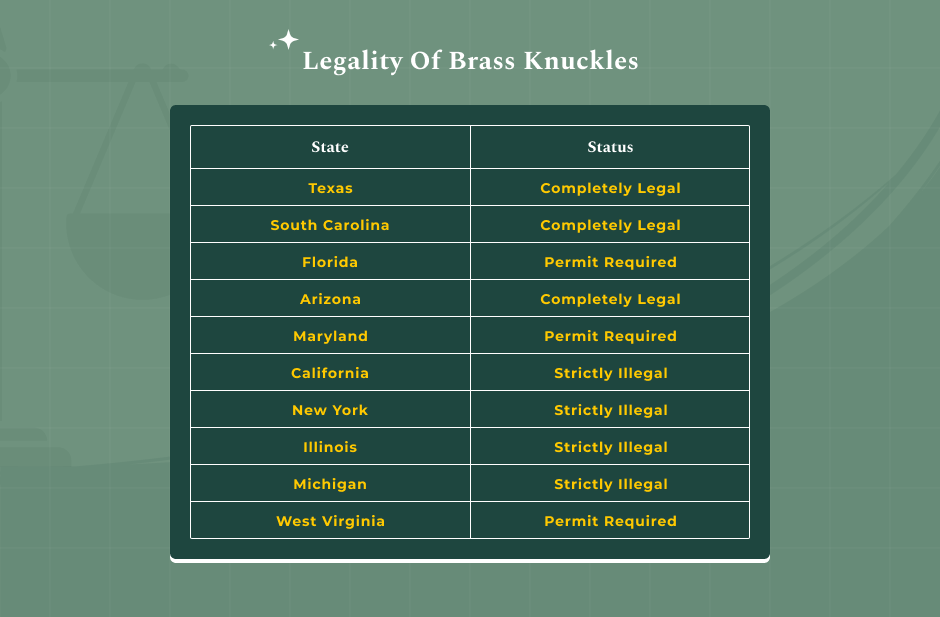
In the United States, there is not a single federal regulation that forbids the possession or sale of brass knuckles.
Generally, state laws and local regulations determine the legality of these weapons.
An item that you can legally carry in one state may be a felony if you carry it just across the border.
Normally, state laws regulate four main areas of:
- Possession (owning them).
- Carry (having them on your person).
- Manufacturing/sale.
- Transportation.
States Where Brass Knuckles Are Completely Illegal
In about 20 states, the law defines brass knuckles as “prohibited weapons.” Therefore, it is against the law to possess, manufacture, sell, or carry them under virtually no circumstances.
In such cases, you can even get criminal charges for keeping them as a “novelty” or “paperweight” in your house.
- California: Severe ban on possession, sale, and manufacture.
- New York: Possession is a criminal offense.
- Illinois: Bans possession and use, including knuckle-shaped jewelry.
- Michigan: Possession, sale, or manufacture of any kind (metal or plastic) is a felony.
Other States in this category include Massachusetts, Nevada, Pennsylvania, Washington, and New Jersey.
States With Legal Or Permitted Possession
Some states are moving in the direction of legalization, and they consider brass knuckles as an acceptable tool for self-defense.
- Texas: House Bill 446 legalized brass knuckle clubs and self-defense keychains for carry, which took effect September 1, 2019. Although it is legal to carry, if you use them unlawfully (e.g, in an unprovoked fight), you might face severe assault penalties.
- Arizona: In general, people over 21 years old are allowed to carry openly or concealed. The recent 2025/2026 legislation (SB 1290), however, has taken measures to ban minors’ possession in line with the increase in teen violence.
- Georgia: In most scenarios, it is legal to have and carry the weapon. However, it is forbidden in school safety zones or hospitals.
States With Restrictions Or Conditional Legality
In those states, the law may permit possession, but carrying the weapon is subject to stringent regulations.
- Florida: You cannot carry brass knuckles without a concealed weapons permit because the law regards them as concealed weapons. Therefore, you cannot hide them while carrying them.
- North Carolina & Ohio: These two states generally permit possession, but if a person is found carrying concealed without a permit, it is usually a misdemeanor.
- South Dakota: The law allows carrying these unless there is evidence of intent to harm, which can lead to a change of the charge to a felony.
Example Statute Deep Dive: California Penal Code § 21810
As we have already briefly mentioned above, California is probably the most comprehensive example of a very strict prohibition. According to PC 21810, it is illegal to manufacture, import, sell, give, or possess “metal knuckles.”
- Prohibited Conduct: The statute applies to everything from making them in a home workshop to receiving them as a gift.
- Penalties: This is a category of crime – “wobbler,” – which means the offender can get a misdemeanor (a county jail for up to 1 year and a fine of $1,000) or a felony (jail/prison for up to 3 years and a fine of $10,000).
- No Intent Required: Different from some states, the prosecution does not have to prove that you intended to use the knuckles; simply having them is enough for a conviction.
Enforcement & Interpretation Differences
Even in states where it is “legal,” local ordinances may overrule state permissions. For example, brass knuckles are generally legal in Arizona. However, the city of Phoenix has laws prohibiting the carry of metal knuckles. [Source: Brass Knuckles Legality by State 2026, World Population Review]
Moreover, courts frequently resort to the prosecutor’s discretion in interpreting the definition of “deadly weapon.”
If someone uses the knuckles during an argument, a basic assault charge is commonly changed to Assault with a Deadly Weapon, even in areas where it is legal to own the weapon.
International Laws: Are Brass Knuckles Illegal Internationally?
Global views on brass knuckles – or knuckle dusters, or fist-load weapons – differ quite drastically from those in the US.
Most developed countries treat these things as “offensive weapons” per se, thus they do not have any lawful purpose.
Just being in possession of them, even if it is in a private residence, can lead to a criminal case and heavy fines.
United Kingdom & Europe
Are brass knuckles illegal in the United Kingdom? The UK has some of the world’s harshest bans on this type of thing.
According to the Offensive Weapons Act 2019, it is against the law to have knuckle dusters in not only public places but also private homes. [Source: Weisberg Attorneys]
There is a risk of imprisonment for selling, manufacturing, or importing them, which is probably the most severe penalty. Similarly, in a great part of Europe, brass knuckles have been by law strictly forbidden:
- Germany: They fall under the category of prohibited items (Verbotene Gegenstände) under the Federal Weapons Act. Having them is a criminal offense.
- France: They belong to Category D weapons. People might sell some to adults for the purpose of collection. However, the law prohibits carrying them in public. And if authorities catch you, you will have to pay a fine.
- The Netherlands & Belgium: There is a complete ban or prohibition on the possession and trade.
Asia, The Middle East, Australia & Canada
In Asia, the laws differ from one country to another and depend on cultural history and the modernization of safety rules.
China:
The sale and purchase of brass knuckles as “self, defense tools” or “collectibles” are generally permissible. Nevertheless, possessing them in public transport (trains, planes, subways) is a breach of public security laws and will result in confiscation and detention without delay.
Israel:
The regulation is mainly concerned with the distribution of weapons. It is not a complete ban; however, there are strict laws on selling dangerous toys and weapons to minors, and the use of these weapons in a public confrontation is considered a high-level felony.
Australia & Canada:
Both nations classify knuckle dusters as Prohibited Weapons (similar to switchblades). Importation of these items is a federal crime that is under the surveillance of border services.
According to Section 91(2) of the Criminal Code, “possessing prohibited or restricted weapons, including brass knuckles, is a criminal offence. If found in possession of brass knuckles, an individual may face either a summary offence or an indictable offence.” [Source: Strategic Criminal Defense]
Understanding Why Brass Knuckles Are Regulated
The primary reason brass knuckles are heavily regulated is their specific engineering: they are designed to maximize physical trauma while remaining easily concealable.
Unlike a knife or a firearm, which may have utility for hunting or sport, knuckle dusters are classified by many legal systems as “per se” offensive weapons.
The Science Of Impact
Brass knuckles are essentially weapons that increase the force of a strike. They achieve this by focusing the impact of the punch on a smaller and harder part of the strike surface (most of the time, the area is reinforced with metal ridges).
Hence, the injuries caused by them are of a level that a bare fist cannot even dream of matching. Police and medical professionals have noted that one single blow is capable of resulting in:
- Comminuted fractures (bones broken into several pieces).
- Traumatic Brain Injuries (TBI) and severe concussions.
- Permanent facial disfigurement and gashes.
Concealability And Criminal Association
Politicians frequently claim that the ability to conceal the weapon is what makes it an extreme threat to public safety.
Because people can easily put them in a pocket or use them as a “fashion accessory” (like a belt buckle or paperweight), the attacker has the power to turn a violent confrontation into a fatal one without any hesitation.
Traditionally, their connection with organized crime and street gangs in the 1920s was what sparked the early waves of “anti-slugger” laws.
Currently, as we have indicated above, the emergence of 3D-printed knuckles and novelty plastic versions has again raised these anxieties.
Consequently, these changes have compelled states such as Arizona and New York to take a second look at their legislation in order to forestall a rise in the number of aggravated assaults among the youth.
Legal Consequences And Penalties Of Carrying Brass Knuckles
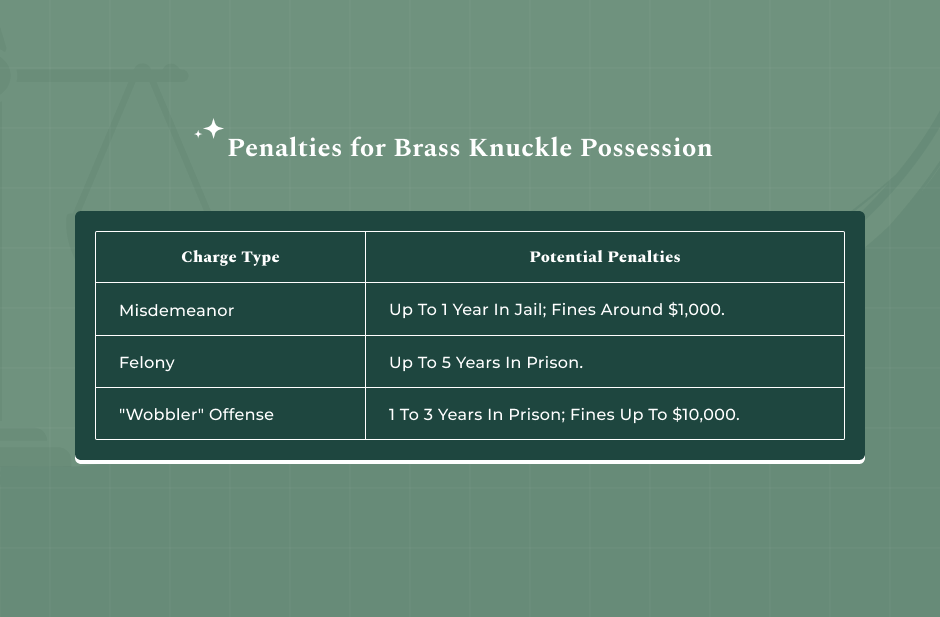
Going against the brass knuckles laws will lead to a wide range of severe consequences that will drastically change your life, such as:
- Very large fines.
- Prison time for several years.
Since these weapons have been commonly declared as deadly or prohibited, the police do not normally see the discovery of such items as an infraction of a lower level.
Besides the immediate punishment, a guilty plea leads to a lifelong criminal record that may negatively affect getting a job, renting a place, and even owning firearms.
Possession vs. Use vs. Distribution
The penalties tend to get harsher depending on what kind of offense it is:
- Possession: Even in very strict states such as New York, just having them on your person is a misdemeanor. In some states, it could be a wobbler (can be a felony) if the individual has a prior record.
- Distribution/Sale: If selling or importing brass knuckles, including ordering them online from international sellers, it will most likely lead to felony charges related to the trafficking of prohibited weapons.
- Use in a Crime: In case of using it for a fight, an original simple assault (misdemeanor) charge is almost certainly going to be upgraded to either Aggravated Assault or Assault with a Deadly Weapon (felony), even in states where the knuckles themselves are legal to possess.
Comparative Penalty Table
Here’s a table that shows how the penalty differs from state to state:
| Jurisdiction | Primary Classification | Potential Jail/Prison Time | Common Fines |
| California | Wobbler (Misdemeanor/Felony) | 1 to 3 Years | Up to $10,000 |
| New York | Class A Misdemeanor | Up to 1 Year | Up to $1,000 |
| Michigan | Felony | Up to 5 Years | Up to $2,500 |
| United Kingdom | Criminal Offence | Up to 6 Months (Possession) | Unlimited Fine |
| Canada | Prohibited Weapon | Up to 5 Years (Indictable) | Varies |
Brass Knuckles As A Weapon: What To Do If You Face Charges?
Getting charged with possession of brass knuckles is undoubtedly a grave issue that demands a well-thought-out legal strategy.
Even though in most places it is considered a crime merely to carry the item (“strict liability”), there are quite a few legal defenses that can be used based on the precise situation and the local laws.
Common Legal Defenses
- Lack of Possession: The prosecution must demonstrate beyond a reasonable doubt that you had “knowing possession” of the item. For instance, if the knuckles were discovered in a shared car or an area where you had no knowledge of their presence, you may have a good defense.
- The “Paperweight” or Collectible Defense: Depending on the local regulations, if the item is firmly attached to a base or doesn’t have finger holes big enough to be used, you could claim that it is a novelty item or a historical collectible rather than a working weapon.
- Illegal Search and Seizure: When the knuckles are found by the police during a search that infringes on the Fourth Amendment rights (no warrant or probable cause), the evidence could be excluded from the trial, and the case dropped.
- Non-Weapon Classification: It can be very difficult to differentiate between traditional brass knuckles and some of the new “multi-tools” or keychains that have the same shape. Therefore, an experienced lawyer may contend that the object does not fulfill the legal criteria of “metal knuckles.”
Practical Steps After Being Charged
Here are some of the practical steps that you need to take if you face assault with a firearm charges or charges of carrying a deadly weapon:
- Ask a Criminal Defense Lawyer: Never try to reason with the police by yourself. It is indispensable to have a lawyer who knows the local weapons laws.
- Check the Law: Make sure the particular item (plastic versus metal) is indeed banned in your town.
- Look at Plea Bargaining: If you are a first-time offender, the majority of the courts provide diversion programs or plea bargains through which the charges can be dismissed after a period of good behavior or after the performance of community service.
Read Also: What Happens If You Get Caught With A Ghost Gun? Understanding the Legal Consequences
Can The Material And Design Of Accessories Affect Legality?
Theoretically, “intent of design” is more significant than “material used” when it comes to the law.
Legislation mainly targets conventional brass or steel knuckles; however, instances where those made of hardened plastic, carbon fiber, or G10 polymers are equally prohibited are quite common.
The main reason for this is that a number of states, like California and the United Kingdom, view these weapons in terms of their ability to enhance the power of the blow, rather than their metal content.
Besides that, “novelty” knuckle-shaped items – such as belt buckles, paperweights, or heavy-duty tactical bottle openers – are in a highly uncertain legal situation.
Even if being sold as a fashion item, if the police figure out that the item is capable of being held and used as a weapon, you will be charged with possession of a weapon of the kind that is not allowed.
In New York, for example, it is common for the courts to apply a “functional test, ” which means that if something has the appearance and behaves as a knuckle duster, it will be considered as such legally.