Doesn’t winning a lawsuit feel exhausting? Almost like crossing the finish line of a marathon. So, the court rules in your favor, the case is over, and you win.
Then? You will obviously expect the defendant to pay up as per the court orders. And then nothing happens.
Days turn into weeks. Your emails go unanswered. The payment deadline passes, but the defendant still doesn’t send the money.
It’s a situation many successful plaintiffs don’t expect.
A court judgment confirms that you’re legally entitled to recover money or damages. It doesn’t guarantee the defendant will write a check the next day. In many cases, collecting the judgment becomes a separate process that requires additional time and effort.
Thankfully, a judgment is more than just a piece of paper. So, if the defendant doesn’t pay up, then there’s more than one legal way to enforce the court’s decision.
Obviously, the right solution usually depends on a few factors, including:
- The financial situation of the defendant.
- The assets a defendant owns.
- Also, the laws of the state you and the defendant reside in.
In this guide, we will break down what happens if a defendant does not pay a judgment, why some defendants fail to pay, and, most importantly, how you can recover the money legally.
Stay tuned.
You Won The Lawsuit: Why Haven’t You Been Paid?
Many people assume winning a lawsuit automatically leads to payment. But honestly, it doesn’t.
A judgment gives you the legal right to collect money from the defendant – that does not mean the court is obligated to actually collect it for you.
The lawsuit determines who owes the money. But collecting that money is often a separate step.
Of course, it is possible that in some cases, a defendant voluntarily pays as soon as the court gives out the judgment. That way, a defendant can move on from the dispute as quickly as possible.
Also, they can avoid paying additional legal expenses as well.
Then, there are defendants who can take an entirely different approach. How? They ignore the judgment, delay payment, or hope the plaintiff eventually gives up.
In such cases, don’t assume that you can’t do anything. Frankly, if the defendant doesn’t pay up, you can always pursue the matter legally to recover your money.
Why Would A Defendant Refuse to Pay?
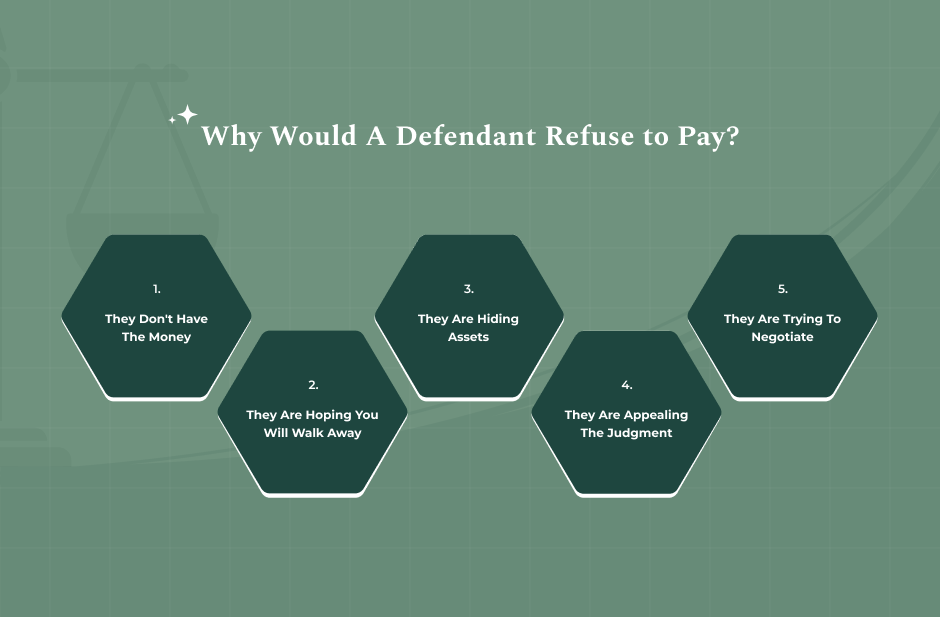
Not every unpaid judgment is the result of bad faith. Some defendants genuinely cannot afford to pay. Others might not pay for some strategic reason.
If you don’t understand why a defendant is not paying, then how will you know what your next step is? Maybe a conversation via email can resolve the matter. Maybe a payment schedule can also improve the situation.
Or, maybe you won’t need to involve the court. That is why knowing why a defendant is refusing to pay is essential – that way you will know what to do next.
On that note, let’s check out the most common reasons as to why a defendant doesn’t pay.
1. They Don’t Have The Money:
This is perhaps the most obvious reason – a defendant is refusing to pay because they don’t have financial backing to pay.
Perhaps they are unemployed, suffered losses in their business, or just accumulated a huge debt before the lawsuit was filed.
Just because you won the case does not mean it will create money that did not exist in the first place. If the defendant had limited money to begin with, then it will take time to collect the full amount from them.
2. They Are Hoping You Will Walk Away:
Now, this is purely unethical. Some people simply aren’t genuine – they have the money, but they won’t pay, hoping you will not pursue the matter.
Moreover, these are the kind of people who know enforcing a judgment is time-consuming and requires lots of paperwork and legal assistance – and that creates the space to hope that you might just lose interest and wait for everything to work out in their favor ultimately.
3. They Are Hiding Assets:
In complex cases, you will be shocked to see that defendants might even hide just how many assets or properties they own. That way, they can get away without paying much – or not paying at all.
While any court of law will take such cases seriously, it is super difficult to prove that someone is intentionally hiding assets. Also, it will need additional legal proceedings.
So, if you have such suspicions, then it is always safe to document all your concerns and get hold of evidence – your assumptions will not help you win.
4. They Are Appealing The Judgment:
A defendant who doesn’t agree with the court’s judgment in your favor might decide to appeal the decision.
Of course, an appeal cannot erase an existing judgment automatically. However, it can definitely impact the collection efforts – especially the timeline.
Plus, the rules can vary a lot depending on your specific circumstances, the court, and the laws of the state you reside in.
5. They Are Trying To Negotiate:
Not every defendant refuses to pay altogether. There are cases where a defendant doesn’t have enough money to pay all of it together at one go.
In that case, the defendant will try to negotiate the total amount with you – maybe reduce the settlement or come up with a payment plan.
However, it entirely depends on you and your situation – you can accept the reduced amount or even consult your attorney on what works best for you.
What Happens If The Defendant Ignores The Judgment?
So, just because a defendant decides to ignore a court judgment and avoid paying, it doesn’t make the judgment disappear.
The judgment still exists, and the defendant still needs to pay up. Also, it is possible that until a defendant pays up, the original amount might keep on increasing, thanks to hefty interest on the total amount owed.
A typical timeline looks something like this:
Court enters judgment
↓
Payment deadline passes
↓
Defendant does not pay
↓
Plaintiff requests payment
↓
No response or payment
↓
Collection efforts begin
↓
Court-approved enforcement methods
↓
Judgment is either paid, settled, or remains outstanding.
Of course, the exact process can differ from state to state. However, one thing does remain constant irrespective of state laws.
The court doesn’t usually monitor whether the defendant has paid. That responsibility often falls on the judgment creditor, which is the person or business awarded the judgment.
Can A Defendant Simply Ignore A Judgment Forever?
Many people ask this question after waiting weeks or months for payment. So, the shortest (and most simple) answer is literally NO!
Just because the defendant ignores the judgment doesn’t mean their debt disappears.
Depending on the law of the specific state, judgments continue to stay enforceable for years. And not just that – the court can even renew the judgment right before it expires, making it a vicious, never-ending cycle.
Also, during this time, the plaintiff can pursue collection if the defendant’s income increases or they acquire assets.
For instance, let’s say a defendant is currently living in a rented apartment and says they have no money to pay right now. However, after a few years, the same person purchases a home.
Similarly, another defendant is unemployed now and says they have no money now to pay. But in a few months, they get a high-paying job at some big company.
In both cases, the defendant’s financial situation changes over time. And that is why unpaid judgments continue to remain valuable even after the lawsuit ends.
Having said that, it is also important to understand how long a judgment remains enforceable in your state – that way you can protect your rights even if the defendant misses payment deadlines.
Before Taking Legal Action, Start With A Simple Conversation
Once you realize that the defendant isn’t going to take the court’s judgment seriously and has no intention of paying you, you will be really mad – so much so that you might start pursuing the matter legally without thinking it out properly.
It is only normal to act impulsively and act out legally in such cases. But honestly, that isn’t really the first step.
For starters, you can request via an email or a formal letter to the defendant to clear your dues. And you will be surprised to know that this is enough to resolve the matter without involving the court.
So, if you go ahead with the letter, then you should clearly state:
- The amount owed.
- The date the judgment was entered.
- When payment is expected.
- How payment can be made.
Also, do keep copies of every conversation – this includes your emails, letters, and messages.
This is because if you have no option apart from involving the court later, then you will need these records as evidence. You can show how you tried to resolve the matter formally without involving the court.
In this context, it is important to highlight that if a defendant refuses to pay, then it doesn’t always mean they don’t want to pay.
In some cases, they might need some time to arrange the payment. So, a reasonable payment schedule works in that case. Starting with communication doesn’t weaken your legal position. It often strengthens it.
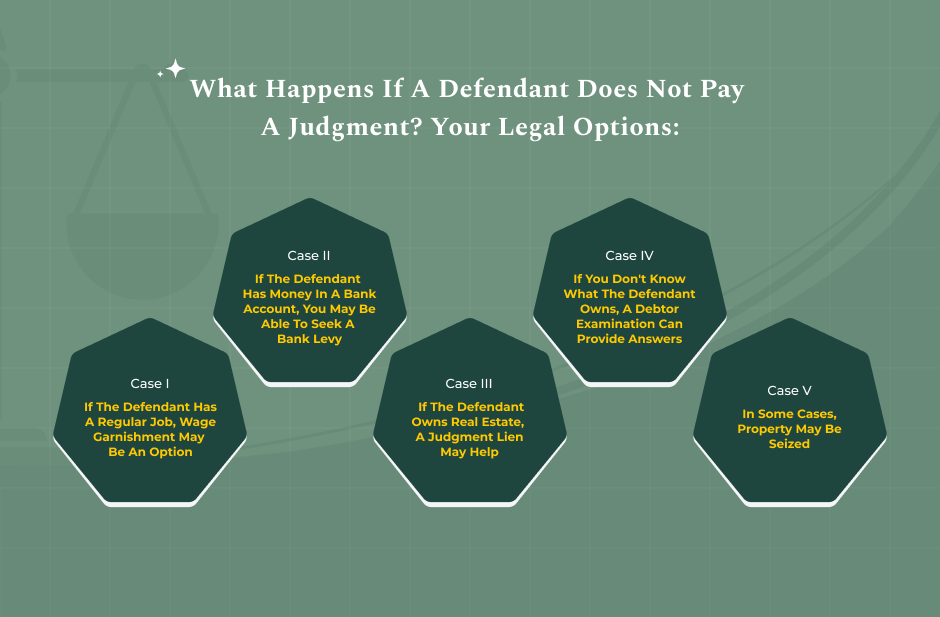
What Happens If A Defendant Does Not Pay A Judgment? Your Legal Options:
So, the defendant is ignoring the court’s decision and not paying up. That’s all good, but it does not mean you have to keep waiting indefinitely.
Depending on the laws of the state you reside in, you can involve the court and ask for legal help to resolve the matter.
While the remedies at your disposal will differ from state to state, they literally all serve one purpose: to help you collect money that the defendant already owed to you.
Not every option will fit every case. Frankly, the best option for someone usually depends on a few factors:
- The income of the defendant.
- The assets of the defendant.
- Also, the financial circumstances of the defendant.
Let’s look at the most common enforcement methods and when they may be appropriate.
Case I: If The Defendant Has A Regular Job, Wage Garnishment May Be An Option
One of the most common collection tools is wage garnishment.
Instead of asking the defendant to make payments voluntarily, the court may allow a portion of their wages to be withheld by their employer and sent toward the judgment.
This doesn’t happen automatically.
In a majority of cases, you will have to follow the legal process specific to your state before wages can be garnished.
Also, it is crucial to understand that both state and federal laws usually restrict how much of a person’s paycheck can be withheld. Those limits are designed to ensure the defendant still has enough income for basic living expenses.
Wage garnishment tends to work best when the defendant has:
- Stable employment.
- Regular income.
- No legal exemptions that prevent garnishment.
Plus, if the defendant has a habit of changing their job frequently or even working independently as a contractor, then this option might turn out to be less effective in the long run.
Case II: If The Defendant Has Money In A Bank Account, You May Be Able To Seek A Bank Levy
A bank levy allows money in a defendant’s bank account to be used to satisfy a judgment, subject to state law and any protected funds.
For many plaintiffs, this can be an effective option because it targets available cash rather than future earnings.
Before pursuing a bank levy, you’ll generally need information about where the defendant banks.
Without that information, enforcement becomes much more difficult.
Also, it’s worth remembering that not every dollar in a bank account can necessarily be collected. Certain funds may be protected under federal or state law.
Case III: If the Defendant Owns Real Estate, A Judgment Lien May Help
So, let’s assume the defendant owns a house, or commercial real Suppose the defendant owns a house, a rental property, or commercial real estate.
In many states, a judgment lien can attach to that property.
A lien doesn’t usually force an immediate sale.
Instead, it creates a legal claim against the property.
If the defendant later decides to sell or refinance, the judgment may need to be addressed before the transaction can move forward.
This makes judgment liens particularly useful when the defendant owns valuable property but doesn’t have enough cash to pay immediately.
Case IV: If You Don’t Know What the Defendant Owns, A Debtor Examination Can Provide Answers
Sometimes the biggest obstacle isn’t enforcement.
It’s lack of information.
You may know the defendant owes you money, but you have no idea where they work, whether they own property, or what assets they have.
In many states, the court can require the defendant to appear for a debtor examination, sometimes called a judgment debtor examination.
During this process, the defendant may be asked questions about:
- Employment.
- Income.
- Bank accounts.
- Vehicles.
- Real estate.
- Business interests.
- Other assets that may help satisfy the judgment.
This information can make later collection efforts much more effective because you’re no longer working with guesswork.
Case V: In Some Cases, Property May Be Seized
Depending on state law, certain non-exempt property may be subject to seizure to help satisfy a judgment.
This is generally considered one of the more serious enforcement options and often involves additional legal procedures.
Not every asset can be taken.
Many states protect essential property, including certain household items, retirement accounts, and other exempt assets.
Because exemption laws vary widely, it’s important to understand your state’s rules before pursuing this option.
Which Collection Method Fits Your Situation?
Every judgment is different.
Instead of asking which collection method is “best,” ask which one fits the defendant’s financial situation.
The table below offers a simple starting point.
| If the defendant… | A possible enforcement option |
| Has a steady job | Wage garnishment |
| Keeps money in a bank account | Bank levy |
| Owns a home or other real estate | Judgment lien |
| Owns valuable non-exempt property | Property seizure, where permitted |
| Refuses to disclose financial information | Debtor examination |
| Agrees to cooperate | Voluntary payment plan or settlement |
Can You Negotiate Even After Winning the Lawsuit?
Yes.
Winning a judgment doesn’t prevent both sides from reaching an agreement afterward.
In fact, many judgments are resolved through negotiation rather than aggressive enforcement.
Imagine the defendant owes you $40,000 but can’t pay the full amount immediately.
Instead of spending months pursuing collection, you may agree to:
- A monthly payment plan.
- A lump-sum payment that’s less than the full judgment.
- Another arrangement that both parties accept.
Negotiation isn’t always the right answer.
But when it leads to faster recovery and avoids additional legal costs, it may be worth considering.
Any agreement should be documented carefully so both parties understand the payment terms.
(Source: Supremecourt.gov)