The question what is racketeering is one of the strongest and most intricate crime categories within the US justice system.
It was initially aimed at eliminating the Mafia but currently is also used against such enterprises as corrupt companies, street gangs, and political factions.
So, what is racketeering?
Generally, it is about an “enterprise” which carries out certain “racketeering activities” with the aim of making illegal gains.
At the moment, April 2026, some of the biggest racketeering lawsuits are taking place. In this article, we will elaborate on the following:
- The legal definition and elements of a racketeering enterprise.
- Federal RICO statutes versus state-level “Little RICO” laws.
- The severe penalties associated with racketeering convictions.
- Landmark case law and current 2026 legal proceedings.
What Is Racketeering – Core Elements Of A Federal Racketeering Case
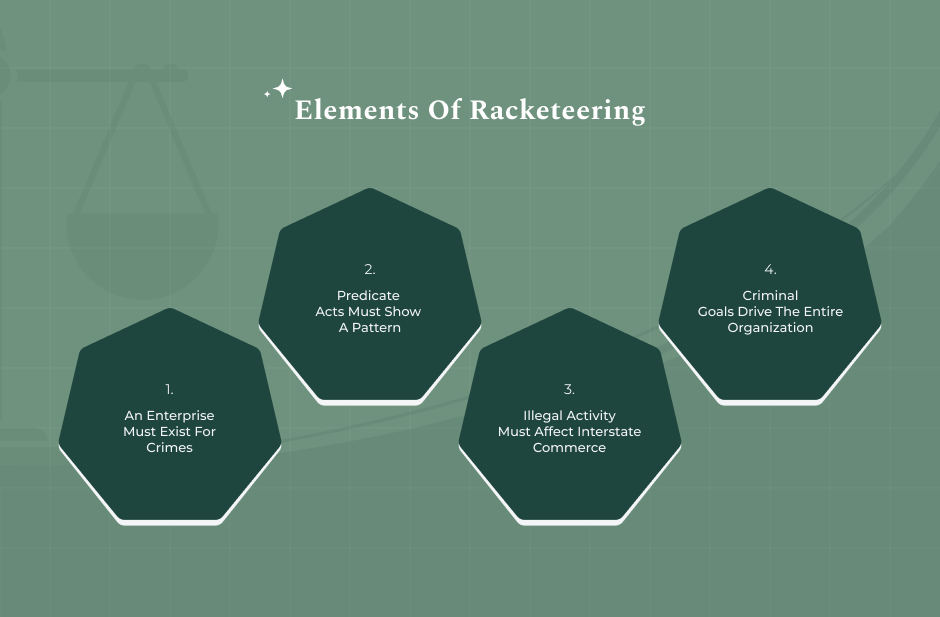
The determination of racketeering requires the identification of the particular elements that make up such a crime.
It involves proving that there is an existing enterprise engaged in interstate commerce and committing a series of offenses.
Racketeering charges usually rely on showing that there are at least two predicate crimes committed in a ten-year period.
Criminal Enterprise Structure Definition
In the question of What Is Racketeering, the “enterprise” is where the answer begins. It serves as the backbone of all racketeering cases.
Thus, it could be incorporated, partnerships, or even associations that are unincorporated.
The courts will need to consider if the organization shares the same objective and maintains continuity in its structure long enough to conduct its criminal activities.
Continuous Illegality Requirement
The continuous element plays an integral role in determining whether racketeering has taken place.
The government must prove that the offense is not a one-time occurrence but that they have become part of the regular business practice of the enterprise (CNN).
Differing Individuals And The Organization
Federal laws recognize the enterprise as an individual entity from the people who make up the company.
Such an action allows the government to seize the property of the entire organization. Additionally, it holds the leaders accountable for their subordinates’ actions.
Explanation Of The Pattern Of Predicate Acts
To have a pattern in “What Is Racketeering”, at least two predicate acts must be involved. These may include bribery, extortion, money laundering, or drug trafficking.
The legislation ties the dots together to establish an overall criminal conspiracy.
Common Predicate Crimes In RICO Cases
Some common offenses are mail fraud, wire fraud, and witness tampering. If the crimes advance the purposes of the enterprise, they qualify as racketeering.
This makes it possible for many other offenses to fall under RICO, whether they are white-collar or violent crimes.
The Ten-Year Statute Of Limitations Principle
There must be ten years between the two predicate acts. This ensures there is enough time for the government to bring a case against the offenders.
It helps prevent offenders from evading punishment simply because they committed the crimes a while back (Jacoby & Meyers).
Racketeering Legislation In The USA
The main instrument in prosecuting such cases would be the Racketeer Influenced and Corrupt Organizations Act.
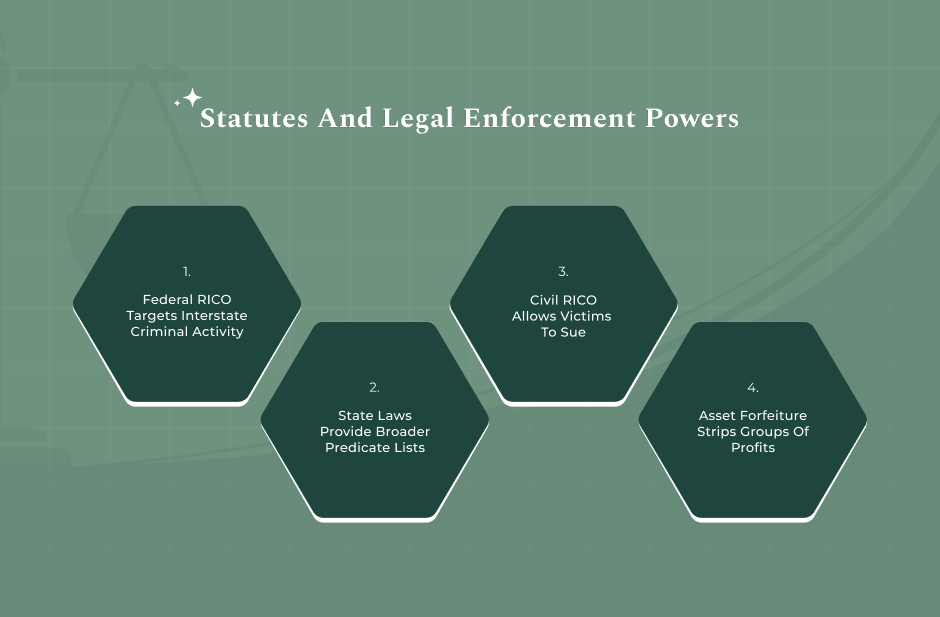
Thus, what is racketeering is actually codified in 18 U.S.C. §§ 1961-1968. This federal statute provides not only criminal sanctions but also civil actions to be taken by the victims.
In addition, many states have enacted similar legislation, referred to as “Little RICO,” which addresses commerce and organized crime that operates locally.
The RICO law has a narrower scope in addressing only matters concerning interstate commerce.
However, some of the laws passed by individual states, including Georgia RICO, are broader and give prosecutors more room to charge different predicate offenses as racketeering.
To fully comprehend racketeering, one needs to know in what jurisdiction the prosecution is taking place.
The Impactfulness Of Federal RICO Laws
RICO laws have transformed how law enforcement agencies pursue organized crime syndicates.
While before 1970, arrests could only be made on individual suspects, now the whole organizational hierarchy of an interstate criminal enterprise can be prosecuted.
Penalties Imposed By Criminal RICO Charges & Mandatory Minimum Sentences
One RICO offense can warrant up to 20 years behind bars in a federal penitentiary.
In case of predicate offenses such as murder that carry mandatory life sentences, the same punishment will apply to RICO convictions.
These penalties often compel many accused offenders to cooperate with investigators.
Use Of Civil RICO Actions by Private Citizens
It is possible for private persons to file lawsuits under RICO laws seeking threefold damages. This is seen mostly in cases involving white-collar crime or fraud against consumers.
What Is Racketeering – Racketeering Laws At The State Level
Laws at the state level are significant tools when dealing with gang activity and other smaller organizations involved in corruption. Often, the evidentiary threshold required by such laws will vary significantly from that of the federal law.
The Wide Scope Of Georgia RICO Law
The Georgian RICO law is known to have quite a wide scope of application. The law permits an extensive range of criminal acts to be joined under one charge.
This is currently under scrutiny in prominent trials of celebrities and politicians.
Sentence Differences Among Several State Borders
The sentencing process in relation to racketeering at the state level differs greatly. While certain states provide leniency among the offenders who do not indulge in violent conduct, other states enforce strict mandatory sentencing that resembles the federal law.
Landmark Case Law And 2026 Legal Developments
The law surrounding What Is Racketeering was clarified through court cases that spanned decades.
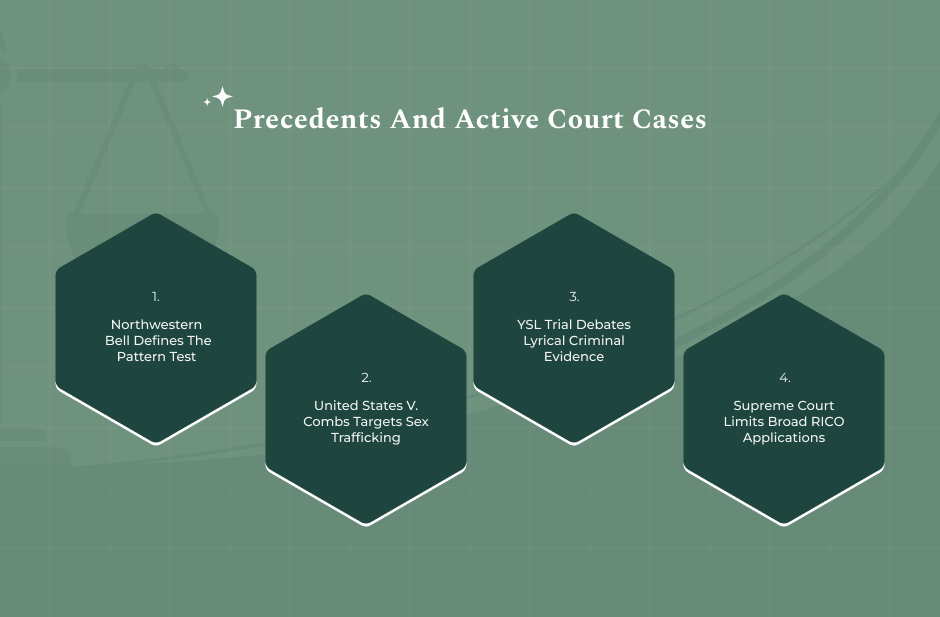
Through the ruling in H.J. Inc. v. Northwestern Bell Telephone Co. (1989), the Supreme Court gave insight into the meaning of “pattern” within the context of racketeering.
The case established that the acts involved must be related and must threaten future criminal activity.
Present-day cases that will be relevant in 2026 continue to expand the legal scope of racketeering charges.
In the pending case United States v. Sean Combs (24-cr-00542, S.D.N.Y.), charges are being brought against a person for sex trafficking and involuntary servitude under RICO.
Another recent case involves the lengthy trial called the Young Slime Life (YSL) in Georgia, where it is being argued that lyrics can prove a criminal conspiracy.
The Importance Of U.S v. Sean Combs
This case will be important for 2026 due to its magnitude. The “Combs Enterprise” used coercion and money to hide criminal activities.
This case is an embodiment of the concept of “racketeering conspiracy” in the entertainment industry.
The Charges Related To Coercion And Crime Enterprise
According to the government claims, the organization was involved in using “runners” and employees in order to perform criminal actions.
When charging the crime as racketeering, the head of the organization is accountable for all actions performed.
In such a way, the government destroys the defense of deniability used by influential persons.
Forfeitures Of Assets And Their Financial Nature
There have been numerous claims related to property forfeiture in this case. The government wants to seize assets and properties connected with the crime committed. Such financial pressure is typical for modern racketeering cases.
Georgia RICO Case Related To Political Personalities
The State of Georgia v. Donald J. Trump, et al. (Case No. 23SC188947) continues to be an important trial of 2026.
This case uses the broad powers granted to the state through the RICO Act, accusing Trump and other politicians of conspiracy to subvert election results.
RICO Trial With Many Defendants Is Complicated
When there are many defendants in this type of trial, it makes the process incredibly complicated.
This is because the defense lawyers file motions differently. Therefore, this results in lengthy court battles with years of delay.
The Case Impact On Public Opinion And Legal Precedents
This case will create a precedent that will be massive.
If political organizations are viewed as criminal enterprises according to this case, then how will it affect the US legal system going forward?
This is an issue that legal professionals have been discussing.
Requirements For Filing A Case Against RICO Organized Crime
If you suspect yourself of being a victim of any criminal organization, there may still be some steps you can take.
According to federal laws, private individuals or businesses can file a private cause of action against an organization.
But there are certain compulsory elements that you must prove.
What Is Racketeering – Four Compulsory Elements Of The Claim
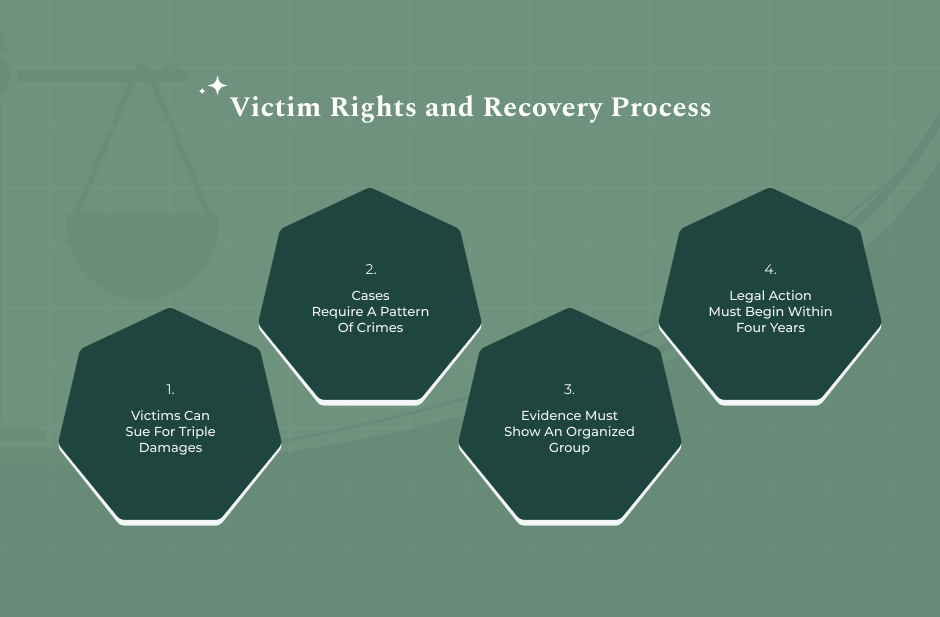
There are four important elements that need to be proved for victory in a civil lawsuit brought against someone accused of racketeering.
They are vital for building a successful claim and, if one of them is not proved, then there is no chance of moving to the next phase of the process – the trial itself.
Conduct Of A Distinct Enterprise
Firstly, the defendant should be shown as a member of an enterprise that is different from their personal activities.
An enterprise may include either a legitimate business used for committing offenses or some sort of criminal alliance of people (9th Circuit Model Jury Instructions).
Pattern Of Specific Predicate Acts
Secondly, a victim needs to provide evidence about the commission of two predicate acts within a period of ten years. These acts should be connected to each other.
What Is Racketeering Victim Identification
It is not always easy to detect racketeering as it can be camouflaged as normal business relations.
One might be a victim if they are experiencing constant threats of violence or extortion aimed at obtaining money or losing money due to an elaborate fraud scheme.
Detecting Evidence of Racketeering
If multiple individuals or organizations appear to be acting in concert to deceive you, then racketeering is at play.
Where a fraud case involves just one perpetrator trying to deceive you, racketeering feels more like a massive, mechanized system operating against you (Justia).
Spotting Extortion Activities In Your Businesses
If you’re being threatened with violence or other forms of punishment if you don’t pay extortion money or agree to use certain suppliers, then racketeering is likely to blame.
What You Need To Do For Recovery
The first step to recovery is gathering evidence. As a result of how complex such claims are, you shouldn’t try handling the matter on your own. Statutes provide for treble damage awards, allowing you to collect triple your actual damages.
Reporting To Federal And Local Authorities
Your first step is to file a report with the FBI or your local District Attorney. A criminal investigation can provide the evidence you need for your own civil lawsuit later on.
Filing A Civil Lawsuit For Treble Damages
Under 18 U.S.C. § 1964(c), you can sue the enterprise for your financial losses. If successful, the court can award you triple your losses plus your attorney fees. This is a powerful tool to help you rebuild your life (FINRA).
Frequently Asked Questions – What Is Racketeering?
It is often the case that the public has very valid worries regarding the functioning of these highly complex laws.
The knowledge of what racketeering entails helps people realize the dangers associated with being involved with specific organizations.
The government uses wire taps, banking information, and testimony from informants. They need to show that the organization in question had the same objective and hierarchy among members.
Additionally, the government needs to demonstrate that the organization had sufficient time to commit several crimes.
A conspiracy involves two or more persons agreeing to commit a crime. On the other hand, racketeering needs both an “enterprise” and a “pattern” of activities.
RICO, which stands for the Racketeer Influenced and Corrupt Organizations Act, is considered much more serious than a mere conspiracy.
Is It Possible For A Lawful Business To Be Indicted For What Is Racketeering Activities Under Federal RICO Statutes?
Yes, because a legitimate business could be deemed a racketeering enterprise. An example would be when an organization uses a business as a facade for committing unlawful actions.
Possible signs are the issuance of federal subpoena orders for financial documentation and visits by FBI officers.
You might also be under investigation if their counterparts have been indicted of racketeering offenses under RICO statutes.
Lawyers will dispute whether the prosecution has successfully established the elements of an enterprise and pattern of activity. Some defense attorneys will also deny that any of the crimes committed were connected or that their clients did not know about the organization’s criminal intentions.
The charge of racketeering is a serious felony both federally and in individual states. The penalty is usually extensive jail time, lasting up to 20 years or even longer. Since it relates to organized crime, judges rarely consider granting leniency. In addition, a person can face a number of restrictions regarding civil rights.