
The Historical School of Jurisprudence has intrigued so many of us for years – especially people without a legal background interested in all things legal!
FYI, Jurisprudence deals with the study and theories of law; a.k.a., it studies the concept and origin of law. Law in itself is a complex subject matter from an academic perspective.
Naturally, the understanding of Jurisprudence often varies from person to person, considering everyone looks at law differently.
For instance, a lawyer and a law student can look at law as a solution to every issue. But a normal citizen with no legal background might look at law as a means for punishing someone.
Now, the Historical School of Jurisprudence said that law is nothing but an exaggeration of society’s customs, religious principles, conventions, economic needs, and the relationships individuals have with society.
Moreover, the school does not believe or even support ideas like how law’s origins have some sort of a divine connection, an idea championed by the Natural School of Law.
Today, we will break down what the Historical School of Jurisprudence is all about and simplify it for anyone who loves law but unfortunately has no legal background.
Stay tuned.
The Meaning And Concept Of Historical School Of Jurisprudence:
With the evolving nature and needs of people, it is only natural that laws will undergo changes too.
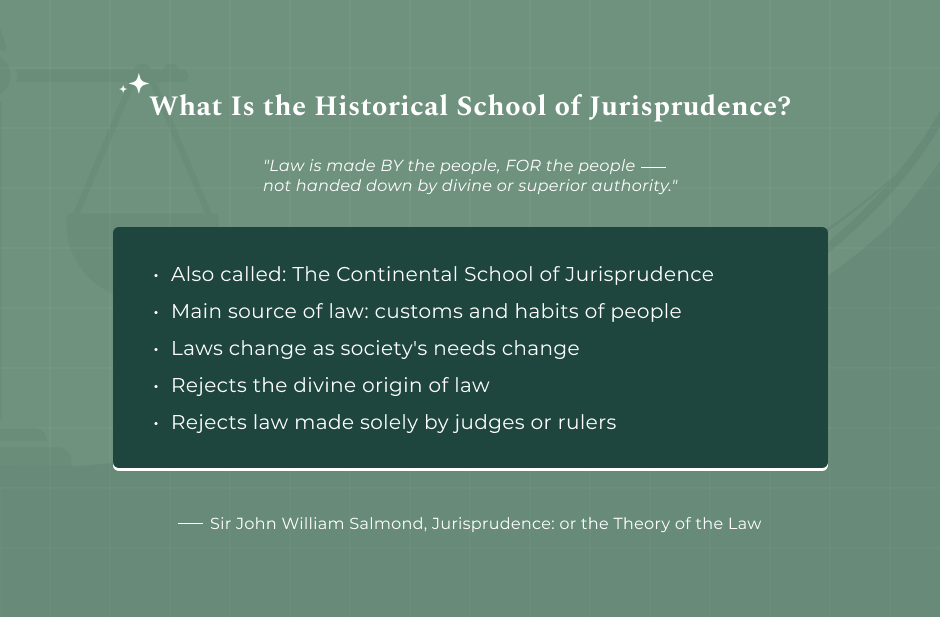
And that is what the Historical School of Jurisprudence is all about – they believe that laws are made by man, as opposed to laws originating from a superior – often divine – authority.
In that case, the school’s foundational idea is: “Law is formulated for the people and by the people.”
This basically means laws can undergo changes to meet the evolving demands of people.
Also known as the Continental School of Jurisprudence, the primary source for this school depends on customs and habits of people – all of which are subject to change as per requirements and needs.
In addition, it is important to highlight how this School of Law rejects two ideas primarily:
- The divine origin of law.
- The formation of laws by a superior authority like judges.
In this context, Sir John William Salmond (1862–1924), a well-known legal scholar and Supreme Court judge, said in his book, Jurisprudence: or the Theory of the Law:
“That branch of legal philosophy which is termed historical jurisprudence is the general portion of legal history. It bears the same relation of to legal history at large as analytical jurisprudence bears the systematic exposition of the legal system.”
Also, he said, “Historical jurisprudence is the history of the first principles and conceptions of the legal system.”
Why Did The Historical School Of Jurisprudence Originate?

So you already know that the followers of the Historical School of Jurisprudence believe that laws undergo changes as per the changing needs of people.
As a result, the primary sources of law are the customs and habits of people.
As per legal theorist R.W.M. Dias, this school of law came into existence as a strong reaction against the Natural School of Law and its theories about how law originated from a superior authority and has some sort of divine relevance.
On that note, the primary reasons behind the emergence of this school of law are as follows:
1. A Reaction To The Natural School Of Law:
The Natural School of Law firmly believes and supports that the origins of law have a divine connection.
Also known as Eternal Law, Natural Law has existed since the inception of the world we live in.
Moreover, Eternal Law is closely related to the intention and morality of God. In this context, it is important to highlight that the Indian Constitution has used bits and pieces of Natural Law and related theories in some of its articles.
In contrast, the Historical School champions laws as something made by man – something with no divine connection.
2. An Ideological Opposition To The Analytical School Of Jurisprudence:
Also known as the Austinian School, the Analytical School of Jurisprudence was established by an English legal theorist called John Austin (1790–1859).
FYI, the primary subject matter that the Analytical School of Jurisprudence follows is optimism in law, i.e, positive law. This means the school supports the idea that a superior authority like judges and legislators made laws.
In contrast, the Historical School of Law emphasized the fact that laws originated as a result of people’s changing habits and customs – and not via any superior authority.
Read Also: The Principle Of Natural Justice: The Rule That Stops A Decision From Being Unfair
The Most Important Jurists Of The Historical School Of Jurisprudence:
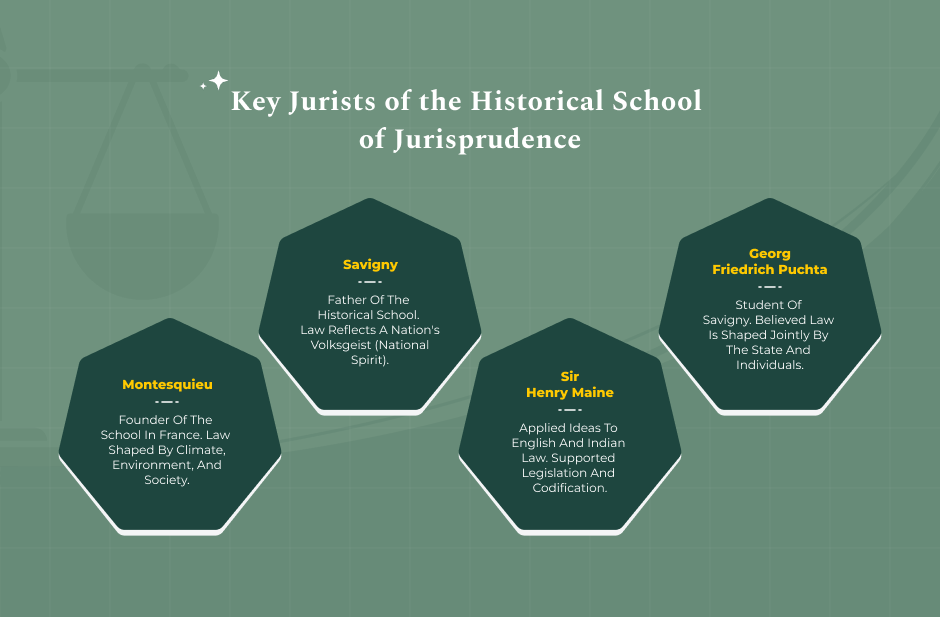
In this section, we have discussed some of the most famous jurists from the Historical School of Jurisprudence, highlighting their theories and philosophies of law.
1. Montesquieu:
As per Sir Henry Maine, Montesquieu was the first jurist and legal professional who adopted the learning championed by the Historical School. To simplify matters, Montesquieu basically laid the core foundation of this school in the legal landscape of France.
According to Montesquieu, it doesn’t matter whether law is bad or good – why? This is because, according to him, law usually depends on the environmental, political, and social conditions that prevail in society.
In this context, he had said, “law is the creation of the climate, local situation, accident or imposture”.
From this, one thing is clear: for Montesquieu, laws should undergo change with the changing demands of any society. Moreover, he didn’t establish any philosophy or theory that focused on the relation between society and law.
In addition, he also suggested that law should be the solution to problems people face while living in a society. It is very much subjected to change as per the needs of the people.
2. Savigny:
Savigny is known as the father of the Historical School of Law. He was of the belief that the legal system’s coherent nature is the result of people’s failure to understand the origins and history of law.
As per Savigny, law happens to be “a product of times the germ of which, like the germ of State, exists in the nature of men as being made for society and which develops from this germ various forms, according to the environing influences which play upon it.”
Moreover, for Savigny, law wasn’t something you could borrow from the outside. The primary and most important source of any law is people and their consciousness.
Additionally, he said that when the nationality of a state strengthens, its laws also grow. Similarly, when the nationality of the same state loses strength, its laws begin to fade away or die.
He was of the view that the law of the state grows with the strengthening of the state’s nationality. Also, law dies or fades away when nationality loses its strength in the state.
3. Sir Henry Maine:
Sir Henry Maine is one of the most popular leading figures of the English Historical School of Law. He played a key role in developing the ideas originally introduced by Savigny.
Moreover, he adapted the historical approach to legal development within the English legal tradition.
Maine gained extensive knowledge of the Indian legal system while serving as the Law Member of the Governor-General of India’s Council from 1861 to 1869.
Also, drawing inspiration from both Savigny and Montesquieu, he combined their strongest ideas.
Moreover, he avoided the excessive romanticism and abstract assumptions that characterized some historical theories.
Unlike Savigny, Maine believed that legislation and the codification of laws were essential for creating a clear, organized, and effective legal system.
4. Georg Friedrich Puchta:
Georg Friedrich Puchta was a German jurist, a devoted student of Savigny, and one of the prominent thinkers of the Historical School of Jurisprudence.
While he was influenced by Savigny’s principles, Puchta developed a more systematic and logical interpretation of the historical approach to law.
Puchta examined the origin and gradual evolution of legal systems from their earliest stages. A significant part of his theory addressed the tension that can arise between the collective interests of society and the interests of individuals.
Also, he argued that the state emerged as a means of balancing these competing wills and creating harmony between them.
According to Puchta, the creation of law cannot be attributed solely to the people or exclusively to the state.
Instead, both the state and individuals contribute to the development and formation of legal rules. And this makes each an important source of law.
Read Also: Judicial Restraint Explained: Definition, Principles, History, And Modern Debate
Key Takeaways:
The Historical School of Jurisprudence explains that law develops gradually through the customs, traditions, beliefs, and practices of society. And not something that some superior authority created overnight.
It views law as a product of historical evolution, shaped by the collective life and experiences of the people.
Moreover, customs, judicial decisions, and long-established social practices are therefore considered important sources of law.
Several distinguished jurists contributed to this school of thought, including Montesquieu, Savigny, Sir Henry Maine, and Georg Friedrich Puchta.
Montesquieu emphasized the influence of social and environmental conditions on legal systems. In contrast, Savigny argued that law grows organically with the people and reflects the Volksgeist or national spirit.
Sir Henry Maine expanded these ideas by adopting a more practical approach and supporting legislation and codification alongside historical development.
Also, Puchta further refined the theory by maintaining that both the state and the people play essential roles in the creation and evolution of law.
Overall, the Historical School highlights that legal systems share a close relationship with a society’s history, culture, and traditions. This, in turn, makes law an evolving institution rather than a fixed set of rules.