Recently, we checked out something on Google. So, we typed ‘Is it illegal to be gay in the Marines?’ And guess what?
All we could find was several sources with the shortest answers ever. Of course, most blogs said it isn’t illegal. And that’s a correct answer; it doesn’t shed much light on the legalities around the topic.
Perhaps why people continue to have this query.
Also, what we could understand was that there is a lot of confusion in the history of the Marine Corps. For years, the queer community has faced discrimination and stringent policies that had the power to end their military careers.
Unfortunately, people used to get discharged just because of their sexual orientation, even if they were honorable members. Those policies were responsible for shaping how the public at large perceived the entire situation for years.
And somewhere down the line, that impact still exists in the present. That is why a simple ‘yes’ or ‘no’ is not enough.
Currently, the U.S. legal landscape has evolved – the U.S. military, including the Marine Corps, does not stop anyone from serving just because they are queer. Anyone in service is expected to meet the same standards of conduct and professionalism irrespective of their sexual orientation.
In this legal guide, we’ll explain what the law says today, how military policy evolved over time, and why the distinction between a military rule and a criminal law matters.
Stay tuned.
Is It Illegal To Be Gay In The Marines?
No.
It is not illegal to be gay in the Marines. So that means you can serve in the Marines even if you are out to the world as gay – you will not lose your job because of who you choose to love.
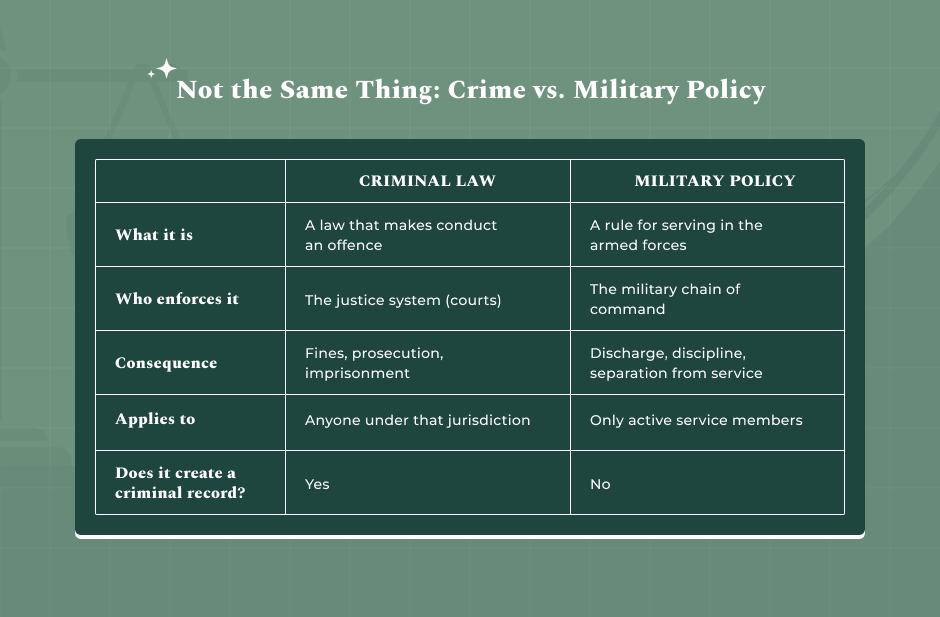
And this is essential to clarify because there are so many people who keep confusing military rules with criminal laws.
FYI, criminal laws can only be enforced via a legal system. Also, it leads to different penalties – simple ones like fines, and tough ones like direct imprisonment.
In contrast, military policies are applicable to anyone serving in the U.S. military.
As of 2026, it is legally acceptable to be queer and serve in the Marine Corps – being gay isn’t going to count as a criminal activity.
Instead, Marines are evaluated on factors such as:
- Physical fitness.
- Professional performance.
- Military readiness.
- Conduct.
- Ability to perform their duties.
Sexual orientation alone is not part of that evaluation.
Is Being Gay Against Marine Corps Policy?
No.
If you possess all the qualifications necessary for serving in the Marines, then you can go ahead and do it- it doesn’t matter whether you are straight or queer.
Who you choose to love is up to you – it doesn’t interfere with your career in the military.
Frankly, the expectations are simple. Just maintain the same standards of conduct and professionalism.
So, it is fairly easy – just maintain the discipline, respect everyone, perform your assigned duties, and follow all lawful orders.
The policies of the Marine Corps in 2026 focus only on the performance and conduct of a person – their identity doesn’t matter.
Why Do People Still Ask This Question?
While everyone is already aware of how someone’s sexual orientation doesn’t interfere with their job in the Marines, it is confusing that this query is so popular in 2026.
The reason is history.
For years, the U.S. military had policies that did look at the queer community in a discriminatory light. There was a time when being queer openly could lead to an immediate discharge from the service.
Then there are rumours about an infamous policy – the ‘Don’t Ask, Don’t Tell’ policy. While we have come across this policy, the information available around it was very vague.
As a result, what happens is outdated information keeps interfering with the actual policies that are applicable now.
It is normal to stumble upon stories, newspaper coverage, and blogs on the topic from a time when being gay in the military was a problem. Now, without any cultural and historical context, it gets too difficult to find out which information is accurate.
Perhaps that is why this query continues to be common, even if the policy around sexuality has changed.
The Difference Between A Crime And A Military Policy
Of course, people are still confused about the policies of the Marine Corps – would coming out as gay get me fired?
Without even checking, the social taboo would make you think you are doing something ‘illegal,’ and you will probably get fired.
Now, you are forgetting that most people use the word ‘illegal’ to describe something that the law prohibits.
From a legal perspective, however, the distinction matters.
A criminal law makes certain conduct an offence that can be prosecuted through the justice system. A military policy, by contrast, establishes the rules for serving in the armed forces.
If you look at the historical context of the topic, you will find out that some service members did get separated from the U.S. military due to policies related to sexual identity.
But that doesn’t mean those service members were convicted of a crime – and that too for being queer.
This is the difference you need to know – that way you will be able to understand why older content on the internet related to this topic uses language that sounds somewhat inconsistent when you look at what’s relevant in 2026.
A policy can affect someone’s military career without making their identity illegal under the law.
That distinction is essential to understanding both the history of military service and the policies that apply today.
How Things Worked Before Don’t Ask, Don’t Tell?
The answer to this question wasn’t always as simple as it is today.
So, if you had asked someone in the 1980s whether a gay person could openly serve in the Marines, the answer would have been very different.
At the time, military policy didn’t permit open service by gay men and lesbians. If a service member disclosed their sexual orientation or it became known through other means, they could be separated from the military.
That meant many people lived with a difficult choice.
They could keep an important part of their personal lives private and continue serving, or they could be honest about who they were and risk losing the career they had worked hard to build.
For many, there didn’t seem to be a good option.
Also, this history is one of the main reasons people still search for the rules today. They know things were different in the past, but they aren’t always sure when those rules changed.
Then Came “Don’t Ask, Don’t Tell”
In 1993, the U.S. government introduced a policy that became known as “Don’t Ask, Don’t Tell.”
At first glance, it sounded like a compromise. Military officials generally would not ask someone about their sexual orientation during service.
But there was another side to the policy.
Service members were also expected not to openly disclose that they were gay. If they did, they could still face discharge.
So while the name suggested silence from both sides, it didn’t mean people were free to serve openly. Many weren’t.
Instead, the policy created a situation where countless service members felt they had to separate their personal lives from their professional ones.
A casual conversation about a partner or family life could suddenly become something they carefully avoided.
Why The Policy Drew So Much Criticism?
With time, people started criticizing the policy about being gay and working in the U.S. military. The main issue? Was the policy able to achieve anything from this discrimination? Not really.
Critics went to the extent of saying that such a policy was putting honest service members in a difficult spot.
The military expects trust within a unit. It values integrity and accountability. Yet some service members believed they had to hide part of their identity simply to continue serving.
Others questioned the practical impact.
Also, Marines, soldiers, sailors, and airmen with expertise had to leave the military because of this stringent policy, even if they were consistent performers.
People who supported the repeal believed that the military should judge people only on the basis of their performance and conduct, not their sexuality.
At this point, it didn’t matter whether people at large supported this view or chose to stay silent. Because the conversation around military service had finally begun to evolve and change.
What Changed In 2011?
Then came 2011 – and the biggest turning point finally arrived. Finally, the repeal of ‘Don’t Ask, Don’t Tell’ came into effect officially – it was no longer ‘illegal’ to be gay in the U.S. military.
Since 2011, anyone who meets the necessary qualifications can serve in the U.S. military, including the Marine Corps – it didn’t matter anymore if you were openly gay!
And this was a significant change because the military finally stopped looking at sexuality as a parameter for letting someone serve the country.
The focus returned to something much simpler – Can this person do the job? Moreover, can this person meet the standards expected from every member in the service?
A Quick Timeline
To make things easier, here’s a table so that you can have clarity on the quick timeline.
| Year | What Changed |
| Before 1993 | Openly gay individuals generally could not serve under military policy and could be separated from service because of their sexual orientation. |
| 1993 | Don’t Ask, Don’t Tell took effect. The policy changed some procedures but still did not allow open service. |
| 2010 | Congress approved legislation to repeal Don’t Ask, Don’t Tell. |
| 2011 | The repeal became effective, allowing gay, lesbian, and bisexual service members to serve openly. |
| Today | The Marine Corps evaluates qualified service members under the same professional and conduct standards regardless of sexual orientation. |
History explains why this question still appears so often. Many people remember the old rules. Then, there are others who have just heard how things used to be from family and acquaintances – people who know how things used to be in the 90s.
And those experiences are all real. But that doesn’t mean those experiences reflect the policies relevant in 2026.
Read Also: Indecent Assault Vs Sexual Assault Charges: What The Charges Actually Mean And How WA Courts Decide
What Serving Looks Like Today?
The policies of 2026 are obviously much more evolved and flexible as compared to the stringent rules of the 90s.
For instance, let’s assume there are two Marines reporting to the same unit in the 90s – One is gay. The other is heterosexual.
They complete the same training. They follow the same orders. And they take the same fitness tests.
Also, these two individuals are expected to show the same level of professionalism, conduct, and discipline. Remember, their evaluations don’t depend on who they happen to be, but on their performance.
And that is the key difference.
Modern policy doesn’t create one standard for gay Marines and another for everyone else. The expectation is the same across the force.