Today’s topic: Is plagiarism illegal?
This is a question that often confuses students, writers, and business professionals alike.
While many people perceive plagiarism as simply an academic form of intellectual dishonesty, the legal implications of such an issue become much more intricate in 2026.
Plagiarism is defined as the process where one plagiarizes someone else’s work without mentioning their name and hence committing a crime against the federal government, as stipulated by the Copyright Act of the United States.
Some of the most anticipated decisions in recent years in the legal field are those from In Re OpenAI, Inc. Copyright Infringement Litigation (2025).
The contemporary controversies reveal the fact that although plagiarism is an ethical issue, its ramifications might go beyond ethics into legality.
Here, we are going to discuss:
- The fundamental legal distinction between ethical plagiarism and illegal infringement.
- Federal and state legislation governing intellectual property and fraud.
- A detailed analysis of whether plagiarism can be classified as a felony.
- Real-world case laws that have shaped modern plagiarism enforcement.
- The intersection of artificial intelligence and traditional attribution laws.
The Legal Distinction Between Ethics And Law

However, the main point of ambiguity when it comes to the idea of “is plagiarism illegal?” revolves around the distinction between the policies of institutions and the laws of the country.
While schools implement honor codes for punishing offenders, courts rely on the Copyright Act of 1976 when dealing with cases of legal infringements.
What Is Plagiarism Under The Law
As far as what is plagiarism question goes, it is imperative to note that the term means “wrongful appropriation.”
More specifically, plagiarism represents the practice of claiming other people’s language, thoughts, or expressions as one’s own and may result in a fraudulent claim for commercial use.
The Connection To Intellectual Property Theft
In most cases, when a person wonders is plagiarism considered theft under law, the answer will most probably be “yes.”
According to US law, the expression of original ideas represents the property, which is why its unauthorized appropriation may be treated as a case of larceny.
Contractual Violations And Plagiarism
Within the business realm, plagiarism can be considered illegal since it usually results in the violation of a contractual agreement.
Most contracts provide that all submitted works should be original. Therefore, any act of submitting plagiarized work is a violation of such an agreement and may lead to immediate dismissal of the individual involved.
Is Plagiarism Illegal: Laws On Federal And State Levels Concerning Plagiarism
There is no “Plagiarism Law” in the United States. However, plagiarism can be addressed through laws that concern copyright, trademark, and fraud.
Federal Copyright Act Of 1976
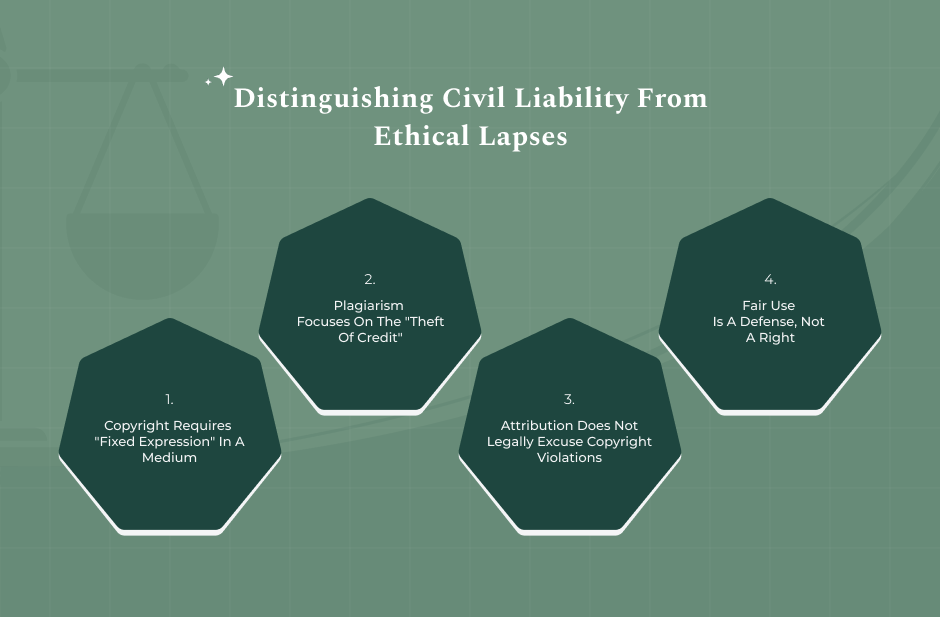
The best means of fighting plagiarism is the U.S. copyright laws. According to 17 U.S.C. §102, an original work enjoys copyright protection right after creation and regardless of a lack of any copyright notice or symbol.
Civil Penalties For Plagiarizers
The majority of lawsuits that deal with is plagiarism illegal cases usually involve civil litigation.
The aggrieved party may claim statutory compensation between $750 and $30,000 per each infringed copy of work, or up to $150,000 if they show intent and willfulness.
Threshold For Criminal Charges
However, if the case of plagiarism is on a large scale or makes substantial profit, then it might become a criminal lawsuit.
It is possible for federal prosecutors to bring charges if there were reproductions and distributions of copyrighted material worth more than $1,000 at retail value.
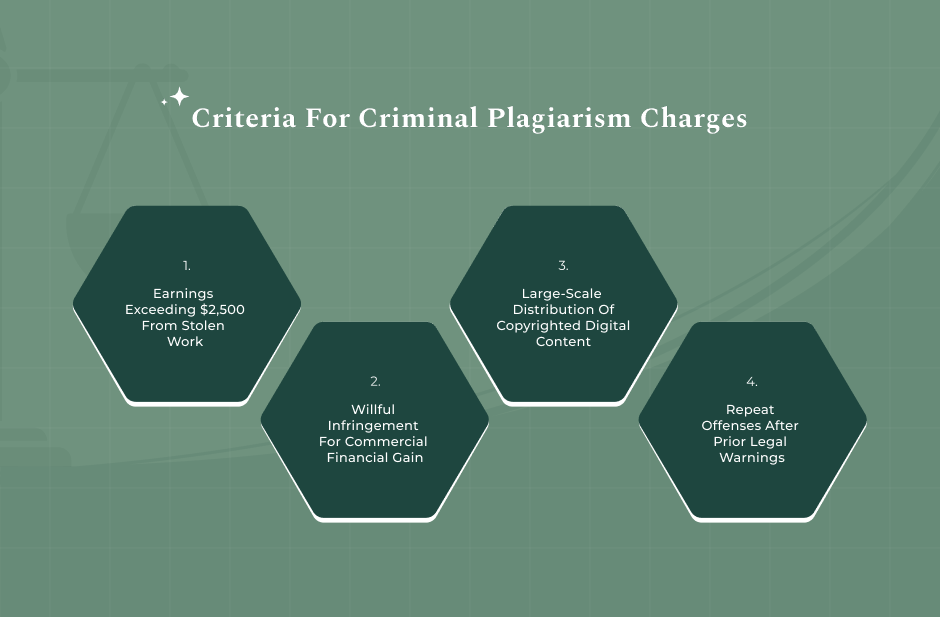
Criteria For Criminal Plagiarism Charges
- Earnings exceeding $2,500 from stolen work.
- Willful infringement for commercial financial gain.
- Large-scale distribution of copyrighted digital content.
- Repeat offenses after prior legal warnings.
Plagiarism: A Felony Crime When It Reaches That Level
One of the many worries among professionals is whether or not plagiarism can be considered a felony.
Most cases involving plagiarism are only punished by suspension in school or dismissal from work, but there are certain requirements that can make this crime a serious offense.
Federal Plagiarism Law
According to state and federal laws, those who earn money exceeding $2,500 from plagiarism can be imprisoned for up to ten years and fined with a maximum of $250,000 (Source: The Citadel 2026).
Misdemeanor Charges For Less Serious Plagiarism Offenses
Plagiarism crimes that fall into the misdemeanor category have penalties such as up to one year in prison and fines ranging from $100 to $50,000, depending on the seriousness of the crime committed.
“The Good Faith” Legal Defense
Judges can consider the distinction between “innocent infringement” and “willful infringement.” Where a defendant shows that they acted in good faith and thought that what they did qualified as “fair use,” judges can lower the legal penalties and fines.
Modern AI Litigation: In Re OpenAI (2025)
In today’s scenario, In re OpenAI, Inc. Copyright Infringement Litigation (MDL No. 3143) is the vital case currently ongoing.
The authors have argued that training AI algorithms using their literary content without seeking prior permission is an enormous case of plagiarism and copyright infringement.
Difference Between Plagiarism And Infringement In Legal Terms
Plagiarism, which can be mistaken for copyright infringement, is not always illegal in terms of relation to infringement.
It is not a criminal offense to plagiarize any literary creation in the public domain (e.g., by Shakespeare), but it would be considered copyright infringement to reproduce another person’s work and use it legally.
In today’s scenario, In re OpenAI, Inc. Copyright Infringement Litigation (MDL No. 3143) is the vital case currently ongoing. The authors have argued that training AI algorithms using their literary content without seeking prior permission is an enormous case of plagiarism and copyright infringement.
The Difference Between Plagiarism And Infringement As Regards To Legality
Plagiarism, which may be confused with copyright infringement, is not necessarily illegal depending on its association with infringement.
Plagiarizing a piece of work in the public domain (such as one by Shakespeare) does not make one liable for a legal offense, whereas one could get sued for copying a work under protection, even if cited.
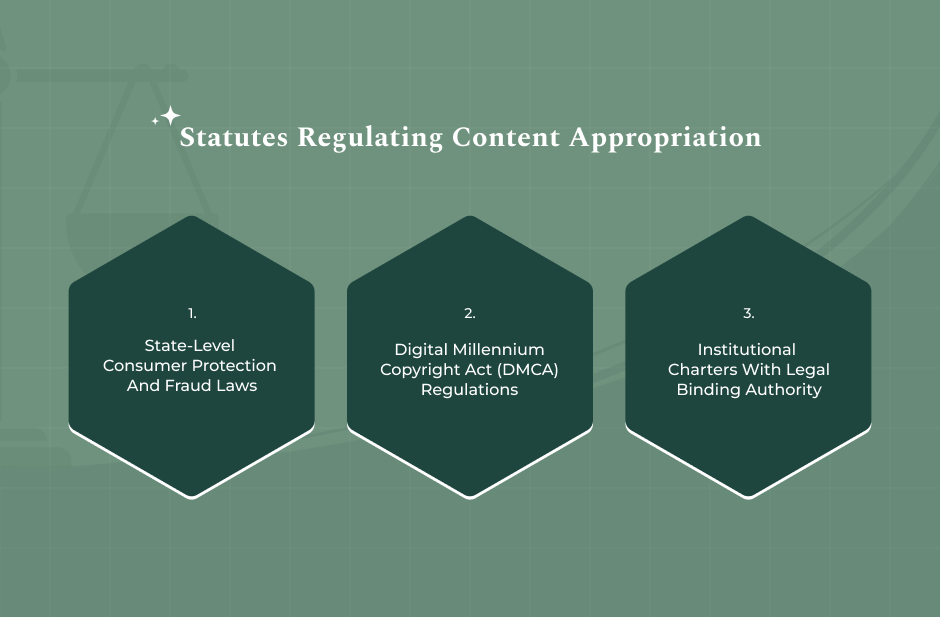
State-Specific Statutes And 2026 Regulatory Trends
Federal regulations are primarily concerned with addressing the “theft” part of the issue, while state laws are geared towards addressing “fraud” when it comes to plagiarism.
Both California and New York will update their consumer protection acts in 2026, targeting “Content Mills” and “Diploma Mills” producing fraudulent plagiarized content.
California’s Plagiarism Provisions In The Education Code
The state of California has updated its Education Code and made changes in the law regarding plagiarism.
Selling any academic papers created specifically for “fraudulent submissions” will result in civil injunction and significant fines imposed by courts on providers, rather than students.
Deceptive Practices In New York
Section 349 of the general business law of New York makes any business selling plagiarized works under the guise of “expert, original research” liable for deceptive business practices, allowing the state Attorney General to take action against a company engaging in such activity.
Laws Concerning “AI-Plagiarism”
Three states in 2026 are planning on passing legislation known as “AI Transparency Act”.
Any work generated via artificial intelligence that is presented as “human authored” for profit without an appropriate disclaimer becomes illegal because the lack of proper information constitutes consumer fraud.
Additional 2026 Info
Once the speech gets documented on paper or digital medium, it becomes the subject matter of copyright protection.
Speech delivery with the act of copying another person’s expression might lead to legal action for “Public Performance Infringement.”
Employer Sues Employee For Plagiarism
The employer can sue the employee for “indemnification” of financial loss resulting from the act of the copyrighted work produced by the employee that leads to lawsuits against the company.
Caption is defined as “an original creative expression.” Based on the 2026 DMCA, it must be deleted if flagged for plagiarism, and those who have committed plagiarism in captions must lose ad revenue along with having their account banned.
Frequently Asked Questions (FAQs):
It is essential to know the boundaries within which one is allowed to create content. The following questions provide the answers to the most frequently asked questions by ordinary citizens about whether plagiarism is considered illegal.
Yes, although you have cited the source, you will still violate the copyrights since you are using the words of another person excessively without putting them in quotations.
Plagiarism is an unethical act that involves not crediting the author of something you write. Copyright infringement is the breach of intellectual property laws. They usually go hand in hand in the court process.
Yes, if you have committed an illegal act and earned more than $2,500 on copyrighted material, then you may be incarcerated for years to come.
No, self-plagiarism is not illegal and punishable by law. It is an ethical issue in academic and business environments because you cannot plagiarize yourself.