Today’s topic: Social Security WEP GPO Retroactive Payments.
For years, teachers, firefighters, and police officers watched their Social Security benefits shrink because of the Windfall Elimination Provision (WEP) and the Government Pension Offset (GPO).
The Social Security Fairness Act just changed all that. Now, those cuts are gone, and a huge wave of retroactive payments is rolling out – going all the way back to January 1, 2024.
If you’re eligible, this isn’t just about getting a bigger monthly check. You also get a lump-sum back pay, which can add up to a lot.
However, understanding if you qualify, how much you will receive, and what this means for your taxes is not always simple. Besides, it is very easy to get lost in detail.
In this blog, we are going to break down the following things:
- A brief understanding of the WEP and GPO.
- What are the Social Security WEP GPO retroactive payments?
- Effective date, timeline, and payment schedule of retroactive payments by the SSA.
- Who is eligible for the Social Security WEP GPO retroactive payments?
- How to calculate your retroactive payment?
- How does the Social Security WEP GPO one-time payment affect your taxes?
- What to do if you have not received the amount?
Therefore, to know about these, keep reading!
Understanding WEP And GPO
Before we explain Social Security WEP GPO Retroactive Payments, let us take a while to understand what WEP and GPO were about.
The Windfall Elimination Provision (WEP) has been around since 1983. It changes how Social Security calculates benefits for people who also get a pension from jobs that didn’t withhold Social Security taxes.
Basically, if you spent part of your career in jobs where you didn’t pay into Social Security – like some public sector positions – WEP steps in to tweak the formula.
The reason behind this was to stop people from getting an extra boost from a system meant to help lower-wage workers.
WEP can cut your starting benefit rate from 90% down to as low as 40%. That drop hits hard for retirees who depend on public sector pensions.
Now, let’s talk about the Government Pension Offset (GPO), which started back in 1977. This rule slashes or wipes out Social Security spousal or survivor benefits for anyone who gets a government pension from non-covered work.
Here’s how it works: Social Security cuts your benefit by two-thirds of your government pension.
Now, for many people, that means their Social Security benefit just disappears. Furthermore, it’s especially tough on public sector spouses who counted on both sources of income in retirement. (Source: Congress)
Both WEP and GPO were supposed to stop “double-dipping” – making sure public workers didn’t end up with higher benefits than private-sector. However, for years, critics argued these rules were unfair.
They pointed out that teachers, firefighters, and other public employees lost out on benefits they had earned.
That finally changed with the Social Security Fairness Act, signed into law on January 5, 2025.
The act repealed WEP and GPO for good, restoring full benefits to about 3 million retirees for payments after December 2023.
Social Security WEP GPO Retroactive Payments
The Social Security Fairness Act has repealed the Windfall Elimination Provision (WEP) and Government Pension Offset (GPO), which previously reduced benefits for public servants with non-covered pensions.
Because of the reduction that resulted from these two provisions, SSA has issued one-time Social Security WEP GPO Retroactive Payments for the general public who were affected by this.
So, basically, if Social Security cut your benefits because of the WEP or GPO rules anytime between January 1, 2024, and 2026, you are in line for a Social Security WEP GPO retroactive payment.
The Social Security Administration started sending out these lump-sum payments from 2025. They are basically paying people back for the money they lost because of those old rules – retirees, spouses, survivors, anyone who took a hit.
Most people don’t have to do anything – the payment shows up automatically in their account. However, if Social Security denied your benefits completely or you got nothing during that time, you might need to reapply to get your money.
Social Security WEP GPO Retroactive Payments Timeline & Effective Date
The Social Security Fairness Act set January 1, 2024, as the date when WEP and GPO provisions end. So, people affected will start receiving Social Security WEP GPO retroactive payments.
Most people will see a one-time lump sum hit their bank accounts by direct deposit in March 2026. (Source: Weymouth Retirement System)
In most cases, this lump-sum amount might show up before any official letter arrives in the mail. If your case is a bit complicated, though, it might take a little longer.
According to SSA, “As of July 7, 2025, we completed sending over 3.1 million payments, totaling $17 billion, to beneficiaries eligible under the Social Security Fairness Act, 5 months ahead of schedule.”
Here is the payment timeline:
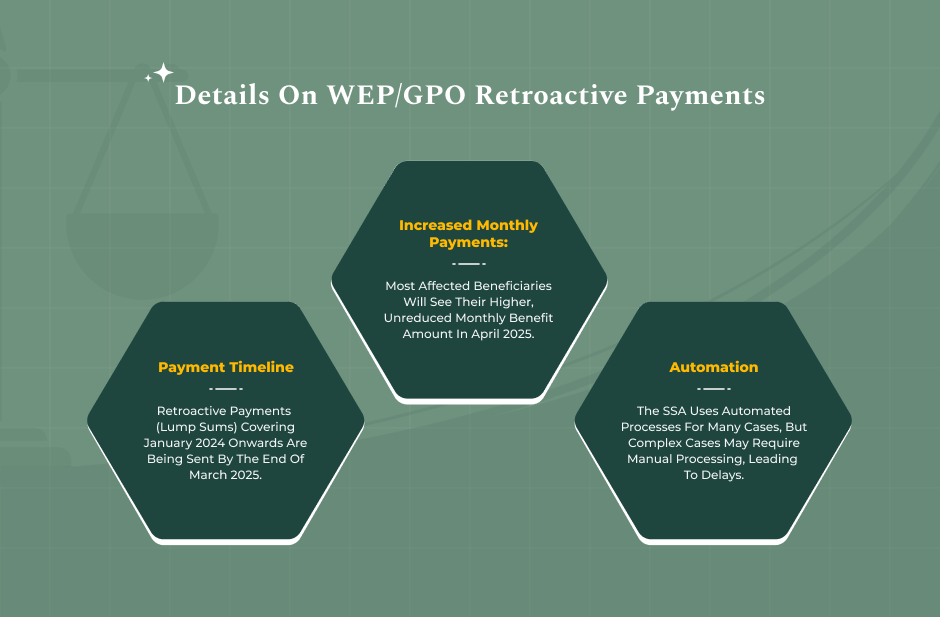
- Automation: Most people are getting their retroactive payments by direct deposit during March 2026.
- Mailed Notices: You will get a letter in the mail that explains the adjustment, but honestly, the payment usually shows up two or three weeks before the letter does.
- Complex Cases: If your case is more complicated – like if you have a certain type of pension – it might take a bit longer than March 2026 to sort everything out.
Social Security WEP GPO Retroactive Payments Eligibility
If you want to get retroactive payments for Social Security under WEP or GPO, you need to check two boxes: First, your benefits got cut or wiped out by these rules. Second, you had a right to those benefits on January 1, 2024.
Here’s who qualifies for the retroactive payments:
- Retired Workers: Retired workers whose own retirement or disability payments got trimmed by WEP.
- Spouses & Survivors: Spouses and survivors whose benefits shrank because of GPO.
- New Claimants: If you become eligible after January 2024, you’ll get your full benefits from here on out. Any back pay will cover the months starting when you first became entitled.
How To Calculate Your Social Security WEP GPO Retroactive Payments?
Figuring out your retroactive payment basically means looking at what you actually got paid under the old rules, then comparing that to what you should have received starting January 1, 2024.
Because the repeal goes back to that date, most people are due more than two years of back pay. Here’s a simple 6-step way to estimate your lump-sum payment:
Step 1: Find Your “PIA” Without The Reduction
Firstly, locate your latest Social Security Benefit Statement or log in to your mySocialSecurity account.
You will have to find your Primary Insurance Amount (PIA) before any WEP or GPO reduction. If you were affected by the WEP, use the standard 90% factor, not the reduced 40% one.
Step 2: Figure Out Your Monthly “Loss” Amount
Secondly, subtract what you actually got in December 2023 from what you should’ve received without the WEP/GPO penalty.
For example, if WEP cuts your check by $500 a month, your “loss” is $500. If GPO wiped out your benefit, your “loss” is the whole spousal or survivor benefit you missed out on.
Step 3: Add In The 2024 & 2025 COLAs
Third, your back pay is not just a flat amount – it needs to include the Cost-of-Living Adjustments. For instance, take a look at this:
- 2024 months: Apply the 3.2% COLA to your base loss.
- 2025 months: Apply the 2.5% COLA to that adjusted 2024 amount.
Step 4: Count The Total Months Of Entitlement
Next, add up all the months from January 2024 through the month before your benefits officially change (for most people, this goes through February 2026). That is usually 26 months in total
Step 5: Multiply Loss By Months
Multiply your adjusted monthly loss (after adding COLAs) by the number of months you counted.
In short: ($Monthly Loss × 12 months for 2024) plus ($Adjusted Monthly Loss × 14 months for 2025 and early 2026).
Step 6: Subtract Medicare Premiums (If They Apply)
If your higher benefit bumps you into a new income bracket, Social Security might take out extra IRMAA charges for Medicare Parts B and D, retroactively. Whatever’s left after those deductions is your final lump sum.
Note: This calculation logic is based on the Social Security Act guidelines for benefit computations and the specific retroactive provisions of the Social Security Fairness Act (H.R. 82)
Social Security WEP GPO Retroactive Payments Tax & Financial Planning Considerations
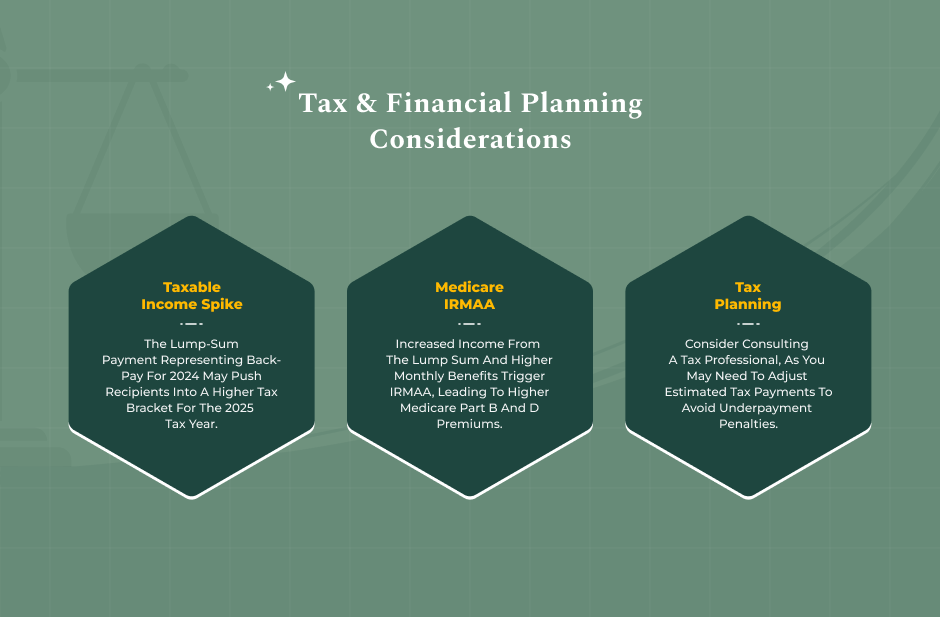
Receiving a rather substantial amount as a Social Security WEP GPO retroactive payment – sometimes more than $20,000 – comes with certain financial headaches.
It’s not just about paying more in taxes. Since Social Security counts this as income for the year you get it, your eligibility for other programs can suddenly change.
The IRMAA And Medicare Premiums
The real surprise for a lot of people is the IRMAA, or Income-Related Monthly Adjustment Amount. Medicare Part B and D premiums go up in steps, based on your Modified Adjusted Gross Income (MAGI).
If you get a big back payment, your income for that year might jump into a higher bracket. When that happens, your Medicare premiums can also increase rather drastically – sometimes a lot. However, you won’t feel it right away.
The Social Security Administration looks at your tax return from two years ago to decide if you get hit with an IRMAA surcharge. So, a sudden windfall now can mean higher monthly premiums down the road.
Taxability Of Benefits
If your combined income goes over certain limits – $25,000 for individuals, $32,000 for couples – up to 85% of your Social Security benefits become taxable.
A $20,000 back payment can easily push you past those thresholds. That means you could owe taxes on a bigger chunk of your benefits for the 2026 tax year.
Medicaid And Asset-Based Eligibility
Finally, there’s another hurdle that most low-income retirees face, and that is mainly related to Medicaid eligibility.
A large deposit can affect Medicaid or Supplemental Security Income (SSI) eligibility. Most states have tight limits on how much you can have in assets.
Usually, the Social Security Administration gives you about nine months to spend down the extra money before it counts against those limits.
However, if you don’t plan ahead, you might lose crucial health coverage, at least for a while.
What To Do If Your Social Security WEP GPO Retroactive Payments Go Missing?
If your Social Security WEP GPO retroactive payment still hasn’t shown up by the end of March 2026 – or if the amount you received is way off from what you expected – do not panic.
Here are a few things that you need to do:
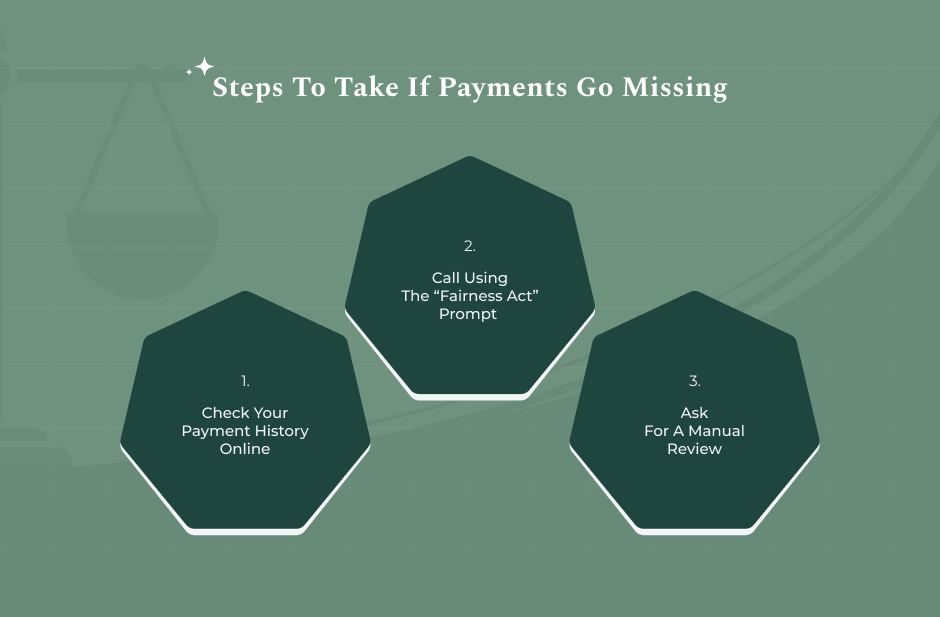
Step 1: Check Your Payment History Online
First, log in to your my Social Security account. Head over to the “Payments” section and look for anything labeled “One-Time Payment.”
Sometimes, the deposit hits your bank before anything changes in your online status or before the official letter even lands in your mailbox, so don’t skip this step.
Step 2: Call Using The “Fairness Act” Prompt
If you don’t see the payment listed, call the SSA National Toll-Free line at 1-800-772-1213 (TTY 1-800-325-0778).
When the automated system asks why you’re calling, just say “Fairness Act.” This sends you straight to someone trained to handle WEP/GPO retroactive issues, thanks to special task forces set up for these cases.
Step 3: Ask For A Manual Review
Finally, if none of the above has worked out, ask the representative for Form SSA-795 (Statement of Claimant).
Additionally, you must explicitly state that you are requesting a “manual recalculation of benefits due to the WEP/GPO repeal effective January 2024.”
This matters a lot, especially if you have a foreign pension or a mix of government and non-government service – details that automated systems sometimes miss.
One last thing: don’t wait past April 30, 2026, to report a missing payment. Waiting longer can make it harder to recover interest or fix tax withholding issues. So, move quickly if something’s off.