Non cognizable offences provide a significant limitation on the powers of the police force within many nations, such as the USA, UK, and India.
Within the USA, such cases are considered non-jailable offences under the Fourth Amendment, which restricts searches without a warrant.
In India, non cognizable offences are specifically mentioned in Section 2(l) of the CrPC (Code of Criminal Procedure) Act (presently Section 2(o) of the BNSS).
Similarly, within the UK, common law considers non cognizable offences to be ‘non-arrestable’ summary offenses.
At present, in the year 2026, international courts have begun to examine the relevance of such outdated laws with regard to petty cyber defamation.
One of the current cases involving such issues concerns the determination of whether Section 66 of the IT Act constitutes a non cognizable offence. The case commenced in late 2025 and is presently under hearing at a high court.
In this article, we will elaborate on the following.
- The non cognizable offence meaning under Indian and International statutes.
- The procedural difference between cognizable and non cognizable offence.
- Specific Acts like the CrPC (India) and the US State Penal Codes.
- Detailed accounts of celebrities charged with these minor crimes.
The Legal Definition Across Different Borders
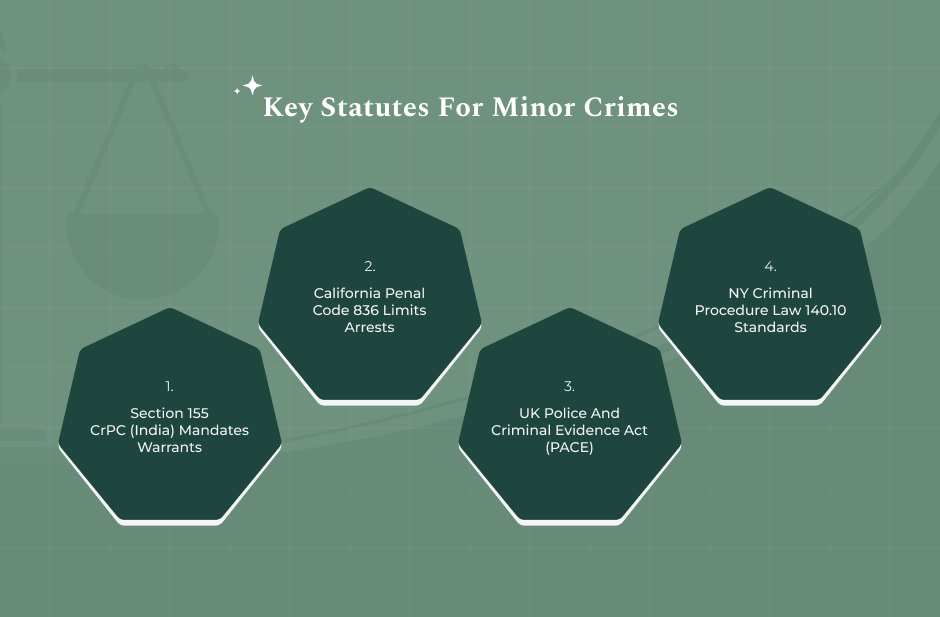
Definition of Non Cognizable Offence remains the same. It is a type of criminal offense, in which an arrest can only be made after an order of the court. However, the different Acts involved in enforcing this law are dependent on which nation we are talking about.
Non Cognizable Offence Definition India
In India, according to Section 155 of CrPC, information has to be recorded in the non-cognizable register, called the NCR. Further, police cannot conduct inquiries and make arrests without the orders from a magistrate.
It is a typical non cognizable offence definition in the subcontinent. The main objective is not to put individuals in jail just because of a petty property dispute or insult.
Non Cognizable Offence Definition Examples Worldwide
Non cognizable offences include those that include simple assault, which does not involve any injury, or Section 504 in India. Class C misdemeanor in the US covers petty offenses such as theft, public swearing, etc.
Such types of non cognizable offences definition help maintain the balance between the crime and the punishment.
Procedural Difference Between Cognizable And Non Cognizable Offence
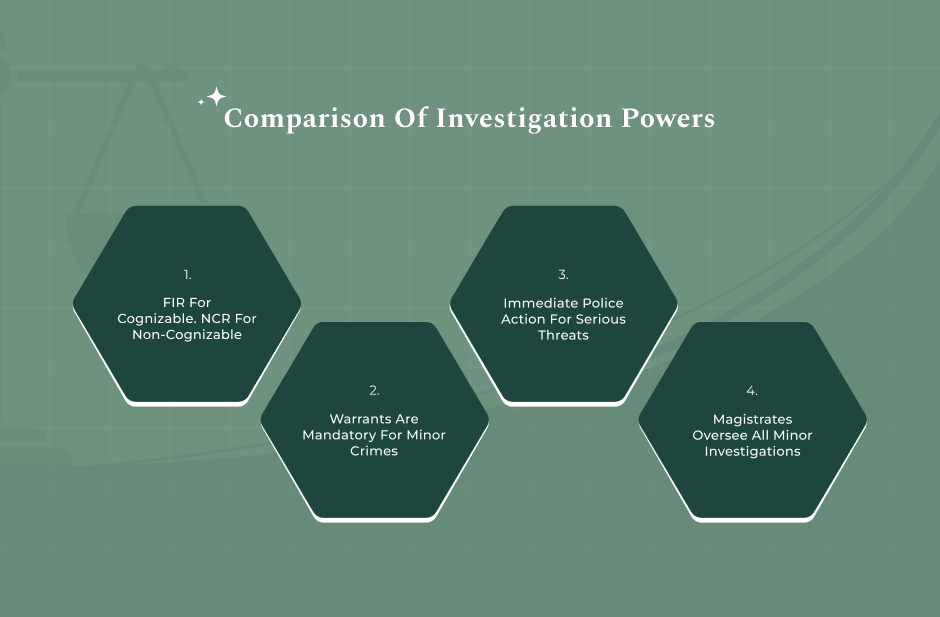
The distinction between cognizable and non-cognizable offenses is in the degree of judicial interference. Although the procedure provided in section 154 of the CrPC permits filing of an FIR against grave offenses, the latter only permits an NCR registration.
Cognizable And Non Cognizable Offence Power Limits
While comparing cognizable and non cognizable offense, the “In-Presence” rule applies in the USA. According to most state laws, including Article 14.01 of Texas Code of Criminal Procedure, the arresting authority may only arrest a person for a minor offense if it occurs before their eyes.
Otherwise, it amounts to non cognizable offense that requires them to obtain a warrant. This ensures that there are no unnecessary “he-said/she-said” arrests over minor disagreements.
Why Section 155 CrPC Is Critical
According to Section 155(2) of the CrPC, all investigations conducted without a magistrate’s authorization are unlawful. It is a major distinction between cognizable and non cognizable offense processes.
If you were arrested without regard for this provision, your case will be thrown away entirely. This provision safeguards individuals from harassment by local officers over insignificant offenses.
Celebrity Instances Of A Non Cognizable Offence
Celebrities frequently appear in the headlines due to non cognizable offence allegations. Although such events gain huge clout through social media, there will be a penalty imposed on the person since such offences are non-violent and minor.
Justin Timberlake – Public Intoxication (2024)
The singer was charged with public intoxication in New York, which involved elements of a non cognizable offence in 2024. Since the charges were misdemeanor charges, he did not remain in high-security prison cells.
His attorneys contended that his stop did not have probable cause in accordance with NY Vehicle and Traffic Law 1192. After the media frenzy subsided, the singer only got a fine and a license suspension.
Cardi B – Misdemeanor Assault (2022)
In 2022, Cardi B pleaded guilty to two misdemeanor charges that stemmed from a fight outside the strip club where she performed. Such offenses qualify as non cognizable offense examples as they involve third-degree assault.
There is also huge clout surrounding the event since it is the “look back” to the events of 2018. She received 15 days of community service thanks to her clean record.
Shah Rukh Khan – The Wankhede Dispute (2012)
The Indian superstar was part of a fight in the stadium, which was reported as a non cognizable offence as per Sections 504 and 506 of the IPC.
The case trended for several months, which had its effect on his reputation. According to his attorneys, he was just trying to protect kids.
Finally, the police registered a case of No Offence, since no crime took place.
Naomi Campbell – Disruptive Behavior (2008)
The supermodel was detained at Heathrow for some misconduct on a plane. As per UK Public Order Act 1986, this was also a non-cognizable offense. It helped gain considerable global prestige owing to her status.
This case involved a lot of emphasis on the stress level of the individual. She was ordered to do 200 hours of unpaid work and pay a hefty amount as a fine to the officers.
Read Also: Signs Your Case Will Be Dismissed: Red Flags And Solutions
Frequently Asked Questions (FAQs):
The world of a non cognizable offence consists of many Acts. This set of questions provides solutions to the legal problems arising from minor crimes in the year 2026.
Just like the CrPC, the new BNSS follows the same principle. Police would require a warrant for minor offences under Section 174 BNSS.
Yes, if the police discover evidence that could indicate a greater crime, such as a weapon, during their investigation, then there could be an amendment in charges.
Yes, as the criminal record will follow your case regardless of the nature of the crime. The lawyer will help resolve the issue in court without having to go through a trial.