Today’s topic: Is voting a civic duty?
Whether voting is a duty remains a very important question among Americans since they are preparing themselves for the next midterm election in 2026.
Even though the United States Constitution recognizes that every citizen has the right to exercise his or her vote, the law draws a line when determining if voting is a choice or a duty.
Currently, several states have begun reviewing the proposed changes to the Freedom to Vote Act.
In this article, we will elaborate on the following:
- The constitutional foundation of the right to vote in America.
- The legal distinction between civic duties and voluntary rights.
- Federal and state legislation governing election participation.
- Major case laws that define the limits of government compulsion.
- The global perspective on compulsory versus voluntary voting systems.
Is Voting A Civic Duty: The Constitutional Framework Of American Elections

Although there is no constitutional mandate that obligates voters to cast their votes, there are several provisions which bar the government from disenfranchising an individual voter based on certain grounds.
Evolution Of Voting Rights Amendments
Is voting a civic duty? Several amendments have made changes to expand the franchise over the years.
These amendments took America closer to universal suffrage by removing restrictions based on race, gender, and poll taxes (FairVote 2026).
A Liberty To Exercise As One Chooses
Voting has usually been considered as a “fundamental liberty” protected under the Equal Protection Clause of the Fourteenth Amendment. Since voting is a fundamental right, the government cannot penalize a citizen for deciding not to vote in an election.
State Sovereignty In Voting Matters
While it is the states’ job to regulate the process of election through time, place, and manner rules, they should conform to the national standards defined by the Voting Rights Act of 1965.
Legal Definitions Of Duty Versus Responsibility
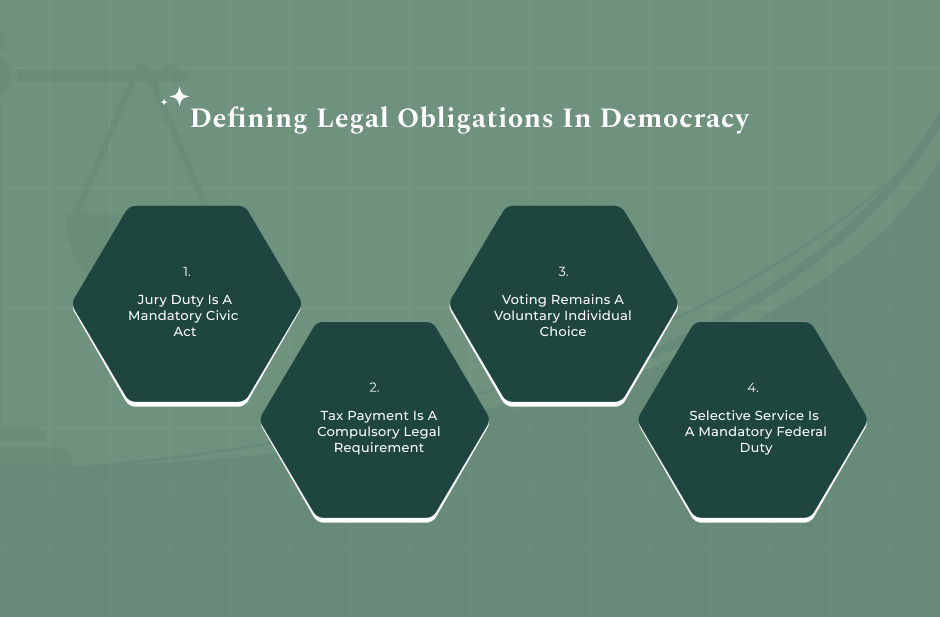
Legal scholars frequently discuss whether is voting a civic duty or responsibility when considering the well-being of a democracy. Legally speaking, the use of “duty” usually means “a mandate,” whereas “responsibility” refers to “a social expectation.”
Compulsory Participation And The First Amendment
A law compelling citizens to cast ballots could violate the First Amendment. Some jurists believe that for “is voting a civic duty” to be a matter of freedom, it must stay voluntary to ensure “freedom of silence” (Source: Stanford Sustainability 2026).
Mandatory Participation Versus Voluntary Participation
Most Americans see voting as a civic duty based on morals rather than law. This cultural attitude backs up the concept that voting should be a voluntary act rather than a requirement.
The Social Contract Theory
According to the social contract theory, citizens must participate to keep the government functional.
While this provides a compelling moral argument for participating, it does not necessarily establish an automatic civic duty in the United States.
Case Law And The Compulsory Voting Debate
In the history of the country, the Supreme Court has made several rulings related to political participation. These court decisions provide insights into answering is voting a civic duty from a legal perspective.
Harper V. Virginia State Board of Elections (1966)
According to Harper v. Virginia State Board of Elections, 383 U.S. 663 (1966), the use of the poll tax was declared unconstitutional. The decision indicates that the economic standing of a person has nothing to do with his or her ability to engage in the voting process.
Prohibition Of Imposing Obstacles
As stated above, the basic right to vote cannot be subjected to any difficulties due to financial burdens. Moreover, the right to vote should be supported and facilitated by the government instead of being considered as a civic duty that can be taxed.
Kusper V. Pontikes (1973)
The issue discussed here involves the protection of the right to freedom of association. It supports the citizens’ ability to freely decide upon joining any political party that they want to support. It indirectly promotes the freedom not to engage in the voting process.
Is Voting A Civic Duty – Federal And State Legislation For 2026
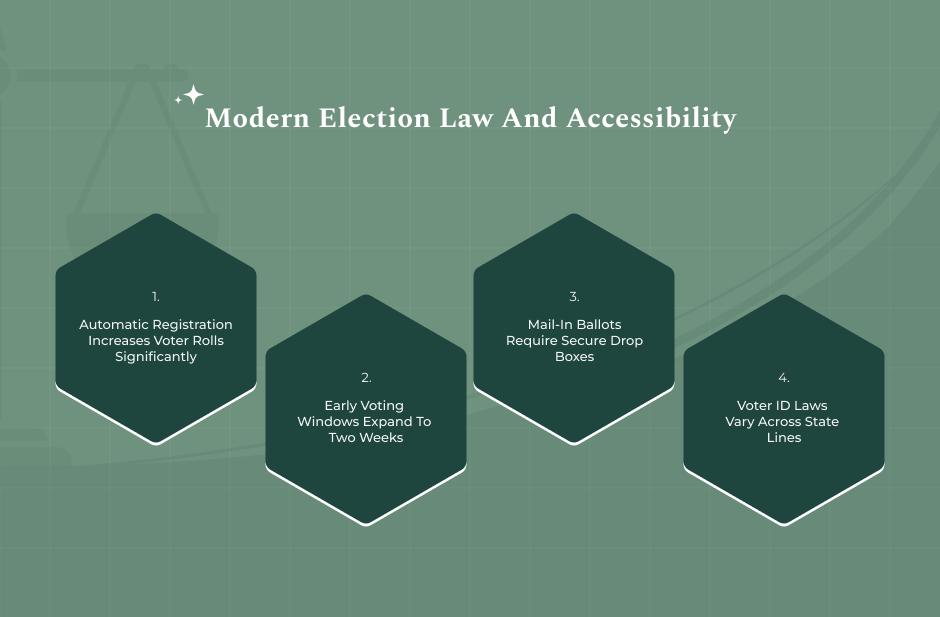
The legislative changes proposed in 2026 revolve around enhancing the voting process. These legislative changes focus on the logistics of voting, which includes making the voting procedure easy.
Freedom To Vote Act Changes
The new provisions made in the federal law will set the standards that will ensure that the elections can be accessed by every citizen. While emphasizing that voting is not mandatory, the legislation seeks to eliminate any barriers to voting by citizens.
Voting Obligations At The State Level
There are no states that mandate voting. However, there are states that have tax incentives for individuals who vote. This is an example of a nudge policy that aims to increase voter turnout without mandating that voters vote.
Implications of Registration Acts
In 2025 and 2026, automatic voter registration (AVR) became popular. AVR occurs when voters are registered at the DMV, and hence the implication that is voting a civic duty.
The Legal Evolution Of “Is Voting A Civic Duty”

Whether it is considered a civic duty to vote in America is tied to the historical context to the development of franchise eligibility from a restrictive privilege based on property to an almost universal right of citizenship since 1776.
The Historical Example Of Mandatory Voting
Even though the modern system of elections in America is built on voluntary participation in voting, its concept of participation as a compulsory duty is related to the period of colonial rule when several colonies, such as Virginia and Georgia, introduced fines for not attending polling stations in order to provide stable governance (Source: Flagler Elections 2026).
Mandated Participation In Colonial Period And Early States’ History
For centuries, colonial mandates for attendance at the polling station were viewed similarly to public services such as maintaining roads and participation in the militia.
They were subsequently abolished because of increasing recognition of the concept of individual liberty and freedom to express dissent by not voting.
Proposing Mandatory Civic Duty To Vote In 2026
In the present-day context, the discussion about civic duty to participate in voting is linked to attempts by legal scholars to solve issues with low turnouts by making it obligatory to take part in voting (Source: Bipartisan Policy Center 2026).
Current 2026 Legislation: The SAVE America Act
With regards to is voting a civic duty, the current main concern in terms of legislation centers on the documentation of the citizen’s right to vote. The Safeguard American Voter Eligibility (SAVE) Act has now made it compulsory to prove citizenship.
Verification Of Citizenship For Voting
The SAVE Act makes it clear that participation in voting is mandatory, but only for those who qualify and are citizens. Under the law, applicants have to submit their passports, birth certificates, or citizenship certificates before registration (NCSL 2026).
Effects On Vulnerable Voters Demographics
The critics have pointed out that these requirements tend to pose difficulties for qualified citizens who may not have these documents easily available. They maintain that although is voting a civic duty, it should be the responsibility of the state to prove the eligibility of its voters.
The Importance Of The REAL ID Act
Until May 2025, the REAL ID requirements became fully effective for travelers within America. In 2026, a majority of the states are utilizing “gold star” cards for the purpose of verifying the citizenship of new voters.
Though the US Constitution guarantees voting as an unalienable right, there is no mention of voting as a “responsibility.” No fines apply for abstaining from the polls.
If you choose not to vote, you might miss the chance to vote on bonds and school issues that impact your tax obligations.
In countries such as Australia, voters participate in “Compulsory Voting,” which requires individuals to go to the polls and pay a minor fee if they fail to do so.
Turnout remains above 90% in these nations. The NVRA prevents removal from the rolls based on lack of participation.
Still, failure to return a notification asking whether you have changed residences will render your registration inactive.
Is Voting A Civic Duty – FAQs:
It is vital to understand your rights as a citizen. Here are some questions related to the legality of voting in 2026.
Voting is not a civic responsibility in the United States that would require you to pay a fine if you miss an election.
The imposition of mandatory voting would necessitate a constitutional amendment or a First Amendment challenge.
Duty is something that you’re obligated to do, whereas right is something that you’re entitled to do.
Not all permanent residents are citizens, and therefore, they may not vote in any federal election. Some cities might have a different stance on allowing citizens to vote in the election for the school board.
Yes, most states use the voter registration list as the main way of calling out citizens for jury duty.
According to the Uniformed and Overseas Citizens Absentee Voting Act, voting remains the right of all Americans overseas, provided that they want to.