The 7 lamps of advocacy are the ethical and professional pillars on which the legal profession is founded.
Originally propounded by Judge Edward Abbott Parry in his 1923 book, these lamps continue to guide the legal fraternity in the challenging legal environment of 2026.
Presently, the legal fraternity is witnessing a number of important events that challenge these ancient values.
The Supreme Court of India’s decision in Rapolu Bhaskar v. State Bar Council (Case No. 123/2026) of January 2026 is where the court held that the “standard of ethical values is higher for lawyers than for the general public.” (Source: The Hindu).
In addition, with the increasing use of AI-generated legal briefs, the “Lamp of Honesty” is being closely scrutinized in state bar ethics opinions (Opinion 701, 2025/2026). This is to ensure that attorneys are held accountable for the truth of their pleadings. (Source: The Law for Lawyers Today)
In this article, we will discuss the following:
- The origin and contemporary relevance of the seven different lamps.
- A detailed analysis of each lamp and how it can be applied in a courtroom setting.
- The relevance of contemporary legal capabilities to the traditional ethical norms.
- Tips and strategies for law students and young lawyers to develop their careers.
What Is Advocacy In Law?
Advocacy is not merely an argument; it is the skill of representing a client’s cause through effective communication and extensive knowledge of the law. It fills the gap between the technical language of the law and the need for justice.
The Role Of An Advocate
An advocate is a legal officer who is tasked with the responsibility of ensuring that the judge reaches a fair and just decision.
This is achieved through the preparation of proper documents, cross-examinations, and oral arguments within the boundaries of the law.
The Role Of Ethical Advocacy
Ethics are very important in ensuring that the competition in the courtroom is fair and that the people have confidence in the judicial system.
Without ethics, the legal profession will no longer be a noble profession but a mere business of technicalities.
Origin And Meaning Of The 7 Lamps Of Advocacy
The book “The Seven Lamps of Advocacy” was written by Judge Edward Abbott Parry to identify the qualities of a good barrister.
He said that an advocate is like a “priest in the temple of justice,” and these lamps are the qualities that keep the temple clean.
Historical Background
The book was written by Parry at a time when the legal profession was strictly oral and traditional.
However, his use of the word “lamps” is pure genius because qualities such as honesty and courage are timeless and will not be diminished even as we enter the digital age of 2026.
Timeless Relevance
Even in this age of cloud-based research software and remote hearings, the human aspect of the 7 lamps of advocacy is still very relevant. A judge in 2026 still needs the integrity of the lawyer as much as a judge in 1923.
The 7 Lamps Of Advocacy Explained In Detail
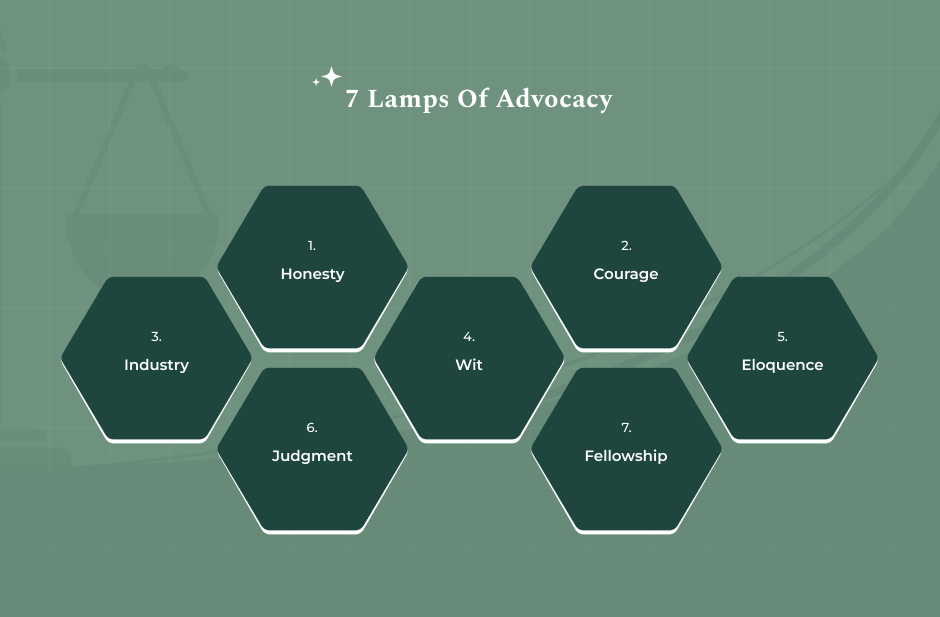
To grasp the full meaning of the legal profession, one must ask: What are the 7 lamps of advocacy? These seven qualities are:
- Honesty
- Courage
- Industry
- Wit
- Eloquence
- Judgment
- Fellowship.
1. The Lamp Of Honesty
Honesty is the greatest of all the 7 lamps of advocacy because an attorney lacking honesty is a menace to the court. You must be truthful with your client about their chances of winning and never deceive a judge about the facts of a case.
2. The Lamp Of Courage
Courage enables an attorney to defend an unpopular client or oppose a strong adversary without fear.
In the recent Lake Pleasant Bodies Case (revisited in 2025 ethics seminars), courage required the attorney to preserve the attorney-client privilege even when faced with enormous public pressure (CEB).
3. The Lamp Of Industry
Industry is simply hard work and preparation; law is a “jealous mistress” that demands endless study. An advocate must be familiar with his or her “brief” or case file as an actor is with his lines, so that nothing is left to chance.
4. The Lamp Of Wit
Wit is the gift of quick thinking and the use of humor or intelligence to relieve a tense courtroom situation. It is the “presence of mind” that enables an advocate to think on his feet when a witness makes an unexpected statement or a judge asks a tricky question.
5. The Lamp Of Eloquence
Eloquence is the art of persuasive speaking, but it does not involve using big words or being theatrical. The true eloquence of the 7 lamps of advocacy is the skill of explaining a difficult legal proposition so simply that it seems to be the only obvious answer.
6. The Lamp Of Judgment
Judgment is the intellectual ability to discern the correct strategy for a case. It is the process of determining which witnesses to call, which evidence to highlight, and when it becomes more advantageous to settle a case out of court rather than taking it to trial.
7. The Lamp Of Fellowship
Fellowship is the ability to ensure that although attorneys are adversaries in the courtroom, they are still professional colleagues in the real world. This is why attorneys refer to each other as “learned friend.”
Types Of Advocacy Skills And Standards

Honesty in the courtroom establishes a reputation of trustworthiness, making judges more receptive to the lawyer’s arguments in the future.
Courage is necessary when a lawyer has to stand up against prejudice, while industry ensures that the lawyer is well-versed in all the Supreme Court precedents.
Eloquence then helps the lawyer to construct a narrative out of facts and laws that would win the case.
Modern Relevance Of The 7 Lamps In Today’s Legal Practice
Though Parry’s work is for a different time and place, the 7 lamps of advocacy are absolutely relevant in today’s 2026 new age of cyber law and international arbitration.
For instance, take the case of social media addiction in Los Angeles, where lawyers have to apply the “Lamp of Industry” to understand the algorithms. (Source: Lion Law)
Corporate Law And Arbitration
In private negotiations, the “Lamp of Fellowship” plays a crucial role in achieving a mutually beneficial agreement.
Even in the absence of a judge, the “7 Lamps of Advocacy” ensure that the negotiation process does not turn into a battle.
Cyber Law And AI Ethics
With the help of AI systems in creating legal content, the “Lamp of Honesty” turns into a cyber shield.
In 2026, lawyers need to check every citation produced by AI systems to avoid the presentation of “hallucinated” or false case laws to the judges.
Step-By-Step Process To Develop Advocacy Skills

Young lawyers can begin by participating in moot court competitions to develop the “Lamp of Eloquence” in a safe environment
Watching senior lawyers in action can help one understand the “Lamp of Wit” and how to respond to interruptions by a judge.
Preparing different kinds of notices can help develop the “Lamp of Industry,” while keeping up with ethics cases can ensure that the “Lamp of Honesty” is always burning bright.
Cost, Time, And Legal Considerations
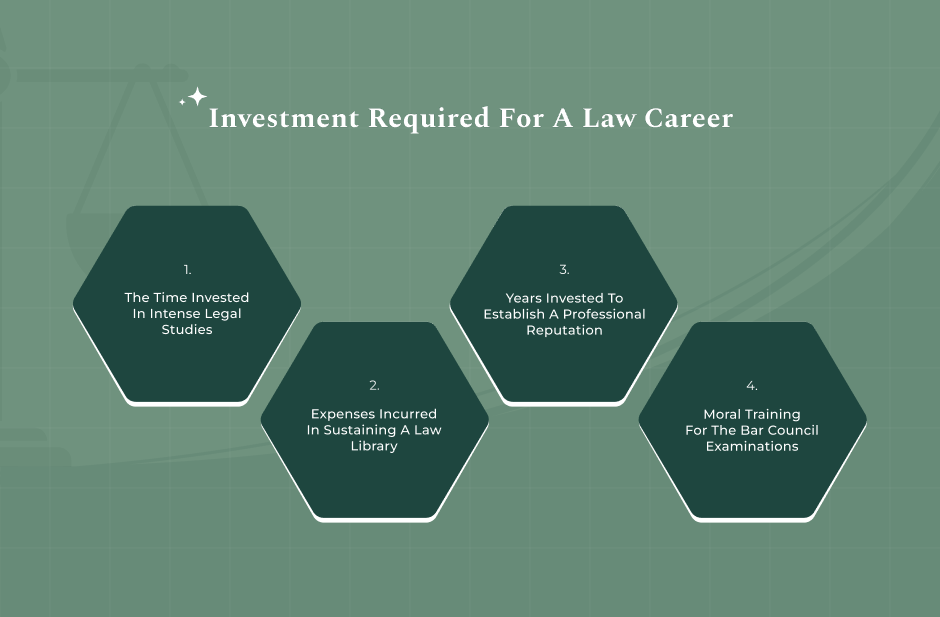
Investing a career in the 7 lamps of advocacy requires years of hard work and substantial financial outlay in education.
The reputation of a lawyer, established through the “Lamp of Honesty,” is his most precious possession but requires decades to achieve perfection.
Continuous legal education (CLE) has become mandatory in 2026 to ensure that the “Lamp of Industry” remains lit.
Key Case Laws On Advocacy Ethics
The 7 lamps of advocacy are often cited in disciplinary actions against an attorney who has defaulted in their obligations. The disciplinary action serves as a reminder to the legal community that the 7 lamps of advocacy are not just suggestions but are obligatory.
Vinay Chandra Mishra (1995 AIR 2348, Supreme Court of India)
This case brought out the significance of the “Lamp of Fellowship” and the significance of showing respect for the judiciary, as the attorney was punished for showing disregard for the judiciary.
V.C. Rangadurai V. D. Gopalan (1979 Air 281, Supreme Court Of India)
This historic case highlighted the importance of the “Lamp of Honesty” and the attorney’s fiduciary duty to the client.
Bar Council Of Maharashtra V. M.V. Dabholkar (1976 Air 242, Supreme Court Of India)
The court held that the legal profession is a “public service” and not a “commercial competition.”
The 7 lamps of advocacy are a classic guide for anyone who wishes to be more than just a legal technician.
By being proficient in honesty, courage, industry, wit, eloquence, judgment, and fellowship, an attorney can truly be called a defender of justice.
In today’s world of rapidly advancing technology, these human values are the greatest assets that any advocate can possess.
Frequently Asked Questions (FAQs):
The 7 lamps of advocacy are the guiding principles for all legal practitioners across the world. Awareness about these tenets can help both the client and the lawyer understand what to expect in a legal journey.
Yes, there is an “eighth lamp.” Justice K.V. Krishnaswamy Aiyar has famously proposed the “Lamp of Tact,” which is the capacity to deal with delicate situations with tact and diplomacy without offending others.
The “Lamp of Wit” talks about one’s “presence of mind.” In the year 2026, where trials are fast-paced, it assists a lawyer in rapidly changing their approach when a digital evidence file is unexpectedly disputed.
Although the 7 lamps of advocacy are a philosophical approach, most of these lamps are incorporated into the Bar Council rules. For instance, not passing the “Lamp of Honesty” by lying to a client or the “Lamp of Judgment” due to gross negligence results in charges of professional misconduct and permanent disbarment (Jus Corpus).