Reckless endangerment provides an effective approach that helps to bring on trial those persons who take part in risky actions but do not cause any harm. In the US, it is classified as a crime that lies between negligence and assault in the legal system.
Reckless endangerment can be defined as personal injury that is based on bringing indictments against someone who totally disregards the value of human life.
Unlike its title, the crime of reckless endangerment is not limited only to driving-related situations. It can be committed in case one is negligent about his or her gun safety and discharges it in public areas.
The most recent instances of reckless endangerment (as of April 2026) are cases related to accidents caused by self-driving cars and work-related accidents.
It is possible to make a conclusion that the presence of intent in reckless endangerment is not necessary.
In this article, we will elaborate on the following:
- The legal definition and core elements of the charge.
- Federal versus state jurisdictional applications.
- The distinction between misdemeanor and felony classifications.
- Recent case law and significant current lawsuits.
The Legal Foundation Of Reckless Conduct Elements
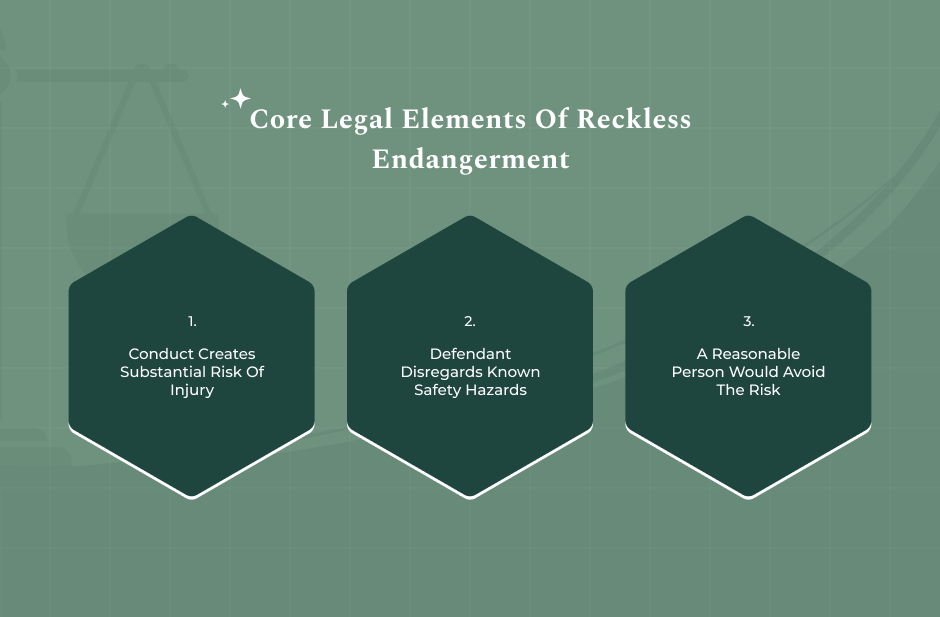
In establishing the existence of a substantial risk of inflicting bodily harm to other individuals, the prosecution must demonstrate that the defendant engaged in conduct that poses a great chance of causing bodily harm.
In determining whether the danger was evident, the court considers what an ordinary individual would perceive the danger to be.
The “Substantial Risk” Element
The “substantial risk” element is a crucial component in most reckless endangerment offenses. The risk must be imminent and apparent rather than hypothetical or imaginary.
Running a red light constitutes substantial risk, but running in excess speed in the absence of other vehicles does not constitute substantial risk.
Determining Serious Physical Injury Thresholds
Physical injury is that kind of injury that leads to one’s life being in danger. In such cases, there will be a risk of death, or there will be either disfigurement or dysfunction of the body organs involved. (Source: Legal Information Institute)
Intent vs. Depraved Indifference
What makes the concept of reckless endangerment quite appealing is that the law does not care about your intentions.
It is irrelevant whether or not you actually meant to cause harm to anyone. What matters is your “depraved indifference” regarding what happens to people around you.
Therefore, shooting from a gun in the air is considered a criminal offense even though you did not intend to injure anyone.
The Reasonable Person Standard Test
It is not unusual for jurors to apply the so-called reasonable person standard test to determine guilt. They need to figure out if a normal and careful citizen would act the same way in similar situations.
The Federal And State Legal Framework Of Reckless Conduct

Reckless endangerment entails laws that vary in each country and even state. Although states usually govern most cases, federal laws govern certain regions, such as national parks or airplanes.
Federal Law And Maritime Law
The federal government handles reckless endangerment in particular industries instead of a general law. Federal laws protect individuals in the skies, seas, and federal jurisdictions like military installations.
Interference With Aircraft Operations In 49 U.S.C. § 46308
The federal law punishes those who obstruct flight crews or endanger a flight crew’s safety. Therefore, any threat to a plane is a severe crime. Any ordinary citizen will face strict federal imprisonment in this situation.
Vessel Recklessness In 46 U.S.C. § 2302
The federal maritime law deals with the negligent or reckless operation of a boat. The purpose is to prevent sailors from jeopardizing passengers’ or other vessels’ lives. In such cases, huge fines and federal arrest may occur.
Penal Codes Of States And Municipalities
States have the most prevalent definitions of reckless endangerment. They mostly define the crime according to levels of endangerment, depending on the amount of danger the perpetrator creates.
New York Penal Law § 120.20 And § 120.25
This is Section 120.20, which deals with second-degree misdemeanor offenses involving creating a substantial risk.
Section 120.25 elevates this offense into a felony when the person acts with “depraved indifference” to human life.
As citizens, we are made aware that one poor decision can create an everlasting criminal history.
Tennessee Code § 39-13-103 And Weapon Enhancements
This law describes the offense in terms of reckless conduct causing imminent danger to another person. If you commit this act using a deadly weapon, it becomes a Class E felony offense.
Landmark Case Law And Current Litigation News
Court decisions frequently change our perception of what constitutes reckless endangerment. For instance, in the case People v. Chrysler from New York, the court assessed the “great risk of death.”
These rulings have established that this threat needs to be “imminent” for a felony charge. At present, in 2026, legal cases revolve around new technologies.
Safety Protocols – Doe V. Roblox Corporation
“In December 2025, the Judicial Panel on Multidistrict Litigation (JPML) transferred various suits against Roblox from other districts to the Northern District of California.
These cases revolve around the claim that Roblox lacked proper safeguards for children while seeking to expand its business.” (Source – US Courts.gov)
The latest development on one of the lawsuits has been the Roblox Settlement of $10 Million. You can check out our previous blog on the topic.
Industrial Mishap – People v. O’Neil, s. 1-85-1853 (1985)
These executives were convicted for reckless endangerment for subjecting their workers to cyanide gas exposure without any form of protection.
It was quite an important ruling since it categorized industrial negligence as reckless endangerment and involuntary manslaughter, but not a civil wrong.
Weapon Discharge – State V. Deskins (1990)
In this case, it was ruled that there had been reckless endangerment where the defendant fired his gun towards the sky while celebrating. The falling bullets posed danger to any person in the nearby neighborhood.
The Evolution Of Depraved Indifference
Notably, the term “depraved indifference” has evolved. Originally, courts mandated a unique “wicked” mental state.
Nowadays, all fifty states assess the objective risks posed by an act rather than an accused’s mental state. The trend favors prosecuting defendants whose conduct lacks premeditation.
Vehicle As A Weapon Precedents
Recent court decisions have established the principle that a car qualifies as a deadly weapon. Recklessly swerving towards pedestrians constitutes a prevalent predicate felony for a reckless endangerment accusation.
Notably, these precedents relate to road rage incidents and attempts to evade arrest.
Challenges To Factual Impossibility Defenses
“Factual impossibility” denotes a criminal act that does not endanger anyone because the situation is impossible. For instance, firing a gun into a vacant apartment.
Recently, courts have been limiting factual impossibility defenses in favor of prioritizing public safety.
Frequently Asked Questions (FAQs):
Issues regarding rights and accusations can occur among citizens. After learning about what reckless endangerment means, one would know how his or her safety could be endangered by the legal institutions.
Yes, it is possible since, according to the criminal law, the accusation does not depend on the effect but rather on the danger itself.
If it was possible to inflict serious injuries on a person and create a situation where a significant danger existed, then the case is considered to be fulfilled. Therefore, it allows police officers to terminate the case and avoid fatal consequences or damage to any individual.
In the first place, the absence of a threat or unawareness of the defendant could be mentioned. The other strategy is to mention factual impossibility if there were no witnesses in the vicinity.
This equipment enables the recording of what happens on the ground, including the actions of the suspect and his/her surroundings. This allows one to show how risky the situation was with regard to the number of onlookers around.