Most of us never actually think about contract law until a situation takes a turn for the worse – contract disputes rarely start with lawyers. Most start with somebody changing their story.
A client who seemed happy with the work suddenly refuses to pay. A business partner remembers a conversation very differently six months later. Or a contractor walks away from a job and insists the original agreement was something else entirely.
That’s usually the moment people start digging through old emails, invoices, text messages, and meeting notes.
The popular belief is that a contract requires extensive paperwork. Plenty of people picture signatures, stamps, and pages of legal language.
But honestly, real life isn’t always that tidy.
Some agreements fail despite having formal documents attached. Others survive scrutiny with surprisingly little paperwork.
What matters is whether the arrangement meets the legal requirements for enforceability when a dispute eventually lands in court.
And on that note, we will break down what exactly makes a contract valid and focus on all the essential elements of any legally enforceable agreements.
Stay tuned.
Quick Note: Contract law changes depending on where you live - not just by country, but often by state or province. The concepts we are covering here are general legal principles and should never be used as a substitute for professional legal advice tailored to your specific situation.
The Short Answer: What Makes A Contract Valid?
In the vast majority of legal systems, a contract is recognized as valid only when a handful of core elements are present simultaneously.
Generally speaking, you need:
- A clear, unambiguous offer.
- An unconditional acceptance of that specific offer.
- Consideration (which is just a legal term for exchanging something of value).
- Mental and legal capacity to actually agree to the terms.
- A lawful purpose (you can’t contract for something illegal).
- Genuine, voluntary consent free from trickery or pressure.
What Is A Valid Contract? (Or What Makes A Contract Valid?)
Stripped to its absolute core, a contract is simply a promise that the legal system is willing to enforce.
That sounds incredibly simple on paper, but the reality is a bit more meticulous.
Before a court decides to enforce an agreement, judges will typically run through a specific checklist of questions:
- Did someone actually make a concrete offer?
- Did the other party unequivocally accept it?
- Were both individuals legally permitted to enter into this deal?
- Did both sides trade something of value?
- Was the underlying goal of the agreement lawful?
- Did everyone truly agree to the exact same terms?
A judge will only declare the agreement enforceable after checking off every single one of those boxes.
Take a close look at what isn’t on that list. Rather, notice that there is no blanket rule saying every single contract must be written down on paper.
Frankly, there is no universal requirement stating you need a notary stamp, and you don’t automatically need a high-priced lawyer to draft the document for it to count.
While those extra steps definitely make a deal easier to prove and significantly stronger in a fight, they are not the raw ingredients that make a contract valid in the first place.
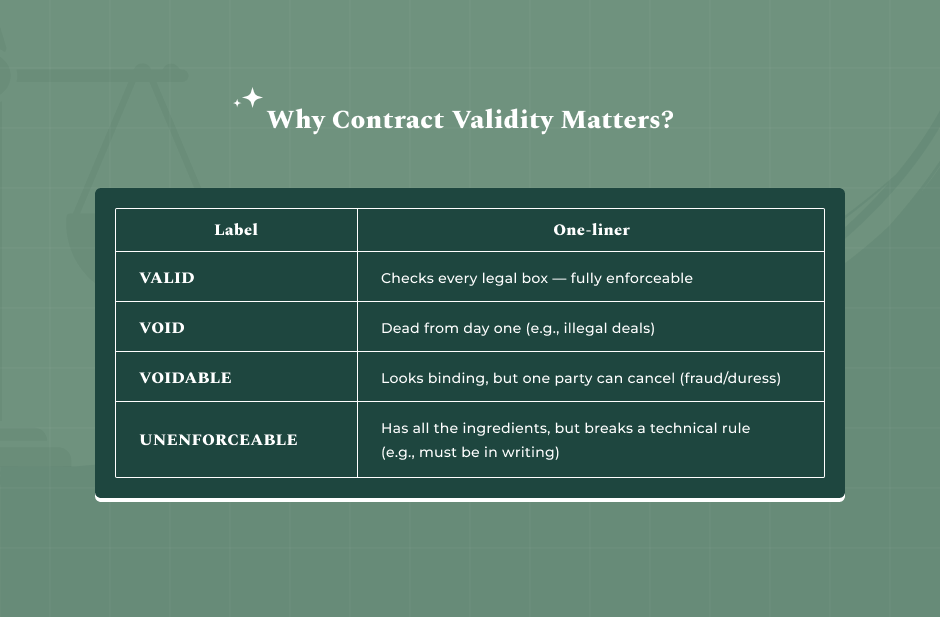
Why Contract Validity Matters?
It is incredibly easy to brush off contracts as boring administrative paperwork. But in the real world, they dictate exactly who holds the cards when a relationship fractures.
Not Every Problematic Contract Is Invalid:
People frequently toss around words like ‘invalid,’ ‘void,’ and ‘unenforceable’ as if they were interchangeable. They aren't. Understanding how lawyers differentiate these terms makes contract law significantly easier to navigate.
1. A Valid Contract:
This agreement successfully checks every legal box required for full enforcement.
So, if one party breaks their word, the other party can use the legal system to seek remedies or financial damages.
2. A Void Contract:
A void contract has zero legal power from the moment it is created.
Honestly, it is dead on arrival. For instance, if you draft a beautiful contract to buy or sell something that’s totally illegal, a court will ignore it.
The law refuses to recognize it as a contract at all.
3. A Voidable Contract:
This one is a bit trickier. A voidable contract looks perfectly fine on the surface and is initially binding, but one party retains the legal loophole to kill the deal.
This usually happens if someone is tricked into signing or forced to do so under extreme pressure.
Until that injured party steps up and exercises their right to cancel, the contract technically remains in effect.
4. An Unenforceable Contract:
An unenforceable contract might have all the core ingredients of a great agreement, but a specific legal technicality prevents a court from enforcing it.
For example, certain laws require that specific deals be in writing. So, let’s assume something like selling a house must be in writing.
If you try to do it by verbal agreement, the contract might be technically valid, but a judge won’t enforce it because you skipped the mandatory written form.
Knowing exactly which bucket an agreement falls into changes everything, because the legal fallout for each scenario is entirely different.
Why So Many People Misunderstand Contract Law?
We can largely blame Hollywood for the persistent myths surrounding contract law.
Movies and television shows love to imply that contracts only happen in mahogany boardrooms with thick stacks of paper and fountain-pen signatures on every page.
But everyday life is a lot messier.
Modern business is conducted on the move. Freelancers routinely map out entire projects over a quick Zoom call.
Also, business owners hammer out pricing structures via casual email threads. Landlords and tenants negotiate building repairs over text messages.
The Essential Elements Of Valid Contract:
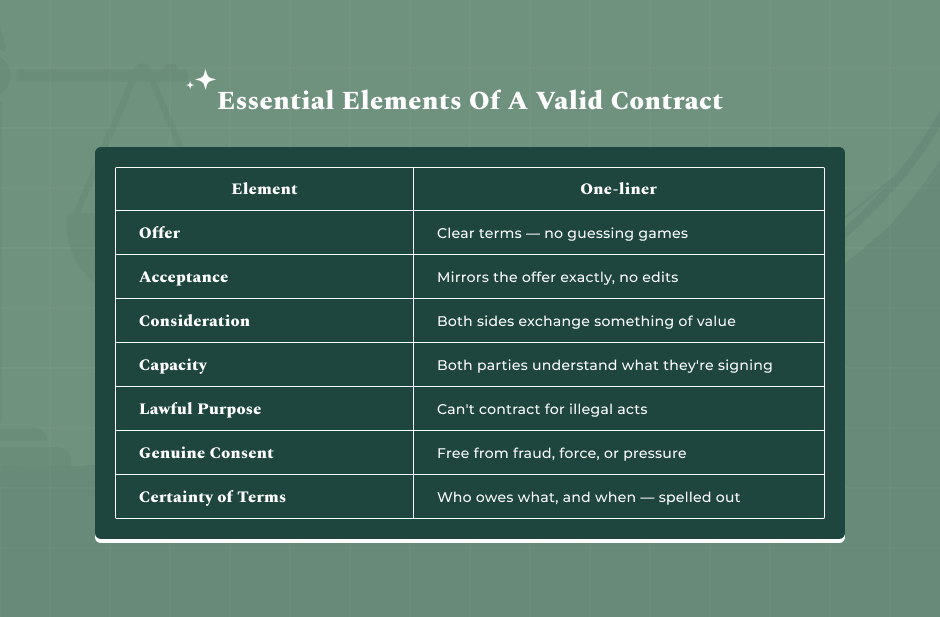
Every single enforceable agreement on the planet relies on a few fundamental pillars. So, if you leave out just one, the whole structure can collapse under pressure.
Fortunately, these concepts are highly intuitive when you strip away the legal fluff. Let’s break them down in plain English.
1. Offer:
Every deal starts with a proposal. One party steps up and lays out specific terms, giving the other party the choice to say yes or walk away.
A valid contract requires an offer that leaves no room for games of guessing. It needs to clearly state what is being traded, who is involved, and what everyone is expected to bring to the table.
Example:
A freelance designer sends a quick email to a local business owner: “I will design a brand-new custom logo for your company for $800. This price covers three rounds of design tweaks, and I’ll turn over the final files within two weeks.”
That is a rock-solid offer. The scope, price, and timeline are completely clear.
The Myth:
People often mistake advertisements for actual offers.
In reality, a store flyer or an online ad is usually just an “invitation to treat,” meaning it’s an invitation for you to come in and make an offer to buy.
2. Acceptance:
An offer is basically just a one-way street until the other side actually jumps on board.
To make it a real contract, the acceptance has to perfectly mirror the offer – no strings attached, no sneaky edits.
So, if you tweak the terms even a tiny bit before saying yes, you haven’t accepted a thing. You’ve actually just killed the original proposal and thrown a brand-new counteroffer onto the table.
The Reality:
Think about a homeowner who tells a painter, “I’ll give you $6,000 to do the outside of my house.”
If the painter says, “Lock it in, I’m down,” that’s a clean, textbook acceptance. But if that painter fires back with, “Sure, but it’s gonna run you $7,500,” the $6,000 offer is instantly dead.
The ball bounces right back to the homeowner to either accept or reject that new price tag.
The Catch:
Silence doesn’t mean a thing in contract law. You can’t just shoot someone a message saying, “Hey, if I don’t hear back from you by Friday, I’m assuming we have a deal.”
The legal system doesn’t let you trap people into obligations just because they ignored your email.
3. Consideration:
Consideration is the engine that drives contract law. In simple terms, it means both sides must bring something of value to the sandbox.
It doesn’t have to be cold, hard cash; it can be physical goods, professional services, property, or even a formal promise to refrain from doing something you have a right to do.
Also, the court does not care if you made a smart financial deal. On the other hand, it only cares that a mutual exchange actually happened.
Example:
A consultant agrees to optimize a company’s workflow, and the client agrees to pay them $2,000 for the strategy.
Both sides are giving up something of value to get something else. That is textbook consideration.
The Myth:
People often assume that the value exchanged must be exactly equal. It doesn’t.
So, if you willingly agree to sell a rare car for a fraction of its value, a court isn’t going to step in and save you from a bad negotiation just because the trade was uneven.
4. Capacity:
The law protects people from being taken advantage of by ensuring everyone entering a contract actually understands what they are doing.
So, if an individual lacks legal capacity, they generally cannot form an agreement that a court will enforce.
Capacity issues typically crop up around:
- Minors (individuals under the legal age of majority).
- Anyone suffering from severe mental impairments.
- Individuals who are too intoxicated to comprehend the nature of the deal.
The exact boundaries for these rules vary significantly depending on local legislation.
Example:
A 16-year-old signs a multi-year commercial lease for a retail storefront without an adult co-signer.
Depending on local state or country laws, that teenager can likely walk away from the deal Scott-free because they lacked the legal capacity to bind themselves to that long-term debt.
The Myth:
Age isn’t the only metric here. Capacity focuses entirely on whether a person had the cognitive ability to truly understand the obligations they were taking on at the exact moment they agreed to them.
5. A Lawful Purpose:
The legal system is not a tool for criminals. If the core purpose of your agreement is to break the law, the contract is completely invalid.
Courts will immediately wash their hands of any deal that requires illegal behavior.
Example:
Two individuals sign a meticulously detailed, typed agreement regarding the distribution of prohibited substances.
It doesn’t matter whether they had it notarized or signed it in blood. In the same vein, the underlying act is illegal, meaning the document is completely worthless in the eyes of the law.
The Myth:
Many people think a signature magically sanitizes an agreement. It doesn’t. No amount of formal paperwork can turn an illegal act into an enforceable obligation.
6. Genuine Consent:
A deal has to be totally voluntary. Period.
If you only sign something because you were lied to, blackmailed, or cornered by intense psychological pressure, the law doesn’t count that as real agreement.
So, it’s pretty simple: a contract isn’t valid if you were held at gunpoint.
The Reality:
Let’s say a guy slaps fresh drywall over a massive, crumbling foundation crack right before selling his commercial property.
The buyer signs the paperwork completely blind to the disaster hiding behind the paint.
Because that active cover-up directly tricked the buyer into making the deal, they have massive leverage to challenge the whole contract in court.
The Catch:
Don’t confuse basic sales hype with real fraud.
The legal system draws a sharp line between an enthusiastic salesperson exaggerating a product’s vibe (“puffery”) and deliberate, malicious lying about major facts.
7. Certainty of Terms
You can’t have a contract if nobody actually knows what they’re supposed to do. The agreement must explicitly layout who is delivering what, when it’s due, and exactly how much it costs.
If you leave the core terms blurry or up in the air, a judge won’t enforce it. Mostly because they won’t even know what they are supposed to enforce.
The Reality:
Picture a signed business deal that casually drops a line like: “We’ll handle the consulting invoices at a later date.” Think about that. Does “later” mean next Tuesday?
Three years from now? Only after the company hits a specific revenue goal? Leaving things that vague is basically an open invitation for a brutal, expensive lawsuit.
The Catch:
This doesn’t mean you have to draft a 300-page document that covers every single freak scenario in the universe.
It just means the core mechanics of the deal need to be clear enough that an outside observer can read it and instantly understand what both sides owe each other.
Written vs. Verbal Contracts: The Reality
One of the most stubborn legal myths on the planet is that an agreement must be in writing to count as a contract.
That is flat-out wrong. Verbal agreements are perfectly valid and legally binding at all times. The real issue with verbal contracts isn’t their legality. To clarify, it is the nightmare of trying to prove them.
If a major disagreement explodes six months down the line, a verbal contract turns into a frustrating game of “he-said, she-said” in front of a judge.
Trying to prove exactly what was said over a coffee meeting is infinitely harder than just pointing to a signed piece of paper. That is exactly why written contracts are the gold standard for any serious transaction.
They remove the guesswork and leave a concrete paper trail.
Furthermore, almost every jurisdiction has specific laws (often called the Statute of Frauds). Again, the laws need certain high-stakes contracts to be in writing to be enforceable.
These almost always include real estate sales, long-term leases lasting more than a year, and agreements that physically cannot be completed within a 12-month window.
The Big Takeaway: Never assume that an exchange of emails, Slack messages, or texts can't bind you to a deal. If those messages clearly show an offer, an acceptance, and defined terms, you might find yourself locked into a completely valid contract without ever having signed a formal document.
Why A Contract Can Still Be Unenforceable?
By this point, you know the core ingredients needed to build a valid contract. You might think that once you tick those boxes, your agreement is completely bulletproof.
Unfortunately, contract law isn’t always that clean. Courts evaluate the entire situation surrounding a deal, not just the text on the page.
Even a beautifully formatted document can completely fall apart if it collides with other legal roadblocks.
Here are the most common reasons a seemingly perfect contract fails in the real world:
- The Core Purpose Violates Public Policy: If an agreement encourages conduct that is fundamentally harmful to society or violates specific statutory regulations, a judge will refuse to enforce it. Even if the paperwork is flawless.
- Deliberate Concealment or Fraud: Contracts require honest dealings. If a seller pulls a fast one and intentionally distorts a critical piece of information to secure a signature, the deceived party can usually get a court to void the deal entirely.
- Coercion and Duress: A contract must be a product of free will. If someone signs an agreement simply because they were threatened with financial ruin, physical harm, or reputational damage, the absence of genuine, uncoerced consent renders the agreement vulnerable to legal challenge.
- Fatal Vagueness: Sometimes people are so eager to close a deal that they use soft, non-committal language. Phrases like “we will figure out a reasonable bonus structure later” mean absolutely nothing to a court. If a judge cannot determine the appropriate remedy, they will simply declare the clause unenforceable.
- Ignoring Statutory Formatting: Skipping mandatory legal formalities can instantly kill a deal. If your local laws state that a prenuptial agreement or a land deed must be written, signed, and witnessed in a specific way, skipping those steps makes the contract dead on arrival in court.
A Practical Checklist Before Signing Any Contract
Whether you are signing a quick agreement for a freelance gig or entering a massive corporate partnership, taking five minutes to double-check the details can save you months of litigation.
Before you pick up a pen or digital signature tool, run through this mental checklist:
- Do I fully understand what every single sentence in this document actually means?
- Are the exact payment amounts, milestones, and deadlines written out in clear numbers?
- Does the text clearly define what happens if one party fails to deliver on time?
- Is there a clear exit strategy or termination clause if the relationship sours?
- Have we explicitly included a process for resolving disputes (such as mediation or arbitration) before resorting to court?
- Were any of the verbal promises or assurances we discussed aloud accidentally omitted from this final written version?
- Did both sides get a chance to read the exact same final draft before signing?
So, if you hesitate or feel unsure about even a couple of these questions, stop typing and ask for clarification.
A slightly awkward conversation today is always better than a devastating legal battle tomorrow.