The discharge of contract is the legal process through which the parties entering into the contract are relieved from their obligations.
It means that the contract agreement is not binding on the parties, and the legal relationship is terminated. Discharge of contract meaning is, therefore, important to all business individuals, employees, and consumers.
In the US, the laws that control the agreement are governed by the Uniform Commercial Code (UCC) and the common law.
Today, the legal cases being raised in the industries are related to the discharge of contract, especially because of the changes that have taken place in the economy. For example, the legal cases being raised in 2025 and 2026 are related to “force majeure” clauses, and the corporations are seeking this on the grounds of “impossibility of performance.”
The judicial system is also starting to lay down new precedents regarding the legitimacy of high inflation and labor shortage as a ground for discharge of contract. In this article, we shall discuss the following:
- The formal and current legal definition of discharge of contract.
- The different modes of discharge of contract that are available under US law.
- Federal and state statutes that affect the termination of contracts.
- Landmark case laws and recent legal precedents.
Understanding The Legal Basis Of Discharge Of Contract
The Basic Concept Of Contractual Discharge
- Performance: Both parties fulfill all agreed duties to end the contract.
- Agreement: Both sides mutually agree to cancel or change the contract.
- Frustration: Unforeseen events make it impossible or illegal to finish performance.
- Breach: One party fails to perform, allowing the other to exit.
Discharge of contract implies that “the life” of the contract has come to a logical conclusion. It ensures that no party bears an undue burden of performance after a set of conditions is met.
Definition Of The Discharge Of Contract Meaning
From a legal point of view, it happens when the main reason for the contract is satisfied or excused. Most contracts terminate upon simple performance; however, conflicts occur when there is partial or interrupted performance.
Triggers Leading To The Discharge Of Contract
There are various factors leading to the discharge of the contract. These factors include the completion of tasks, a mutual decision to terminate, or an external factor making it impossible to complete the contract.
These factors have rules based on the Restatement (Second) of Contracts.
Exploring The Various Modes Of Discharge Of Contract
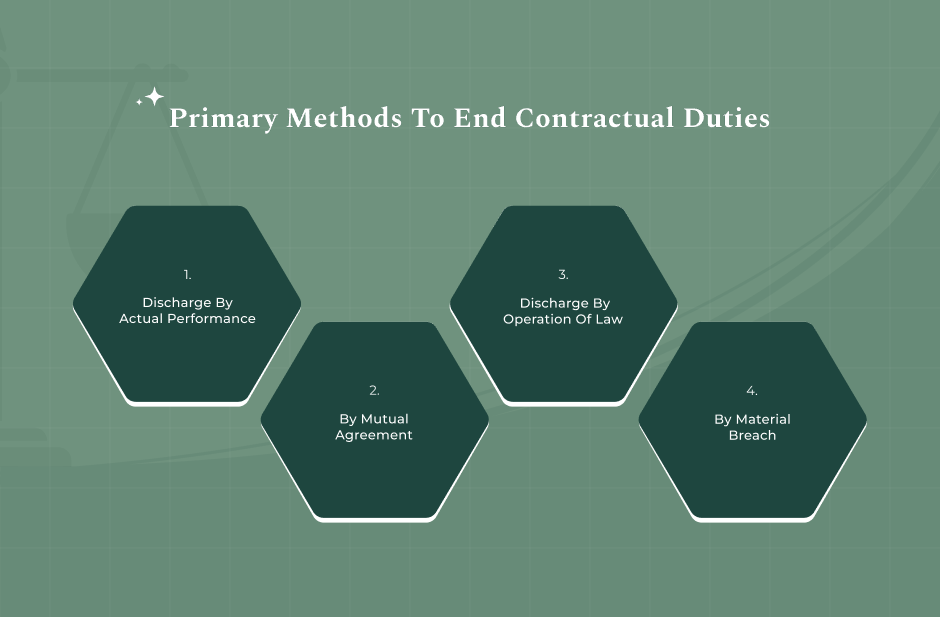
There are various modes of discharge of contract, which the US legal system recognizes. Each mode has its own set of requirements and provides different levels of protection to all parties.
A. Discharge By Full Performance
This is the most common mode of discharge of a contract. In this mode, all parties perform all the tasks they agreed to perform. Once the payment is made and the service is rendered, it is considered a discharge of the contract.
B. Discharge By Mutual Agreement And Novation
It is possible for parties to agree to discharge a contract through a new agreement. In this mode of discharge of contract, all parties must agree to discharge the contract for it to be legally binding.
C. Discharge By Impossibility Or Frustration
Sometimes, an unexpected event occurs, and no one can foresee it. If a house catches fire before it is sold, it is considered a discharge of contract due to “impossibility.” “Frustration of purpose” occurs when the main reason for entering into a contract no longer exists.
D. Discharge By Lapse Of Time
The law specifies how long it can take for rights to be enforced, called a statute of limitations. If a party takes too long to claim performance, discharge occurs by lapse of time.
Federal And State Laws Relating To Contractual Discharge
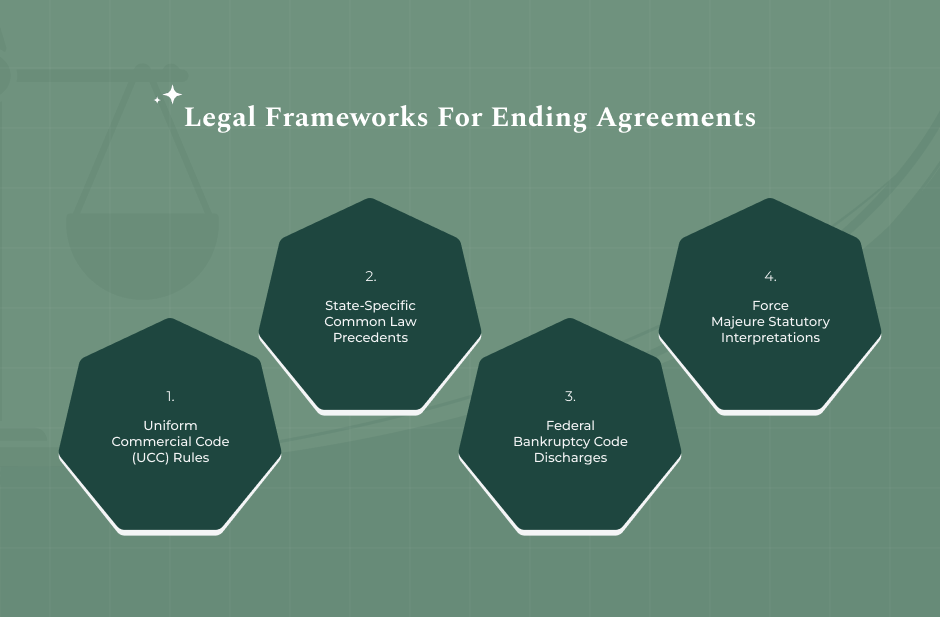
The discharge of contract in the USA is governed primarily at the state level. However, in some cases, federal laws apply.
The Uniform Commercial Code
The Uniform Commercial Code is the governing principle for the sale of goods that involves the crossing of state boundaries. There are specific provisions for the discharge of a contract when the goods supplied were “non-conforming.”
If the goods supplied did not correspond to the description, the buyer is entitled to the discharge of the contract and damages. (Source: ucclaw.org)
State Common Law And Equity
Each state has its own common law history with regard to the discharge of contract. California courts might interpret the term “impracticability” differently from New York courts.
The courts will also consider what is “good faith” in arriving at a decision with regard to the discharge of a contract.
Bankruptcy As Federal Discharge
In cases of bankruptcy, the federal courts have the power to grant a discharge of contract for almost any debt. This is an important principle of federal law that overrides state contract law to provide the debtor with a fresh start.
Employment At Will Statutes
In most states in America, an employee is “at will,” meaning that the discharge of an employee’s contract is valid at any time.
Landmark Case Laws On Discharge Of Contract
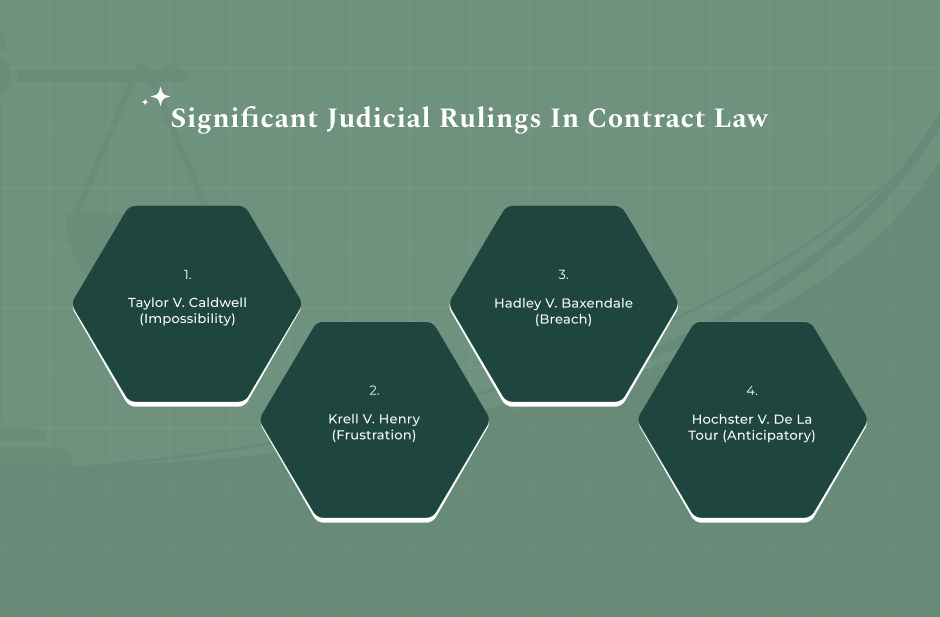
Past cases are used to determine the validity of a discharge of contract. They set the standard of care and the level of excuse.
The Doctrine Of Impossibility- Taylor v. Caldwell
This ancient case established the principle of the impossibility of contract and the discharge of contract. This principle states that when the object of a contract is destroyed, the contract is automatically discharged.
Anticipatory Breach And Immediate Discharge
In the case of Hochster v. De La Tour, the court established the principle of anticipatory breach of contract and the discharge of contract.
This principle states that when a party to a contract states they are not going to perform the contract in the future, the other party is entitled to an immediate discharge of contract.
You don’t have to wait until the deadline to sue the other party and claim damages. (Source: Justia)
Frequently Asked Questions (FAQs):
Knowing what is discharge of contract requires understanding the rights of the citizen when things go wrong. This section provides answers to the common questions of the citizen regarding the discharge of the contract.
Yes, if the contract involves personal skills, such as a famous artist painting a portrait, then if the artist dies, the contract will be discharged.
While some contracts can be discharged through a verbal agreement, under the “Statute of Frauds,” there needs to be a written document for a discharge of contract, especially in real estate or high-priced goods.
Termination happens under certain clauses or breaches, while this is a general term that encompasses all obligations.
Read Also: