Remedies for breach of contract are the safety net that is necessary for any individual or business that enters into a contract.
In the rapidly changing legal environment of 2026, it is more important than ever to understand these rights and how they are changing, particularly with the increasing use of smart contracts.
There are several lawsuits currently taking place that are determining how contracts will be interpreted, including Gateway Development Commission v. Federal Government, Case No. 26-101C, U.S. Court of Federal Claims, 2026. In this, more than $1 billion of infrastructure funding is at issue due to political freezes (Source: NJ.gov).
According to HIPAA Journal, litigation illustrates how “breach of third-party beneficiary contract” is being used to bring justice to millions of data breach victims.
(Source: Conduent Business Services Data Breach Litigation, Case No. 2:25-cv-01234, D.N.J., 2025)
In this article, we will elaborate on the following:
- The definition of a contract breach and why legal recourse is necessary.
- A detailed breakdown of monetary and equitable solutions available to you.
- The specific “five remedies” are most commonly recognized by modern courts.
- Practical steps for citizens to take when an agreement falls through.
Understanding The Remedies For Breach Of Contract
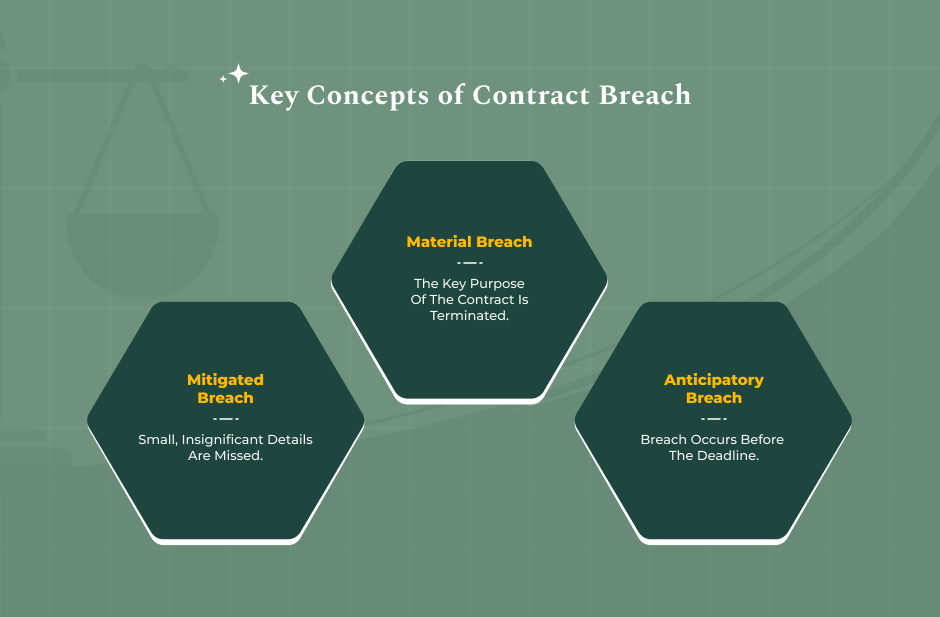
A breach occurs when one of the parties fails to honor their obligations under a contract without a valid legal reason. This can include failure to perform on time, failure to perform, or failure to perform to the required standards.
Remedies For Breach Of Contract: The Most Common Monetary Damages
When people inquire about the remedies for breach of contract, they always think of money first. Monetary damages are the most common remedies that courts use to repair a broken contract by shifting the financial burden back to the party that caused the problem.
Consequential And Incidental Damages
Consequential damages are indirect damages that were foreseeable at the time of signing the contract. A factory shutdown due to the late delivery of parts may result in lost profits, which can be claimed as consequential damages.
Liquidated Damages Clauses
In contemporary business contracts, the “liquidated damages” clause is often employed. This clause provides that a fixed amount of money is payable in the event of a breach of contract. This is an inexpensive method of resolving a dispute because you do not have to prove the amount of your damages.
What Are The Five Remedies For Breach Of Contract?
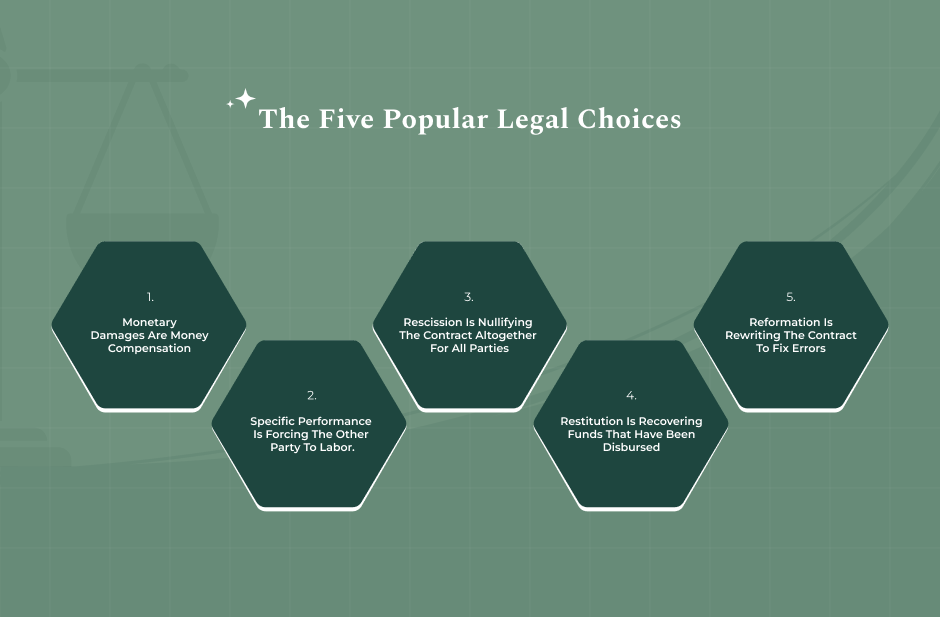
Attorneys often simplify the most popular remedies by listing them in five categories. Knowing what the five remedies for breach of contract are will help you decide which option to take when your business partner or service provider disappoints you.
Specific Performance – Doing the Work
Specific performance is a special remedy that is needed when money alone is not sufficient to cure the problem.
This is often the case in real estate transactions or when the contract is for a one-of-a-kind item such as an original painting or a rare antique.
Rescission And Restitution
Rescission is a remedy that permits the aggrieved party to disregard the contract as if it never existed.
Restitution is then used to require the party in breach to return any money or property received so that all parties are returned to the original point of departure.
Equitable Remedies For Breach Of Contract Beyond Money
There are times when a check in the mail is not the answer to the problem, especially in intellectual property or non-compete contracts. In these situations, equitable remedies for breach of contract are used to ensure fairness.
Legal Injunctions
An injunction is a court order that tells a person to refrain from an action. In one well-known case involving non-compete clauses, an injunction may be issued to prevent a former employee from working for a competitor while a lawsuit is pending.
Quantum Meruit
This is a Latin expression that is translated to “as much as he deserved.” This is applied when a contract is not completed.
The court will make sure that the individual receives payment for the work they have done before the breach of contract occurred (FindLaw).
Landmark Cases Shaping Modern Remedies For Breach Of Contract
The history of contract law is founded on landmark cases that have set the standards that are applied today. These cases have determined the amount of money that can be won in a lawsuit. (Source: Hadley v. Baxendale, 9 Exch 341, Court of Exchequer, 1854)
This classic case established that you can only recover damages that were “reasonably foreseeable” by both parties when the contract was made. (Source: Carlill v. Carbolic Smoke Ball Co., [1893] 1 QB 256, Court of Appeal)
This case proved that a clear, public offer can create a binding contract, entitling the victim to a remedy if the promise is broken.(Source: Balfour v. Balfour, [1919] 2 KB 243, Court of Appeal)
This taught us that social or domestic agreements between family members are often not legally binding unless there is a clear intent to be bound by law.
Read Also: What Are The Valid Reasons To Get Out Of A Subpoena?
Special Cases In Contract Law
Not all contracts are the same, and not all solutions are the same either. Contracts involving the government or international sales have special rules, such as the Uniform Commercial Code (UCC) or the Convention on Contracts for the International Sale of Goods (CISG).
- Sales of Goods: In UCC contracts, buyers have a right to “cover” by purchasing substitute goods and suing for the price difference.
- Government Contracts: Suing the government usually involves strict time limits and special administrative procedures. which is why many vendors now rely on AI for government contracting to stay compliant before disputes arise.
- Real Estate: Since land is always considered unique, specific performance is always the preferred remedy for a house sale that went sour.
Professional Advice On How To Handle A Breach
If you think a breach has happened, you need to take action right away to protect yourself. If you wait too long, it may appear as though you have “waived” your rights to the breach and are simply accepting the poor performance. Let’s learn about the steps that can help you get proper remedies for breach of Contract.
1. Record Everything
Save all emails, texts, and invoices about the project.
2. Mitigate Your Damages
You have a legal obligation to attempt to limit your damages.
3. Send A Notice Of Breach
In many contracts, you must give the other side a “notice of breach” before you can sue them.
4. Look For Arbitration
Check your contract to see if you have to go to arbitration rather than court.
Frequently Asked Questions (FAQs):
When individuals look for remedies for breach of contract, they may have very particular concerns about their own legal exposure. Below are answers to some of the most common questions that U.S. citizens may have in their everyday legal disputes.
No, generally. Punitive damages are intended to punish an individual, but contract law is only intended to compensate the plaintiff.
Unless the breach of contract also constitutes a separate crime, such as fraud or a tort, such as battery, you can only recover the actual value of your loss (Cornell Law School).
Duty to mitigate refers to your obligation to act in good faith to limit the financial loss resulting from the other party’s breach. If a tenant breaks a lease early, for instance, the landlord is obligated to find another tenant instead of simply leaving the property vacant and suing the tenant for the entire year’s rent.
This is sometimes referred to as “mutual breach.” In such a situation, the court will determine which party breached the contract first. In most cases, when both parties are at fault, the court may rule that neither of them is entitled to compensation.