Specific performance of contract is a strong legal remedy that compels a defendant to perform their specific promises instead of merely paying a fine.
In the present legal scenario of 2026, this remedy has changed from being a “discretionary choice” of the judge to a “mandatory right” of the victim, thanks to the historic 2018 amendments to the Specific Relief Act.
There are also some landmark cases being presently tested on these lines, such as KS Manjunath v. Moorasavirappa, Case No. 13507-13508 of 2025, Supreme Court of India, which recently clarified the contracts that are “determinable” or easily cancellable (Source: Bar and Bench).
Another important timeline is the 2025 judgment in Annamalai v. Saraswathi, Civil Appeal No. 2025 INSC 1267, Supreme Court of India, in which the court held that plaintiffs must show their “readiness and willingness” throughout the trial period.
In this article, we will discuss the following:
- The general definition and purpose of specific performance in modern law.
- The important 2018 legal amendment that altered the court’s treatment of such suits.
- A comparison between this remedy and general monetary damages.
- The process and costs of filing a suit for performance.
What Is Specific Performance Of Contract?
Specific performance is an equitable remedy where the court passes an order to perform a specific act, usually what the party agreed to do in a contract. This is the best way to ensure justice is served when the object of a contract is unique, like a piece of land or an antique.
Legal Definition
This remedy is guaranteed by the Specific Relief Act, 1963. This ensures that the actual terms of the contract are met. This remedy also prevents a rich party from simply “buying their way out” of an agreement by paying a small fee.
Why Courts Use This Remedy
Courts will step in when money cannot fix the damage that has been caused by a breach of contract. For instance, if you buy a specific 100-year-old heritage home, getting your deposit back with interest will not help you because there is no other home like yours.
Legal Framework Governing Specific Performance In India
The important legislation for the specific performance of contracts in India is the Specific Relief Act, 1963.
This legislation was completely rewritten in 2018 to make the process more business-friendly and to ensure that the time taken for the case in court is reduced.
Important Provisions
The most important section of this Act is Section 10, as it now states that the court is obligated to perform the contract. The change from “may” to “shall” shows that if you are eligible, the judge is obligated to give you relief.
Effect Of The 2018 Amendment
The amendment has removed the requirement that the plaintiff had to show that money was not a good remedy. The new law assumes that for most contracts, the default remedy will be to perform the work as agreed. (Source: Khaitanco)
Essential Elements For Granting Specific Performance
To succeed in a case for specific performance of a contract, you must establish the following facts in court.
You cannot merely establish that there was a breach. You must establish that you were an honest and prepared party to the contract.
Valid Contract
There must be a valid, written, and signed contract with specific terms.
Certainty Of Terms
The court must be able to determine what each party was to do.
Readiness And Willingness
You must show that you have the money and the willingness to carry out the transaction.
No Substituted Performance
You cannot ask for this from the court if you have already hired another person to do the task.
When Courts Grant Specific Performance
The courts always issue specific performance of a contract in matters of immovable property, such as land, apartments, or office space. As no two lands are alike, every property transaction is considered a “unique” case by law.
Rare Commodities
This includes original artworks, customized machinery, or collectibles.
Infrastructure Projects
The courts are now established to dispose of such cases within 12 months to prevent delays in the progress of the nation.
Sale Of Shares
If the shares are of a private company and are not listed on any stock exchange, the court can compel the sale.
When Specific Performance Is Not Granted
There are, however, a number of instances when a court will not enforce the specific performance of a contract. These are exceptions because some contracts are simply too personal or too complex for a judge to monitor on a daily basis.
Personal Skill
A court cannot order a singer to sing or an artist to paint if they do not want to.
Continuous Supervision
If a contract is such that the judge must monitor it on a daily basis for years, they will most likely not enforce it.
Determinable Contracts
If the contract states that either party can void it at any time, the court will not enforce it to remain in effect.
Vague Agreements
If the agreement is “I will buy some land from you eventually,” a court cannot enforce such a vague agreement.
Types Of Specific Performance Orders
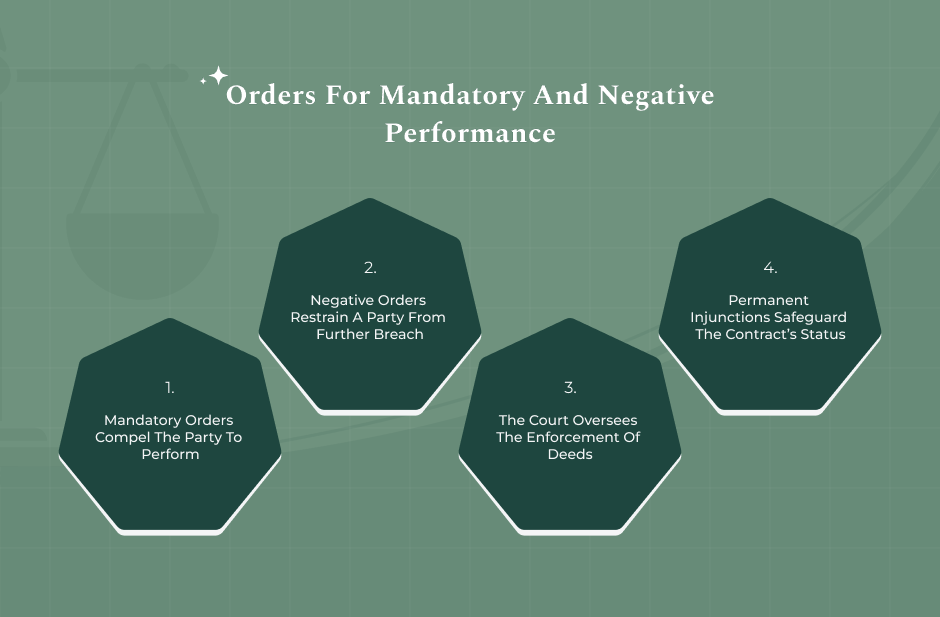
In mandatory orders, the court specifically directs the defendant on what to do, like executing a sale deed. In a negative performance, also known as an injunction, the court prevents the party from violating a promise, like a “no-compete” provision.
Specific Performance Vs Damages
When a person asks what the remedies for breach of contract are, they are typically deciding between money (damages) and action (specific performance). Money is the most popular solution, but it is not always the best.
Specific performance is an equitable remedy, which means it is based on fairness, while damages are a legal right to money. The enforcement of an action takes longer because the court must see that the defendant actually performs the work.
A Comparison
Comparing Monetary Awards And Specific Performance
- Nature: Equitable action versus monetary payment.
- Availability: Unique cases versus general breaches.
- Enforcement: Court supervision versus simple bank transfer.
- Purpose: Actual performance versus financial compensation.
Step-By-Step Process To File A Suit
Filing a suit for specific performance of a contract is a legal procedure that needs to be done with utmost care. If you skip one step, such as not sending a notice, the judge may throw out your entire case.
First, you need to send a notice to the other party giving them a final opportunity to perform. If they fail, you file a “plaint” in the civil court of the region where the property is or where the contract was signed.
You need to take bank statements with you to prove that you actually have the funds to complete the purchase (Source: MyAdvo.in).
Cost, Time, And Legal Considerations
When you are looking to get specific performance of contract, you need to understand that you are in it for the long haul.
The 2018 law, which is the Specific Relief (Amendment) Act of 2018, makes the specific performance of a contract a rule and not just an exception.
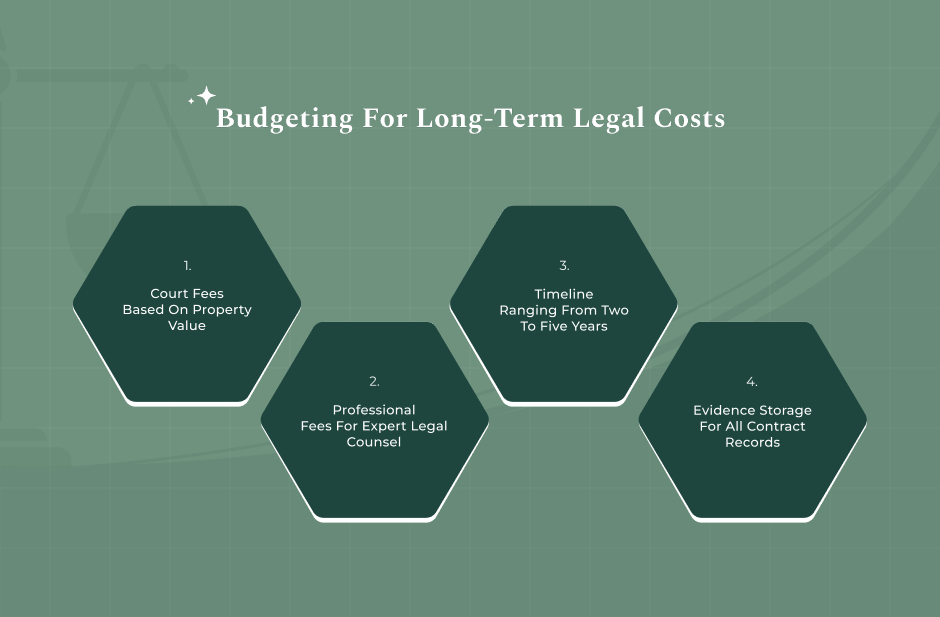
The court charges are usually a percentage of the contract value, and this can be very high for very expensive real estate.
Most cases will take between 12 months (for infrastructure projects) and 5 years to come to a final decision. You have to retain all receipts, emails, and text messages as evidence for the trial.
Practical Real-Life Examples
You are a homebuyer who has paid 20% of the price for an apartment. The builder then decides to sell it to another person for a higher price. You can sue for specific performance of contract to prevent the sale and get your home.
The other example is a supplier who has the patent for a life-saving drug. If they decide not to deliver a shipment that you have already paid for, a court can compel them to deliver the drugs immediately.
Expert Tips & Best Practices
To ensure that you emerge victorious in your contract performance case, you must be the “perfect” party. Any delay on your part can be used by the defendant as evidence that you were not serious about the contract.
Keep Records
You must keep all the WhatsApp messages and emails that show you asked the other party to finish the work.
Financial Proof
You must keep the balance in your bank account or have a “sanction letter” from a bank to show the judge.
Timely Action
The limitation period is 3 years, but you must file your case in months after the breach of contract.
Specific Clauses
When you are drafting a contract, you must include the clause “this agreement shall be specifically enforceable.”
The specific performance of the contract is an essential defense for anyone entering into a life-changing purchase or a big business contract.
The law has finally recognized the worth of a promise by moving away from money damages. If you are involved in a contract breach, you should remember that you have the right to demand exactly what you were promised.
Frequently Asked Questions (FAQs):
Before you go to court, it is essential to know the smaller details of the specific performance of contract. These are the questions that will help you understand how the law applies to common people in the United States of America and India.
Yes, you can. According to Section 21 of the Specific Relief Act, a plaintiff can claim specific performance of a contract and also claim “compensation” for the loss suffered due to the delay.
For instance, if the handing over of a house is delayed by two years, the court may award you the house and also the rent you paid in another house during the delay period (Lawsikho).
If the court finds that your case is not fit for performance, it will normally rely on other remedies for breach of contract. These usually include compensatory damages (money), rescission (voiding the contract), or restitution (return of the deposit).
If a contract goes sour, attorneys will examine what the five remedies for breach of contract are to determine which one is the best fit.
The five remedies are: (1) Money Damages, (2) Specific Performance, (3) Injunctions, (4) Rescission of the contract, and (5) Reformation.