Today, we talk about the types of evidence. The legal arena is completely dependent on the presence of different forms of evidence in order to establish the truth and arrive at justice.
Whether it is a case of a civil lawsuit or a criminal trial, awareness of the types of evidence in trial of a trial is very important. In the present scenario, big lawsuits, including the mass tort suits regarding environmental and privacy law, depend mostly on the different forms of “digital and forensic evidence“.
These types of evidence establish liability in the courtroom. Missing the deadline on “discovery” will mean exclusion from the courtroom as well as case records.
In this article, we will elaborate on the following:
- The fundamental definition of legal proof.
- Distinction between direct and circumstantial proof.
- The role of physical and documentary items.
- Digital footprints in modern litigation.
- Types of Evidence.
- Admissibility rules and witness testimony.
Types Of Evidence: Why Understanding Evidence Matters In Court
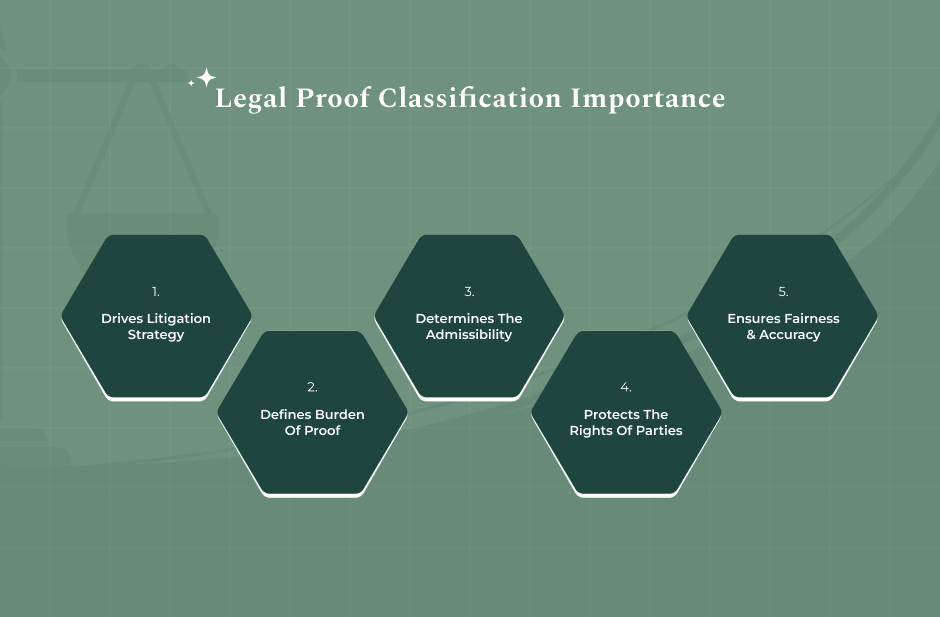
First, proper categorization of types of evidence is essential for any winning legal plan because this helps in determining what the judge will take into consideration.
Various regulations apply to different types of evidence, and misidentifying them can result in a case being dismissed.
Types Of Evidence: Major Classifications: Direct Vs. Circumstantial Proof
Lawyers classify evidence with respect to how it can establish facts into two broad categories. These are evidence that requires laying down an inferential step and evidence that speaks for itself without any need for implication.
Direct Evidence Explained
Directly related evidence is perhaps the most persuasive type of evidence since the evidence directly proves a fact.
For example, evidence such as a video recording showing a suspect perpetrating a crime is direct proof of the crime. The jury does not have to piece the crime together since they can directly see the crime.
Eyewitness Accounts And Videos

Eyewitness testimony is one of the traditional sources of proof in law that comes under the direct category.
When an individual gives testimony in court about something they claim to know, like, “I witnessed the defendant sign the contract,” they offer direct proof to support the claim.
The potential drawbacks to this type of proof lie in the memory and integrity of the testifying party.
Circumstantial Evidence In Law
Types of evidence consist of a very important category. And that is Circumstantial Evidence.
There is a common misconception that circumstantial evidence is weak. However, it is one of the most typical forms of evidence.
This is a kind of fact that, taken individually, leads a judge or jury to a conclusion that a different fact is true.
Understanding Inference And Logic
What, then, are the types of evidence in the legal world that rely on logic? The answer would be perfect with the circumstantial proof.
For instance, if a witness did not see a theft but only the suspect running away with a bag, then that would be the circumstantial proof. This would suggest guilt, even though no one saw the actual crime occur.
Examining Physical And Real Evidence In Types Of Evidence
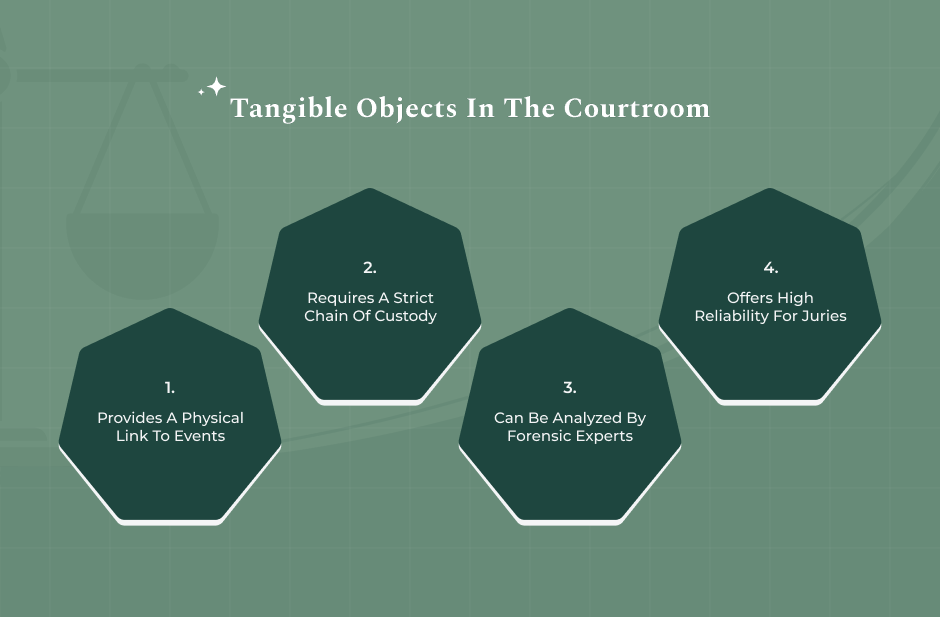
Physical things are commonly labeled as “real evidence” and typically consist of physical forms of evidence discovered at the crime scene.
They are essential as they do not tend to “lie” or “forget,” as human witnesses often do, meaning they could be mistaken.
Forensic And Biological Evidence
Forensic science has altered how types of evidence are perceived in the law field over the past several decades. DNA evidence, blood spatters, and ballistic evidence are various categories of evidence classified under this field of science.
The Function Of DNA And Ballistics
DNA is often labeled the “gold standard” among the kinds of evidence introduced in the modern courtroom.
DNA can locate an individual at a particular spot with a certainty of almost 100%. Ballistics can trace a particular bullet to a particular gun, establishing an irrefutable connection in instances of violence.
Providing A Trial Jury With A Demonstrative
At times, evidence may not even be evidence in kind but rather proof of evidence. This is known as demonstrative evidence. It’s utilized to make complex information easier for jurors to understand.
Maps, Models, And Re-Enactments
A 3D model of a car accident represents an exemplar of demonstrative types of evidence. Although the model itself was not at the scene of the car accident, it represents the testimony of an expert witness. This aids the court in understanding the series of events that took place.
Documentary And Digital Evidence In The Modern Era
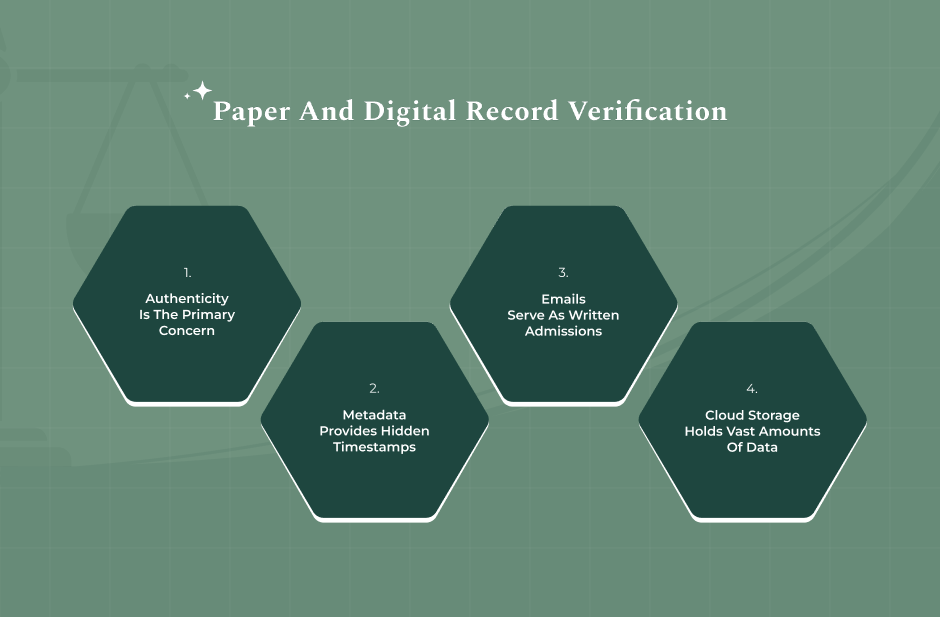
With the increasing online nature of our lives, digital evidence is now one of the most in-demand types of evidence in civil and criminal litigation.
From the email to the social media post, these documents offer a comprehensive history of a person’s thoughts and deeds.
Enhancement Of Digital Evidence
Electronic files are special types of evidence in that they contain “metadata,” which tells us the time of creation of such a file or its alteration. Files with this metadata are much more difficult to falsify than paper evidence.
Social Networking Sites & Text Messages
Social media postings are often found to be utilized as a form of proof in divorce cases, employment disputes, and other litigations.
A litigant can be video-recorded dancing at a party on the social media platform, Instagram, while a lawsuit alleges the litigant is unable to work due to physical injuries.
The Best Evidence Rule
Documentary evidence would consist of anything recorded on film or paper. Under the “Best Evidence Rule,” evidence would need the original document in court if such types of evidence are documentary.
Contracts & Official Records
Contracts are the most frequent form of evidence in commercial disputes. They are the “black and white” proof of an agreement between two parties.
When a breach of a commercial contract does occur, the proof often will fall on the written word, rather than on oral testimony.
Testimonial Evidence And Witness Credibility
The testimony can be referred to as a verbal or written testimony that a person swears to during a legal case. In fact, testimony can be considered one of the oldest forms of evidence.
Lay Witness Testimony
A lay witness refers to a citizen who testifies on the perceptions of the senses. This is one of the most basic forms of criminal law evidence, in which a resident may give the description of a car seen speeding away (U.S. Courts, USCourts.gov).
Observations And Personal Perception
Such types of evidence are carefully analyzed by the courts according to the witness’s ability to witness or hear the incident. Lightening, distance, and even the witness’s sight may affect the weight attached to their testimony.
Expert Witness Testimony
Expert witnesses represent a specialized area with professional opinions. Their testimony is permissible with conclusions not allowed by other witnesses, distinguishing them from other evidence (Federal Rules of Evidence, Rule 702).
The Role Of Doctors, Scientists, And Engineers
A specialist, like a medical doctor, gives evidence gained from long training. They could give evidence about how a certain poison has affected a victim. Their function is to teach jurors about issues that ordinary people cannot be expected to understand.
The Admissibility And Evaluation Of Evidence

Not all kinds of evidence can be presented before the jury. The “gate-keeper” function is performed by the judges.
Explanation Of The Hearsay Rule
Hearsay is a statement that is made out of court and offered in a trial to prove the matter asserted in the statement. Hearsay is normally excluded as one of the types of evidence that can be allowed in a court because its originator can’t be cross-examined.
Exceptions To The Hearsay Rule
However, there are several instances where hearsay can become one of the kinds of acceptable forms of evidence.
For instance, the ‘excited utterance’ made at the time of shock is usually admissible since, at times of shock, individuals are not likely to lie.
The Need For A Chain Of Custody
For physical evidence and electronic evidence, the chain of custody is a documentation record showing how the item was transferred among people since its collection. Ruptured evidence, therefore, is rendered invalid if its chain of custody is broken.
Maintaining AD/HD Integrity and Satisfying
This means there might be evidence tampering by one of the parties in the case. If blood evidence was left in an unlocked car for three hours, it would mean the results can no longer be credible, and the evidence should not be allowed in the court trial.
Emerging AI Standards And Machine-Generated Proof
As we enter 2026, the legal community is facing a new frontier of what constitutes evidence in the form of artificial intelligence.
The courts are presently considering “Proposed Rule 707,” which considers AI-generated evidence in the same way as expert testimony in order to avoid deepfakes and hallucinations.
The Challenge Of Deepfakes And Synthetic Data
One of the most difficult forms of evidence in 2026 is synthetic media. As a result of the ability of AI to produce hyper-realistic video and audio, the courts are now requiring a “Synthetic Evidence Admissibility Test” to ensure that the file in question is of a legitimate camera or recorder.
Otherwise, evidence of this form could potentially be ruled inadmissible in order to avoid institutional fraud.
Exculpatory And Character Evidence In Defense
In criminal trials, it is often the difference between conviction and acquittal that relies on the proper identification of the relevant evidence.
But aside from physical evidence, attorneys must also concentrate on data that has direct relevance to the case of the defendant or to his credibility as a witness.
The Duty To Disclose Exculpatory Proof
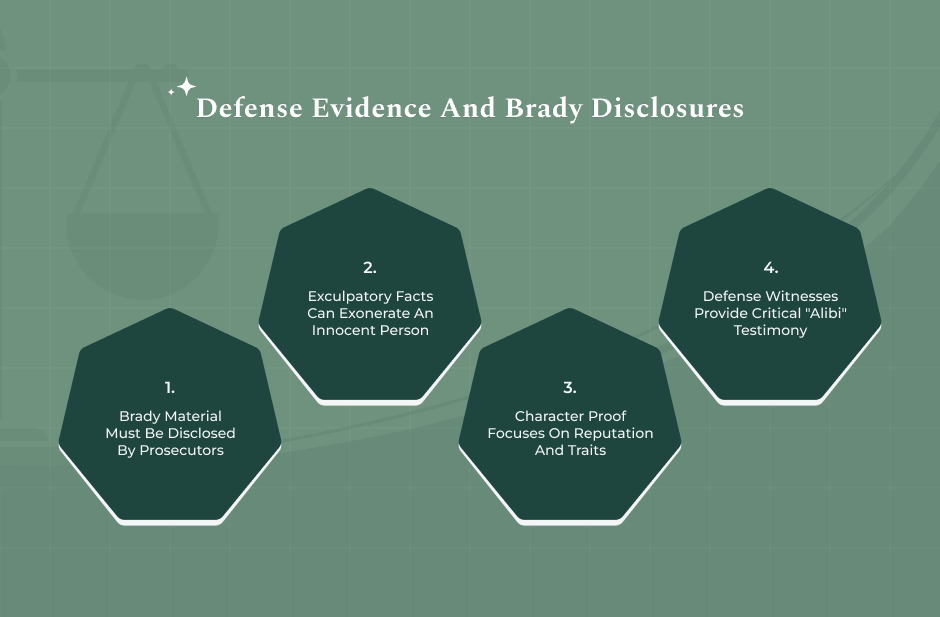
Exculpatory evidence is one of the most important forms of evidence in criminal law, and it encompasses any information that has a tendency to excuse or exonerate the defendant from the crime.
The “Brady Rule” states that prosecutors are required to disclose this form of evidence even if the defense attorney does not request it. Failure to disclose a witness who may have seen another suspect, for instance, will lead to an automatic mistrial.
Read Also: What Is Expungement? The Complete Guide To A Clean Slate
Character Evidence and Reputation
Although character evidence is often limited, it is one of the types of evidence that can be used to describe a person’s personality traits or past actions to indicate they are not likely to commit a crime. In the year 2026, the “Mercy Rule” still permits defendants to present positive character evidence first.
However, once the door is opened, the prosecution can then present other forms of evidence to refute such allegations and demonstrate a pattern of similar “bad acts.”
Frequently Asked Questions About Types of Evidence
It can be confusing for a US citizen to understand the rules of proof in a legal battle. The legal system is very particular about how information is obtained.
Even if the information is “true,” it is not very helpful if it has been obtained in a manner that is not legal.
These FAQs will cover some of the most common questions and concerns that people have had about the nature of the evidence and how it will affect their rights in the 2026 legal environment.
Yes, a person can be found guilty on circumstantial evidence alone. In fact, many murder cases are won without the body or the gun, as long as the cumulative effect of the circumstantial evidence is sufficient to prove guilt beyond a reasonable doubt.
Absolutely. It is possible to recover deleted information from phones and servers. In the year 2026, digital messages are considered a very reliable form of evidence because they provide a contemporaneous record of communication.
Under the “Exclusionary Rule,” all types of evidence obtained in violation of the Fourth Amendment are not normally admissible. This means that even if the police discover a gun, it will not be used against you if the search is illegal.
Mastering The Rules And Types Of Evidence
In conclusion, the different types of evidence are the building blocks of every legal case. The difference between direct and circumstantial evidence allows you to understand better how a jury comes to a verdict.
From the tangible aspect of physical evidence to the complex metadata of digital files, each type has its own set of rules for admissibility.
With the advancement of technology, we can witness the increasing use of scientific and digital forms of evidence in courts. But the basics of evidence in terms of relevance, reliability, and authenticity remain unchanged.
Whether you are a law student or a common citizen embroiled in a legal matter, you must be aware of the different forms of evidence. Always take the advice of a legal expert to ensure that your evidence is accurate and proper.