Jury duty is a responsibility that lets citizens take part in the court system. We all have surely heard of this.
The jurors help the court by helping it reach a decision regarding legal cases.
Additionally, the courts use juries in both criminal and civil trials.
Therefore, this way ensures fair and unbiased. The jurors obviously take into account the evidence that the lawyers present in court.
However, even if we know all about it, many people feel confused or nervous when they get a jury summons.
Legal experts claim that this happens because they do not fully understand the process.
Also, it may happen because they don’t know whether they can avoid serving.
Even though jury duty may seem inconvenient, it is important for the justice system.
But if it is a hundred percent impossible to avoid, how to get out of jury duty?
That is exactly what today’s legal article will guide you about.
Courts depend on jurors to examine evidence, listen to testimonies, and help decide if legal claims or criminal charges are proven.
Is Jury Duty Mandatory? What Happens After You Receive A Jury Summon?
To answer whether jury duty is mandatory or to find out how to get out of jury duty, one must know what the exact process is after receiving a jury summons. (Source: TheLawBrigade)
The jury duty process initiates when an individual receives an official summons by mail.
Additionally, when you see this document, you will see an outline of all the important details.
It says everything regarding when and where to report for service.
Courts generally select potential jurors from:
- Voter Registration Records
- Driver’s License Databases
- Other Governmental Sources
Once a person is summoned, they may be required to complete questionnaires to help the court assess their eligibility for jury service.
The summons typically contains important information, including:
- Reporting dates and times
- The location of the court
- The type of case involved
- Instructions for requesting postponements
- Qualifications for exemptions
It is important to note that disregarding a jury summons can lead to fines or other legal penalties, which vary by state law and court regulations.
How To Get Out Of Jury Duty: Listing All The Valid Reasons And More
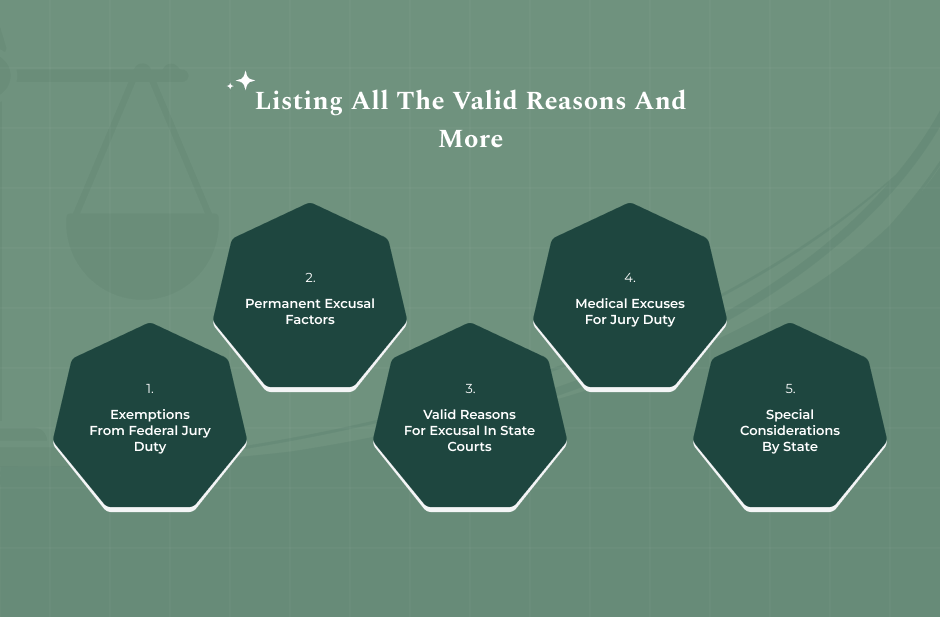
These are the various stages, or let’s say factors, that you need to look at very closely to figure out how to get out of jury duty. (Source: USCourts)
1. Exemptions From Federal Jury Duty
Certain individuals are exempt from federal jury duty under specific categories.
These exemptions include convicted felons and active-duty military personnel.
In addition, it also includes all the full-time members of professional police and fire departments.
Additionally, full-time public officers—those serving federal, state, or local governments—are also exempt.
This policy ensures that individuals who may be unable to perform jury duties due to their obligations are not selected.
Therefore, it allows for a fairer process, as those exempted play significant roles in public safety and governance.
Understanding these exemptions can help clarify who is eligible for jury duty.
2. Permanent Excusal Factors
U.S. district courts have the authority to permanently excuse jurors who may experience undue hardship or extreme inconvenience due to jury duty.
This category can apply to individuals facing chronic medical issues, those with significant personal responsibilities, or others in challenging situations.
Furthermore, the courts recognize certain demographic groups as deserving of special consideration.
For instance, people over the age of 70 or non-professional volunteer firefighters can be permanently excused.
These policies aim to protect individuals from unnecessary stress during jury selections while maintaining the integrity of the jury process.
3. Valid Reasons For Excusal In State Courts
In most state courts, potential jurors may request to be excused for valid reasons.
Common justifications include severe financial hardship, being a medical caregiver, or serving as the sole caretaker for young children.
Additionally, full-time students can present their circumstances to avoid jury duty.
Courts often require supporting evidence to validate these excuses. For instance, a valid student ID that shows enrollment in full-time courses can suffice.
These regulations ensure that those who genuinely cannot serve will not face undue burdens from jury duty.
4. Medical Excuses For Jury Duty
Medical conditions—both physical and mental—serve as valid reasons to be excused from jury duty.
In numerous states, including New York, individuals facing such challenges must provide documentation to support their claims.
For example, a signed statement from a licensed physician may be required.
This document must detail the individual’s condition and the expected duration of its impact.
By enforcing these rules, courts recognize that health issues can hinder a person’s ability to serve effectively.
Furthermore, it highlights the importance of considering jurors’ well-being when determining eligibility.
5. Special Considerations By State
Different states have unique policies regarding jury duty exemptions.
For example, in Texas, individuals can be excused from jury duty if their duty coincides with a religious holiday.
This provision respects the diverse beliefs and practices in the community.
Similarly, states like Colorado and New Jersey allow exemptions for breastfeeding mothers, provided they submit appropriate medical documentation.
These tailored policies reflect a growing recognition of individual circumstances and rights.
By accommodating diverse personal situations, states aim to create a more inclusive jury selection process, ensuring that all voices are heard while respecting personal commitments.
How To Get Out Of Jury Duty: All The Invalid Excuses Explained
Jury selection often involves hearing a wide range of excuses from potential jurors seeking to be excused from their duty, some of which can be quite unusual. (Source: AETV)
For instance, claims may commonly include outlandish reasons—such as being from another planet.
In one notable case, a woman, whose husband is a police officer, stated she could not be objective in a trial involving police testimony, asserting,
“I wouldn’t believe one word they said, because they are all drunks and jerks. I have seen them all at my house.”
This perspective led to her prompt dismissal from the jury pool.
Another prospective juror mentioned that serving on the jury would conflict with an upcoming surgical procedure.
When invited to discuss her situation privately with the judge and defense attorney, she candidly responded,
“No, it’s just a boob job,” which evidently did not warrant further consideration for her excusal.
Additionally, one man claimed he could not serve because he had no one to walk his dog.
However, when asked about the frequency of his dog walks, he admitted, “I don’t walk my dog. He goes through the back door by himself into the back yard,” indicating he had minimal obligation.
In a humorous exchange, a potential juror in New York acknowledged prior experience with lawyers by stating, “You picked me up at a bar five years ago,” which was sufficient for her to be excused from the selection process.
These examples illustrate the variety of reasons individuals provide during jury selection.
In addition, this highlights the sometimes humorous and unexpected nature of the process.