Circumstantial evidence sometimes has a bad reputation in popular television drama.
People believe that a case based on indirect evidence is a weak case or an insufficient case for a conviction. However, in actual fact, nothing could be further from the truth.
The United States legal system utilizes circumstantial evidence every single day to prove a fact that no one witnessed. In the year 2025, white-collar crime cases in New York courts and federal courts are relying on digital footprints.
Furthermore, a number of lawsuits involving corporate espionage are currently being utilized to determine how much circumstantial evidence a jury is to be presented with.
Therefore, it is important for a person to grasp this legal term if they wish to grasp what is currently going on in the United States. In this blog, we will break down the following things:
- The formal circumstantial evidence definition and its role in court.
- The critical differences between direct vs circumstantial evidence.
- Federal and state laws that regulate the admissibility of indirect proof.
- Landmark case laws that demonstrate the power of inference.
Defining The Concept Of Circumstantial Evidence

The legal world has a particular definition for circumstantial evidence that differentiates seen evidence from inferred evidence. In essence, it is evidence that makes use of an inference to connect with a conclusion.
What Does Circumstantial Evidence Mean In Court?
In order to understand what does it mean, it is necessary to use your imagination to think of a puzzle.
A single piece of evidence may not make sense, but as a whole with ten pieces, a picture is created. For example, a person sees another person running out of a house with a bloody knife.
This is considered to be circumstantial evidence of a crime. The person did not see the crime occur, but he or she saw enough to make a conclusion.
What Is An Example Of Circumstantial Evidence?
Daily events can become examples of this in a courtroom trial. A person who is a forensic scientist may use fingerprints to connect a suspect to a crime scene.
Even though he or she did not see the suspect touch a table, he or she can use the fingerprints to make a statement that he or she touched it.
A person’s web search history or his or her sudden urge to buy a getaway car can become circumstantial evidence.
Federal And State Laws Regarding Indirect Evidence
The United States has strict rules to ensure that circumstantial evidence remains reliable and fair. Both federal and state courts follow specific guidelines to prevent a jury from guessing wildly about a defendant’s guilt.
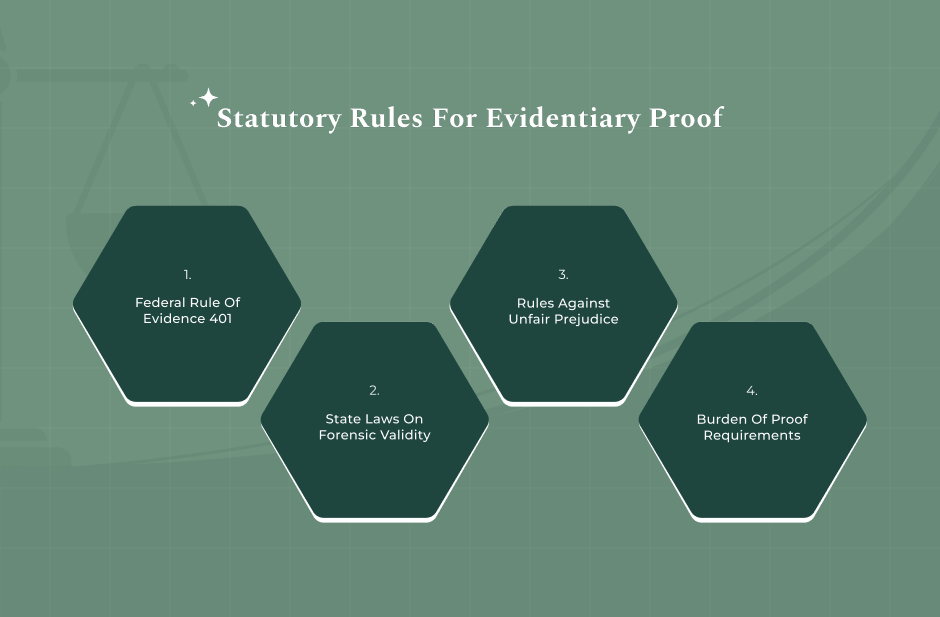
The Federal Rules Of Evidence
The Federal Rule of Evidence 401 states:
“Relevant evidence is evidence that makes the facts of a case more or less probable.”
This rule includes a wide range of circumstantial evidence. However, the role of the judge is to ensure it is not a mere distraction.
He/she has to ensure whether the circumstantial evidence is really helpful for the jury to come to a logical conclusion. (Source: Cornell Law School)
State Variations In Evidence Rules
Although most states follow the federal rules, there are a few states with different variations of circumstantial evidence. For example, there are a few states where a specific jury instruction is required.
This jury instruction informs the jury that they can convict a defendant of a crime based on circumstantial evidence only if it excludes every other reasonable theory.
The Role Of Forensic Science Statutes
The role of state laws is crucial when it comes to the admission of forensic evidence of a circumstantial nature.
For example, it ensures that DNA or ballistic tests are of a very high standard. If the science behind it is not sound, the circumstantial evidence will be thrown out of the trial even before it begins.
Constitutional Limits On Evidence
The Fourth and Fifth Amendments also have a bearing on circumstantial evidence. If the police seize a suspect’s text messages without a warrant, then such evidence cannot be used against the suspect. This ensures that the government does not break the law in building a case against a citizen.
Direct Vs Circumstantial Evidence Comparison

The difference between direct and circumstantial evidence has been misunderstood by many. They believe that direct evidence is superior to circumstantial evidence. However, this is not necessarily true in a real courtroom.
The Nature Of Direct Evidence
As for what constitutes direct evidence, direct evidence is a statement by a witness who saw the incident. If a witness says, “I saw the defendant shoot the gun,” then that is direct proof.
There is no need for inference. However, the direct evidence could be wrong if the witness is lying or has bad vision.
Why Circumstantial Evidence Is Often Stronger
Lawyers who prefer using circumstantial evidence do so because it is difficult to fake. A witness can lie on the stand, but a fingerprint is a fact.
In many cases, a mountain of circumstantial evidence is stronger than the testimony of a single eyewitness. A jury will find a pattern of circumstantial evidence incredibly compelling.
The Logical Bridge Requirement
The only difference between direct and circumstantial evidence is the mental bridge the jury has to cross. In a direct evidence case, the jury only has to believe the witness.
In a circumstantial evidence case, the jury has to believe the evidence AND the logical connection between the evidence and the crime.
That is why prosecutors spend so much time explaining the “links” in a chain of circumstantial evidence.
Weight In Modern Criminal Law
In modern times, in most nations, the judge instructs the jury to state that the law does not recognize any difference in the weight to be given to direct or circumstantial evidence.
A jury can convict a defendant based solely on circumstantial evidence. If this evidence proves guilt “beyond a reasonable doubt,” it is adequate for a verdict to be made.
Landmark Case Laws And Historic Rulings
There have been several famous cases that have determined the way in which we use circumstantial evidence in the USA today. These have become the guidelines for modern lawyers to follow in their cases.
Holland V. United States (1954)
In this case, the Supreme Court made a ruling about circumstantial evidence in tax evasion cases.
In this case, the defendant contended that the jury should have been instructed that circumstantial evidence is inferior to direct evidence.
The Supreme Court did not agree with this contention. In their ruling, they stated that circumstantial evidence is intrinsically just as good as testimonial evidence.
The Scott Peterson Trial
The trial of Scott Peterson is one of the most famous modern cases of circumstantial evidence. There was no DNA evidence, no murder weapon, and no witnesses.
But the prosecution had a mountain of evidence based on the defendant’s behavior, phone records, and changing stories.
The jury found the defendant guilty because they could not refute the sheer volume of circumstantial evidence.
State V. Anderson And Scientific Proof
This case demonstrates the power of DNA as a form of circumstantial evidence. Without a confession, the link provided a bridge for the jury.
It forced the legal system to accept the fact that modern science can provide a stronger form of circumstantial evidence than the memories of the human mind.
Frequently Asked Questions:
Understanding what is considered to be circumstantial evidence is important in order to break through the common myths that are often depicted in TV programs about crimes.
Yes, the judiciary can convict most people who have committed crimes depending on circumstantial evidence, as criminals do not commit crimes in front of a crowd of witnesses.
Some people say that circumstantial evidence is weak or insignificant simply because they are using the word “circumstantial” incorrectly. A number of pieces of indirect evidence can be stronger than one direct witness.
A jury uses the most logical explanation that fits in with all the facts and rules out any doubt about the guilt or innocence of the defendant.
Read Also: