Today’s topic: is dumpster diving legal?
The basic definition of ‘dumpster diving’ according to LegalMatch is the act where “someone is digging through another person’s trash to look for the things they left behind.”
It is more or less safe for us to say that this act is somewhat of a legal “gray area” in the United States. Most people think that once someone throws something away, it’s free for anyone to take.
However, the actual situation is a complicated mix of ownership rights, different local laws, and privacy issues.
People who rescue things from the trash or pick up unwanted food to eat must know where the law stands so that they do not get into trouble with the police or get heavy fines.
In this blog, we will talk about the following things:
- Is dumpster diving legal?
- About California v. Greenwood (486 U.S. 35).
- The three “legal pillars” of the law.
- Laws about scavenging retail store trash.
- Penalty for illegal dumpster diving.
- Modern risks of identity theft and digital loss.
Therefore, keep reading!
Is Dumpster Diving Legal?

Dumpster diving has changed from a very small underground movement into a big worldwide trend.
Thanks to the social media haul videos and also the desire to fight with corporate waste, more and more people are reaching the bins to find different things such as luxury electronic products or even food which is still good for eating.
On the other hand, as the movement is getting bigger, it is very important to understand the legal issues in order not to face charges for trespassing or theft.
In the USA, a very important Supreme Court case – California v. Greenwood (1988) – decided that if a person puts the trash outside the door or on a public footpath, then he or she can no longer have the expectation of privacy.
This basically means that the law would normally regard foraging throwaways as legal. In fact, it is usually allowed in the streets or at residential curbsides where no local restrictions specifically prohibit it.
However, it would be a criminal offense if the person who is dumpster diving is doing so on private property – breaking locks or even disregarding trespassing signs. (Source: FindLaw)
Additionally, there are a lot of retailers who have compactors or fenced enclosures to keep the customers away, and there are still some cities that have passed very strict anti-scavenging laws.
Because the rules can be different from one city to another, you have to do a very good study of your local city laws and state laws before going.
The Supreme Court Precedent: California v. Greenwood (1988)
The groundbreaking case of California v. Greenwood (486 U.S. 35) serves as the foundation of legality in dumpster diving.
In 1988, the Supreme Court took issue with whether the Fourth Amendment protects the trash left on a curb from a warrantless search and seizure.
After police found narcotics evidence in plastic bags that Billy Greenwood had left on a public street, the court opened the case.
Greenwood maintained that it was an invasion of his privacy. Yet the Court ruled 6 to 2 that since the trash was intentionally exposed to the public, there was no “reasonable expectation of privacy.” (Source: Oyez: California v. Greenwood Case Summary)
In this, the key characteristics of determining whether the act of dumpster diving is legal or illegal are as follows:
- Abandonment: Items placed on a public sidewalk for waste collection are regarded as having been abandoned and thus become part of the public domain.
- Accessible to Public: The Court explained that since “animals kids scavengers and snoops” are potential trash users, the owner is unable to assert that it is a private thing.
- Property Line: Usually, this ruling applies only to trash on public property. If a dumpster is within the “curtilage” (the immediate yard or private enclosure) of a house or commercial premises, then the Fourth Amendment protections may be in effect, which means that unauthorized entry is criminal trespassing.
Is Dumpster Diving Legal: The Three Legal Pillars Of Restriction
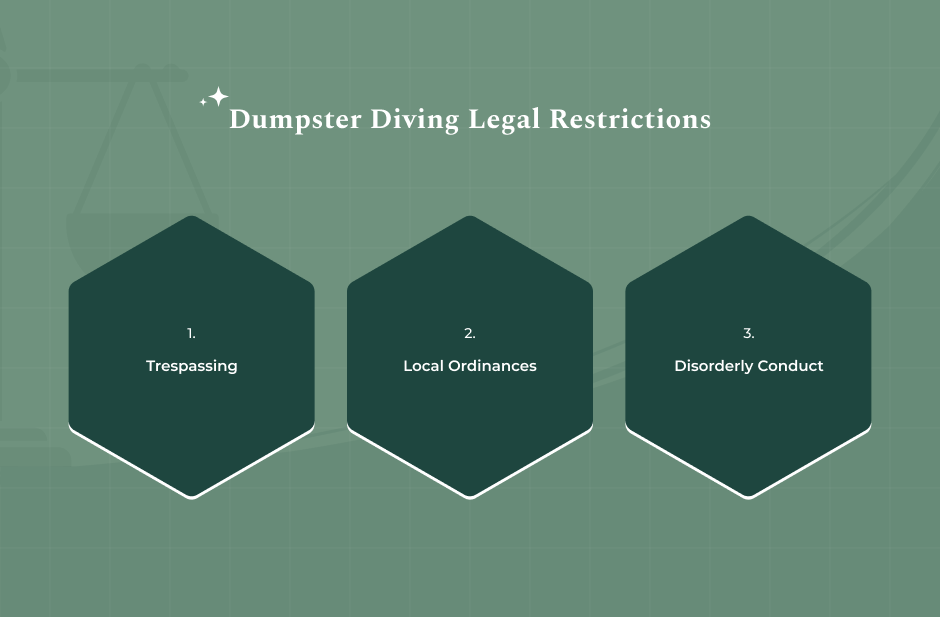
In California v. Greenwood, the court held that trash is usually a matter of public records. However, there are three “legal pillars” of the law that greatly limit your right to take the trash to begin with.
If you break these three pillars, legal scavenging may even turn into a criminal offence. They are as follows:
1. Trespassing:
This is the biggest legal hurdle that is most likely to happen to you. Most dumpsters are located on private property.
So if you get over a fence, go into a gated enclosure, or just ignore “No Trespassing” signs, you are likely to be arrested for the following criminal charges:
- Criminal trespass.
- Felony.
- Misdemeanor.
And that would be regardless of the dumpster’s contents.
2. Local Ordinances:
Secondly, the Supreme Court decisions can set only a benchmark. However, city and county regulations often have a different opinion.
Several cities have “anti-scavenging” laws that directly forbid taking things out of waste containers in order to protect the health of the public or to help maintain contracts with private waste management companies.
3. Disorderly Conduct And Littering:
Finally, police frequently use these “catch-all” charges if a diver makes a mess and leaves. If you open the bags and fail to put them back, then you may be subjected to a fine for littering or “creating a public nuisance.”
Also, breaking locks or defacing enclosures is vandalism. And that, too, is a criminal offense in several states.
Scavenging At Major Retailers
Walmart, Target, and Home Depot stores carry higher risks than residential diving. These chains view dumpsters as private spaces with active security or cameras monitoring access.
“Many shopping malls and stores have back areas that are largely considered private property, according to FindLaw.com, which also notes proper signage could be used in court to show a business took appropriate precautions,” notes Delaware Online.
As we have already mentioned above, many retail stores use compactors that crush trash instead of open bins. That makes entry a criminal act and dangerous.
Even with open bins, stores can charge for theft of services if they pay waste companies to handle the trash.
Additionally, waste management companies claim ownership the moment material hits the bin. Many companies have clear rules banning scavenging to avoid legal liability under OSHA regulations.
And that is primarily because they fear lawsuits. These arise if someone hurts themselves or gets sick from old or unsafe items while dumpster diving.
What Is The Penalty For Dumpster Diving?

While dumpster diving itself is rarely a felony, the associated legal violations carry real consequences. Penalties vary significantly by city and state, but common repercussions include:
- Trespassing Fines: The most frequent penalty. Fines typically range from $50 to $500, though repeat offenders or those ignoring “No Trespassing” signs may face higher costs. (Source: Criminal Defense Lawyer)
- Jail Time: For criminal trespass or “breaking and entering” (e.g., cutting a lock), sentences can range from 24 hours to 6 months in county jail.
- Criminal Record: A conviction for trespassing or vandalism can appear on a permanent background check, affecting future employment.
Additionally, in many places, leaving trash outside the bin can result in “Quality of Life” fines, often starting at $100.
Is Dumpster Diving Legal? Understanding The Modern Risks Of Data Privacy & Identity Theft
While dumpster diving is often legal in public spaces, the act becomes a severe criminal offense when used to harvest personal information for identity theft or fraud.
When it comes to cybersecurity, this is a low-tech but highly effective method for criminals to gather “treasures in the trash” to launch spear-phishing attacks or assume a victim’s identity. (Source: Science Direct)
This includes:
- Bank statements.
- Social Security numbers.
- Discarded digital drives.
Here are some of the modern risks of this act:
- Criminal Charges: If found with stolen personal identifying information, individuals can face a 13-count federal indictment. This includes bank fraud and aggravated identity theft, which are punishable by up to 30 years in prison.
- Wobbler Offenses: In states like California, identity theft is a “wobbler,” meaning it can be charged as a felony with up to 3 years in jail and a $10,000 fine. (Source: Cron, Israel & Stark)
- Data Breach Impact: For businesses, improperly discarded documents can lead to massive data breaches costing millions. In the EU, such lapses violate the GDPR, which enforces strict data disposal standards.
According to the Federal Trade Commission and the Identity Theft Resource Center, retrieving and using sensitive documents like tax forms or bank statements can result in federal prosecution under the Fair and Accurate Credit Transactions Act (FACTA).