If you have ever faced foreclosure, you will know that it is a challenging and stressful situation.
In fact, it often not only entails the loss of one’s home. Rather, you face the added financial and emotional repercussions.
Therefore, it is very important that we address this issue promptly and strategically.
Homeowners frequently grapple with the question of how late is too late to intervene in the foreclosure process.
To effectively navigate this difficult time, it is important to understand the foreclosure timeline and recognize when to seek professional legal assistance.
Engaging a knowledgeable attorney can significantly enhance your chances of saving your home.
This blog will delve into these important topics and highlight the vital role that legal support can play during such trying circumstances.
What Is Forclosure?
To know when is it too late to stop foreclosure, we must have a clear idea of what it is and how it functions.
Most people buy homes with a mortgage. When you sign your loan agreement, you’re agreeing that your home is collateral for the loan. (Debt.org)
This means if you stop making payments, the lender can take back the home through a process called foreclosure.
The lender will then sell the property to get back as much of the debt as possible.
Foreclosure forces you out of your home and can seriously hurt your credit report, which can stay for up to seven years.
States Where Foreclosure Risks Are Higher In 2026
I have given you a comprehensive table below of the states that are experiencing a massive upsurge in foreclosure risks. (Quartz)
So, if you are a resident of any of these states, it’s high time you start thinking about when is it too late to stop foreclosure.
| State | The Foreclosure Risk Situation |
| South Dakota | In Q1 2026, South Dakota experienced 57 foreclosure filings, marking a 185% increase from Q1 2025, the highest percentage rise among states. This equates to one filing for every 7,107 housing units. |
| Georgia | Georgia reported 4,549 filings, a 77.83% increase from the previous year, the second-highest percentage increase. One in every 998 housing units had a filing, worse than the national average of one in 1,211. |
| Idaho | Idaho had 506 foreclosure filings, up 75.69% from Q1 2025, with one filing for every 1,571 housing units. This indicates a continued trend rather than a one-time spike. |
| Colorado | In Q1 2026, Colorado had 2,092 foreclosure filings, up 74.04% from Q1 2025, with one in every 1,238 housing units affected, keeping pace with the national average. |
| Montana | Montana reported 104 filings, a 67.74% increase, with one in 5,081 housing units, below the national average, showing a quarterly rise of 2.97%. |
| Alaska | Alaska had 198 filings, up 66.39%, with one in 1,615 units, reflecting a 10% quarterly increase. |
| Arkansas | Arkansas logged 947 filings, a 65.27% rise, with one in 1,473 units, worse than the national average, and a 3.95% quarterly gain. |
| Mississippi | Mississippi filed 491 cases, an increase of 64.77%, with one in 2,731 units, below the national average, but a notable quarterly increase of 20.94%. |
| North Carolina | North Carolina recorded 4,141 filings, up 55.79% from the previous year, with one in 1,182 units, worse than the national average, and a significant 29.81% quarterly boost. |
The 2026 Foreclosure Timeline: The Six Phases
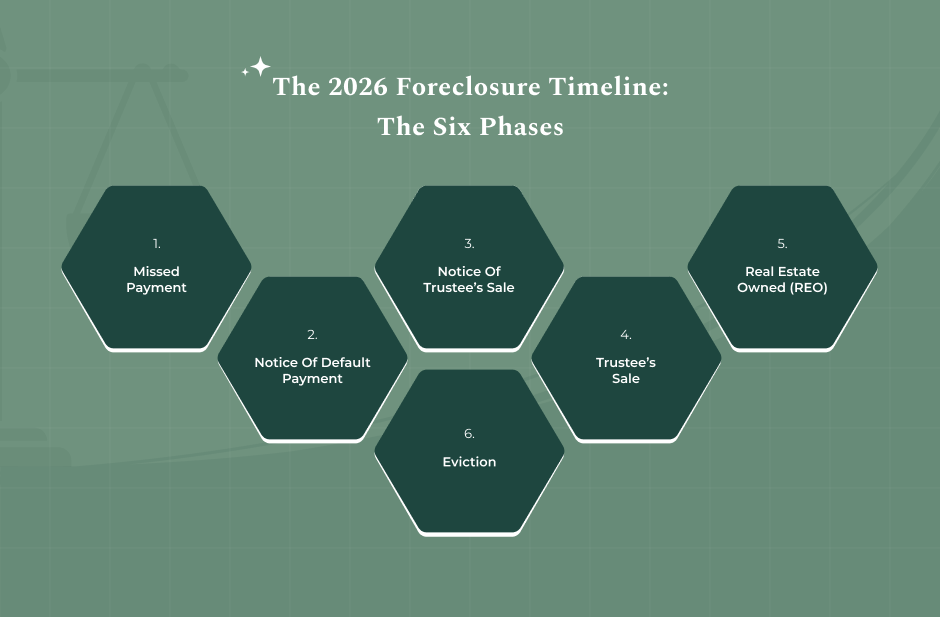
The entire legal timeline of a standard foreclosure is divided into six significant phases. (Investopedia)
1. Missed Payment
Most mortgages allow a grace period of about 15 days, but this can vary by lender.
If borrowers make their monthly payment during this period after the due date, they won’t incur a late fee.
2. Notice Of Default Payment
If a borrower fails to pay, the lender will send a notice of default as the second step of foreclosure.
This notice, which is filed with a court, informs the borrower of the missed payment and includes details about both the borrower and the lender, as well as possible next steps the lender may take.
3. Notice Of Trustee’s Sale
As foreclosure continues, the lender’s lawyers will reach out to the borrower, possibly adding more fees.
After four missed payments, the lawyers might begin the foreclosure sale process.
The borrower will receive a notice of the sale in accordance with local and state laws.
4. Trustee’s Sale
The time between receiving the notice of the trustee’s sale and the actual sale depends on state laws.
This period can be as short as two to three months.
The sale is the official foreclosure of the property and can occur in various ways depending on state regulations.
5. Real Estate Owned (REO)
If no one bids enough to cover the mortgage amount at the sale, the property becomes Real Estate Owned (REO).
Lenders may try to sell these properties on their own or with the help of a real estate agent.
6. Eviction
Once the mortgage company finishes the foreclosure process, the people living in the home can be evicted.
The time allowed for former homeowners to move out after the sale varies by state.
In some states, they may have just a few days, while in others, they could have months.
Key Strategies To Stop Foreclosure In 2026
So, if you are losing your sleep wondering when is it too late to stop foreclosure, legal experts say that it is never too late.
Also, these are the core strategies they usually recommend:
1. Reinstatement
Reinstatement involves bringing your mortgage account current by paying any missed payments, along with any applicable late fees or penalties, before the foreclosure sale.
2. Loan Modification
Loan modification is a process where you negotiate with your lender to alter the terms of your loan.
This could include reducing the interest rate, extending the loan term, or incorporating missed payments into the overall loan balance.
3. Short Sale
In cases where a home’s market value has declined below the mortgage balance, a lender may consider a short sale.
This allows the homeowner to sell the property for less than what is owed on the mortgage.
4. Deed In Lieu Of Foreclosure
As a final alternative to avoid foreclosure, homeowners may opt for a deed in lieu of foreclosure.
By transferring the property deed to the lender, the lender agrees to forgive the outstanding debt and cancel the foreclosure process.
The Role Of Chapter 13 Bankruptcy In Mitigating Foreclosure Risks
Chapter 13 bankruptcy is a valuable option for individuals seeking to reorganize their debts, particularly for managing secured debts such as mortgages. (American Bankruptcy Institute)
This form of bankruptcy is particularly effective for those facing difficulties and wondering when is it too late to stop foreclosure.
To initiate Chapter 13, the debtor, along with their attorney, must present a repayment plan to the court.
To prevent foreclosure, this plan should address any outstanding arrearages, as well as any homeowner’s association fees and property taxes that are overdue.
It’s important to note that during this process, ongoing mortgage payments must still be made.
A significant advantage of filing for Chapter 13 is the opportunity to strip away second mortgages and home equity lines of credit (HELOC).
These types of debts, secured against the home’s equity, can potentially be transformed into unsecured loans.
Since unsecured loans are given lower priority in the Chapter 13 repayment hierarchy, debtors may find themselves required to repay only a portion of this debt, or, in some cases, have their second mortgage eliminated entirely.