The maxim ubi jus ibi remedium, which means that where there is a right, there is also a remedy, is the cornerstone of justice.
The American law makes sure that citizens do not have any unenforceable rights that cannot be vindicated in the court of law.
As we examine the current legal situation in April 2026, we shall see that this principle plays an important role in critical legal cases, especially concerning the civil rights of Americans and issues of digital privacy.
For instance, when courts hear federal cases dealing with Section 1983, they may question whether some statutory right gives rise to a cause of action based on this principle.
Moreover, many cases are currently being filed against several major technology companies over their illegal data harvesting operations, testing just how far this principle applies to violations of intangible rights.
When one’s right is violated, he or she is entitled to a remedy by the court of law.
In this article, we will elaborate on the following:
- The historical origin and ubi jus ibi remedium meaning.
- The integration of this doctrine into the United States federal and state laws.
- Landmark US case laws that established the right to a remedy.
- How the doctrine protects citizens and ensures judicial accountability.
Defining The Origins And Philosophy Of Ubi Jus Ibi Remedium
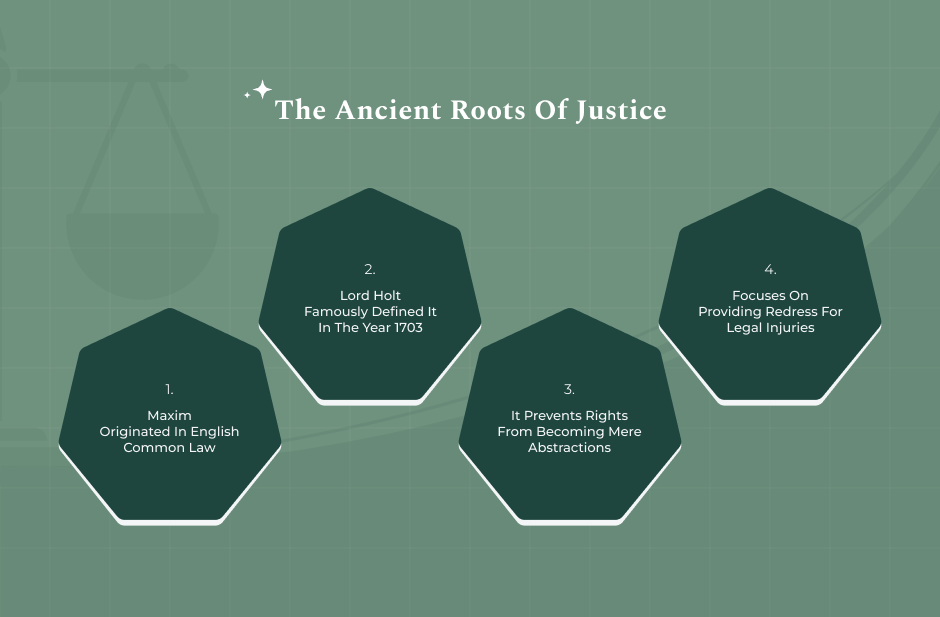
Ubi jus ibi remedium, translated from Latin to English, means where there is a right, there is a remedy. It means that the right cannot be considered an effective one without any remedy provided by the law.
The True Meaning of Ubi Jus Ibi Remedium
The main meaning of this phrase lies in the fact that there must be a way to remedy violations of one’s right to ensure justice in cases where one’s right is violated. The lack of remedy turns the right into “a shadow without a substance” (Source: iPleaders).
Legal Right Vs Moral Right
It is important to differentiate between the legal right and the moral one because ubi jus ibi remedium applies exclusively to the former notion. Only those rights are guaranteed by this principle that are acknowledged through a statute or common law.
A Need For Legal Injuries
It means that there should be an issue of legal injuries instead of physical or monetary ones. An example of the latter would be injuria sine damno – violation of one’s legal right without doing any harm but demanding the remedy anyway (Source: Lawctopus).
Integration Of The Maxim Into United States Federal And State Laws
In the United States, ubi jus ibi remedium goes beyond theory and is entrenched in the Constitution itself, as well as several other federal laws.
Both state and federal governments utilize the doctrine to guarantee that constitutional protections are more than empty promises.
Remedies At The Federal Level By Section 1983
Among the many uses of ubi jus ibi remedium within the USA is Section 1983 of federal law.
According to the section, an American citizen can file a lawsuit against any federal official who infringes upon their constitutional rights (Cornell Law).
Remedies For Individual State Constitutions
Several states, such as Ohio and Pennsylvania, include specific “Remedy Clauses” in their constitution.
In particular, Article I, Section 16 of the Ohio constitution says explicitly that all people shall receive a remedy by due course of law for any injury to their person, property, or good name.
Use Of Due Process Clause
According to the Fifth and Fourteenth Amendments, individuals are entitled to Due Process, which can be considered the procedural aspect of ubi jus ibi remedium.
As a result, if someone’s rights are being violated, they must receive a hearing to protect their interests.
Landmark US Case Laws Establishing The Right To A Remedy
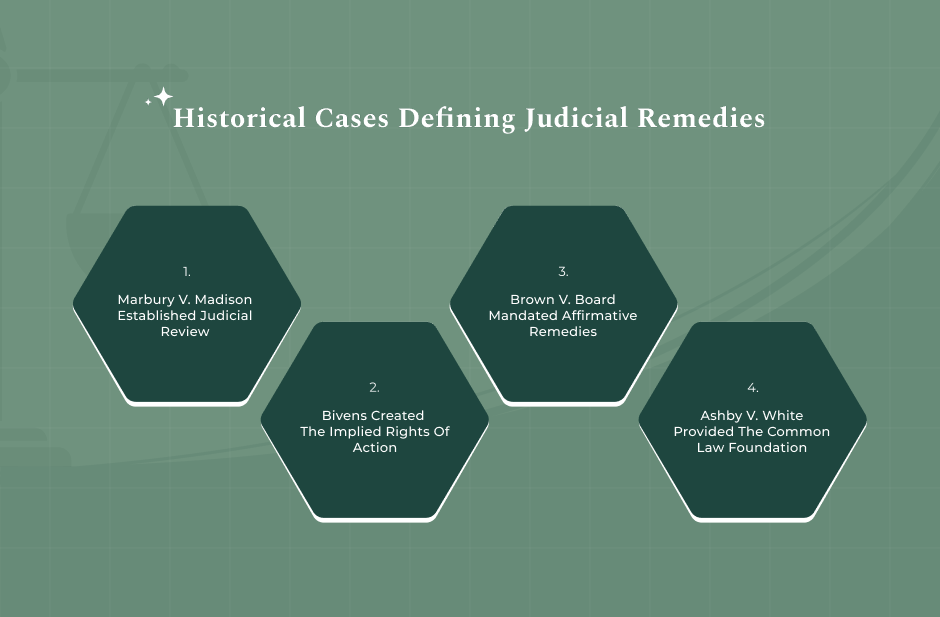
American legal history has been marked by certain court cases whereby the Supreme Court would decide whether a particular right exists and, above all, the proper remedy.
It is in these kinds of cases that ubi jus ibi remedium has emerged to become a fundamental principle of the judiciary.
Marbury v. Madison (1803)
In the landmark ruling of Marbury v. Madison in 1803, Justice Marshall declared in his opinion: “The very essence of civil liberty certainly consists in the right of every individual to claim the protection of the laws.”
The importance of this case lies in the fact that America became a country ruled by the laws and not the people. Where there is a right, there is also a remedy.
Bivens v. Six Unknown Named Agents (1971)
In the 1971 case of Bivens v. Six Unknown Named Agents, the Supreme Court established that citizens can sue federal agents violating their constitutional rights under the Fourth Amendment despite the absence of any statute providing a remedy for such actions.
Brown v. Board of Education (1954/1955)
Brown I ruled segregation unconstitutional. Brown II (349 U.S. 294) dealt exclusively with the relief aspect.
The Court mandated the “process of converting to a system of public education that has been freed from racial discrimination,” demonstrating that once a right is established, the relief must follow.
The Limitations And Exceptions To The Rule
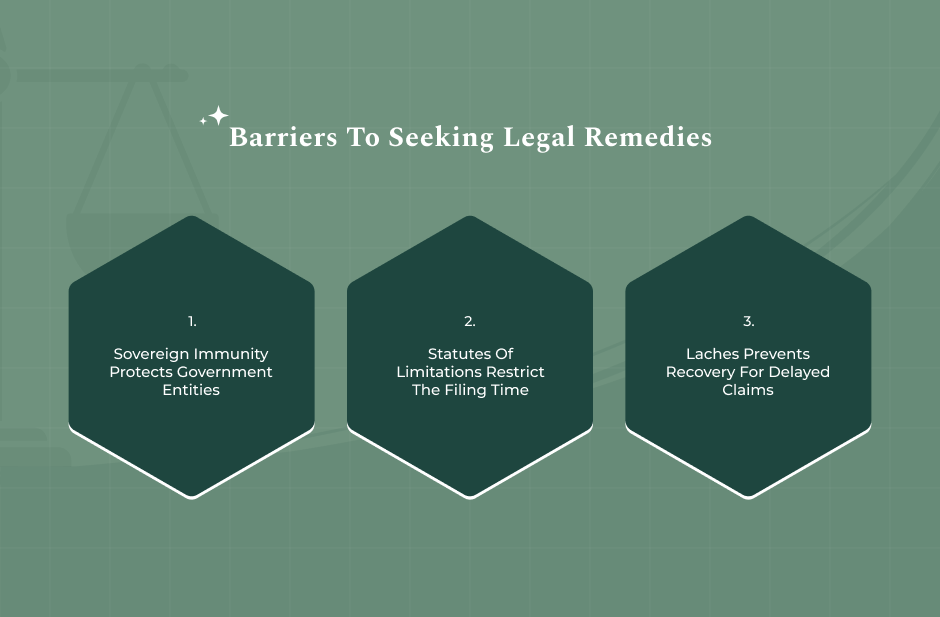
Despite the availability of a legal right, several constraints may hinder an individual from accessing judicial relief.
Such constraints guarantee the predictability of the legal process while preventing defendants from being dragged into disputes involving ancient or privileged rights.
Doctrine Of Sovereign Immunity
This is an old legal principle which suggests that there can be no action against the government without its express permission. In case an individual feels that his rights were violated by any government agency, he needs to look for any particular statute under which the government waived its immunity.
Waiver Under Federal Tort Claims Act
The Federal Tort Claims Act works as an exception to the rule of sovereign immunity. This legislation helps people recover from injuries, both physical and property damage, due to the negligence of federal employees while performing their official duties.
Qualified Immunity For Public Officials
In 2026, qualified immunity continues to serve as an obstacle for individuals trying to sue public officials and the police for a wrong done to them.
Under this principle, an individual cannot bring legal proceedings against an officer until their rights are clearly established.
Ubi Jus Ibi Remedium In The Digital And AI Era
As we move deeper into 2026, the legal system is working to apply the right to a remedy to new technologies.
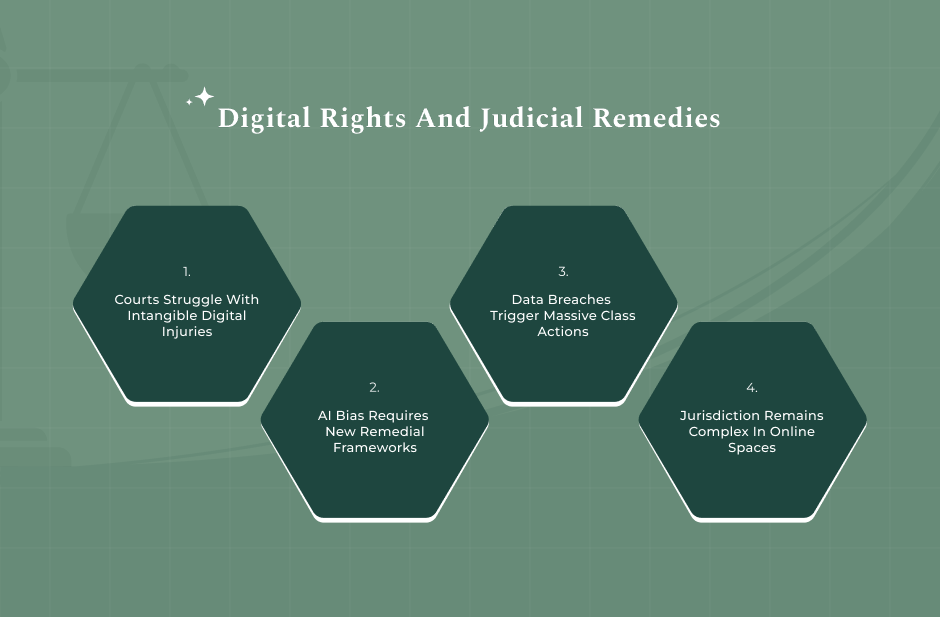
When an algorithm or a data breach causes harm, the court must decide if a traditional legal right was actually broken.
Remedies Against Discrimination By Algorithms
If a machine-learning system refuses your loan application or denies you employment because of biased data, you should be provided with equal treatment.
Nowadays, many individuals use the principle ubi jus ibi remedium to demand that companies reveal details about “black-box” algorithms and offer monetary compensation for discrimination.
The Burden Of Proof In Black-Box Systems
Proving that an artificial intelligence model has made a mistake is likely to become the major problem of 2026.
Being extremely complicated and difficult to understand, such algorithms make it nearly impossible for a plaintiff to present a claim proving their rights have been violated through the automated decision-making process.
Injunctions Against Automated Decision-Making Processes
Monetary compensation may not always serve as an effective remedy when dealing with AI-based discrimination.
Therefore, courts frequently issue injunctions ordering businesses to discontinue utilizing prejudiced algorithms or destroy data leading to discriminatory outcomes.
The Difference Between Legal Rights and Moral Duties
It is clear that the law cannot resolve every problem or issue. To apply this maxim, an injury must be to one of the legally recognized interests instead of social or moral frustrations.
Damage Sine Injuria (Damnum Sine Injuria)
An actual damage without legal injury.
This doctrine is exactly the opposite of the maxim discussed above. Here, there is actual damage, but there is no breach of any legal right. In such cases, there will be no remedy for the complainant as there has been no violation of any law.
Competition In The Market Of Business Ventures
If a new store opens up in your locality and attracts all your customers, thereby causing a financial loss to you, then you have actually been damaged.
However, you cannot claim relief from the court. That’s because you cannot enforce a right to the absence of competition in the marketplace.
Exercise Of Constitutional Rights
If a person makes an insult to you in public, you suffer great mental distress.
But the person enjoys the right to freedom of speech under the Constitution. So, there will be no “injury” that the law can redress.
Comparative Analysis: The Provision of Judicial Remedy Globally
While there are similarities with regard to how the remedy is provided in the United States and how it is approached in other jurisdictions, there is no doubt that the exact nature of the remedy may differ significantly.
The Impact Of International Human Rights Law
The interpretation of ubi jus ibi remedium within international treaties has expanded in some instances. As a result, it now encompasses environmental matters.
Courts around the globe have recognized the right of individuals to a sustainable earth. And, as such, demand remedial actions when this right is infringed upon by the government.
Climate Change Litigation And Intergenerational Justice
In various court rulings in 2026, children filed suit against their governments. They argue that the failure to combat climate change constitutes a violation of their basic rights. They also state that this entitles them to remedies via national environmental policy revisions.
Frequently Asked Questions (FAQs):
Here are some questions that people often ask about the theory of ubi jus ibi remedium. Take a look at these:
No, since it simply states that where there is a violation of your legal right, the law gives you a way of seeking redress.
You still need to satisfy all the requirements of proof and procedure concerning your cause of action.
In accordance with the rule of ubi jus ibi remedium, the court “implies” a remedy. Courts normally imply a remedy through judicial interpretation. But this is only where a right exists and there is no legislation on the enforecement.
Yes. Some restrictions include “sovereign immunity” as well as the fact that there is no legal remedy for a moral or social injury.
Yes. In the event of a breach, the contracting party breaches your legal right to the performance of such a contract. And there are various legal remedies like “damages” or “specific performance.”
Legal remedy refers to damages awarded in terms of monetary payment. On the other hand, an equitable remedy refers to a court order issued to perform or cease from certain actions. This is also called “injunctions.”
Yes, this principle is internationally recognized and is included in international laws. In this principle, states must be answerable for violations of their obligations towards other states or people.