Is Polygamy Legal in the US?
The legality of polygamy in the US is an incredibly complicated matter for many Americans as there exists a very difficult relationship between religious rights and governmental control.
Even though the US has always been regarded as a country where individual freedom is valued, the law has strictly prohibited bigamy in America since the late nineteenth century.
Nevertheless, moving forward into 2026, there is a shift in focus regarding the discussion due to the new trend in the process of decriminalizing polygamy and changing the definition of family structures within states like Utah and Massachusetts.
At the moment, one of the most pressing issues in this context is the Brown v. Buhman case.
In this article, we will elaborate on the following:
- The historical Supreme Court rulings that set the foundation for modern bans.
- The difference between criminal polygamy and civil decriminalization in Utah.
- Recent local ordinances in Massachusetts and California regarding multi-partner families.
- The legal distinction between bigamy, polygamy, and polyamory.
- Frequently asked questions regarding the penalties and risks of plural lifestyles.
Federal Law And The Constitutional Prohibition Of Plural Marriage
The issue of is polygamy legal in the US is unequivocally stated under federal law. The United States government set its stand on this issue in the latter part of the 19th century, guaranteeing the survival of the “traditional” marriage institution as the foundation of society.
The Landmark Decision of Reynolds V. United States (1879)
Reynolds v. United States (98 U.S. 145) concerned whether an individual was entitled to a religious exemption from bigamy laws. In Reynolds’ case, he claimed that his religion mandated him to have multiple wives.
Nevertheless, the Court held that even if the First Amendment guaranteed protection for religious beliefs, it did not offer any protection to acts of religion that were against the law.
This landmark decision has served as one of the strongest supports for the answer to the question, “Is polygamy legal in the US?”
The Effects Of The Edmunds Anti-Polygamy Act
In response to the Supreme Court decision, the Federal Congress passed the Edmunds Anti-Polygamy Act of 1882.
By criminalizing “unlawful cohabitation,” the government had the legal basis for prosecution even without obtaining a second marriage license.
This historic piece of legislation has greatly affected the definition of bigamy by most states to this day.
State Laws – Where Is Polygamy Legal In The United States?
Is polygamy legal in the US? Although no state recognizes multiple marriage licenses per individual, its penalties against polygamous behavior vary widely.
The question where is polygamy legal in the United States often comes up when there is news about decriminalization in the West.
State Boundaries Dictate Marriage License Penalties
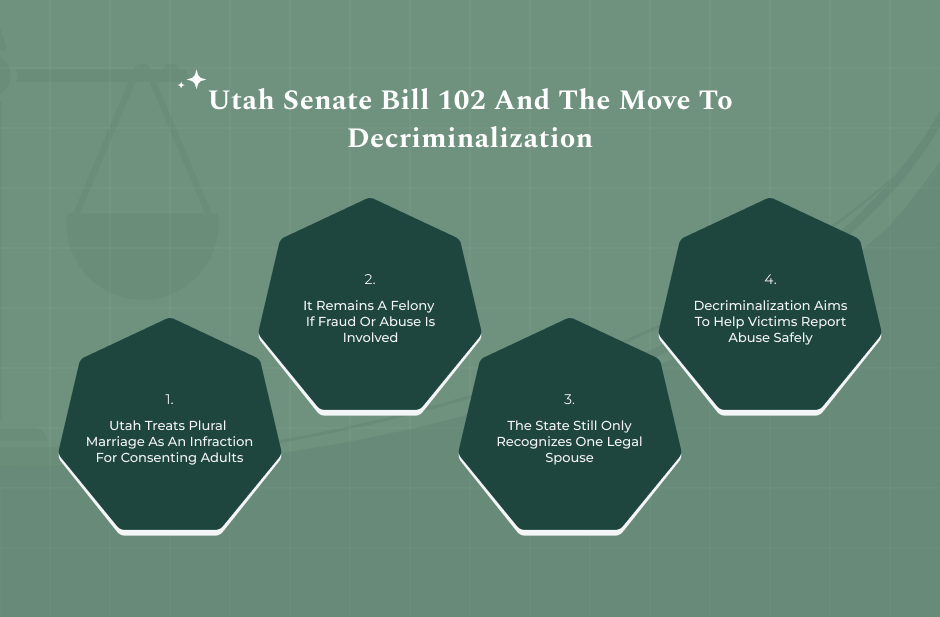
Utah grabbed international attention in 2020 after passing Senate Bill 102, which legalized polygamy between consenting adults.
This bill downgraded the criminal activity of being married twice to a minor offense, comparable to receiving a parking ticket (Source: TRT World).
Note that this move does not legalize polygamy or permit issuing a second marriage license in the state.
Rather, it only eliminates the government’s obligation to waste its resources investigating law-abiding plural households.
Legal Standing Of Bigamy In California And Texas
Is polygamy legal in the US? Bigamy continues to be considered an offense punishable by imprisonment in states such as California and Texas.
As per California Penal Code 281, any person who has a husband or wife living and marries any other person commits the crime of bigamy.
Bigamy is a fraud upon the government and an unsuspecting spouse in the jurisdiction of states such as California and Texas.
Emerging Challenges In Modern Legal Frameworks And Polyamorous Couples’ Protection
New legal challenges have arisen in response to changes in social dynamics that necessitate protection for polyamory.
Modern legal challenges revolve around issues such as housing, employment, and domestic partnerships, and not necessarily marriage licenses.
Review Of Legal Standing On Issues Affecting Modern Family Structure Rights
Brown v. Buhman & The Sister Wives Case Analysis- The iconic “Sister Wives” family challenged Utah’s cohabitation laws through the Brown v. Buhman suit.
Although they lost at first in the lower courts, their appeal was subsequently dismissed based on mootness by the 10th Circuit Court of Appeals.
However, despite their legal loss, the decision laid the foundation for legislative decriminalization years later in Utah.
Is Polygamy Legal In The Us For Immigrants Who Are Married To Multiple Individuals?

Polygamy is illegal in the US since the Immigration and Nationality Act (INA §212) explicitly lists "practicing polygamists" as inadmissible persons. Even if the polygamous marriage is legal in a foreign country, it is not recognized under US immigration laws.
Nondiscrimination Ordinances In Massachusetts And California
By 2024 and 2025, some cities, such as Somerville and Oakland, enacted groundbreaking ordinances that would give protection to multi-partner families. These cities enable multiple people to become a part of the same “domestic partnership.”
Although it will not affect the question is polygamy legalin the US in relation to marriage, it offers insurance and visitation privileges to non-nuclear families (Source: Harvard Law LGBTQ+ Advocacy Clinic).
The Growth Of Local Protections And The Respect For Marriage Act
Whereas federal legislation tends to be very strict, the world in 2026 can best be described as one where there is an increasing “checkerboard” of municipal safeguards. Knowing whether is polygamy legal in the US today demands considering the city hall and not just the Supreme Court.
Ordinances For Domestic Partnership In Massachusetts And California
Since Somerville, Massachusetts, first adopted a unique ordinance in 2020, other cities, including Cambridge and Oakland, have enacted similar legislation in 2025.
These municipalities have changed their definition of domestic partnerships from those involving only two individuals to incorporate multiple adults.
They now offer the same local rights associated with these partnerships, such as hospital visiting privileges and city-level employee benefits. These changes do not affect polygamy legalization in America.
However, they create a legal “safe harbor” for families of more than two partners, allowing them to handle their affairs legally.
Respect For Marriage Act (RFMA) And The Polygamy Carve-Out
Is polygamy legal in the US? An essential federal statute frequently ignored in this discussion is the Respect for Marriage Act.
Although the law gained widespread attention when it codified gay and interracial marriages in 2022, its provisions also included a “Rule of Construction.”
According to the act, the federal government cannot be required to recognize plural marriages if a state such as Utah ever legalized them.
- RFMA Exclusion: Federal law explicitly bars plural unions from “Full Faith and Credit” protections.
- Local Ordinance Limits: Municipal partnerships only apply within city limits and do not affect federal taxes.
- The Two-Person Limit: Current 2026 doctrine under the Dobbs framework suggests no fundamental right to plural marriage exists (JURIST 2026).
- Employment Protection: New “Poly-inclusive” anti-discrimination laws in cities like Somerville protect plural families from being fired due to their relationship status.
Legal Issues Concerning Multiple Parenthood within Polyamorous Couples
As of 2026, where is polygamy legal in the US has become a question of what parental rights should be recognized.
With its Three-Parent Law, according to California Family Code §7612, California states that, if necessary, a child can legally have three parents. If a third parent is excluded, it will be “detrimental” for the child’s welfare.
Thus, polyamorous families have a chance to gain custody and obtain child support rights, making the concept of “functional polygamy” an option around the current marriage laws.
What Does The 2026 Automatic System Mean For Plural Families?

Government programs will continue to employ automatic registration using the filter of a single-spouse system. Therefore, spouses other than the primary one in plural marriages will not be able to receive any Social Security or tax benefits as the head of the household.
How Does It Matter For You
If you are part of a plural couple, it is crucial to differentiate between how you live and how you look from the government’s perspective.
Although you can coexist legally by sharing one roof and even obtaining a partnership license in certain cities, in the eyes of the IRS and SSA, you are just separate people.
The development of multi-partner domestic partnerships is the biggest milestone on the road to making is polygamy legal in the US a reality, but only locally.
Frequently Asked Questions (FAQs):
The legal system surrounding marriage is rapidly evolving, making many citizens question their legal rights. It is crucial that people in polygamous relationships learn more about the intricacies of the legality of is polygamy legal in the US.
Bigamy is the practice of legally trying to marry someone else while already married. Polygamy is the wider concept of being married to multiple spouses for religious reasons but without getting another marriage license.
Yes, the practice of polygamy or even its advocacy is inadmissible under federal immigration law. This applies whether the activity violates a state statute or is decriminalized.
It depends if the municipality where you are staying recognizes multi-partner domestic partnerships and whether the insurance company covers their ordinance. Otherwise, the insurance provider will likely require only two spouses or domestic partners.
While it grants parental rights to three people, it does not grant marriage rights. It ensures the child’s stability but does not allow the adults to file joint taxes or receive spousal survivor benefits.
Registration is based strictly on the individual’s sex assigned at birth. Family structure, whether monogamous or plural, has no bearing on the automatic registration mandate for those aged 18-25.