
The divorce process in India is a highly complicated one, depending heavily on the religion of the persons involved as well as the manner of their split-up.
In 2026, the legal system of India has taken a turn towards an emotionally intelligent process, especially in situations where the marriage cannot be saved anymore.
Regardless of whether they go for mutual consent or end up in a fight, all couples will have to strictly adhere to the procedural statute.
In 2026, there are various important cases pending before the Supreme Court of India concerning the compulsory six-month cooling-off period.
In addition, the Constitution of India, through Article 142, has come into play in many cases where procedural delays are not permissible.
It is therefore vital for everyone who wants to end their marriage to be aware of such changes.
In this article, we will elaborate on the following:
- The statutory framework and specific sections governing matrimonial relief.
- The step-by-step breakdown of mutual consent and contested filings.
- Significant case laws and recent celebrity divorce highlights.
- The modern evolution of financial support and maintenance rules.
Statutes And Legal Framework Of Divorce Procedure
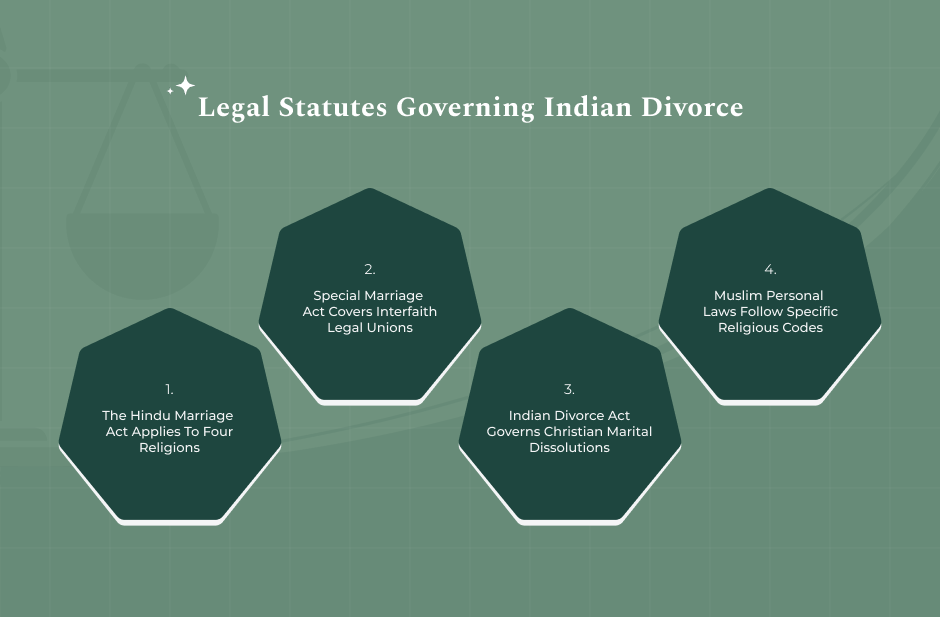
The rules governing the divorce process are mainly contained within the personal laws of the concerned individuals. This law provides the reasons under which an individual may apply for a decree of divorce or judicial separation.
Important Provisions In The Hindu Marriage Act
Mostly, the most preferred route in case of divorce among Hindus, Buddhists, Jains, and Sikhs is contained in the Hindu Marriage Act of 1955. According to Section 13(1), an individual is allowed to file for divorce on grounds such as cruelty, desertion, or adultery.
However, Section 13 B contains provisions regarding divorce by mutual consent and is the quickest way.
– Section 13B (Hindu Marriage Act, 1955)
The Special Marriage Act Of 1954

When it comes to a marriage that is done via civil law, the grounds needed are stated in Section 27 of the Special Marriage Act.

The significance of this Act lies in the provision of grounds for individuals of different religions, and it also offers an alternative to religious personal laws.
Mutual Consent Divorce: Step By Step Process
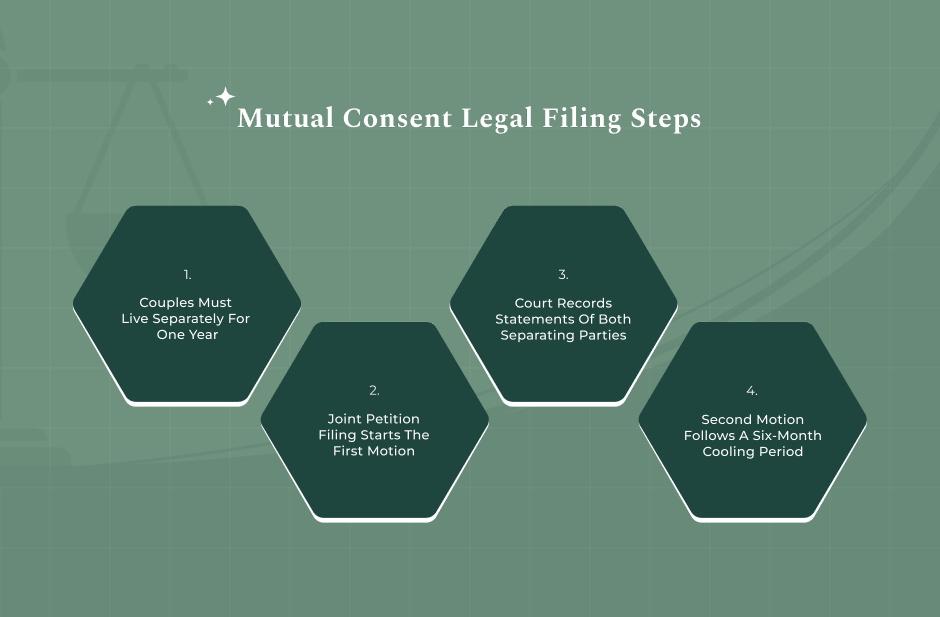
If you want to obtain divorce through mutual consent then it is one of the most preferred methods as it involves less suffering and expense. First and foremost, both spouses must agree on various aspects, for example, alimony and child custody.
Making The First Motion
The proceedings start by filing a joint petition under Section 13B(1) of the Hindu Marriage Act of 1955. The court considers the joint petition and takes statements from both the husband and wife.
Once convinced that their consent is not under any kind of compulsion, the court makes the “First Motion.”
Cooling-Off Period And Waiver Of Cooling-Off Period
The usual cooling-off period of six months comes after the first motion, during which there was an opportunity for reconciliation.
But now under new rules of alimony in India, the Supreme Court has made it possible to waive off this period. It can be waived off only when there is no chance left for reconciliation at all.
Litigious Issues Surrounding Contested Divorce
In cases where one party to a marriage refuses to dissolve it, then the other is compelled to take up the route of contested divorce. This entails showing grounds of certain faults through litigation and takes several years.
Establishing Proof Of Cruelty And Desertion
The most common fault ground invoked in Section 13(1)(ia) of the Hindu Marriage Act, 1955, is cruelty.
The recent judicial pronouncements of 2026 recognize that “cruelty” can also mean prolonged financial domination and mental indifference.
Desertion entails proving that one spouse has deserted the matrimonial house for over two years continuously.
Other Fault Grounds – Adultery and More
Even though adultery is not a criminal case anymore in India, it still remains a ground for divorce. The grounds for divorce include conversion from one religion to another, unsoundness of mind, and diseases that may be transmitted.
“The Rajasthan High Court has dissolved a marriage on the ground of mental cruelty, holding that repeated failure to pay maintenance, skipping court proceedings, and abandoning marital responsibilities cannot be brushed aside as minor lapses.” – (Source: Latest Laws)
The 25% Alimony Benchmark And Modern Precedents
The determination of maintenance in India is done by following certain judicial standards. They are designed to provide for the dignified living of the dependent party. Now, we examine the cases which led to the formation of this benchmark.
Kalyan Dey Chowdhury V. Rita Dey Chowdhury (2017)
In this landmark case of 2017 (Civil Appeal No. 5369) the Supreme Court determined that 25% of the gross salary of the husband would constitute an appropriate sum.
This percentage constitutes the “just and proper” monthly maintenance that should not be left to the discretion of lower courts during the divorce proceedings.
Rajnesh V. Neha (2020)
In the year 2020 (Criminal Appeal No. 730), the mandatory disclosure of information about the total income of the spouses was introduced.
Affidavits of their assets and liabilities had to be submitted by both spouses. This step helped prevent concealment of income to decrease the amount of alimony paid.
Computation of Alimony Settlements
Where there is an agreement for lump-sum alimony, then the sum payable will range between one-third and one-fifth of the payer’s net worth.
This will cover all properties, securities, and business enterprises. The new alimony laws in India state that an affidavit must be furnished stating all the assets. (Source: Aditya Birla Capital, 2026)
Child Custody And Interim Maintenance Rules
Child welfare and urgent financial support are key issues in a divorce case. Such provisions enable urgent help during lengthy proceedings.
Interim Maintenance Provision 125 CrPC / BNSS
Provisions for interim maintenance under Section 125 of the CrPC (now Section 144 of the BNSS) are meant to offer rapid redress.
This provision entitles the applicant to receive monthly maintenance. It applies to all nationals irrespective of their faith. The court seeks to render a decision within sixty days.
This way, the claimant is saved from living in destitution while fighting a lawsuit.
Child Custody Standards
What is best for the child is the paramount issue. The court looks at the mental stability and economic situation of the two parties. It tends to award physical custody to one party and visitation rights to the other. Joint custody has gained ground recently among courts in India in 2026.
Divorce Law For Christians And Muslims
Although the Hindu Marriage Act is widely used, other personal laws must not be overlooked. Such laws cover millions of Indians.
Legal Faculty For Christian And Muslim Divorce In India
Under the Indian Divorce Act of 1869, provisions for divorce between Christians are covered. According to Section 10 of the act, any one of the spouses can petition for a divorce citing reasons for their decision, such as adultery and cruelty, among others.
Also, for a couple to apply for divorce, it is important that in case of abandonment, the partner who left should have abandoned the other for a minimum of two consecutive years.
Section 10A
Section 10A of the same act offers an alternative approach towards divorce, whereby couples may voluntarily decide to divorce through mutual consent.
According to the section, the husband and wife should have stayed apart for a minimum of two years before applying for divorce.
The process is monitored by the court to ensure that no child is hurt.
Financial security still forms one of the core concerns in the recent legal changes in 2026. In the Christian maintenance cases, strict adherence to the law governing divorce alimony in India is required in order to ensure equal rights for both sexes.
In addition, the courts now have the power to give a judicial separation before making any divorce decisions. Through such an approach, the individuals are accorded a reasonable period within which to make their considerations without affecting the legality of the marriage.
Dissolution Of Muslim Marriages Act, 1939
The Dissolution of Muslim Marriages Act, 1939, is another essential statute that gives Muslim women the power in India.
According to this law, women have the ability to sue for a judicial divorce in relation to nine different causes. An example of such causes is where the husband has been out of touch for four years.
Through the courts, therefore, women are able to end marriages which are no longer functional.
Another important protection is when a husband fails to provide maintenance to the wife.
If a man does not provide maintenance to his wife for a period of two years, the process of divorce can be initiated by the wife. Cruelty and ill-treatment on a mental level also qualify as causes for judicial divorce.
In this way, women are assured of being freed from marriages which do not meet their standards. Judicial divorce has emerged as the norm for such matters in contemporary Indian society.
In order to protect a woman’s economic interests during and after a divorce, special provisions are made in the laws of India.
Protection of dower or Mehr that was given to the wife at the time of marriage is one such provision.
Moreover, alimony new rules in India have been considered for making future judgments fairer. In this way, a woman’s economic independence is ensured in any case.
Case Laws And The Power Of Article 142
The case laws have played an essential role in the day-to-day practice of divorces in local family courts.
In many instances, the judiciary exercises its powers to give complete justice when the statutes fall short.
Shilpa Sailesh Vs. Varun Sreenivasan (2023 INSC 433)
In this groundbreaking case, the Constitution Bench of the Supreme Court of India held that the court has the power to dissolve marriages based on irretrievable breakdown under Article 142 (Constitution of India, 1950).
In addition, this gives it the authority to ignore the mandatory waiting period that needs to be satisfied under the Hindu Marriage Act. Such a landmark case became the basis for several cases of dissolution from 2024 to 2026.
Rakhi Sadhukhan Vs. Raja Sadhukhan (2025 INSC 1436)
In this recently concluded case, the main issue revolved around the divorce alimony rules in India.
The Supreme Court substantially increased the maintenance amount and gave the right to transfer their marital home to the wife.
Read Also: Annulment Vs Divorce: Key Differences, Legal Grounds, And Guide
Famous Divorce Cases In India
The divorce process often comes into the limelight when celebrities break up and shed light on how the rich manage asset division and custody issues.
Hardik Pandya And Natasa Stankovic (2024)
In the latest case that was in the news due to rumors about the transfer of property worth 70%, the couple got divorced privately in India.
Although the details of the divorce remained confidential, it proved the interest of the public regarding alimony regulations in India. This example showed that celebrities settle down matters out of court with the help of private mediation.
Dhanush And Aishwaryaa Rajinikanth (2024)
After making an official announcement in 2022 about their divorce, the court issued the decree on their divorce in November 2024.
They filed for divorce through mutual consent, which demonstrates the ability of celebrity couples to divorce peacefully following the right procedure.
(Case No: OP 688/2024)
New Alimony Rules In India And Financial Security
Alimony rules in India in 2026 have changed significantly by addressing issues such as gender justice and recognizing the economic worth of domestic services provided by homemakers.
The alimony has been described as a fundamental right to maintain the same standard of living rather than being viewed as a gift from one party to another.
Calculation Of Permanent Alimony
The courts now consider the “earning potential” of the husband rather than the “current salary.”
In cases where the spouse decides to quit a well-paying job intentionally to evade paying maintenance, judges consider earning potential and compute alimony based on earnings. This factor is crucial when analyzing the new alimony rules in India.
Inflation Adjustment Clauses
One of the most significant changes in 2026 includes the inflation adjustments clause. Several courts now include a “5% increase every two years” in maintenance decrees. It ensures that the support’s purchasing power does not go down with time. (Source: Legal Eagle)
Expert Tips For Managing The Divorce Process
The whole process of divorce may be very emotional, but by having a plan in place, you can cut down the stress involved with it.
- Organize all financial documents, along with details of jointly owned property.
- Put the effort into getting mutual consent to save many years of court cases.
- Take advice from an experienced family lawyer according to your religion.
- Maintain evidence about any domestic or psychological abuse.
Frequently Asked Questions (FAQs):
There are numerous queries that arise in respect to the divorce process, which include those from NRIs staying abroad.
These frequently asked questions attempt to answer some common issues faced by people while seeking divorce in India in 2026.
Yes, it is possible if your marriage took place in India or one of the spouses stays in India.
In case of waiver of the cooling-off period, it takes about two to three months.
Yes, if the foreign decree has been passed by a competent court and follows natural justice.