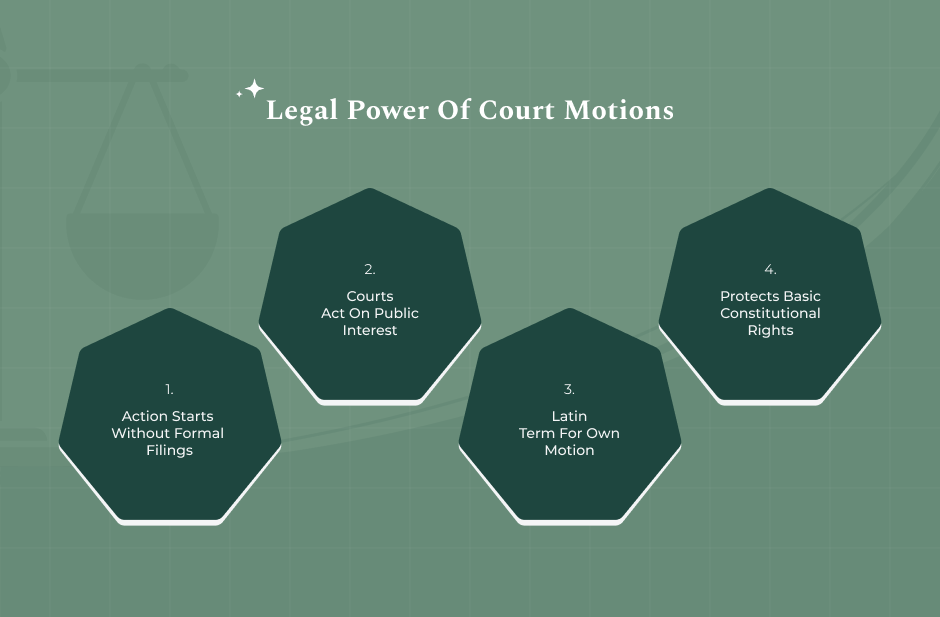
The suo moto case definition describes an instance in which a court will take up a matter of its own accord, without any formal petition being filed before it.
In most legal systems, the role of judges is that of a neutral party between the two contending sides. But in some cases, there needs to be intervention by a court to avert a major injustice.
At present, many high courts around the world are considering environmental emergencies and healthcare-related problems from this perspective.
Though there are no mass tort class-action lawsuits by this title in the US currently, the concept is sometimes invoked in discussions of judicial activism.
In this article, we will elaborate on the following:
- The core definition and legal origins of the term.
- How the American legal system views court-initiated actions.
- Notable instances and triggers for these proceedings.
- The difference between traditional litigation and autonomous judicial action.
- Federal and state perspectives on inherent judicial powers.
Defining The Suo Moto Case Meaning And Origins
Suo moto case definition comes from the Latin term “on its own motion.” It implies that the court can move on without waiting for any aggrieved party or complainant to initiate the process by filing a case.
Understanding “What Is Suo Moto Case” requires knowledge about “Inherent Power,” which the courts exercise in order to make sure that justice administration becomes equally efficient for everyone.
Difference Between Suo Moto and Conventional Legal Proceedings
In conventional lawsuits, there needs to be a plaintiff who files a case against an opponent. However, in a suo moto case, the judge himself initiates proceedings after observing an irregularity in a news item or letter.
American Standpoint On Independent Court Initiative
In America, suo moto differs slightly from what it means in common law or the Commonwealth system. In America, the “Case or Controversy” requirement of the Constitution is used to confine judicial power.
Federal Courts And Sua Sponte Motions
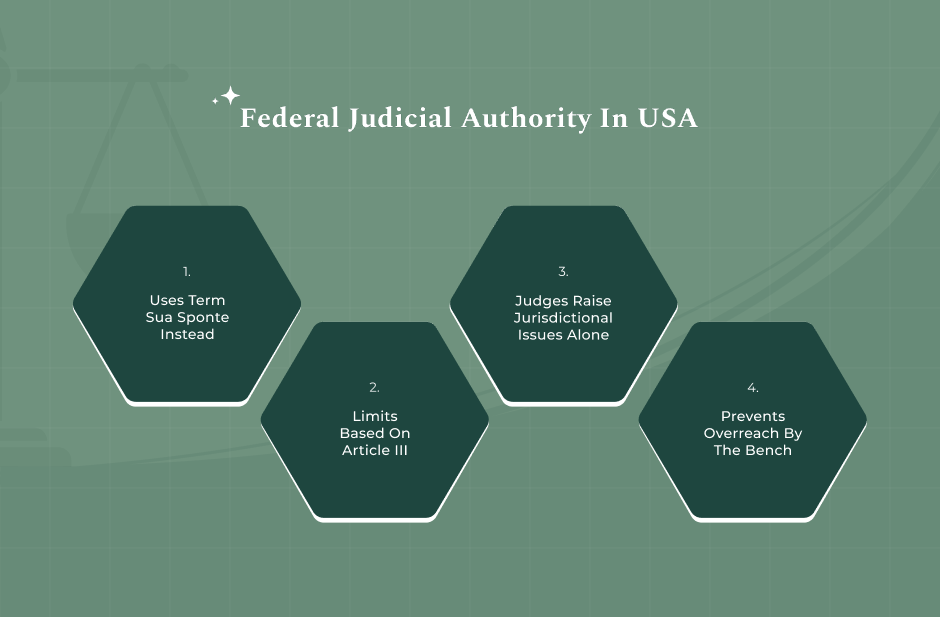
As opposed to suo moto, Americans have a word called “sua sponte”. The term describes situations where the judge brings out an issue not brought up by any of the parties’ lawyers.
The Limitation Of Judicial Power Under The Constitution
It is usually said that Article III of the US Constitution does not give the judges the power to seek out controversies in which to take an interest. For this reason, a judge can sue to dismiss a suit on his or her initiative, but never initiate a trial on his or her own initiative.
Judicial Triggers For A Suo Moto Case – Suo Moto Case Meaning
When the court takes suo moto case, it indicates that the situation observed by the court requires intervention. Such occurrences include instances where the fundamental rights of citizens are infringed upon or when public safety is threatened.
Media Reports And Public Outcry
It is common practice for judges to read the morning newspapers just like ordinary citizens.
In the event that there is a widespread calamity or scandal reported in the media, the court may exercise its suo moto case meaning powers to ask the government for explanations regarding the matter.
Examples Of Suo Moto Cases In Modern Law
One exemplary suo moto case example is the Supreme Court of India taking note of oxygen shortages during the recent global pandemic.
In the United States, a judge can exercise suo moto powers to issue sanctions against lawyers guilty of misconduct during court proceedings.
Suo Moto Case Initiated Based On Social Media Post
Social media posts often inspire courts to initiate proceedings. Where such posts depict a violation of fundamental rights, the judge can take cognizance and request the concerned department to provide a report (Source: Bar and Bench).
Does The Suo Moto Case Indicate That The Defendant Is Guilty?
Suo moto case definition only pertains to the way the case was initiated; however, the outcome of the case remains uncertain.
As per natural justice principles, a court must provide all sides involved in the case an opportunity to submit relevant information and arguments before making its ruling.
Can A Citizen Recommend Suo Moto To The Judge?
While a suo moto case can never be filed by a citizen, individuals may submit letter petitions to the Chief Justice.
When the petition brings up issues that are of vital national importance, a court might decide to elevate the letter to a suo moto case.
“The Supreme Court of India has often taken up cases ‘suo moto’ without any petition being filed, or interest being brought before them.” (Source: Scob Server)
Limitation Of The Power Of Suo Moto
Generally, the power of suo moto applies to Constitutional Courts, including Supreme Court or High Courts.
Lower courts have no choice but to try the cases submitted to them since they do not possess the “inherent powers” possessed by higher courts.
Suo Moto Case Dismissal For Insufficiency Of Evidence
The judge may take independent action on dismissing a case when it is realized that there is no justification for it.
This serves as a way to avoid wasting court time and ensure that the defendant is not harassed due to a baseless legal suit.
The suo moto case definition ensures that there is a safety valve for the oppressed. When victims of crime are unable to afford or lack the education to sue, the court takes independent action to ensure that the oppression ends by guaranteeing the constitutional rights of the oppressed.
However, critics believe that suo moto action in many situations leads to judicial activism. Taking independent action may see a judge usurping powers from the executive arm of government, which violates the separation of powers.
Read Also: Judicial Restraint Explained: Definition, Principles, History, And Modern Debate
Difference Between Suo Moto And Sua Sponte In US Law
The suo moto case definition and “sua sponte” are almost synonymous. Both terms mean of its own motion.
Although “suo moto” is used in many Commonwealth countries, US federal courts use “sua sponte” to refer to instances where judges raise questions such as jurisdiction without the consent of either party.
Independent Actions – Good Or Bad
Suo Moto Case Meaning Becomes Different In Terms Of The Level Of The Court You Are Presenting Your Case
In most cases, states offer more powers to the judges of handling the matters than that in the federal courts.
Discretionary Powers Offered To State Supreme Courts
Most state constitutions give their highest courts discretion in issuing extraordinary writs. This means that they can handle the issues in the subordinate court without being asked by the parties involved.
Guidance On Independent Actions From Rules Of Civil Procedure
Rule 11 of the Federal Rules of Civil Procedure offers a way for a judge to conduct proceedings in the interest of justice without being prompted by the litigating parties. This means that the suo moto case meaning still exists in the US.
Case Laws Elaborating Suo Moto Meaning
These are the cases that show that independent actions of courts help in safeguarding the integrity of the laws.
Chambers V. NASCO Inc. 501 U.S. 32 (1991)
According to this court decision, the United States Supreme Court has confirmed that the Federal Courts have the authority of “inherent power”.
This implies that it has the power to take necessary measures to manage itself. Even without any statutory law, it may sanction bad faith behavior by the parties involved. (Source – Justia)
Link V. Wabash Railroad Co. 370 U.S. 626 (1962)
It states that the Judge may decide to dismiss a case where the plaintiff does not bring a lawsuit against it.
This shows the suo moto case meaning in light of the fact that the court exercised the suo moto jurisdiction.
Why You Need To Know The Suo Moto Case Meaning
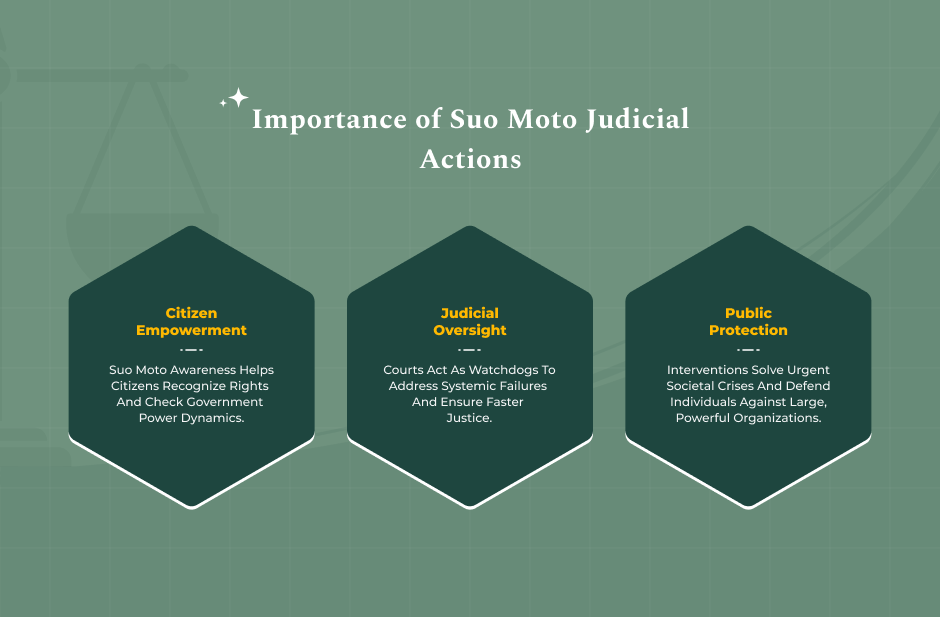
Not only law practitioners but every citizen needs to know the suo moto case meaning.
It is important for each and every citizen to understand how judiciary serves as a social watch dog.
In case of an emergency where the other branches do not take measures to solve it, then the suo moto case meaning may be useful.
The concept of What Is Suo Moto Case provides knowledge on how larger problems, such as environmental pollution or violation of human rights, are dealt with.
This information will help one know when the courts have intervened to defend the “little guy” from more powerful organizations that would have escaped scrutiny otherwise.
Judicial Accountability Monitoring
Knowledge of the definition of the suo moto case ensures that the judiciary can also be held accountable. The conversation on when judicial intervention stops and “judicial overreach” starts will always be ongoing to maintain equilibrium in the democratic system.
Frequently Asked Questions (FAQs):
The suo moto case definition assists citizens in realizing that law-making goes beyond traditional cases. The following are some frequently asked questions about the use of suo moto powers by the court.
No. Normally, criminal cases in the United States are initiated by the executive branch of government using a prosecutor to indict or file charges against an individual for crimes. The judge is not able to initiate the criminal process by himself.
In Public Interest Litigation (PIL), the citizen files a suit as an individual on behalf of the community. In the case of a suo moto action, the judge initiates it on his own accord.
Certainly, an appeal can be filed by anyone whose rights were violated through an independent action taken by the courts. A person may question the correctness of the decision, alleging that it was beyond the powers of the judge and/or the law.
It acts as a backstop mechanism. Marginalized communities who are unable to afford an attorney have no option but to wait for a suo moto case. It allows for justice to be delivered even without a complaint being filed.