Paralegal vs Lawyer is a comparative analysis that aims to assist clients and students in comprehending how legal teams operate in the USA.
Although the two specialists are engaged in complicated legal issues, their scopes of duties and educational backgrounds are completely different from each other.
At the moment of April 2026, the legal profession is undergoing a revolution due to the introduction of the Access to Justice campaigns in various states of the nation.
Presently, litigation processes are taking place in Oregon and Arizona regarding Licensed Legal Paraprofessionals.
The program grants the opportunity for non-lawyers to do tasks that were done by lawyers, including the representation of litigants in family courts.
Besides, artificial intelligence is becoming an integral part of legal studies, which changes the working routine for the two specialists, i.e., Paralegal vs Lawyer.
In this article, we will elaborate on the following:
- The core definitions and professional boundaries of each role.
- Educational requirements and licensing paths in the US.
- Specific tasks that distinguish a lawyer vs paralegal.
- Current legislative trends and landmark legal precedents.
- Answers to common questions about legal representation.
Defining Professional Boundaries And Legal Authority
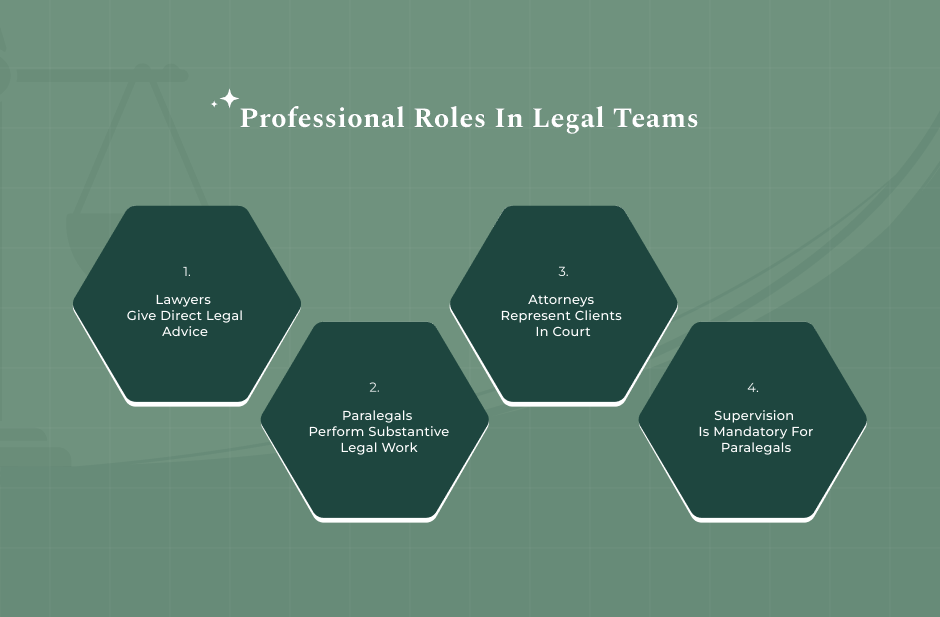
When discussing paralegal vs lawyer roles, people tend to focus on what each of the professionals is allowed to do according to the law.
While attorneys have their law license, paralegals are very important in assisting them in their work.
Scope of Practice And Licensing
When distinguishing between a paralegal vs lawyer, it is crucial to consider state bar associations, where lawyers need to have a bar license while paralegals are not required to get a license issued by the state, although they have certain certificates.
Unauthorized Practice Of Law
The most prominent distinction in the paralegal vs lawyer vs attorney comparison is related to “Unauthorized Practice of Law.”
This means that paralegals cannot make decisions on fees, file a pleading, or provide independent legal advice.
Setting Legal Fees And Contracts
It is only possible for a lawyer to make contracts with clients and determine legal fees. Paralegals can explain how much a lawyer charges for his/her services, but it should be an attorney who does all the paperwork.
Paralegal Vs Lawyer – Giving Independent Legal Advice
Paralegals can discuss legal matters with clients through attorneys. However, they cannot offer legal interpretations of any acts or give independent advice on how to resolve legal issues.
Paralegal Vs Lawyer – Educational Paths And Certification Standards
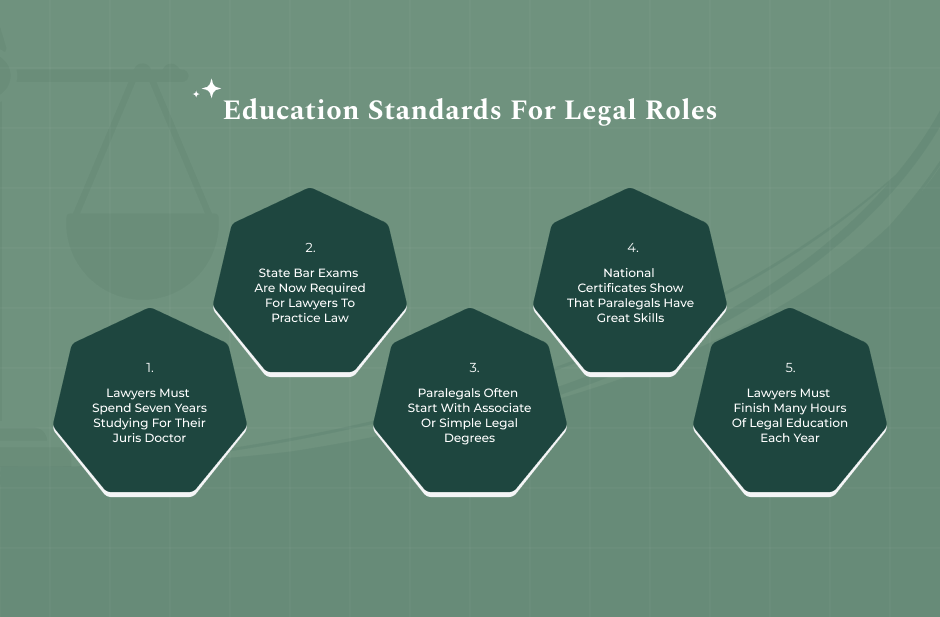
The journey towards a profession entails different amounts of effort in education and finances. Lawyers take a highly standardized route while paralegals enjoy a wide range of ways to enter their profession.
The Requirement For A Juris Doctor Degree
Lawyers must graduate from a four-year program and then pursue three more years of law school education. They need to earn a Juris Doctor degree and then successfully pass the state bar exam (Indeed).
Requirements For Paralegal Certification/Degrees
Many paralegals have either an associate’s or a bachelor’s degree in paralegalism. They can also obtain a certificate from any recognized organization, such as NALA and NFPA, to demonstrate their knowledge to potential employers (Clio).
The Number Of CLE Hours Per Year
Licensed lawyers have a legal requirement to accumulate a specified number of CLE hours every year. It helps them keep abreast of changes in laws and ethics.
Specializations For Support Staff
Paralegals choose one specialization that includes litigation, real estate law, or IP protection. Their educational programs involve understanding procedural issues of documentation and discovery.
Legislative Trends And Landmark Legal Precedents
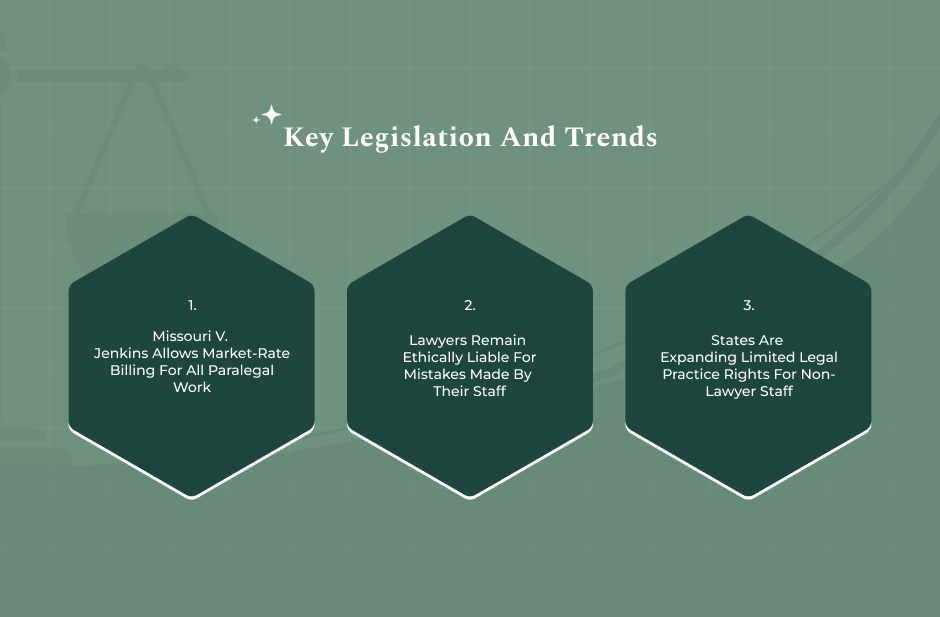
However, the laws relating to the relationship between Paralegal Vs Lawyer are continuously being defined by court rulings in the recent past.
In the impact of Missouri v. Jenkins (491 U.S. 274), the Supreme Court allowed legal fees for paralegal work that would be done at market price.
This ruling confirms that the legal fees for paralegal work are independent of the fees charged for secretarial work. (Source: ABA Model Rule 5.3)
The ABA Model Rule states that lawyers are answerable for the conduct of the assistants in matters of ethics. (Source: CliffNotes)
Consequently, when the paralegal makes legal errors, it is likely that it will be the supervising attorney who suffers the consequences.
Legal Paraprofessionals In 2026
States such as Washington and Minnesota are leading the way in introducing new classes of legal personnel that fall under the category of paralegal vs lawyer.
These legal workers will provide limited legal assistance in certain areas of law.
Cases Relating To Effective Assistance
A court may reverse a decision in a case such as People v. Alexander (161 Misc. 2d 647) because of the use of non-lawyers for important legal work without supervision.
Paralegal Vs Lawyer – The Financial Return On Investment For Legal Professionals
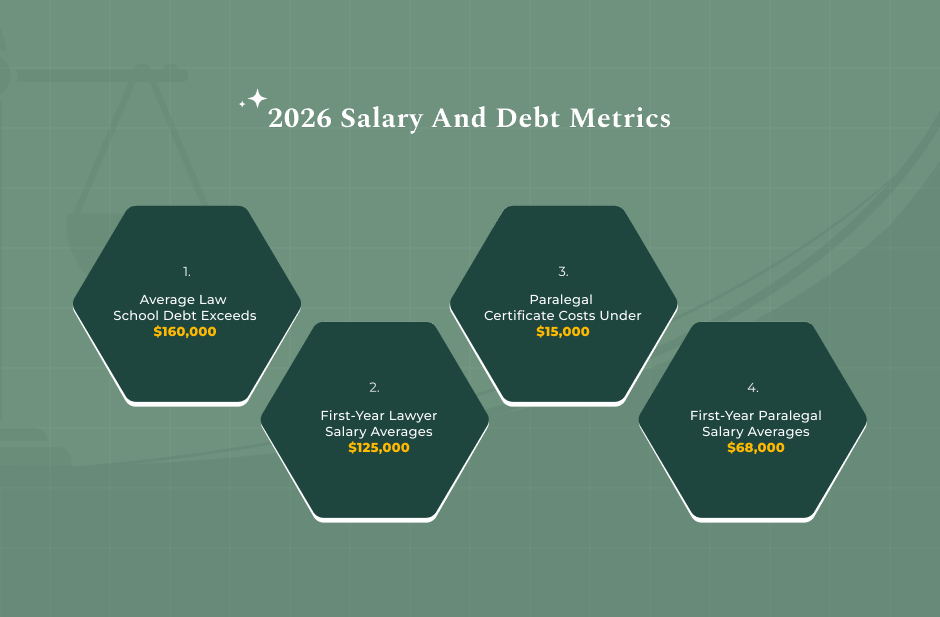
Choosing between the two career paths in 2026 demands an assessment of finances versus the ability to earn money right away.
Even though lawyers make larger salaries, the debt-to-income ratio tends to be much better for young professionals among paralegals (Indeed).
Long-Term Earnings Comparison
One has to consider the “break-even” period when looking at the financial lawyer vs paralegal comparison.
It takes lawyers more than ten years to repay debts, whereas paralegals start earning money right from the beginning after training for a much shorter period.
Law School Cost And Lost Earnings Potential
An attorney spends three years without making money because he/she studies full time in college.
The lost earning potential and expensive federal student loan financing represent a major obstacle for most candidates considering a law degree in 2026.
Salaries Of Experienced Paralegals Surge
Senior paralegals in specialized areas, such as IP law, already earn six figures, which reduces the disparity between paralegals and lawyers considerably.
AI And The Transformation Of Daily Legal Workflows
For the paralegal vs lawyer in 2026, it is all about how they use generative AI technology. Today’s paralegals cannot operate without technology.
The technology has advanced so far that every modern law office has it (Source: Clio).
The Evolution Of The Legal Prompt Engineer
Today’s paralegal is no longer just a person who files paperwork. He is the Legal Prompt Engineer, whose job is to check the accuracy of the AI summaries and protect any sensitive data while reviewing the case on digital devices.
Defending Against Artificial Intelligence Hallucinations
Since an artificial intelligence may make up case laws that do not exist, it becomes the job of the paralegal to defend the firm against such cases by checking all citations made by machines to protect the firm against a lawsuit.
Human Approval By The Attorney
The role of the attorney in the paralegal versus lawyer relationship changes here because it requires him to approve everything in his capacity as a human being involved in the whole process.
The Expansion Of Licensed Legal Paraprofessionals
Among the new developments expected in 2026 will be the emergence of the LP, which is located in terms of a paralegal vs lawyer debate.
The LP allows a non-lawyer professional to offer limited-scope representation in some particular courtrooms.
The Filling Of The “Access to Justice” Void
States such as Arizona and Minnesota have addressed the “Access to Justice” issue through the involvement of LPs.
Here, one finds an intriguing situation whereby the discussion about what a paralegal is vs lawyer is complicated since LPs are entitled to appear before judges in courts.
The LPs Limited Scope Representation Policy
There are certain cases in which the LP cannot engage, including those involving high-stakes litigation.
By limiting the LPs to particular tasks, the system seeks to prevent LPs from overstepping into the domain of licensed lawyers.
Consumer Effects On Costs
An LP may help you reduce your spending by 40%-60%. This development requires conventional law firms to rethink their fee policies in 2026.
Frequently Asked Questions (FAQs):
Knowledge about the differences between paralegals and lawyers could be beneficial for citizens when choosing the right type of legal assistance.
Here are answers to the issues relevant to both existing clients and those planning to become law students.
Typically, a paralegal will need to work under a lawyer’s supervision. In some states, however, licensed paraprofessionals may be able to provide family law services.
Indeed, it applies to a lawyer’s entire team. Your information remains confidential if you talk to a paralegal who works for your lawyer.
You should hire a lawyer for that task. Even though a paralegal can prepare a contract, only an attorney can advise you about its legality.
Each state has a “bar directory” available on its website. A quick search of his/her name will reveal if he/she is a practicing, licensed attorney in good standing in the state.
Paralegals incur fewer expenses when providing legal services. Their education and overhead costs are significantly different from those of attorneys.
The use of a paralegal makes it possible for the firm to offer affordable services.
Usually not. You must either appear in court alone or hire an attorney. Administrative agencies such as the Social Security Administration permit hiring non-lawyer representatives.
The supervising lawyer would be liable for giving any legal advice to you. You could file a case of malpractice against the attorney or complain to the bar association in your state.