Today’s topic: Is it legal to ride in the bed of a truck?
Whether you’re cruising through a rural town or hauling a crew between job sites, seeing passengers in a pickup bed is a familiar sight. However, this common practice carries heavy legal and physical risks.
However, beyond the lack of seatbelts and structural protection, the safety stakes are startling. For instance, according to the Child Safety Network, roughly 50 people under age 21 lose their lives annually in truck-bed-related incidents. (Source: STAVER)
While some view it as a harmless tradition, state laws have become a complex patchwork of age limits, agricultural exemptions, and strict prohibitions.
As a driver, navigating these regulations is vital to avoiding hefty fines or liability in the event of an accident.
In this article, we will talk about the following things:
- Is it legal to ride in the bed of a truck?
- Statutory framework of riding.
- Legal exceptions to riding in the bed of a truck.
- Civil liability in case of accidents.
- Insurance and policy exclusions.
Therefore, keep reading!
Is It Legal To Ride In The Bed Of A Truck?
Safety experts may have warned you that riding at the back of a pickup truck is not safe. However, you might also be asking yourself: Is it legal to ride in the bed of a truck?
Magnum Truck Racks points out that roughly twenty-four states have no law whatsoever banning riding in the bed of a pickup. At the same time, close to 30 states have some sort of regulations.
For instance, states like Alabama, Alaska, Arizona, Idaho, and several others have no restrictions at all.
At the same time, many states do specify things like the minimum age and safety measures that must be taken to ensure the well-being of the person riding in the bed of the truck.
U.S. States With Age And Safety Restrictions
RealTruck explains that states such as Florida, Texas, and Georgia typically allow riding in a truck bed only to persons who are 18 or older, although some states set the age limit lower.
Some other rules that are imposed in these states are speed limitations (e.g., 35 mph in Pennsylvania), the requirement to be seated directly on the bed floor, and the necessity of wearing a seatbelt, as in California.
Near-Total Bans and Exceptions
To give some examples, New Jersey outright bans riding in a truck bed. On the other hand, New York enforces strict regulations, but with a few exceptions for very short trips. Most states allow for exceptions when it comes to farming or parades. (Source: RealTruck)
Statutory Frameworks: The Three Tiers Of State Law
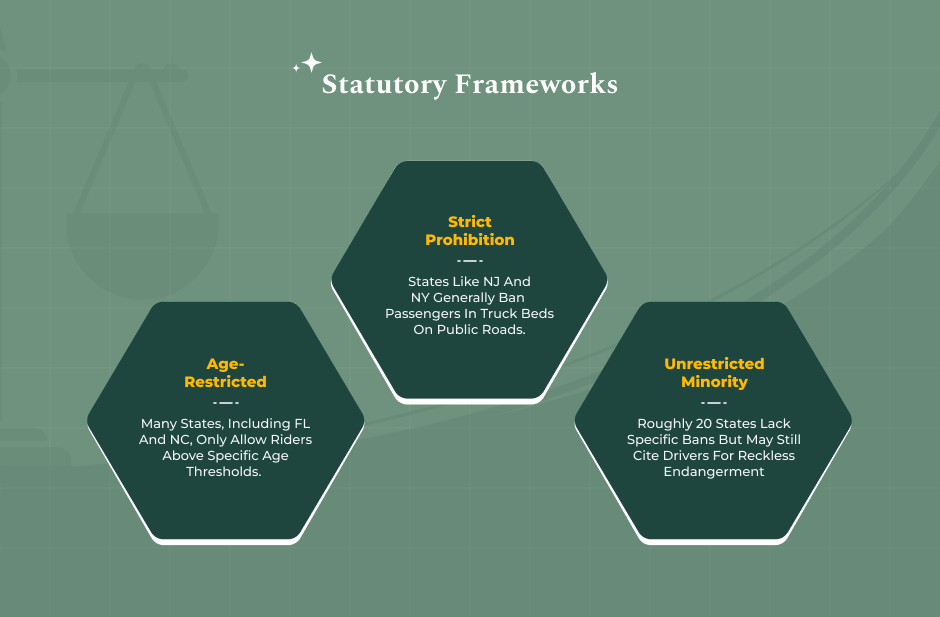
The statutory landscape for riding in a truck bed is a patchwork of state-level police powers, as no federal mandate exists. Laws generally fall into three distinct tiers:
Tier 1: Strict Prohibition States
States such as New York, New Jersey, and Arkansas are among those that have implemented highly restrictive mandates.
For example, New York’s VAT 1222 disallows carrying passengers in the body of a truck if there are more than five people under 18 years of age, unless the vehicle is equipped with side racks and a tailgate. (Source: National Highway Traffic Safety Administration)
However, New Jersey’s N.J.S.A. 39:4-69 is a more general law that prohibits riding on any part of the vehicle that is not intended for passengers, thereby making it illegal to travel in the bed of a truck on public roads.
Tier 2: Age-Restricted Jurisdictions
The majority of states utilize age as the primary regulatory threshold. There are two of these thresholds that you need to know about:
- The “Adult Only” (18+) Rule: States such as Florida (Fla. Stat. § 316.2015) and Texas (Tex. Transp. Code § 545.414) strictly prohibit passengers under 18 from riding in an open bed, with limited exceptions for parade or agricultural use.
- The “Teen Permissive” (16+) Rule: Jurisdictions like North Carolina (N.C.G.S. § 20-135.2B) allow passengers aged 16 and older to ride unrestrained, provided the tailgate is secured.
Tier 3: The Unrestricted Minority
In around 20 states, such as Alabama, Arizona, and Montana, there are no separate laws regarding truck-bed passengers. But, this is not a “legal blanket.”
In these states, the police officers usually use Reckless Endangerment or Negligent Operation laws if the driver’s speed or moves so endanger the passengers as to constitute “a substantial risk of serious physical injury” (for example, Alabama Code 13A-6-24).
Key Legal Exceptions And Affirmative Defenses
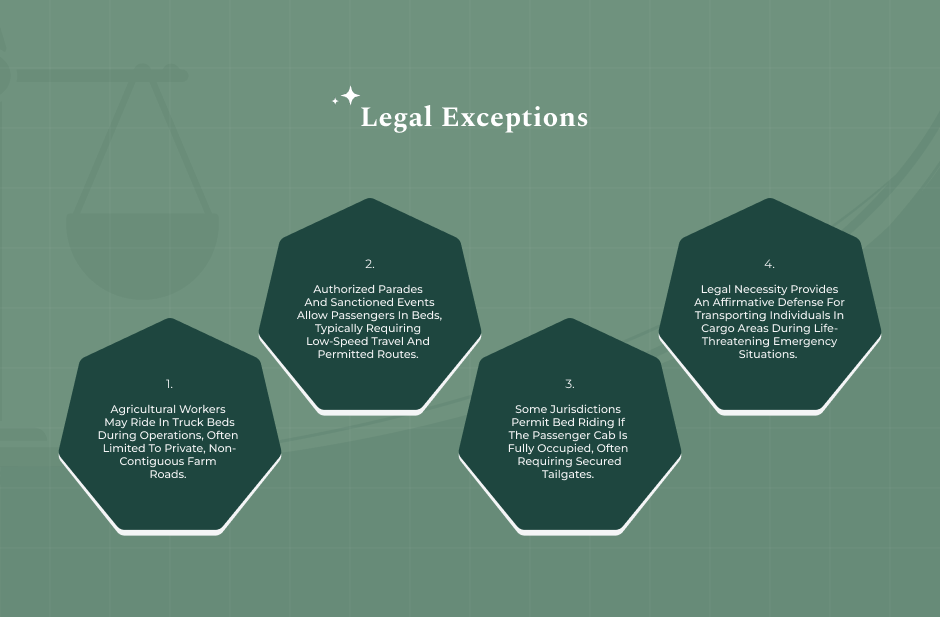
So, is it legal to ride in the bed of a truck? The shortest answer is: it depends on your state. However, there are a few things that you need to know!
Even in states with restrictive statutes, specific exemptions often serve as affirmative defenses against traffic citations or civil liability.
These exceptions generally prioritize economic utility, community tradition, or immediate safety.
Agricultural And Occupational Necessity
The “Farm Worker” exemption is the most common legal carve-out. States like California (VC § 23116) and Florida (Fla. Stat. § 316.2015) permit passengers in the cargo area if they are engaged in agricultural operations.
However, this is typically limited to transit between “non-contiguous fields” or on private farm roads.
If the transport occurs on a high-speed highway or for non-work-related purposes, the exemption may be voided, as seen in North Carolina’s N.C.G.S. § 20-135.2B.
Sanctioned Events And Parades
Secondly, many jurisdictions allow unrestrained passengers during “authorized parades.”
These exemptions, such as those in Texas (Tex. Transp. Code § 545.414), usually require the vehicle to maintain a speed below 20 MPH and operate within a defined, permitted route.
Additionally, violation of these speed or route parameters can strip the driver of legal protection.
The “Seat Capacity” Rule
A niche but critical defense exists in states like Hawaii (HRS § 291-14), where riding in the bed is legal if the passenger cab is fully occupied.
This “necessity of space” rule often applies only to passengers over the age of 12 and requires that the tailgate be closed and passengers sit flat on the floor.
Emergency Situations
The doctrine of “legal necessity” applies in life-threatening scenarios.
In states like Ohio (ORC § 4511.51), authorities permit the transport in a cargo area during emergencies. Especially where no other reasonable means of transport exist.
This acts as an affirmative defense. It shifts the burden to the defendant to prove that the urgency outweighed the safety risk.
Civil Liability And Tort Implications
Transporting passengers in a truck bed frequently exposes the driver and vehicle owner to great risk in a civil lawsuit. Typically, when a crash takes place, the legal dispute revolves around these three fundamental concepts in tort:
The “Assumption Of Risk” Defense
Under this particular principle, the defendant can maintain that the plaintiff was fully aware of the danger in riding the unsecured cargo area. Still, they voluntarily and intentionally accepted it.
In those states where this is an affirmative defense, passengers’ awareness about the risk can entirely prevent or greatly diminish the plaintiff’s damages. For instance, this would include the absence of seatbelts or the possibility of being thrown out.
However, many modern courts have merged “implied assumption of risk” into comparative negligence frameworks.
Comparative Vs. Contributory Negligence
There are times when the state’s negligence standard determines the legal outcome. Here’s what you should know:
- Comparative Negligence: Most states follow this approach. Here, the jury decides the percentage of fault for each party. For example, if a passenger is 30% responsible for getting into the vehicle’s bed, then the $100,000 award will go down to $70,000.
- Contributory Negligence: There are a few jurisdictions, like North Carolina and Alabama, where if a plaintiff is even 1% at fault for his/her own injury, they will not get any recovery.
Negligent Entrustment
Authorities can hold a vehicle owner directly liable if they allow someone to use their truck to transport passengers in the cargo area. And that is irrespective of the driver’s actions.
To prevail, a plaintiff must show the owner knew, or should have known, that the driver was likely to use the vehicle in a manner involving an unreasonable risk of harm.
Insurance And Policy Exclusions
Insurance coverage for truck-bed injuries is often precarious due to strict policy definitions regarding “occupancy.”
The “Designed For Transport” Clause
Typically, standard ISO (Insurance Services Office) personal auto policies define “insured premises” as areas specifically designed for seating.
Insurers have often used “non-passenger area” exclusions to refuse claims, stating that a truck bed is a cargo space, not a passenger compartment.
If a passenger is thrown out of a vehicle, the insurer might claim that the person was not “occupying” the vehicle in accordance with the model, resulting in a complete refusal of the liability coverage.
MedPay And PIP Limitations
In “No-Fault” states, it is possible that Personal Injury Protection (PIP) or Medical Payments (MedPay) coverage will be denied to the claimant if they were not following the relevant state safety laws at the time of the accident.
State laws that require the use of seat belts for all occupants will, in general, render the unrestrained riding in the bed of a truck a “statutory exclusion,” which will then allow the insurers to legally skip the mandatory payments.
Read Also: How Long Does A Speeding Ticket Stay On Your Record?
Commercial Risk And Premiums
Lastly, for construction or landscaping enterprises, carrying workers in truck beds is a very dangerous practice.
Commercial General Liability (CGL) as well as workers’ Compensation underwriters tend to point this out as a risky behavior when they do their audits.
Sustained and recurrent employment of open-bed laborer transport may result in the designation falling under the category of “high-risk.”
Additionally, there will be the inevitable consequences of significantly high premium costs. Or even the insurer’s refusal to renew the policy on the grounds of the destructive potential that a “multi-claimant” ejection would present.