How long does a speeding ticket stay on your record? This is a concern that millions of American drivers face every year after seeing those flashing lights in the rearview mirror.
As of 2026, most states have updated their digital tracking systems to make it easier for insurance companies to detect even the slightest infraction in days of the conviction.
Although there are no major federal lawsuits that have changed the national traffic laws, most states, including California and New York, have recently changed their point reduction eligibility criteria to encourage defensive driving courses. (Source: U.S. News)
In this article, we will discuss the following:
- How long does a speeding ticket stay on your record, on an average?
- The difference between the points and the actual conviction.
- The state-by-state guidelines for ticket retention.
- Ways to remove or conceal the ticket from your public driving record.
The Short Answer: How Long Does A Speeding Ticket Stay On Your Record
For the average driver in the United States, a speeding ticket will appear on a driving record for three to five years.
However, this is not a hard and fast rule, as this is contingent upon the state in which the ticket was issued and the speed at which the driver was traveling.
What Determines The Length Of Time A Speeding Ticket Appears On Your Record?
How long does a speeding ticket stay on your record? The answer to this is that not “one-size-fits-all”.
There are multiple factors, and understanding these will help you answer the question under multiple types of circumstances.
State Laws And Dmv Regulations
Each state’s Department of Motor Vehicles (DMV) has its own set of administrative regulations regarding record retention.
For example, while one state may remove a minor violation from your record after two years, another state may keep the information on record for a full decade to determine repeat offenders.
Level Of Offense Determining How Long Does A Speeding Ticket Stay On Your Record
A speeding ticket for driving five miles per hour over the speed limit is different from a “super speeder” ticket or a charge of reckless driving.
Speeding tickets are considered serious offenses and stay on your record much longer than a minor technicality.
Your Driving Record
If you are a repeat offender, the DMV might give you a longer time period for a speeding ticket to be active on your record so that they can keep a close watch on your activities.
However, a first-time offender might be eligible for options that will keep your speeding ticket hidden from insurance companies almost instantly.
Average Time A Speeding Ticket Stays On Record (By Category)
Speeding tickets are generally categorized based on how much you were speeding over the posted speed limit, and this helps determine the “shelf life” of the ticket as per the law.
The more dangerous your act, the longer the state will keep a close watch on your driving privileges.
Here are the Violation Categories and Time Periods.
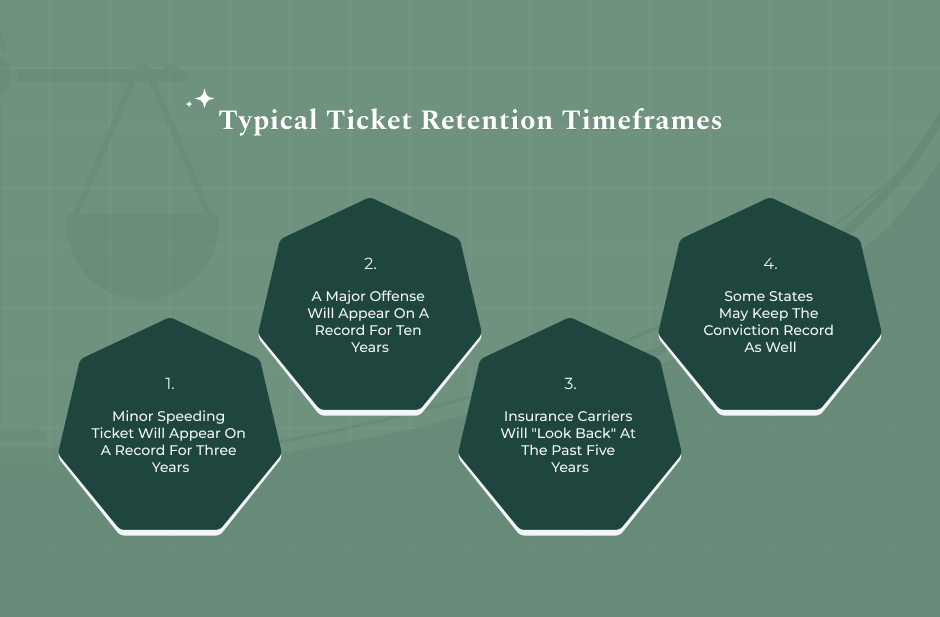
- Minor speeding (1-10 mph over) stays on record for 3 years.
- Moderate speeding (11-20 mph over) stays on record for 5 years.
- Excessive speeding (21+ mph over) stays on record for 7 to 10 years.
- Criminal speeding charges result in a permanent record.
How Long Does A Speeding Ticket Stay On Your Record: Examples Of Ticket Length Per State
Due to the fact that traffic laws are not uniform, the amount of time a speeding ticket will remain on your record changes as soon as you cross state lines.
Certain states are known to be extremely lenient, while others rely on permanent records to keep you in line for as long as possible.
California And Texas
In California, a speeding ticket will remain on your record for three years and three months (Source: AutoInsurance.com).
In Texas, speeding tickets will remain on your record for three years, although it is the insurance companies that are most concerned with this information.
Florida And New York
Florida is a bit tougher, keeping most speeding tickets on your record for five years. In New York, points from a speeding ticket will only count toward a license suspension for 18 months, although the conviction will remain on your record for three years. (Source: scheuermanlaw.com).
Permanent Record States
Examples of states like Alabama and Colorado are known to keep traffic convictions on a driver’s record permanently.
The “points” from your traffic ticket will soon expire and no longer affect your license status.
However, the record of the event will be accessible to law enforcement officials indefinitely.
Driving Record vs Insurance Record – Why They’re Different
It is commonly believed that once the ticket “expires” from your DMV record, your insurance rates will automatically lower.
This is not the case, as insurance companies have their own records. Moreover, “look-back” periods are separate from state regulations.
How Speeding Tickets Affect Your Insurance Rates
One speeding ticket can raise your annual insurance rate by an average of 20% to 30% (Source: Liberty Mutual).
This is because a speeding ticket is perceived as a symptom of high-risk driving, which can lead to a future accident.
Average Premium Increase
If you pay $2,000 per year as a driver, a 25% increase would mean an additional $500 per year.
Having to switch from a clean record to a record with a ticket may also make you ineligible for “good driver” discounts, adding to the overall expense.
How Long Will The Increase Last
Most insurance companies will consider the last three to five years of your driving record when you renew your insurance.
Although the state may retain the ticket for ten years, most insurance companies will stop charging you the surcharge after the third or fifth year, assuming you have not received any other tickets.
How Points Are Calculated On Your Driving Record
Some states operate a “demerit point” system to monitor poor driving behavior without immediately revoking your license. Points are a convenient way for the DMV to determine how many tickets you have accumulated over a certain period of time.
When Points Expire
In most states, points expire much more quickly than the ticket itself, typically within one to two years of the date of conviction.
For instance, in New Jersey, points are decreased by three for every year of clean driving.
When Tickets Disappear Vs Points
It is crucial to recognize that even if points have expired, the speeding ticket will still appear on your public record.
This means that your employer or background screening firm will still be able to see the conviction even if your “point balance” is zero.
Can You Remove A Speeding Ticket From Your Record Early?
How long does a speeding ticket stay on your record? Well, fortunately, there are a number of ways to legally avoid having a speeding ticket haunt you for years to come. The trick is to take action quickly after receiving a ticket.
Traffic School Programs
Most courts will permit you to take a defensive driving course in exchange for “hiding” the ticket.
This means that the ticket will still appear on your record, but it will not be accessible to insurance companies, which will prevent your premiums from rising.
Ticket Dismissal Or Plea Bargains
A traffic attorney may be able to plea-bargain your speeding ticket down to a “non-moving violation.”
Non-moving violations, such as a broken taillight, will not put points on your license or raise your insurance premiums.
Special Circumstances That Can Alter the Timeline
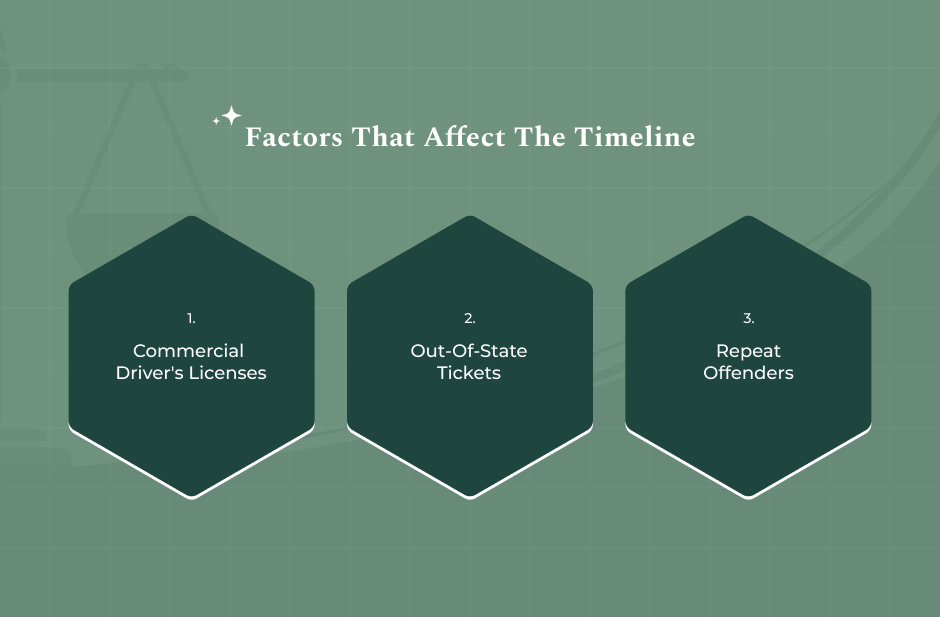
There are some special circumstances that can significantly affect how long does a speeding ticket stays on your record.
These include:
1. Commercial Driver’s Licenses
CDL drivers are held to a much higher standard and may have permanent records placed on them for offenses that would be merely a minor violation for a non-commercial driver.
2. Out-of-State Tickets
Most states are members of the Driver License Compact, which means that a ticket in the state of Nevada will definitely show up on your record in the state of Florida.
3. Repeat Offenders
Receiving multiple tickets within a 12-month period may result in an automatic license suspension and an extended record retention period.
Read Also: How Long Before An Unpaid Ticket Becomes A Warrant?
Professional Advice To Lessen The Impact Of A Speeding Ticket
Even if you have a ticket on your driving record, there are steps you can take to minimize the damage. If you’re fighting a citation locally, an experienced traffic ticket lawyer in Atlanta can help you choose the best option—traffic school, negotiation, or contesting the ticket—based on Georgia court practices.
Consider switching to a new insurance company after two years to find a company with a shorter look-back period.
a. Shop Around for a New Insurance Company: Not all insurance companies have a five-year look-back period; some only care about the last 36 months.
b. Take a Voluntary Course: In some states, such as New York, you can take a point reduction course even if it was not ordered by the court.
c. Check Your MVR: Request a copy of your Motor Vehicle Record (MVR) from the DMV to ensure that old tickets have been removed on time.
d. Avoid “Niche” Tickets: Speeding in school zones or construction zones usually carries double points and is retained on record for a longer period of time.
FAQs About Speeding Tickets And Driving Records
How long does a speeding ticket stay on your record? The answer to this is best arrived at by studying state policies and insurance rationality.
We have answered a few pertinent questions relating to “how long does a speeding ticket stay on your record” that will make your life easier as a driver.
In case of background checks for jobs, tickets will have a valid status up to seven years. This is ofcourse subject to the state laws and the type of employment. However, if your job requires you to drive a company car, your complete record will be up for consideration.
In case you move to a new state, your driving record, including your tickets don’t simply go away. The Driver License Compact (DLC) extends to multiple states. This is an agreement between states to exchange information about traffic violations. This will, therefore allow for the speeding ticket from one state to be transferred to another.
Expungement is typically considered for criminal offenses, not administrative driving records. In some states there is a “record sealing” or “set aside” process. It applies to minor traffic offenses, if a significant amount of time has passed since the offense and no other offenses have been committed.