Is it illegal to drive with headphones? Or is it just about safety? This is a question that most people have been asking for years. Literally. But not many actually have the real answer.
A lot of drivers slip on noise-canceling earbuds or a headset. They think it’s the perfect way to catch up on podcasts or take calls without using their hands.
Sounds convenient, right? But before you settle in for your commute, you have to ask: Is this even legal? The answer isn’t always a simple yes or no!
For instance, in the US, there’s no federal law that says you can or can’t wear headphones while driving. It really depends on which state you’re in.
Some states don’t have any rules about this. However, others have laws that ban wearing headphones altogether. And if the police authorities catch you, you could end up with a big fine.
It’s not just about what the law says, though. Police and safety experts are worried about how safe it is to wear headphones while driving.
And this is primarily because of “auditory masking.” Due to this, you can’t hear important sounds like sirens, tires screeching, or car horns.
Even if it’s not against the law where you are, a police officer might still give you a ticket for distracted driving. Especially if they think your headphones are making it hard for you to pay attention to the road.
In this blog, we will talk about the following:
- Driving laws and the use of headphones.
- Where is it illegal to drive with headphones?
- Laws about distracted driving.
- Penalties and legal consequences of wearing headphones and driving.
Therefore, if these are what you want to know, keep on reading…
Driving Laws & Headphones: An Overview
So, is it illegal to drive with headphones? To understand that, you need to first learn about the driving laws in certain states.
The legal situation for driving while wearing headphones is quite complex. Moreover, there is no single global standard.
Many places do not have specific laws about headphones. However, that does not mean that you cannot use them.
Most areas use general distracted-driving or “careless driving” laws. And police officers can apply at their discretion.
Additionally, they can charge you with not keeping a proper lookout or with unsafe operation of a vehicle if they see that the use of headphones is reducing your ability to hear important sounds, like:
- Emergency sirens.
- Car horns.
- Tires screeching.
For instance, the Podor Law Firm mentions that in Texas and similar states where there is no specific prohibition against headphones, people have been charged with “failure to maintain proper lookout” when headphones were a factor in an accident.
Headphones vs. Earbuds: Key Legal Distinctions
In general, technological differences denote the rigor with which authorities enforce such laws:
Wired Headphones/Over-Ear Sets:
These are usually the ones that get banned from usage by “both-ear.” This is because they prevent a great deal of outside noise. Legally, in most U.S. states, it is a primary offense to wear any device that covers both ears.
Earbuds (AirPods/In-Ear):
Among jurisdictions that limit the use of headphones, a “one-ear” exception is quite common. The states of Florida, Illinois, and New York have a rule that generally permits using only one earbud. The catch: Well, you can do so as long as the other ear is free to hear the traffic.
Bluetooth & Hands-Free Devices:
Finally, people have traditionally treated the use of wireless devices for communication more leniently.
Especially when a person is on a call or using a navigation system. However, some areas are now imposing stricter regulations.
In the case of certain international cities, such as Bengaluru, India, recently, the authorities have included Bluetooth headsets in the crackdowns that aim at reducing the number of distracted drivers.
Federal vs. Local Traffic Laws (U.S. Context)
There is no federal law in the United States that forbids the use of headphones while driving. Since the regulation of traffic is mostly a matter of state law, the resulting variation is quite wide:
- State Primacy: States can regulate their own standards for “personal electronic devices.”
- Varying Severity: An activity that is fully legal in one state may lead to a $175 fine. Additionally, there might be points on your license in the state next door, as per California’s very strict Vehicle Code 27400.
- Primary Enforcement: In several limited states, the headphone restriction is a primary enforcement law. This means a police officer can stop you merely because he/she saw that you had headphones in both ears, without there being any other reason for the stop, depending on another traffic violation.
Where Is It Illegal To Drive With Headphones: Jurisdictional Bans (U.S. & Beyond)
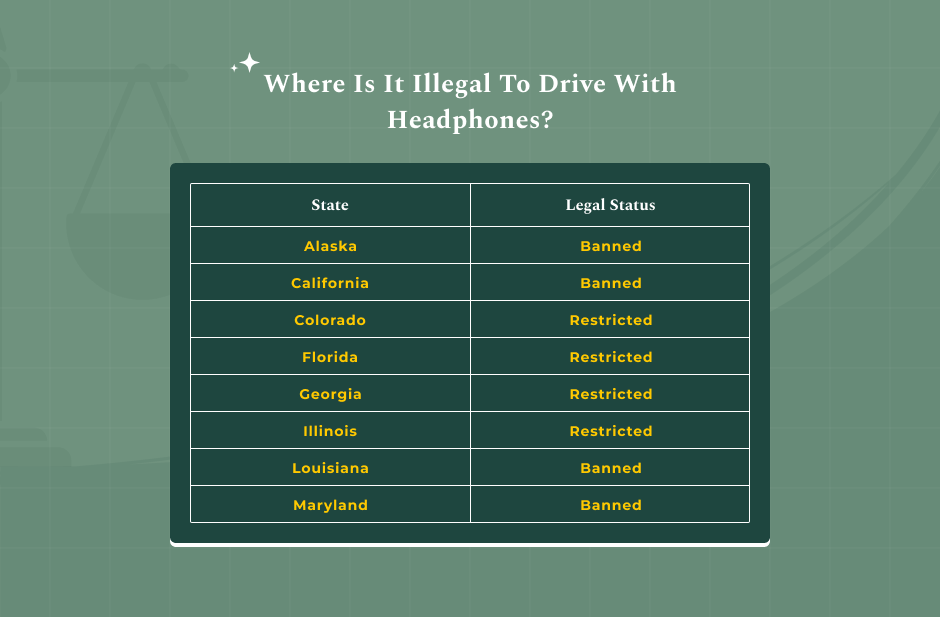
Navigating the legality of driving with headphones is complex. This is because there is a patchwork of local and national authorities governing road safety. What is a harmless habit in one region could lead to a significant fine just across the border.
U.S. States With Explicit Bans
When you’re driving, it’s a good idea to be aware of what’s going on around you. That’s why some states in the US have laws that say you can’t wear headphones or earbuds in both ears at the same time.
This way, you can still hear important sounds, like sirens or other cars, while you are behind the wheel.
For example, in California, there’s a law that says you can’t drive or bike with anything covering both ears. This includes headsets, earbuds, and even earplugs.
Maryland has a similar law – no headsets, earphones, or earplugs in both ears while driving [Source: Justia]. And in Minnesota, you do not have permission to drive with headphones covering both ears.
Other states, like Virginia, have laws that say you can’t use earphones in both ears while driving.
In Washington, the law is clear – if your headset or earphones cover both ears and are connected to a device, you are breaking the rules.
Alaska and Louisiana also ban headphones that cover both ears, and in Louisiana, you will even get a $25 fine if you get caught.
So, to sum it up, if you want to follow the law in these states, make sure to keep at least one ear open when you’re driving.
It’s just a good idea to be aware of your surroundings and hear what’s going on around you. By doing this, you can help stay safe on the road.
States With Limited Exceptions
Many states, to varying degrees, have acknowledged the desire for hands-free communication and hence allow the use of a single earbud, mostly for phone calls or navigation.
- Colorado, Florida, & Illinois: These states authorize the use of a single-sided headset or earbud as long as the other ear remains free to hear the traffic.
- Georgia, Pennsylvania, & Rhode Island: Allow the use of a single earbud, but only for communication purposes (phone calls).
- Massachusetts: You can only wear a single earbud, and you should use it for GPS or navigation only.
- Arizona: There is no ban for all drivers, according to Eisenberg Law Group. However, authorities strictly prohibit school bus drivers in AZ from using wireless devices while operating the vehicle. This also includes headphones.
International Examples
Global regulations, in many cases, take the matter even further. They emphasize the driver’s overall “attentiveness” rather than just the number of ears with headphones or earbuds.
United Kingdom:
Is it illegal to drive with headphones here? Well, in the UK, wearing headphones is not explicitly prohibited. Nevertheless, according to The Highway Code Rule 148, a driver should not be distracted from the road by any means – for example, loud music.
If the police officers think that wearing headphones has reduced your control over the vehicle, they may charge you with “Careless Driving.” For this, you might have to pay a fine of 100, along with 3 penalty points.
France:
In 2015, the total ban on all sound-emitting devices that can be “brought to the ear” was introduced in France.
Please note that the ban also covers Bluetooth headsets and single earbuds. The police have the right to impose a $135 fine and take three points off the license.
Italy:
The Italian law prohibits the use of headphones. However, they allow the use of single ear headsets under the condition that the driver keeps his/her “adequate hearing capacity” in both ears. And that they use the device hands-free.
Distracted Driving Laws & Headphone Use
Even in states or countries that do not explicitly mention headphones in their traffic code, wearing them is far from a legal “safe harbor.”
Most jurisdictions operate under broad distracted driving or “due care” statutes. These laws act as a catch-all for any behavior that diverts a driver’s attention from the primary task of operating the vehicle safely.
If an officer observes you weaving, reacting slowly to traffic, or failing to notice an emergency vehicle while wearing headphones, they can issue a citation regardless of whether a specific headphone ban exists.
How Police Evaluate Distraction
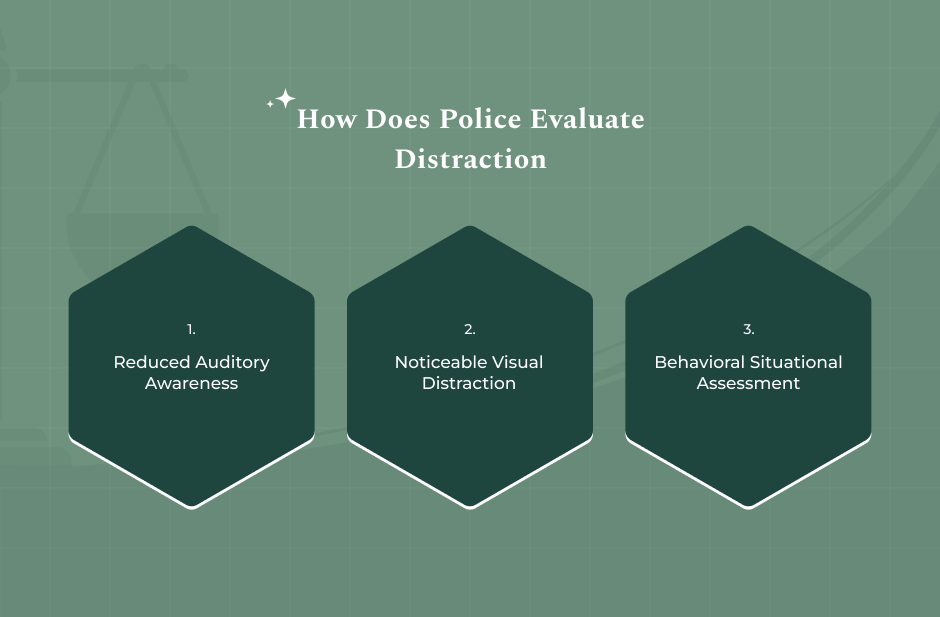
Law enforcement officers rely on a mixture of physical evidence and situational observation to decide whether headphone use is a violation. The evaluation of the officers usually concentrates on three main points:
- Reduced Auditory Awareness: This is by far the largest reason for concern. Officers check if the driver is capable of hearing the outer sounds like sirens, horns, or an officer’s voice at the scene. If a driver does not yield to an ambulance until it is just behind them, the headphones would be the main piece of evidence of “auditory masking.”
- Visual Distraction: A charge of visual distraction may be brought against the headphones if an officer witnesses a driver looking down to change a playlist on the phone or struggling with tangled wires.
- Situational Assessment: Police observe a driver’s behavior for “erratic driving cues.” These signals include drifting from the lane, delayed braking, or not moving at a green light. If the driver has their headphones on during these mistakes, the officer will blame the device for the manual or cognitive distraction.
Case Examples Of Citations Without Explicit Ban
In states such as Texas or New Jersey, there is no specific legislation prohibiting the use of headphones. Nevertheless, drivers are often penalized under different parts of the transportation code:
- Failure to Maintain Proper Lookout: In Texas, if a driver wearing headphones causes an accident, the driver is usually charged with failing to pay attention to the surroundings. The headphones serve as evidence that the driver was not “completely aware” of what was going on around him/her.
- Careless Driving: In numerous states without bans on headphones, an officer might issue a Careless Driving ticket. For instance, if a person driving with noise-cancelling headphones does not notice a police siren, the officer can contend that by listening to the music, the driver was operating the vehicle in such a way that “endangered or was likely to endanger” others due to the inability to hear emergency warnings.
- Reckless Driving: In very serious situations, such as wearing large, over-the-ear gaming headsets, law enforcement officials have increased the charges to reckless driving, contending that the driver consciously disregarded the most basic safety rules.
Read Also: Is Blackmail Illegal? Penalties & What To Do If You’re Targeted [Complete Guide]
Penalties & Legal Consequences Of Wearing Headphones & Driving
Violating headphone laws while driving can bring about a variety of financial, administrative, and civil consequences.
Since there is no federal standard in the U.S., these punishments rely solely on state laws or broadly on the enforcement of “distracted driving”.
Financial And Administrative Penalties
States that have explicitly banned the use of headphones while driving (e.g., California, Maryland, and Virginia) usually impose penalties such as:
1. Fines: Usually, first-time offenses are punished with a fine of $25 to $500.
- Louisiana: approximately $25.
- Maryland: Up to $100.
- California: approximately $175 after adding mandatory fees and assessments.
- Illinois: Up to $500.
2. License Points: Drivers should be aware that some states consider this a moving violation, therefore, it will result in adding points to his/her driving record. If a driver accumulates points, it can cause his/her license to be suspended.
3. Criminal Charges: In case the use of earphones by a driver leads to a serious accident causing injuries or death, the driver may be subjected to criminal charges such as reckless driving, or vehicular manslaughter.
Insurance And Civil Liability
One of the biggest sources of costs over time is insurance and civil lawsuits:
- Higher Premiums: Usually, a ticket for driving with headphones will be considered a distracted driving offense by the insurers, which can cause your premiums to go up by 10% to 20%.
- No Coverage: If you get into a car accident while you have prohibited headphones on, your insurance provider can refuse or limit your coverage, citing that you breached a safety rule.
- Proof of Negligence: Wearing headphones during an accident can significantly be used as evidence of negligence. For instance, in contributory fault states like Maryland, if, due to wearing headphones, you were found just slightly at fault, then you could be denied compensation for your injuries.
International Penalties
Outside the U.S., penalties can be much harsher. For instance, in France, the use of all “in-ear” devices is totally banned.
Additionally, those caught violating this law have to pay a fine of 135, and 3 points will be deducted from their driving license.
On the other hand, in the United Kingdom, it is not a direct violation. However, if the police find you are distracted by your headphones, they might charge you with “Careless Driving”, which comes with a 100 on-the-spot fine and three penalty points.