Is blackmail illegal? Well, because of the fact that it is a form of extortion, it is widely considered illegal across jurisdictions.
Just think about a hypothetical situation! You wake up to a message that flips your world upside down – someone threatening to leak your private photos, spill your secrets, or share business information (or something extremely confidential) unless you pay up.
That kind of panic hits fast, and you start wondering if this is even legal. Here’s the deal: it’s definitely a crime.
While it is true that most people call it “blackmail” colloquially, the law treats it as extortion or criminal intimidation.
It doesn’t matter if what they’re threatening to reveal is true or made up – using that information to force you to hand over money, property, or favors – it is illegal!
In today’s blog, we will be talking about the following things:
- What is the legal meaning and elements of blackmail?
- Is blackmail illegal?
- Penalties and consequences of blackmail.
- What to do if someone is blackmailing you?
- How does the court prosecute blackmail charges?
- What are the legal defenses against blackmail charges?
Therefore, if these are what you want to know, keep on reading!
What Is Blackmail: Legal Definition & Core Elements
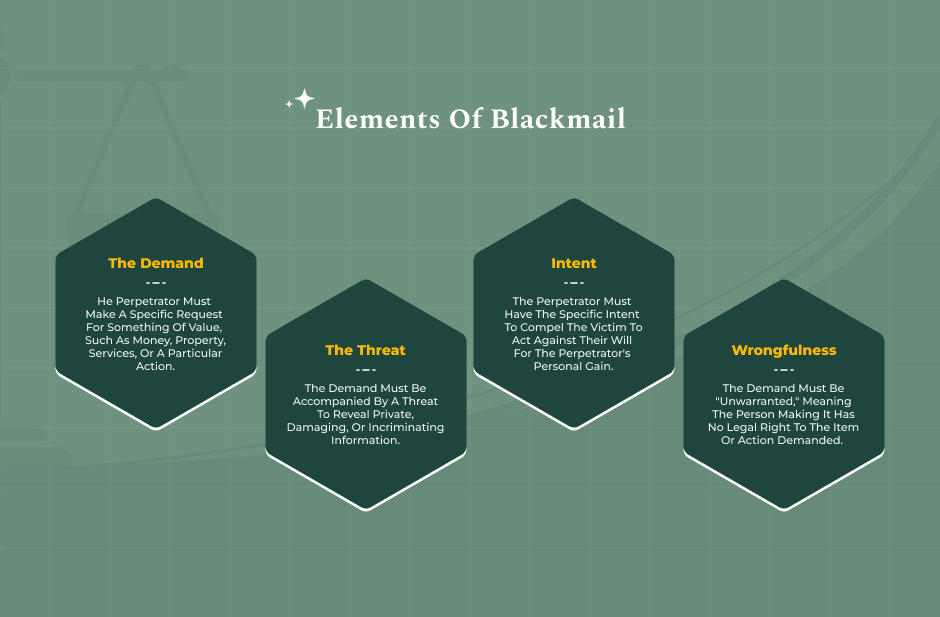
In the United States, blackmail is basically a crime and is typically understood as the act of demanding money, property, or services from a person by threatening to disclose sensitive, damaging, or embarrassing material about them.
Even though “blackmail” is the popular term, cases are often prosecuted under more comprehensive extortion or coercion statutes. However, it completely depends on the jurisdiction.
The major elements of blackmail include:
- Threat.
- Demand.
- Intent.
- Wrongfulness.
According to 18 U.S. Code 873, blackmail is the act of making a demand or receiving something of value under the threat that one will reveal a violation of a federal law (or in consideration of not informing) to federal authorities.
However, the state definitions, although different, usually classify it as one of the ways a person can steal by extortion.
Blackmail vs. Extortion Under The US Law
Under U.S. law, blackmail generally falls under a specific subset of extortion. It is true that both involve using coercion to extract money, property, or services. However, they differ in the nature of the threat used to pressure the victim.
For instance, here’s what you need to know about the difference between the two terms:
| Feature | Extortion | Blackmail |
| Primary Threat | Physical harm, property damage, economic loss, or abuse of official power. | Disclosure of embarrassing, sensitive, or damaging information (true or false). |
| Means of Coercion | Force, violence, fear, or intimidation. | Leverage over reputation, relationships, or career. |
| Federal Statute | Multiple statutes, including the Hobbs Act (18 U.S.C. § 1951), for acts affecting interstate commerce. | Specifically defined under 18 U.S.C. § 873 as demanding value for not reporting a violation of U.S. law. |
| Severity/Penalty | A felony; federal convictions can carry up to 20 years in prison. | Federal blackmail is a misdemeanor (up to 1 year); state-level charges are often felonies. |
Legal Terms Associated With Blackmail
Here are some of the major terms that one might often associate with blackmail:
Threat
Firstly, the foundational element of blackmail. Legally, a threat must be a “communicated intent” to inflict harm – not necessarily physical, but reputational, financial, or social.
Under 18 U.S.C. § 875, if someone sends this threat via “interstate communication” (like an email or DM), it can trigger federal prosecution.
Coercion
Secondly, there’s coercion that describes the act of compelling a person to do something they would not otherwise do.
In blackmail cases, coercion is the “means” by which the perpetrator overrides the victim’s free will.
If the victim complies only because they fear the consequences of the threat, coercion has occurred.
Valuable Consideration
Thirdly, this refers to what the blackmailer wants. It isn’t limited to cash; valuable consideration can include:
- Property.
- Services.
- Intangible Benefits.
Unlawful Demand
Finally, this is the “wrongfulness” of the act. A demand is unlawful if the perpetrator has no legitimate legal claim to what they are asking for.
For example, a lawyer demanding a settlement to drop a valid lawsuit is usually legal. However, a person demanding money to hide a secret is an unlawful demand and hence illegal.
Offenses Related To Blackmail
According to Justia, some of the major offenses that one can relate to Blackmail are as follows:
- Extortion.
- Robbery
- Fraud
- Larceny.
Is Blackmail Illegal? Understanding Blackmail Laws By Jurisdiction
Blackmail is illegal in common law jurisdictions and is often considered a form of extortion or coercion.
In the UK, blackmail is defined under Section 21 of the Theft Act 1968 as an “unwarranted demand with menaces.”
It is something that one does with a view to gaining something or causing loss to another person. Additionally, an offender is liable to imprisonment for a term not exceeding 14 years.
In India, the Bharatiya Nyaya Sanhita has provisions similar to:
- Extortion (Section 308): inducing property delivery through fear of injury.
- Criminal Intimidation (Section 351): threatening injury to compel action.
Under both these laws, blackmailing is an offense punishable with rigorous imprisonment for a term which may extend to 7 years or 10 years in cases of more serious offenses, along with a fine.
On the other hand, US federal law includes provisions such as 18 U.S.C. 873 that we have already mentioned above.
This basically penalizes the demand for value or property under threat of informing. Additionally, separate felony provisions, such as those under the Hobbs Act, can lead to a sentence of up to 20 years.
In addition, Canada treats blackmail as Extortion under Section 346 of the Criminal Code. Furthermore, it carries a sentence of life imprisonment.
Moreover, Australian states – such as Victoria – have their own blackmail legislation. According to that, the maximum penalty for blackmail is 15 years.
Is Threatening To Report A Crime Blackmail?
To speak very clearly, just threatening to report a crime, by itself, cannot usually be blackmail or extortion.
However, if the threat is to report the crime unless the person pays money or gives you something else, then it is blackmail or extortion. And that is illegal.
In fact, everyone has a general right (and sometimes a legal duty) to point out crimes to the authorities, and the law will severely punish those who use such a right as a tool for their own personal advantage.
How A Threat Becomes A Crime
The distinction between a threat and a crime depends almost entire only the intent and the demand when it comes to law. Here’s what you need to understand:
- Criminal Reporting: Using the threat of calling the police to make the other person stop the crime or make a legitimate legal restitution (e.g., “Give me back my bike, or I’ll call the police”) is usually not considered blackmail.
- Illegal Blackmail: Threatening to report a crime to the authorities unless the victim agrees to pay a “hush” fee (e.g., “If you don’t give me $5, 000, I will tell the FBI about your tax fraud”) is a criminal offense.”
Legal Framework In The U.S.
As we have already mentioned above, 18 U.S. Code 873 makes it a federal crime to threaten or demand money or other valuable things in return for silence about a violation of U.S. law.
However, many states, including California under Penal Code 518 PC, consider threatening to accuse someone of a crime to get something from them as extortion.
Also, you cannot legally defend yourself by mentioning that you are telling the truth. The moment you demand something in return, it becomes extortion.
In the event that the individual did commit the offense you are threatening to reveal, it is still possible to be charged with blackmail if you use that knowledge to extort the person.
Penalties & Legal Consequences Of Blackmailing
Now that you know the answer to “is blackmail illegal?” let’s talk about the consequences of the crime.
As already stated above, blackmail or extortion, according to Title 18 of the United States Code, Section 873, is a felony at the federal level and comes with one or more of the following punishments:
- Up to 1 year in federal prison.
- A fine.
- Or both imprisonment and a fine.
As per EGA Attorneys, the defendant’s actual sentence will depend on the case factors addressed in the United States Sentencing Guidelines, the equitable factors in Title 18 of the United States Code, Section 3553(a), and the judge’s relatively broad discretion.
Additionally, a first-time offender may be able to get away with a non-custodial sentence by using sentencing alternatives such as:
- Home confinement.
- Community service.
- Drug treatment.
Different case facts and circumstances will usually determine the exact details, especially pertaining to the defendant’s prior criminal history and personal character, related factors.
What Should You Do If Someone Is Blackmailing You?

So, is blackmail illegal? Yes, it is! And can you do something about it? Yes, you definitely can!
If someone is blackmailing you, the foremost thing to keep in mind is not to give in to the demands of the harasser. This does not often stop the perpetrator from blackmailing you further.
In fact, it usually results in the harasser demanding even more as he or she now knows that you are willing to pay or comply.
Below is the precautionary protocol, which is in line with the FBI and other safety organizations. Take a look at them:
1. Stop All Communication
Firstly, you must immediately sever any form of communication with the blackmailer. Don’t argue, don’t beg, and above all, don’t hand over the money.
If you have already given money, you really should stop now. In fact, paying turns you into a “high-value target” and also provides them with the means to target more victims.
2. Preserve The Evidence
Don’t get rid of the messages or your account just yet. The authorities will require a record of the crime.
Take screenshots of the offender’s webpage (URL/username), the exact threats, and the payment directions or any account details they shared with you.
Emails can also be very useful as they include header information, which can aid law enforcement in locating the sender’s IP address.
Save the emails – they have header information that can help law enforcement track the sender’s IP address.
3. Secure Your Accounts
Thirdly, change the passwords for your email and social accounts. Also, add Two-Factor Authentication so the blackmailer won’t be able to lock you out of your profiles.
Besides that, you can make your social media profiles “Private” to only allow selected people to message you.
4. Report The Crime
Blackmail is a serious crime, and you can get help in a number of ways:
- Local Police.
- FBI (IC3).
- Platform Reporting.
5. Take Action Against Sextortion
Finally, if the threat is of a sexual nature, you can use particular tools to stop the photos from being circulated:
- StopNCII.Org: With this site, a digital “hash” (fingerprint) of your photo will be generated, so that participating platforms can block the upload of such content proactively.
- Take It Down: The National Center for Missing & Exploited Children runs this service to help minors or people whose images were taken when they were minors.
How Are Blackmail Cases Prosecuted?
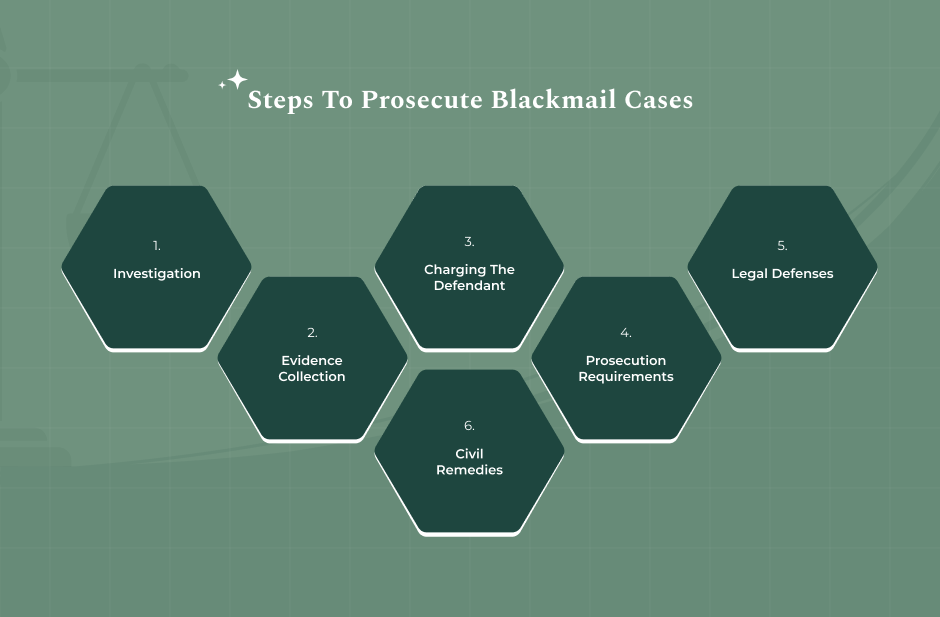
Blackmail cases are dealt with at both state and federal levels via a mix of investigation, digital forensics, and court proceedings.
Since the crime involves communication, the case of prosecution mainly rests on the documents and the victim’s testimony.
1. Investigation And Evidence Collection
The cycle starts when the victim files a complaint with the local police, a cyber cell, or federal agencies such as the FBI.
- Digital Footprints: Detectives track down IP addresses from emails or social media messages and examine call details records to unmask the offender.
- Financial Trails: Authorities following the money, if it was a demand, keep tabs on the blackmailer’s bank accounts or digital wallets.
- Forensic Analysis: Computers and other devices seized from suspects are examined to recover deleted files and document evidence.
2. Charging The Defendant
Prosecutors determine the statutes that will be applied to the case based on the type of threat and the way it was communicated:
- Federal Misdemeanor: Under 18 U.S.C. 873, cases that involve a threat to expose a federal law violation are usually charged as misdemeanors (punishable with up to 1 year in prison).
- Federal Felonies: If the crime affects interstate commerce or includes the use of interstate communications (18 U.S.C. 875), more serious charges (with a maximum sentence of 20 years) are brought under the Hobbs Act.
- State Felonies: As in California (Penal Code 518 PC), most states treat blackmail as a felony extortion charge.
3. Key Prosecution Requirements
In order to secure a conviction, the government must demonstrate the following:
- Wrongful Intent: The defendant had a specific purpose to obtain a benefit by means of unlawful coercion.
- Induced Fear: The victim’s agreement to relinquish the property was the direct result of a reasonable fear of the threat.
- Transferable Benefit: If the case is a federal extortion one, then the “property” sought has to be a material or a thing which can be transferred (like money) and not simply an intangible favor.
4. Legal Defenses
Defense attorneys frequently counter the allegation by putting forward arguments such as:
- No Actual Threat.
- Claim of Right.
- Lack of Evidence.
5. Civil Remedies
In addition to criminal charges, the victims can also request civil injunctions. A court may issue an injunction, which can be kept confidential, to prohibit the blackmailer or online platforms from disclosing the private matter.