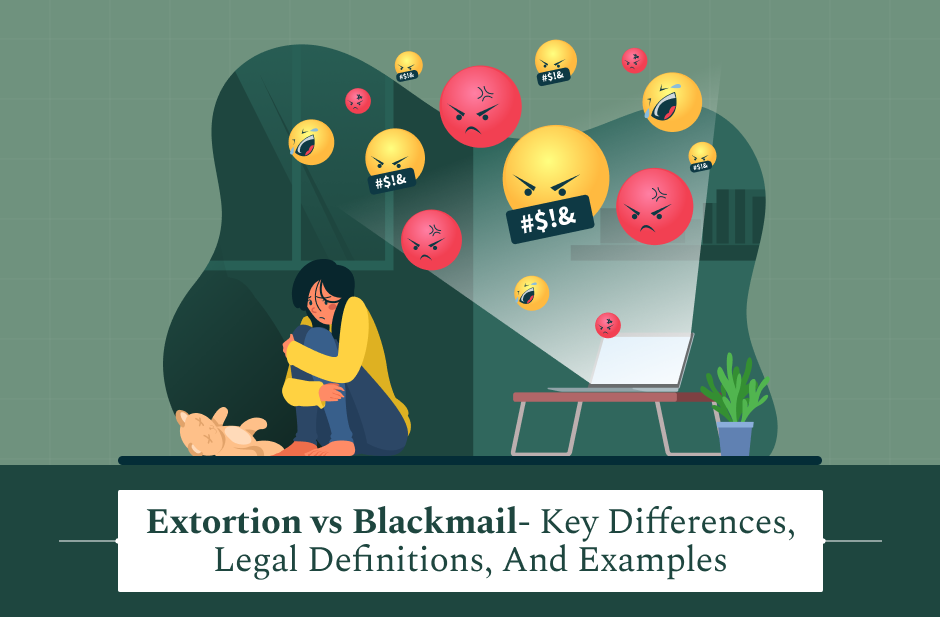
Today, we talk about extortion vs blackmail. A comparison between extortion and blackmail is normally a source of public confusion.
It puzzles us all as they try to understand the two criminal acts, which seem similar in nature.
In early 2026, the judicial system brought to the forefront famous cases of ‘sextortion,’ a term blurring the differences between the two criminal acts of extortion vs blackmail (prosecution of Jinfeng Luo.)
As the world becomes more technologically advanced, people can commit a crime against a person’s reputation or life from a safe distance. Thus, the need for the public’s clear understanding of the two acts is important now.
In this article, we will elaborate on the following:
- The formal legal definitions of extortion and blackmail.
- The specific nature of the threats used in each crime.
- How do different jurisdictions like the US, UK, and India handle these offenses?
- Practical steps for victims to report these crimes safely.
What Is Extortion? Legal Definition and Core Elements
In order to discuss extortion vs blackmail in more detail, it is necessary to consider the wide application of the definition of extortion.
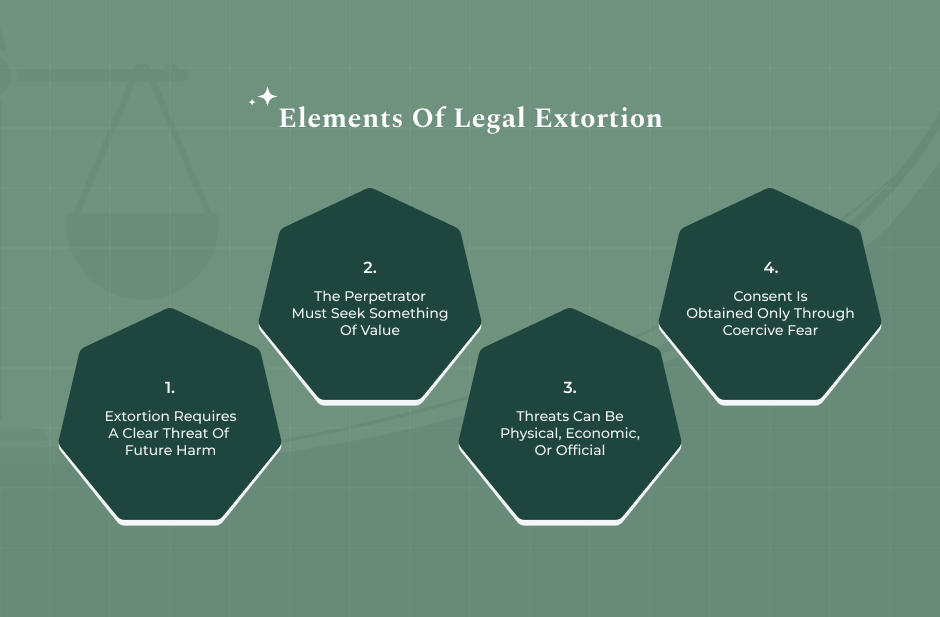
What does the term “extortion” even mean in the context of law? It is the act of obtaining money, property, or services from another person by coercion or threats of injury to their person, property, or future interests.
Finally, in the concept of Extortion vs Blackmail, extortion is a “specific intent” crime. This means that the prosecutor and jury must agree that a value or valuable item was indeed taken.
While robbery involves the threat of present force or harm, extortion usually involves a threat of future action.
This could be anything from threatening to burn a building down to threatening harm or using a position as a public official to deny a permit unless payment is made.
The Role Of Public Officials
Extortion has one special category, which is called “under color of official right.” This means that a governmental employee uses their authority to coerce an individual into paying money that is not owed to that employee.
For example, an inspector will not approve a safe house until a special fee is paid.
Coercion By Fear Of Harm
Essentially, extortion has the nucleus of the word “fear” incorporated in it. There does not have to be a threat of the physical kind.
There could be a threat of the financial kind, e.g., the president of the union threatening the destruction of the business if he does not receive a payment from the business.
The intent of the legislation is to prevent people from being forced to make certain financial decisions.
What Is Blackmail? The Threat Of Information

In the concept of Blackmailing Vs Extortion, blackmailing differs from extortion. In Blackmailing, physical and economic harm shifts the focus to reputational damage. Blackmail refers to a special type of extortion.
Here, the threat involves the publicizing of damaging or embarrassing information concerning a person to the family or public.
Notably, Blackmail can indeed be 100% true information. The crime is not the secret, but asking for money for its silence.
For the law, utilizing a secret as leverage to demand money is an act of criminal coercion. It takes the “truth” and uses it as a means for illegal gain.
The Power Of Reputational Threats
Blackmailers capitalize on the victim’s desire to uphold his or her social or professional status.
For instance, there is the threat of exposure of marital infidelity, previous criminal convictions, or medical details.
The victim feels he or she has nothing to lose, thus pays the blackmailer, thereby encouraging the criminal to demand more.
Blackmail Vs Extortion – Digital Blackmail And Sextortion
In the year 2026, digital blackmail is the most common form. ‘Sextortion’ refers to threatening to share private images unless a given ransom is paid.
This has caused a global epidemic, and many states are enacting laws to specifically address digital blackmail in the same way as they do real-world blackmailing.
Extortion vs Blackmail – A Comparison
The difference between blackmail and extortion is often found in the “nature of the threat.”
Even though blackmail is a form of extortion, not all extortion is blackmail. One may think of extortion as a sort of umbrella category, where blackmail is a specialized form of extortion focused specifically on information and secrets.
Distinguishing the Type of Threat
In extortion, the threat is typically, “I will hurt you or your property if you don’t pay.” In blackmail, it is, “I will tell everyone your secret if you don’t pay.”
The first threat appeals to fear of pain, while the second appeals to fear of shame. But in either case, nothing remotely like free will is involved.
Required Proof in Court
In an extortion or blackmail case, to be able to win it, one has to prove that a demand was made. Additionally, one has to prove that the demand was satisfied due to the threat.
In this case, in some states, the offense is complete the moment the threat is made, even if no money is paid.
International Legal Perspectives On Coercion
These crimes are also prosecuted differently throughout the globe. An example of this is the way extortion vs blackmail is treated in the United States compared to the way it is handled in either India or the United Kingdom. This is very important knowledge if one wishes to deal with international legal issues.
The United States And The Hobbs Act
Federal law in the US frequently uses the Hobbs Act to prosecute extortion when it may affect interstate commerce.
The states have their statutes, and many have combined the two terms under the catch-all of “theft by extortion.”
This makes things easier for prosecutors who no longer have to worry about proving which particular label applies to the crime.
India And The Indian Penal Code (IPC)
The difference between blackmail and extortion in India is rooted in Section 383 of the IPC.
In Indian law, extortion is clearly defined. However, there is no specific law on ‘blackmail.’
Blackmailing a person with secrets is treated as extortion or criminal intimidation under Section 503 of the Indian Penal Code.
Defenses And Legal Strategies In Court
Now, let us elaborate on the Common Defenses Against Extortion Charges. It can include the following.
- Lack of criminal intent is primary in both Extortion vs Blackmail.
- A claim of right has limited legal power.
- Truth is not a defense for blackmail.
- Entrapment is rarely a successful defense here.
Anytime a person is accused of these acts, there are certain defenses that lawyers have to look for to clear the person’s name.
If the person was merely asking for money that they were legally entitled to receive, the situation becomes complicated. Thus, the most common defense in the extortion vs blackmail debate is the lack of “intent to extort.”
Extortion Vs Blackmail – Claim Of Right Defense
If you believe you are simply collecting a debt owed to you, you may be able to argue that you had a “claim of right,” but it’s impossible to collect money owed to you by threatening to use violence.
This means that even if you have a right to the money, it does not give you the right to use threats of violence to collect it.
The ‘Truth’ As A Defense
Typically, when in a blackmail scenario, it is not relevant if what you are blackmailing someone about is true.
There is no way to say, “Well, you can’t blackmail me. This is all true.” The relevant piece is that you are blackmailing this person for money.
This is a pretty big mistake people make when trying to defend themselves in a criminal case.
Read Also: Can You Get In Trouble For Prank Calling? Know The Legal Consequences
Expert Tips And Best Practices For Victims When Dealing With Extortion Vs Blackmail
Your instinctive reaction if you are a victim of extortion or blackmail may be to pay what the blackmailer demands in order to get the problem out of the way.
However, experts are keen to point out that such a move always fails. Once a blackmailer is given money, it is a guarantee that they will come back in the future seeking more because they know they can get money from the victim.
- Do not pay the demand: By paying, you only encourage the criminal’s strategy.
- Save all evidence: Take screenshots of all texts, emails, and social media communications.
- Stop communication: Do not argue or plead with the perpetrator.
- Report to authorities: Contact the FBI or local police.
Frequently Asked Questions (FAQs):
The first step towards attaining security within the law is grasping the intricacies of extortion vs. blackmail. These are the most fundamental issues affecting American citizens when encountering these frightening dilemmas in the year 2026.
Dealing with the event is frightening. The answers given here will help an individual dealing with extortion in finding legal rights.
Generally, no. Making threats against another person, saying that you will take them to court to settle your legal dispute, is a legitimate use of the legal system.
It becomes a crime, though, if you don’t have just cause for the lawsuit, if you are, indeed, using the “threat” of a lawsuit against them for the purposes of harassing their business or stealing from them.
Extortion is generally considered a felony. For state convictions, the punishment can involve a prison sentence that ranges between 2 and 20 years, depending on the nature of the threat made and the amount of money involved.
For a conviction under the Hobbs Act, the punishment can extend up to 20 years per count.
Yes. As related to blackmail vs extortion, the crime is the demand/threat with the intent to obtain money. You don’t have to be successful in the process of obtaining the cash to be guilty of the crime.
Conclusion
To conclude, the fight against extortion and blackmail all depends upon the fear that the criminal instills in you, whether it is extortion, which instills the fear of pain, or blackmail, which instills the fear of exposure.
Both are felony offenses that the legal system takes very seriously as we move into 2026, especially in the age of technology, which is often associated with blackmail, which is becoming increasingly common.
Having this knowledge about the laws and your rights will help you stand up against the criminal and ensure that they are brought to justice. The legal system was put there to protect you, the victim, in this case.