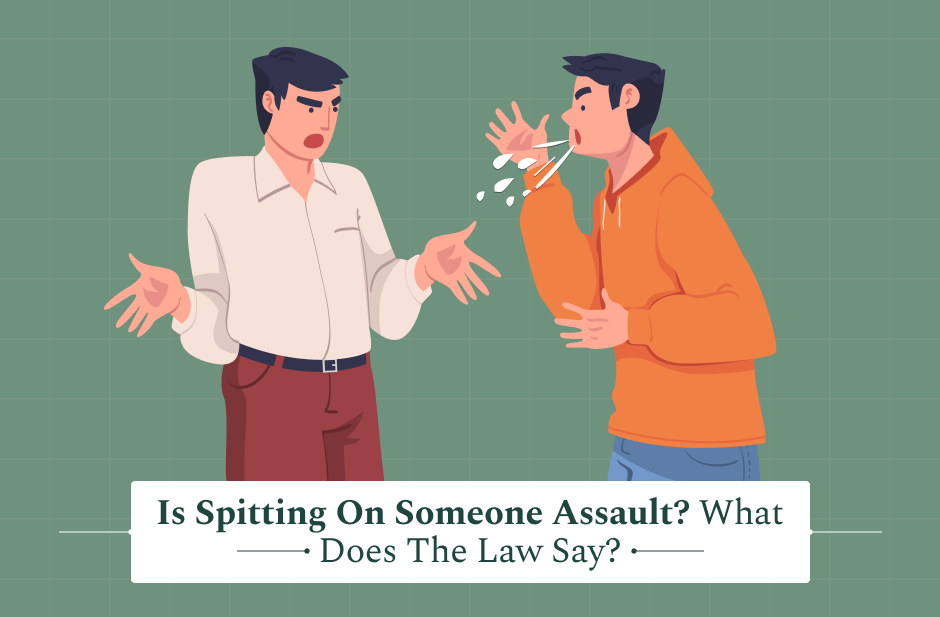
Is spitting on someone assault? This might sound like a question that people would say in jest. However, what if we tell you that splitting on someone actually might be an assault?
We all know that spitting on someone is as disrespectful as it gets. It’s gross, sure, but it’s also a real health risk since it can spread diseases.
But here’s the tricky part: spitting usually doesn’t involve hitting or touching someone directly, so is it actually considered assault – or even a crime?
Well, it’s not a simple yes or no. It all comes down to where you are and how the law defines things in your state.
So, while it sounds shocking, the keyword here is ‘intent.’ Yes, you read that right. Intentionally spitting on someone might actually land you in jail. But is that all?
To know more, keep reading…
What Is Assault Under The Law?
Before we get to answering your query on “Is spitting on someone assault?” let’s talk about what an assault really is when it comes to legality.
Under the law, assault is generally defined as an intentional act that causes another person to reasonably fear immediate physical harm or offensive contact.
According to the Legal Information Institute, it is “an intentional act that puts another person in reasonable apprehension of imminent harmful or offensive contact.”
So, basically, an assault is both a:
- Criminal offence: punished by the state with jail or fines.
- Civil tort: allowing the victim to sue for monetary damages.
Also, we would like to note that historically, the common law separated “assault” from “battery.” However, many modern jurisdictions now use “assault” as an umbrella term for both
Is Spitting On Someone Assault?
Yes, spitting on someone is widely considered assault or battery under the laws of most jurisdictions. This includes the United Kingdom, the United States, Canada, and Australia.
According to the West Yorkshire Police Department, “spitting at a person deliberately will constitute an offence of assault. However, if it is accidental it will not usually be deemed to be an offence.”
In November 2025, Courts News Ireland published an article stating that a man “was convicted and given a fine of 300 euro, before later lodging an appeal against the severity of his sentence.”
Though commonly, people often use the word “assault,” the precise legal term can differ from one place to another.
Let’s analyze it step by step:
1. Common Assault/Simple Assault:
Firstly, in several countries – such as the UK and Ireland – the law considers spitting on someone a “common assault.”
This is due to it being a physically aggressive gesture that instils the victim with the fear of imminent harm or victimization.
2. Battery:
Secondly, in those legal systems which draw a line between the two, spitting is usually battery by law.
The main reason is that it constitutes “unwanted or offensive physical contact”, which is present even in spitting.
In fact, a contact that results in no physical injury is still a battery. Thus, the offensiveness of the act itself is enough.
3. Aggravated Assault/Felony:
Finally, it is also possible to escalate spitting to a higher level of severity if, for example, the offender spits on a law enforcement officer deliberately.
Or if they knowingly possess a communicable disease (such as COVID, 19, HIV, or Hepatitis), which may then be classified as assault with a deadly weapon or a “biological attack.”
What Are The Penalties For Spitting On Someone?

The act of spitting on someone and its penalties differ across jurisdictions. However, generally, it is considered criminal assault or battery, and the criminal laws prescribe that it is treated as offensive physical contact.
The penalty may range from a fine to a prison term of several years, especially if there are aggravating factors, such as targeting public officials or the transmission of a disease.
1. India
Spitting on someone, in the first place, is regulated by Bharatiya Nyaya Sanhita (BNS) (which replaced IPC recently) as well as state or local laws in India.
BNS Section 130 (previously IPC 351) establishes that spitting can be considered an assault if the victim is scared of the imminent use of force.
Some of the other things that you need to keep in mind are:
- Insulting Modesty: Spitting on a woman’s face is an offense under IPC Section 509, and the offender can be punished with imprisonment that may extend up to 3 years, fine, or both.
- Municipal Fines: Different cities have different local laws. For instance, in Mumbai (BMC), the initial fine for spitting in public is ₹1,000. Additionally, for a repeat offence, the fine can go up to ₹ 5,000, plus the offender may be ordered to perform community service.
- Public Premises: Due to hygienic reasons, the Supreme Court of India has recently issued a circular to ban spitting on the Court premises.
2. United Kingdom
Deliberately spitting on somebody under UK law is regarded as a common assault (specifically “assault by beating” or battery) under the Criminal Justice Act 1988.
- Standard Offence: Is punishable with imprisonment for a term not exceeding 6 months and/or a fine.
- Aggravated Offence: If the offence is racially or religiously motivated, or the victim is an emergency worker, the maximum penalty is increased to 2 years’ imprisonment.
As evidence, a public transport staff member on occasion uses “spit kits” to retrieve DNA samples for police investigations.
3. United States
Finally, even though laws can be different from one state to another, spitting is generally considered a misdemeanor in most parts of the US.
For instance, in California, it is regarded as a battery and can result in jail up to 6 months and a fine of up to $2, 000.
On the other hand, in Texas, it is regarded as “offensive or provocative physical contact” assault. In such cases, a physical injury is not necessary to file a charge.
Spitting on a police officer or the employer knowingly having a communicable disease (such as HIV or Hepatitis) are instances where the charge can be raised to a felony in several states, leading to 2 to 5 years of imprisonment.
What To Do If A Person Spits On You?

Now that you know that spitting on someone is an assault and that it can cause you legal trouble, let’s talk about what to do if someone spits on you.
According to Albers & Associates from Maryland, “[the] first thing you should do is try to get away from the person who [spat] on you and ensure that you are in a safe place. If you are in a public place, you may want to alert a security guard or other authority figure. If you are in a private location, you can call the police to report the incident.”
So, if you are the victim of a spitting incident, legal experts recommend the following actions:
- Do Not Retaliate & Stay Safe: A physical retaliation – such as punching the person – might not be considered a reasonable response. Instead, it can be a reason for you to be charged with assault.
- Ensure Safety: Try to get away from the person and find a safe location immediately.
- Document Everything: Write down in detail the date, time and place. In case the saliva is on your clothes, you can save them as physical evidence.
- Identify Witnesses: Take the details of the witnesses who saw the incident, and if there are security cameras nearby, check with them as well.
- File a Police Report: Ring the local police to report what happened. They will make an official record of your report. This will be necessary for any future criminal or civil case.
How To File A Lawsuit For Spitting?
Filing a lawsuit and suing someone for spitting on you is a time-consuming process. However, it is definitely worth the fight since it is about your self-respect.
Here’s how you can file a lawsuit:
Step 1: Consult A Lawyer
If you consult a personal injury or criminal law attorney, they can inform you of your legal options.
They can evaluate your case and tell you whether it has merit or what kind of compensation you may be entitled to.
Step 2: File A Complaint
With your lawyer’s assistance, you will file a complaint in civil court. The complaint is a formal legal document that describes the events and the basis of your claim for damages.
Step 3: Gather Evidence
The lawyer will assemble the evidence for the case, which may include:
- Statements of witnesses
- Video or photo
- Medical records
- Police reports
Step 4: Negotiation Or Trial
Usually, cases are resolved through settlements before the court hears them. The person who spat on you might want to avoid the trial and pay compensation. In case of a refusal, the lawsuit will be presented in front of a judge.