“How long does a dui stay on your record?”
It is a question that determines your future when you are convicted in the USA. This stain will follow you everywhere, in every background check, or in case of applying for an insurance renewal.
However, the amount of time it takes until you can remove this from your record will depend on what kind of record it is. Whether it is a driving abstract or a master criminal file, your record matters.
By April 2026, most states will update the Clean Slate law related to automatic expungement for all non-violent crimes.
Currently, several Midwest states are litigating about whether it is allowed to show your old record on private background checks after ten years.
This is because there is an ongoing trend toward finding ways to protect the right to move on after making a mistake. You need to know everything before this problem happens to you.
In this article, we will discuss the following points:
- The critical distinction between driving logs and permanent criminal history.
- Federal and state law variations regarding look-back periods and retention.
- The impact of recent court cases on record visibility and privacy.
- How professional opportunities and insurance rates change over time.
- Available legal methods to seal or expunge a conviction from view.
Duration For A DUI To Remain On The Driving Record
In most jurisdictions, a DUI offense will remain on one’s record for 5 to 10 years for the purpose of points.
But it will remain on one’s criminal record for life unless they manage to have it sealed or expunged. Insurance companies only care about offenses 3 to 5 years prior.
Duality Of Traffic And Criminal History
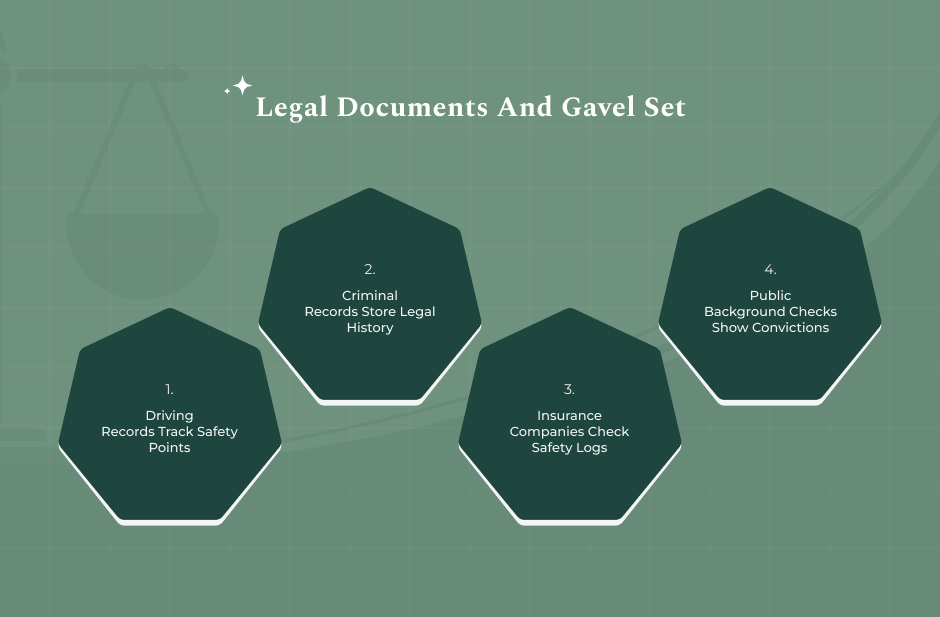
To understand how long a DUI will stay on your record, one needs to understand that there are actually two separate systems in which these records will be kept.
Points And Safety Violations In Your Record
State Departments of Motor Vehicles (DMV) keep track of each violation you commit in relation to road safety.
When people inquire into how long does a DUI stays on your record, it generally means whether it will have an effect on the issuance of licenses and insurability.
In numerous states, it will serve as grounds for suspending or revoking your license according to the point system.
Determining The Length Of Time In Administrative File
The administrative file length refers to the time during which the offense stays on your active record.
It is less likely that you are going to keep the violation in your administrative record than your criminal record. As a result, you can gain your driving privileges before the criminal record expires.
Permanency Of Criminal Offense In The National Law Enforcement Database
It is much more significant to be found guilty of a crime than to be ticketed for a traffic violation. It is generally known how long does a DUI stay on your criminal record, meaning forever. The latter serves as the basis for identifying repeat offenders.
Effect On Background Checks
The criminal record will be examined by potential employers and landlords; therefore, this record is permanent, and even after you have paid for any traffic tickets, this information may still follow you for years to come. Additionally, volunteering background checks could reveal this information. This is often the case when running parks and recreation background checks.
Furthermore, an official intervention will be necessary to ensure that this record stays private.
Laws About The Duration Of The Record
There is no national law about how long DUIs stay on your record in the US. The Federal government simply creates guidelines. However, each state has its own laws about the matter.

Knowledge Of Look Back Periods In America
The look-back period refers to the period during which a prior crime remains valid for sentencing purposes.
This period is an important determinant of how long does a DUI stay on your record. For instance, if there is a look-back period of ten years and you commit an offense during those years, you will receive severe punishment. (Source: Gorelick Law)
Recidivism And Mandatory Minimums
The Federal Highway Administration mandates that each state ensure the existence of stringent look-back periods.
In this case, recidivists are automatically mandated to serve prison time for any offense. Words like “consequently” demonstrate how mandatory federal requirements compel states to retain criminal records.
National Driver Register And The Government
The federal government has established the National Driver Register (NDR) in order to enhance safety.
NDR contains information about offenders whose driving privileges have been revoked due to severe crimes.
In this regard, how long does a DUI stay on your record might also mean being in the database of NDR.
How Long Does A DUI Stay On Record – Statewise
How long DUI stays visible varies depending on whether it is the DMV driving abstract record or the permanent criminal record.
State legislatures have been taking differing paths with respect to how far back they look when it comes to criminal records.
For example, while some states have passed Clean Slate laws, states such as Washington are now expanding their criminal look-back window to 15 years.
California
The driving record reflects DUIs for 10 years after the arrest. For the criminal record, you can only get it removed via a successful 1203.4 petition.
“1203.4 Petition (Expungement): You can petition the court under California Penal Code section 1203.4 to have the conviction dismissed, which allows you to answer “no” to most questions about criminal convictions on job applications.” (Source: LAHC.edu)
“A petitioner files the CR-180 Petition for Dismissal (Pen. Code, §§ 17(b), 1203.4, 1203.4a) to request that a judge dismiss an old conviction. If the petition is approved, the judge signs the CR-181 Order for Dismissal, legally granting the expungement.” (Source: Kern County Law Library)
Florida
The driving record holds DUI convictions for 75 years, while the criminal record is permanent unless you were never adjudicated guilty of the crime.
“Alcohol-related entries, including DUI convictions, are retained on a driving record for a statutory period of 75 years.” (Source: FLHSMV)
Texas
The offense shows up on the driving record for 10 years, while the criminal record is permanent except in cases where an order of non-disclosure can be secured.
Additionally, “in some cases, an order of non-disclosure can be secured to seal the record from public view.” (Source: Texas DPS)
New York
Misdemeanor DUI offenses are reflected on the driving record for 10 years, while the criminal record is permanent, unless sealed under the Clean Slate Act provisions. (Source: New York DMV)
Washington
The time frame of felony DUI in Washington has increased to 15 years from 2026, but the points will drop off from the driving record after five years.
Illinois
In Illinois, a DUI does not drop off driving records and remains permanent, while criminal records can only be sealed by an application.
“DUI convictions are typically excluded from this process, remaining permanently visible to law enforcement and certain employers”. (Source: Illinois Secretary of State)
Pennsylvania
A DUI stays on a driving record for ten years, while under the amendments to Act 58 in 2026, “erased” diversion records also get counted in sentencing.
Other Jurisdictions And Related Queries
In other states that are not included above, the look-back period is usually 10 years for sentencing purposes.
However, the criminal conviction stays forever on your record unless you have an option for “Set Aside” or expungement in your state.
Drunk driving in some states, such as New Jersey, is a traffic violation that shows on background checks forever.
- So, will a DUI be on my record forever in most states?
Yes, because the criminal conviction will remain in effect for many years. Only through court-ordered expungement or sealing will it be hidden from public view.
- How long does a DUI stay on your record for insurance?
Usually, in 2026, most insurers will only consider the last 3 to 5 years of your driving record.
In some cases, when SR-22 coverage applies, the requirement is valid for up to 3 years following your getting back your driving privileges.
- As for your doubts on “Can I get a DUI off my record after 7 years?”, it is a different case altogether.
In Fair Chance employment states, it is impossible to see a conviction after 7 years.
Legal Precedents In 2026

The courts are continuously setting precedents regarding the management of your past transgressions as well as your privacy.
Precedents affect how long does a DUI stay on your record as they influence the policies concerning data sharing.
Important Precedents Regarding Record Retention Policies
In this recent case, it was determined whether the storage of perpetual records of minor crimes by the state government violated the rights of the individual under the state’s constitution.
The decision rendered by the judges stated that perpetuity of minor criminal records is an act of “perpetual punishment.”
This showed that the strict “sunset clauses” regarding access to such records.
State V. Mann (2026) And Impact On DUI Records
This is the landmark case that has largely been behind the “Right to Move On” campaign of 2026. This particularly influenced how long a DUI stays on one’s record through the following changes:
Digital Sealing
This case now requires private data brokers to be synchronized with the official annulment orders by the states, such that DUI records cannot surface in any private background check once past the statutory time limit.
Ten Years’ Automatic Sealing For Small DUI Offences
It is noteworthy that almost all states chose “automatic sealing” for DUI offenses not involving injury after ten years, following State v. Mann.
Change In Sentencing Factors
The judgment highlighted that a DUI offense may still exist in a private criminal justice database for 15 years. However, it should not be utilized to “defame” a person in the public domain or the housing application process.
Digital Privacy And The Data Brokers Industry
Today, many lawsuits target private data brokers that obtain old information from court records.
Although a certain criminal record may have been expunged, it still might be available on these websites.
Case law is starting to require private data brokers to remove old information in a timely manner.
Modern Legal Shifts And The Expanding Reach Of DUI Records
There have been many radical updates to the legal system in 2026. All of these factors have helped to alter the traditional way people think about the question of how long does a DUI stay on your record.
There are those who believe in a ten-year rule regarding DUI convictions. But the implementation of various state laws has helped to effectively increase the shelf life of this charge.
Fifteen-Year Look Back Window
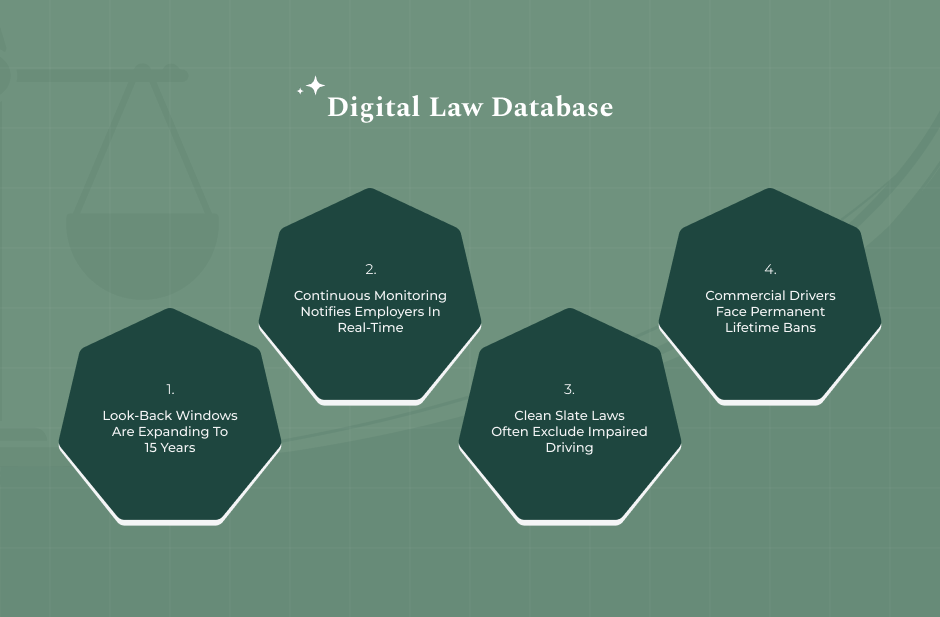
Among the biggest changes in 2026, there is the introduction of extended look back windows in numerous states.
For instance, in Washington, lawmakers have increased the length of this period from ten to fifteen years.
So, even the crime committed as far as fourteen years ago may result in the mandatory jail time for the defendant in his or her next offense.
There are similar tendencies throughout the Midwest, too, as lawmakers try to decrease recidivism rates by ensuring that past offenses remain valid when it comes to sentencing.
The Failure Of The Automatic Process For DUIs
A majority of American citizens are misguided in thinking that Clean Slate laws would automatically seal their cases. Most of the 2026 laws have clauses specifically excluding DUI from automatic sealing.
A small petty case, like a simple robbery, may automatically be sealed, but a DUI case would require manual filing of a petition and a judge’s consent.
Therefore, when asking how long does a DUI stay on your record, the answer is that it depends on legal actions.
Continuous Monitoring For Professions Requiring Licenses
Healthcare professionals, lawyers, and teachers should know that a seven-year period for background checks is outdated.
Today’s employers have access to continuous monitoring programs which are directly linked to the state database.
These programs alert the employer whenever an employee gets arrested. A nurse’s or a teacher’s career can change overnight after being involved in a DUI accident, despite how long does a DUI stay on your record.
The Reality Of Your Career For CDL Carriers
If you possess a CDL license, the legal penalties are among the harshest in the country.
Per present-day laws enforced by the federal FMCSA agency, the second offense automatically renders you ineligible to operate any commercial motor vehicles for the rest of your life.
There is no statute of limitations for the “major offenses” law. No matter how far apart the two occurrences were, be it 20 years, you will never be able to work as a driver again.
Frequently Asked Questions (FAQs):
Without professional legal guidance, it is hard to know what the laws related to being arrested involve. The following frequently asked questions will deal with the issues concerning how long does a DUI stay on your record in 2026.
In the majority of the states, a DUI offense will stay on your criminal record forever. Nevertheless, you may apply for the expungement or sealing of your record after five or ten years if no other offenses were committed during this period.
Most regular background checks that an employer carries out are limited to seven to ten years in the past.
Nevertheless, if you apply for highly sensitive positions in some organizations or work with children, then they can check your entire record. The only option to avoid this is sealing your record.
In most cases, you might find expunging your record to be easier after seven years. It is important for you to pay all the required fines and fulfill the probationary terms before requesting a record expungement. Speak to an attorney in your area for help with this.
There is usually no much difference in these two terms since it depends on where you come from. DUI stands for Driving Under the Influence, whereas DWI stands for Driving While Intoxicated.
Get Legal Help Now
Future laws will be more stringent, with tougher punishments and reduced BAC levels.
You must not take any chances with a how long does a DUI stay on your record issue when your job hangs in the balance.
A slip-up on your forms might end up putting you behind bars and paying extra for insurance for the rest of your life.
Contact An Attorney
Your lawyer can contest the accuracy of the breathalyzer test or the legitimacy of the traffic stop.
Take Immediate Legal Action
You generally only have 10 days to file a hearing petition to retain your driver’s license.
Consultation At No Cost
Most attorneys who defend DUI cases will give you a free consultation to consider the possibilities of expunging your record.