A DWI Vs DUI comparison is an important aspect of being arrested for the operation of a motor vehicle when under the influence of either drugs or alcohol in the USA.
While many individuals assume that these terms are synonymous with one another, there are vast differences between their definitions according to the state in which the offense occurred.
As of March 2026, there are several states that are contemplating implementing laws that will reduce the permissible amount of blood alcohol content to 0.05 percent.
Ongoing cases of litigation have tested the boundaries of implied consent laws pertaining to blood testing. Litigation tends to revolve around how a case is worded within the statute law.
In this article, we will elaborate on the following:
- The basic definitions and legal terminology for impairment.
- The primary differences between the two charges across various states.
- Federal guidelines and specific state law variations in the USA.
- Case law examples and current legal trends in 2026.
- The long-term consequences of a conviction on your record.
Understanding The Basic Definitions Of Impairment – DUI Basics
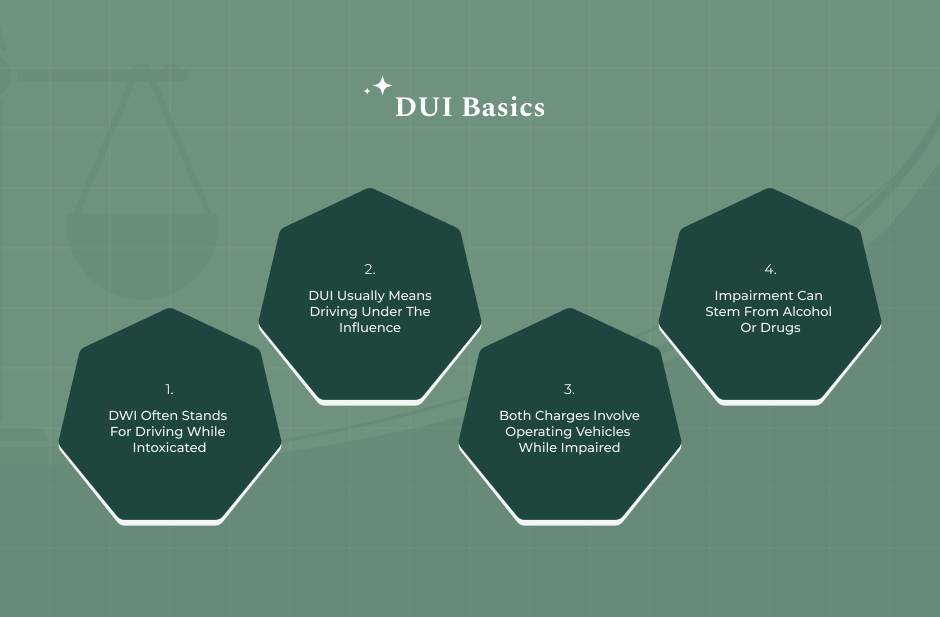
There are several abbreviations used by the law to refer to driving under the influence. While assessing whether DWI or DUI is appropriate, one must appreciate the fundamental difference between being under the influence and being intoxicated.
Definition Of Driving Under The Influence In Local Court Systems
In most places, a DUI charge is a wider term compared to DWI charges. It means that the individual had their capabilities reduced by a particular substance. Such substances include drugs (legal and illegal), prescribed medicine, and alcohol.
In some states, a DUI charge may mean that the offense is lesser than another one regarding impairment. The difference between DUI vs. DWI matters since it affects the standard of evidence required in the state.
What Is The Difference Between DUI And DWI Charges?
Individuals asking about the difference between DUI and DWI mostly need to know which offense is more severe. Sometimes, the charge of DUI could be given at lower BAC levels than DWI charges.
In other states, the terms DWI and DUI are equal, and there is no difference in them from a legal standpoint. This lack of consistency leads to complications for motorists in different states.
The Evolution Of State Laws Regarding Impairment
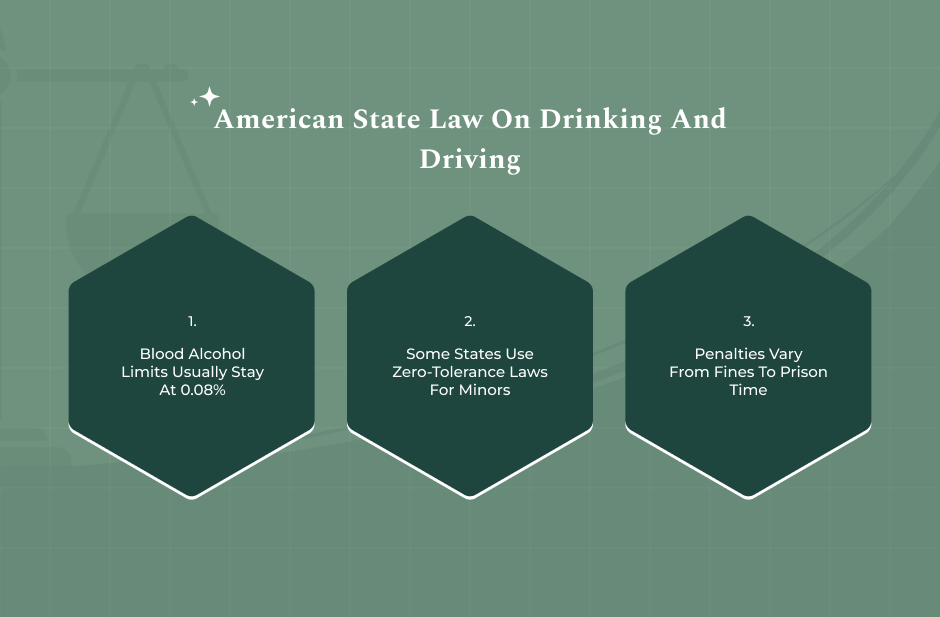
Each state has the authority to make its own traffic and criminal laws. As a consequence, there is a complicated system regarding DWI versus DUI across the United States. In some jurisdictions, either the former or the latter has been abolished in order to make it easier for people to understand their legal system.
Drinking And Driving Statutes
Federal pressure is placed on states to keep tough laws through attaching highway funding to certain safety guidelines.
This pressure has resulted in the uniform standard of a 0.08% BAC for adults. Nonetheless, whether or not to use the terms dwi or dui is a choice made at the state level.
The New York State Impairment Model Analysis
The New York State system offers a perfect case study to see the differences between the two terms in use. In New York, DWI is applied when there is a BAC of 0.08%. (Source: Understanding DUI vs DWI New York – WNY Lawyers)
It also provides a “Driving While Ability Impaired” (DWAI) offense when there is a reduced level of alcohol. This demonstrates the role of the difference between DUI and DWI in the punishment of offenses.
Difference Between Dui And Dwi – Texas Application
The state of Texas applies this terminology to differentiate between an adult and a minor. A minor may be charged with a DUI if he has alcohol even in traceable quantities.
An adult is guilty of DWI either when he attains the limit of 0.08% or impairment of abilities. It is clear that the difference between DUI and DWI lies in the age of the driver.
Notable Case Law And 2026 Legal Precedents
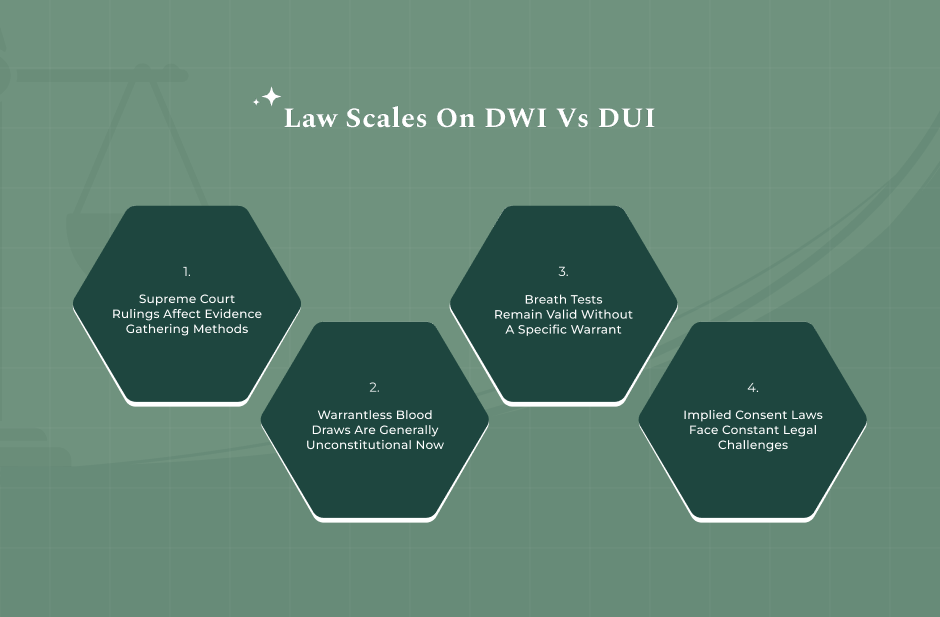
Law enforcement continuously develops methods for establishing proof of impairment in a DWI Vs DUI scenario. New Supreme Court decisions are usually based on the Fourth Amendment and the right of privacy.
The decision made here shows whether law enforcement must obtain a warrant in order to get a blood sample from the motorist.
The Influence Of Mitchell V. Wisconsin On The Charges In Modern Days
In Mitchell vs. Wisconsin (2019), the case related to unconscious motorists.
It ruled that where a motorist was found unconscious, the police would have been allowed to draw blood samples from him without any search warrants.
This ruling forms the core legal principle upon which the DWI Vs DUI cases depend on in 2026.
Comparison Of OUI And OVI To Other Charges
There are some states that have opted out of this entire debate by adopting new acronyms such as OUI and OVI. OUI means Operating Under the Influence, and OVI stands for “Operating a Vehicle Impaired.” (Source: Find Law)
Even in these jurisdictions, the disparity in DUI and DWI law remains relevant in terms of burden of proof.
The Long Term Consequences Of A Conviction
A DWI Vs DUI conviction is more than just fines. It could impact your job prospects, insurance premiums, and even your civil liberties.
Most states now mandate the installation of an ignition interlock system in the vehicle of first-time offenders. This system ensures that the vehicle does not start if alcohol content is detected in the driver’s breath.
Professional Licensing Issues
Most organizations conduct background screenings for potential employees. Many professionals such as medical practitioners, flight crews, or nurses risk their professional licenses due to impairment offenses.
A DWI Vs DUI conviction is a scarlet letter in most professions. Most states allow expungement of criminal records, although not in these particular cases
Insurance Premium Spikes And SR-22 Requirements
For insurance companies, individuals who drive under the influence of alcohol or drugs fall into the category of risk clients.
You can expect your insurance premium to increase two to three times after a conviction. In addition, you might have to submit an SR-22 form to the government agency. This document confirms that you meet the minimum insurance requirement.
Legal Difference Between DWI And DUI
Depending on your state’s 2026 laws, the acronyms used on the ticket you receive will be different. While some jurisdictions use these two to mean the same, others use them to differentiate whether you are young or have been caught intoxicated.
Which One Is Worse – DUI Vs DWI?
For most states, DWI is considered to be the worst since it entails intoxication. In jurisdictions such as Maryland, a DUI is the worst. Generally, any crime that lands on your criminal record will be the “worst.”
Let us go through a quick summary first.
• What Is A DUI? Driving Under The Influence. It involves driving a motor vehicle while your senses are impaired by alcohol or drugs, regardless of your BAC being less than 0.08%
• What Is A DWI? Driving While Intoxicated. This generally relates to a per se violation since it entails a BAC of 0.08% and above.
DWI Or DUI- What Will Happen To Me?
To understand the differences between a dwi vs dui charge, we can use practical examples to illustrate how these offenses may apply to our lives.
Scenario A: Minor Driver In Texas
The laws in Texas recognize varied ages as either adults or minors. A person under the age of 21 that has even an ounce of alcohol in his body can be charged with DUI.
In case of an adult who blows above 0.08%, he would be charged with DWI. Thus, one can see that DWI is a more serious matter than DUI.
Scenario B: Slightly Impaired Driver In Colorado
The state of Colorado has adopted a special definition of driving while ability impaired, or DWAI. A person can receive a DWAI charge if they have a blood alcohol concentration of between 0.05% and 0.07%.
Anything above 0.08% automatically becomes a DUI offense. The distinctions between DUI and DWI charges depend entirely on the chemical test results of the suspect.
If you have concerns regarding your background check or employment history, the above scenarios will provide the necessary information.
You might be asking yourself, “Is DUI worse than DWI?” It all comes down to what state you reside in.
Typically, DWI carries a higher degree of alcohol content, which makes it harder to prove in court. But can DUI be reduced to reckless driving?
Yes. In several states, an attorney can negotiate for something called “Wet Reckless.”
Will DUI Show Up On My Background Check?
Yes, if there is a conviction, it will show up in most criminal background checks for about seven to ten years, depending on the privacy laws in your state.
Will I get fired from work because of this DUI charge? If your job requires you to drive, or if you hold any professional licenses, like being a nurse or lawyer, then yes.
Get Legal Help Now – Protect Your Future
This legal environment regarding BAC levels is becoming more strict for 2026, so you need to be very careful about DWI vs DUI charges.
The possibility exists that one wrong move on your documents will result in a lifelong criminal history for you and high insurance premiums for the rest of your life.
Contact A Lawyer Today For A Free Consultation
Exercise Your Legal Rights. They can contest the calibration of the breathalyzer or the legitimacy of the stop made by law enforcement officers.
Save Your License
You have just ten days to schedule a hearing in order to preserve your driving license.
Expert negotiators could land you with a “Wet Reckless” plea or some sort of a diversion program.
So, don’t panic, speak to a lawyer today to protect your record. Get legal help now for your DWI vs DUI case, and be sure not to conceal any facts from your lawyer.
Frequently Asked Questions (FAQs):
In general, people find themselves in a difficult situation when interacting with the police and court system. The first thing to do is to understand the nuances of a DWI vs. a DUI.
The attorney may argue that the breathalyzer is faulty or that the stop was illegal. The prosecutor may negotiate a plea bargain on a lower charge if the case is not strong.
Failing to take the test results in an automatic suspension of your driver’s license under implied consent laws. This occurs even if you are not convicted of committing a crime.
Most of the cases will result in a misdemeanor unless there are certain aggravating circumstances.
They include the presence of a minor in the vehicle at the time of driving or involvement in an extremely dangerous situation.
Some nations such as Canada have extremely stringent regulations against the admission of such offenders.
Both will usually cost you about the same thing if you have never been convicted before. The main distinction is based on the period during which your license is suspended by the state.
These violations are recorded for a minimum of ten years in most states. In some places, they can never be removed from your criminal history.