We all know that in order to establish a case, an attorney needs proof or evidence. This can be anything – a testimony from a witness, a document, or tangible evidence.
Irrespective of the type of evidence, it must be presented in court if that is what the court demands.
However, it is also important to understand that obtaining evidence that can be produced in court is not always an easy task.
Therefore, courts usually have subpoena power to compel the production of evidence for a legal proceeding.
A subpoena (with its Latin roots) is basically a court order that commands the production of documents or for someone to testify at trial or other legal proceedings.
With its Latin meaning “under penalty,” anyone who receives a lawful subpoena and does not comply may be subject to civil or criminal penalties, or sometimes both.
Which brings us to today’s topic: Are there any valid reasons to get out of a subpoena? And if so, what are those?
Therefore, if that is what you want to know, keep on reading this blog till the end…
Understanding Subpoenas & Their Legal Obligations
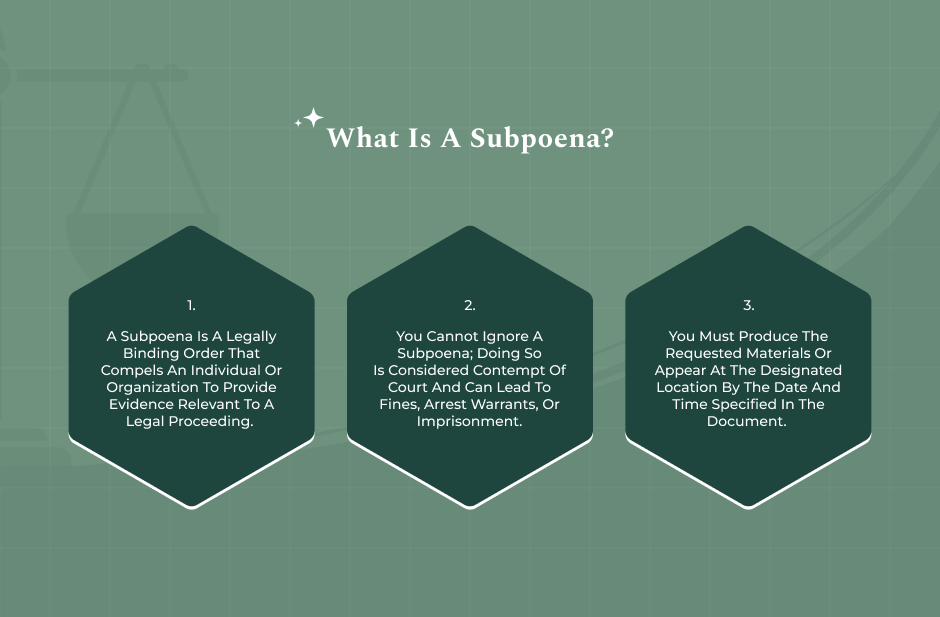
A subpoena is basically an official legal order. It requires an individual to show up in front of the court or to supply particular documents regarding a judicial matter.
A court officer, such as an attorney or a judge, generally issues the subpoena. This is because it is necessary to gather evidence or testimony in both criminal and civil courts.
Compliance with this order is mandatory, and if a person fails to respond, they may face severe penalties, including contempt of court.
Importance Of Subpoenas
In most cases, a subpoena is a document that a lawyer requests from a court on behalf of a judge, and the court clerk, notary public, or justice of the peace issues it.
The court official can hand over a subpoena to a person in the following ways:
- In person.
- Through email.
- Mailed by certified mail.
- Reading it aloud.
It is also sometimes called a writ or an administrative summons. So, a subpoena is a court order that cannot be disregarded, and not responding to it could lead to a contempt of court charge.
“Attorneys use subpoenas to gather information that can support their client’s case,” according to Investopedia.
Should a subpoenaed witness not show, the lawyer can ask the judge for a postponement in order to have time to get in touch with the witness.
In the other case, the lawyer may ask for the witness to be arrested if he/she does not respond to the subpoena.
Types Of Subpoenas
Here are some of the most common types of subpoenas that you need to know about:
- Witness subpoena: It is a legal document that requires a witness to appear before a court on a set date. Here, they need to provide testimony under oath about relevant information in a case. This is to assist in determining the facts and to help establish the truth in any legal action.
- Subpoena duces tecum: It is a document that legally requires a subpoenaed person to produce evidence (documents or records) at a particular date and location for use in a court hearing. It is typically part of the discovery stage of a lawsuit. The term duces tecum is a Latin phrase meaning bring with you.
- Deposition subpoena: It is a legal document that requires a person who is not a party to the litigation (3rd party) to provide copies of documents and appear at a deposition. This is to respond to inquiries from either of the parties involved in the underlying litigation.
What Happens When You Ignore A Subpoena?
It is worth mentioning that ignoring a subpoena is not something to be done, and a defendant who does not comply with a lawful subpoena will be subject to civil or criminal contempt of court charges.
A person can incur civil or criminal contempt of court charges, and the court could impose a fine or even place the individual in jail until that individual complies with the subpoena.
If there are valid reasons for getting out of a legal obligation under a subpoena, you should work with a qualified attorney who understands the legal requirements and will assist you in getting an order from the court to have the subpoena withdrawn or quashed.
What Are The Valid Reasons To Get Out Of A Subpoena?
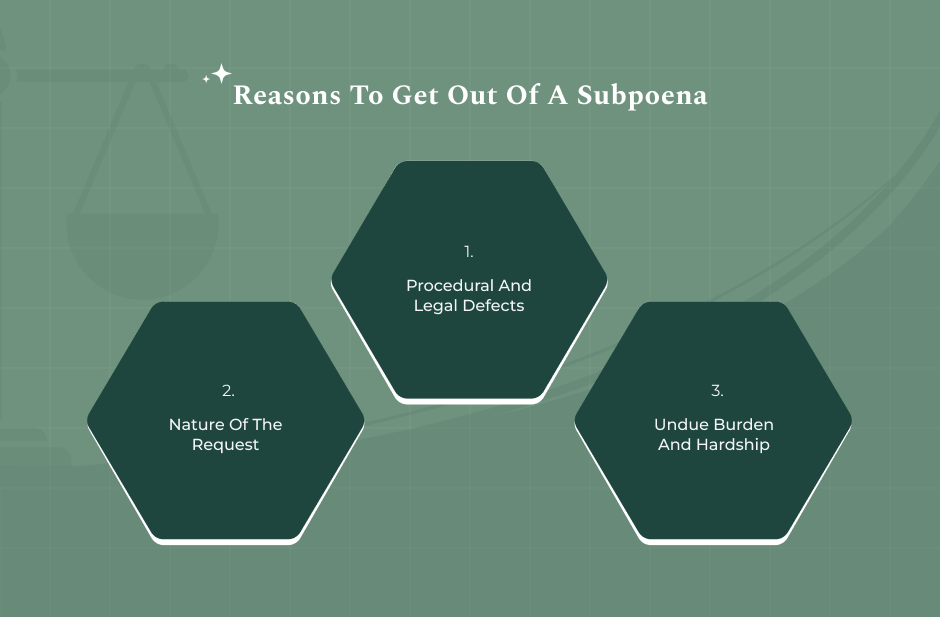
Here are the valid reasons to get out of a subpoena:
1. Improper Service Or Defective Issuance
Firstly, it is important to understand that the laws require subpoenas to be served properly. For example, this can be by hand-delivery of an authorized process server.
However, in case of failure to meet these requirements, the court never obtains jurisdiction over you. Thus, in this case, the document is not enforceable.
2. Lack Of Jurisdiction
Courts have certain geographical and subject matter limits. A subpoena may be void if the court is beyond its allowed area.
For example, this happens if the travel required is over 100–150 miles in some jurisdictions. Additionally, this can also happen if the court has no power over the person named.
3. Privileged Or Confidential Information
Thirdly, the law protects certain relationships, such as the Attorney-Client and Doctor-Patient relationships. This is in place in order to allow free communication.
If a subpoena demands these types of records, the court has to safeguard them to maintain these policy interests.
4. Fifth Amendment: Protection Against Self-Incrimination
It is against your rights to be compelled to testify against yourself in a way that would incriminate you.
Moreover, in some instances, one can interpret even the “act of production” (i.e., admitting that you possess particular documents) as self-incriminating. And thus, eligible for Fifth Amendment protection.
5. Undue Burden Or Over-Broad Requests
One of the valid reasons to get out of a subpoena is undue burden. One can consider a request oppressive and quash it if it is so extensive that it requires unreasonable costs, thousands of work hours, or the search of hundreds of sources.
6. Irrelevant Or Overly Broad Requests
Next, subpoenas must be specific and directly related to the issues in the case. If a request constitutes a “fishing expedition” attempting to gather information unrelated to the case, it lacks the legal basis to compel your response.
7. Medical Or Personal Hardship
In case of serious illness, incapacity, or a disability causing physical non-compliance, the subpoena may be challenged.
In most cases, a doctor’s statement is needed to show that being there is not just inconvenient but medically impossible.
8. Confidential Business Information & Trade Secrets
Usually, courts will allow information that, if disclosed, would enable competitors to gain an unfair advantage.
Despite the fact that you may be ordered to submit the information, you can, in most cases, avoid public disclosure through a protective order.
9. Duplicative Or Already Provided Information
Next, in case the information has been previously submitted to the court or can be obtained easily from another source, the subpoena is regarded as unnecessary and redundant.
10. Procedural Errors In The Subpoena Itself
Finally, one of the valid reasons to get out of a subpoena includes procedural errors in the order itself. For instance, a few minor mistakes that can make the subpoena legally “defective” and invalid are:
- The document doesn’t have a court seal.
- It has the wrong date/time.
- Insufficient notice.
Motions & Court Hearings: How The Process Of Getting Out Of A Subpoena Works
Getting out of a subpoena is a formal legal process that typically starts with negotiations and, if it is a last resort, a judge ultimately at a hearing decides the matter.
Here are some of the ways in which motions can become a part of the process:
1. Pre-Motion: Negotiation (“Meet And Confer”)
Before putting anything on paper, most courts require that you strive for a resolution with the party that subpoenaed you in good faith.
You can reply to the issuing attorney to point out the reasons why the request is a problem (like it asks too much, or you have a scheduling conflict).
The attorney may be willing to withdraw the subpoena, narrow its scope, or reschedule the date. Thus, there will be no necessity to involve the court.
2. Filing The Motion To Quash
In case the negotiation does not work, you have to file a Motion to Quash or Modify the subpoena.
You generally have to get this done before the compliance date (the “return date”) on the subpoena. In many federal and state cases, one can expect objections or motions within 14 days of service.
You (or your lawyer) file a Motion in writing to the court that authorized the subpoena. It normally consists of a “Memorandum of Law” which sets out the legal grounds and also a “Proposed Order” for the judge’s signature.
In numerous jurisdictions, filing the motion often means the temporary suspension of your duty to comply until the judge issues a decision.
3. The Court Hearing
Where the court doesn’t decide the matter based only on the written documents, a hearing will be arranged.
You (the “movant”) normally get to talk first and justify the excessive burden, privilege, or mistake in procedure.
You may submit supporting materials, such as financial records that document compliance costs or a doctor’s statement.
The opposition party that issued the subpoena will try to convince why the information is crucial for their case and that they have the right to obtain it.
4. The Judge’s Decision
The judge may make one of the following decisions after the hearing:
- Motion is granted: The subpoena is “quashed” (discontinued), and you are not held responsible for anything further.
- Modify the Subpoena: The judge limits the request (e.g., “hand over documents from the last 2 years instead of 10”). Or he/she changes the location/time.
- Deny the Motion: Follow the original subpoena or be at risk of the court declaring you in contempt and punishing you for noncompliance.
Jurisdictional Variations When Getting Out Of A Subpoena
Whether it is permissible to contest a subpoena and how a subpoena can be contested largely depend on the state where the issue arises, since the local courts have their own regulations concerning time limits, territorial scope, and interstate enforcement.
Federal Courts follow the provisions of the Federal Rule of Civil Procedure (FRCP) 45. Typically, any objections raised must be served within 14 days from the date of receipt or by the date of production, whichever comes first.
A Motion to Quash must be submitted to the court of the district where compliance is required. However, in some cases, the court may decide to transfer them to the issuing court if there are “exceptional circumstances”.
As for State Courts, the laws governing civil procedures are different from one state to another.
In this respect, California imposes very strict 10-day limits on certain motions, while in Florida, one has to submit a written objection to subpoena duces tecum (for documents) within 10 days.