Extenuating circumstances are the specific details and context surrounding a situation.
This makes it quite clear that these circumstances are a significant piece of information for a complete understanding. (Law Cornell)
Providing this additional context may make an individual’s unlawful actions appear less serious.
Additionally, the law may even take it as the degree of that individual’s culpability may be reduced.
What Are The Common Categories Of Extenuating Circumstances?
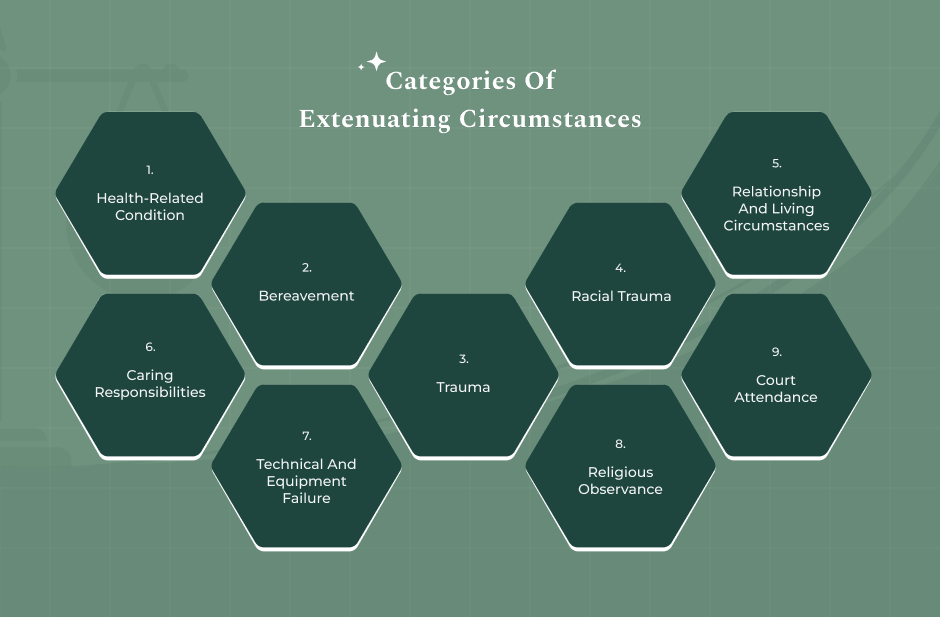
These are the various categories under which the judiciary accepts the notion of these extenuating factors: (Goldsmiths University of London)
1. Health-related Condition
A health-related condition can involve a personal injury or a medical or mental health issue that typically arises for the first time.
Additionally, it may also refer to a worsening or acute episode of a pre-existing medical or mental health condition.
Moreover, physical disabilities can also fall under this category.
In fact, these conditions may also arise from pregnancy-related circumstances.
2. Bereavement
Bereavement refers to the death of someone close to you. This can include close family members and partners.
Additionally, the list includes death of housemates too.
Coping with such a loss is often challenging. Therefore, it can significantly affect one’s emotional well-being.
Support during this time is crucial for healing.
3. Trauma
Trauma encompasses various forms of victimization.
This includes being a victim of crime, such as hate crimes or other violent acts.
It also includes experiencing violence of all sorts, such as:
- Domestic
- Sexual
- Physical
- Gender-Based Violence
Discrimination related to factors such as age, disability, or race also qualifies as trauma.
4. Racial Trauma
Racial trauma, or race-based traumatic stress (RBTS), refers to the mental and emotional injuries caused by encounters with racial bias and discrimination.
This includes experiences of racism and hate crimes. The effects of racial trauma can be profound and long-lasting.
It is essential to acknowledge and address these impacts on individuals and communities.
5. Relationship And Living Circumstances
Family breakdowns or the dissolution of close relationships can significantly affect one’s well-being.
Additionally, forced eviction from a home can create instability and stress.
This may occur due to circumstances such as a fire or other damage to a residence.
Adjusting to these changes can be difficult and may require support.
6. Caring Responsibilities
Unexpected caring responsibilities can arise from sudden illness, injury, or a worsening health condition of a loved one.
A change in circumstances may lead to additional caregiving demands.
These responsibilities can be overwhelming and may limit personal time and resources.
It’s important to seek help when needed to manage these challenges.
7. Technical And Equipment Failure
Technical failures of specialist software or the equipment necessary for assessments can hinder progress.
This may include assistive technology that is vital for completing tasks.
Damage to essential equipment, such as musical instruments or lab tools, also falls under this category.
These failures can disrupt planned assessments and require quick solutions.
8. Religious Observance
Religious observance can sometimes impact your ability to complete assessments.
If you feel that your observance has adversely affected your performance, it’s important to communicate this.
Understanding and flexibility regarding religious practices are vital.
Accommodations may be necessary to support individuals in these situations.
9. Court Attendance
Attending court or tribunal can be a significant obligation.
This includes jury service or serving as a witness, defendant, or plaintiff.
Such responsibilities can impact one’s ability to complete assessments or meet other commitments.
It is essential to notify the appropriate parties when these circumstances arise to manage potential conflicts.
What Does Extenuating Circumstances Mean In Different Verticals?
When it comes to extenuating circumstances, the perspective varies depending on the verticals you use it in.
I have presented a comprehensive table below highlighting the differences. Let’s take a look:
| Domain | Typical Use Case | Potential Outcome |
| Criminal Defense | The sentencing phase after a conviction | Reduced prison sentence, probation, or community service |
| Academic Institutions | Missed exams or failed assignment deadlines | Penalty-free extensions, capped grade waivers, or retro-withdrawals |
| Employment Law | Unexcused absences or performance failures | Protection against wrongful termination; mandatory medical leave |
| Contractual Disputes | Inability to fulfill a supply or service agreement | Mitigation of damages; invocation of Force Majeure clauses |
Extenuating Circumstances In A Military Criminal Case
Extenuating circumstances refer to specific facts surrounding an incident that provide insight into why an offense occurred and may lessen the perceived severity of the crime.
These factors typically relate to the situational context rather than the individual’s personal background, making them crucial during the sentencing phase of a court-martial.
In military law, some common examples of extenuating circumstances include:
- The misconduct occurred in self-defense.
- The service member reacted to provocation or a credible threat.
- A deadly weapon was used defensively to safeguard others.
- There was an urgent necessity to act amid a chaotic combat scenario.
In military courtrooms, the context in which the behavior occurred is significant.
Extenuating circumstances can illustrate that, while the conduct in question was inappropriate, it took place under conditions that a reasonable person might navigate similarly.
This might involve operating under extreme stress in a hostile environment or reacting to rapidly changing combat situations, where delay could be fatal.
These factors can be pivotal in persuading a military judge or panel to consider a more lenient sentence, particularly when effectively articulated by a skilled criminal defense attorney.