The topic of the day: E Zpass Toll Scam!
There is currently a big rise in “smishing” – a social engineering attack via fake SMS messages – which is hitting drivers all over the country. After the EZDriveMA scam, the E-ZPass Toll Scam has come to light.
These phishing texts pretending to be official E-ZPass alerts mention “unpaid toll” amounts that are usually quite low – e.g., $11.69. This basically induces a sense of panic and leads the victims to disclose their sensitive data without them realizing it.
The E-ZPass scam is far from being just a small inconvenience. Rather, it is a large-scale criminal network.
In fact, the FBI’s Internet Crime Complaint Center (IC3) has received more than 60,000 complaints so far this year about this very toll-themed scam alone.
When users click on harmful links, they may suffer identity theft and financial loss because criminals can obtain credit card details through very trustworthy-looking spoofed websites.
In this article, we will be talking about the following things:
- What is the E Zpass Toll Scam?
- How does the smishing work?
- Critical red flags to keep in mind.
- Legal and regulatory guidance when it comes to E Zpass Toll Scam.
- The legal recovery checklist after clicking on a phishing link.
Therefore, if these are what you want to know, keep reading!
What Is The E ZPass Toll Scam?
The E ZPass toll scam is an extremely crafty “smishing” (SMS phishing) plot that has been aimed at millions of vehicle owners throughout the country.
Scammers send fake texts stating that the recipient has an “outstanding toll balance,” usually a small, believable figure like $ 11.69, and that the payment must be made immediately to avoid late fees or license suspension.
These texts are accompanied by a link to a fake website intended to look like official portals such as E-ZPass or SunPass. (Source: The Times of India)
The scale of the damage has been very large; the FBI’s Internet Crime Complaint Center (IC3) alone got more than 60,000 complaints in 2024.
Those who click the links get exposed to risks of identity theft, losing money, and getting their computers infected with viruses.
In turn, the FBI, FTC, and other federal and state agencies have released public warnings alongside telecom carriers with whom they are collaborating to block the culprit domains and identify the criminal gangs behind the scams.
How Does The E ZPass Toll Scam Work?
The E ZPass scam consists of a very specific combination of psychological pressure and technical deception. The pain point through which it is sprung is a fraudulent message aimed at causing panic.
As a rule, these messages may use very harsh language, chasing the recipient with threats such as “immediate late fees”, “court summons”, or even “suspension of driving privileges” to appear if a small balance is not paid immediately.
The urgency here is a classic technique in social engineering designed to get the target to bypass their rational thinking.
On top of that, the very setup of the scam is just as deceiving. Fraudsters create thousands of fake domains which are very close to the real ones, e.g., by adding extra characters or using deceptive subdomains – for example, e-zpass.com-roadioe.cc or ezpass-service.org.
Such websites are exact copies of official government sites with official logos among them and payment forms that look like secure ones but are used to steal credit card details. Security specialists have also revealed that these sorts of scams are run by international criminal groups.
Studies published by Akamai and Lookout reveal that these “scam-in-a-box” kits are typically controlled by highly skilled overseas criminal organizations mainly located in Southeast Asia and Eastern Europe.
They are capable of launching a huge, highly coordinated attack on several states at the same time. (Source: Akamai)
Critical Red Flags To Watch Out For In The E ZPass Toll Scam

Spotting a toll scam involves being alert for the technical features that scammers use, which are different from those of the legitimate authorities.
Before you start interacting with the message, you can use the following checklist to recognize problematic ones:
1. Suspicious Sender IDs:
Real toll agencies usually send their messages through legitimate 5-digit or 6-digit short codes.
If you get an “unpaid toll” notification from a regular 10-digit mobile number or from an international country code, you should be very suspicious.
For instance, codes like +63 for the Philippines or +84 for Vietnam undoubtedly point to a trick that has come from abroad.
2. Top-Level Domain (TLD) Errors:
Although legitimate organizations use stable domains such as .com or .org, fraudsters tend to use “disposable” high-risk TLDs.
Be cautious of web addresses that end in .xin, .top, .vip, .world, or .biz. These are cheap to register in large quantities and are often associated with harmful activities. (Source: Spamhaus Project)
3. Instructional Bypasses:
Finally, one very obvious indication of a scam is the instruction to “reply ‘Y'” or “type a keyword” in order to see the message. (Source: VECTRA)
This is a clever trick to get around the smartphone security measures – such as link protection in iMessage – which mostly disable hyperlinks from unknown senders unless the user has first engaged with the conversation.
Legal & Regulatory Guidance In The E ZPass Toll Scam
It is very important to be familiar with the laws and rules of digital tolling in order to protect consumers.
A very basic guideline for drivers is to know the Official Communication Standards. According to this, legitimate and official agencies like E-ZPass, SunPass, and FasTrak clearly state that they do not request payment via E ZPass text scam message.
Any SMS claiming you must pay immediately for “unpaid tolls” to avoid legal action is fraudulent.
To further assist the federal enforcement and protect the digital ecosystem, users should adhere to these Reporting Requirements:
- FBI Internet Crime Complaint Center (IC3): File an official report at ic3.gov. When filing, include the originating phone number and the malicious URL found in the text.
- FTC Report Fraud Portal: A person who has been victimized or has come across a scam can use this portal to report it at ReportFraud.ftc.gov so that the Federal Trade Commission can track the new trends and also build cases.
- FCC Smishing Reporting: You can forward the fraudulent message to 7726 (this spells out “SPAM”). This is a free service with which the Federal Communications Commission and wireless carriers can identify and block malicious senders.
Legal Recovery Checklist After You Click The Link
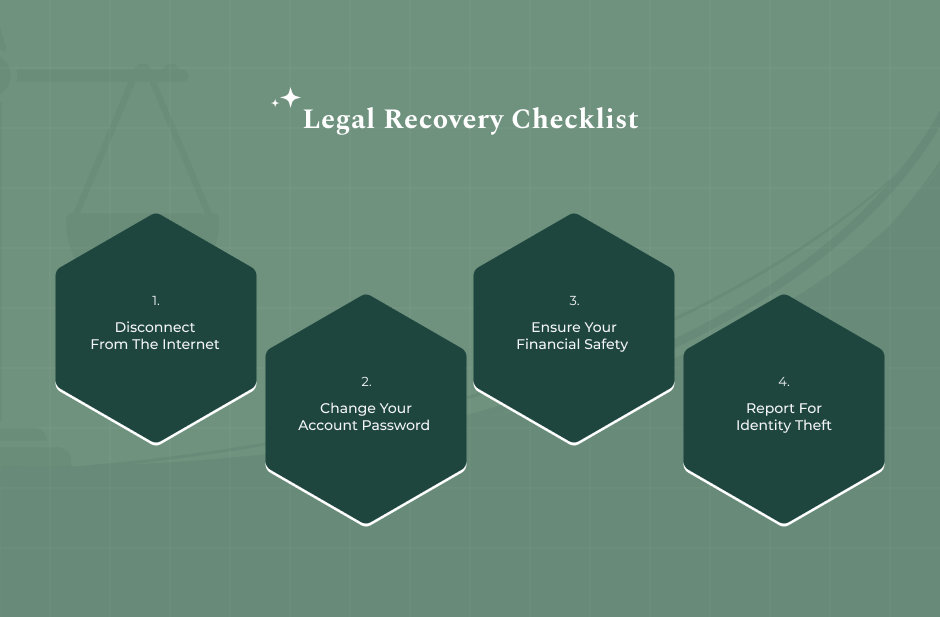
If you have accidentally clicked on a phishing link or entered payment details, it is very important to act quickly to prevent any further damage.
This Legal Recovery Checklist will help you take the necessary steps to protect your digital identity:
- Immediate Actions: Simply unplug your device from the internet – both Wi-Fi and cellular data. This will stop any malware from communicating with the scammer’s server or stealing your data.
- Account Security: Change your E-ZPass account password from a different, secure device. Also, it is very important that you change the passwords of all your sensitive accounts. Particularly, your email and bank accounts should have strong and unique passwords, and enable multi-factor authentication (MFA).
- Financial Safeguards: Call your bank or credit card company to block your card and report the transaction as unauthorized. Ask for a new card number to avoid further fraud.
- Identity Theft Reporting: If you gave your Social Security number or date of birth, report the incident officially at IdentityTheft.gov. This Federal Trade Commission (FTC) site will guide you through the recovery process and provide an affidavit that creditors often need to dispute fraudulent activity.
Protection Against E ZPass Toll Scam: Staying Vigilant In A Cashless World
As more and more highways across the country go for 100% cashless tolling, the E-ZPass smishing scam serves as a warning. It tells us that our digital footprints are a major target for scammers.
These “unpaid toll” scam schemes are likely to be more sophisticated and even more personalized. And that they will be easier to mistake for legitimate billing notices.
At present, being aware of what is going on is no longer a choice. Rather, it is a must for your financial security.
Do not fall for the scam because phishing messages can be the cause of identity theft and other security compromises. The best protection is a simple rule: don’t ever believe the text message.
In order to protect your identity and your money, you have to disregard any links that come unsolicited to you. Additionally, you should always double-check your toll accounts only through official channels.
Ultimately, since we are entering a cashless society, your preventive verification is what makes you least vulnerable to cyber attackers.