Today’s topic: Digital contract management.
Global legal landscapes have changed during the present times. They did not just react to the digital shift. Instead, they underwent a fundamental rebuild.
Modern enterprises now treat digital contract management as a core strategic pillar. It is no longer just a back-office task. It directly influences corporate strategy and risk mitigation.
Global privacy frameworks have matured significantly.
The CCPA 2026 updates and strict GDPR enforcement led to this change. Because of these rules, how companies capture and store agreements determines their legal survival. This process also dictates their operational speed.
The stakes are high for consumer-facing sectors. These include fintech, healthcare, and insurance. In these fields, poor contract management is a systemic legal flaw.
It is not merely a technical glitch.
To solve this, experts recommend moving toward automated, active consent frameworks. These systems act as a vital link. They help firms achieve “meaningful consent” while automating regulatory compliance.
What Is Digital Contract Management?
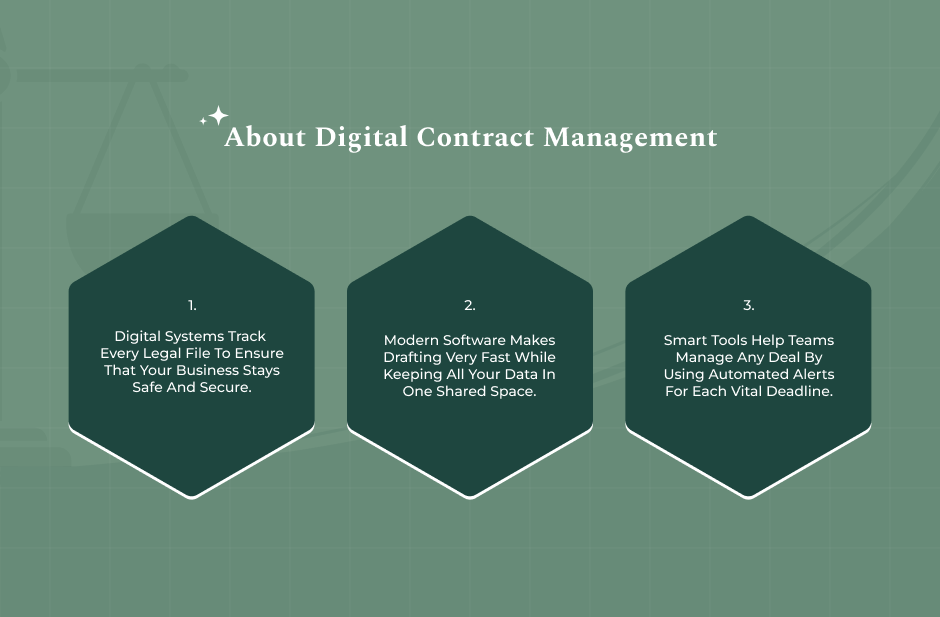
At its core, digital contract management replaces the physical lifecycle of an agreement with a fully electronic workflow.
This transition moves organizations away from manual wet-ink signatures and disorganized filing cabinets. Instead, teams embrace browser-based processes. These simplify how contracts are:
- Drafted.
- Negotiated.
- Archived.
The impact of this shift is measurable and immediate.
By automating routine administrative tasks, legal and business departments often reclaim up to 90% of the time previously spent on manual oversight.
To achieve this at scale, many organizations integrate clickwrap software into their workflows. This tool ensures that high-volume digital agreements remain both seamless for the user and legally defensible for the company.
Beyond time savings, digital transformation directly protects a company’s financial health. Research indicates that fragmented, legacy contract processes can leak up to 40% of an agreement’s total value.
By digitizing these assets, businesses can bridge that gap, driving efficiency across the entire lifecycle and ensuring they capture the full value of every commitment they make. (Source: Juro)
Need For Digital Contract Management: Why Traditional Methods Are Failing
For years, businesses used “browsewrap” agreements. These passive links sit at the bottom of websites. They assume users agree just by browsing.
However, this era is over. Regulators and courts now prioritize consumer rights. They view passive consent as a relic. It lacks necessary transparency.
A central tension exists in 2026.
It pits “Contractual Certainty” against “Individual Autonomy”. Courts now strike down agreements that use Dark Patterns. These manipulative designs nudge or trick users into agreeing.
Consequently, companies must move toward active, affirmative agreement methods. Regulators forced this shift because they grew tired of “fine print” culture. Power is shifting back to the consumer.
How Digital Contract Management Sets The Standard For Enforceable Agreements
Technical solutions now offer a definitive fix for this persistent legal problem. Specifically, modern digital contract management creates a standardized consent engine that far exceeds the reliability of fragmented manual steps.
For instance, it forces users to take an explicit, affirmative action before they can access a service. Consequently, they must check a box or click a button labeled “I Agree.”
Furthermore, the system links this specific action to the exact version of the terms displayed at that precise moment.
Because of this, businesses value this approach for its significant impact on Enforceability Rates. Historically, older browsewrap methods fail often in court, succeeding only about 14% of the time.
In contrast, using dedicated software delivers a much higher success rate of roughly 70%. Beyond just success rates, these platforms provide an immutable audit trail.
This means they can prove exactly what the user saw and when they saw it while simultaneously recording every digital interaction.
The Critical Mandate: The “Right To Withdraw” As A Functional Requirement
The 2026 legal landscape changed consent from “Static” to “Dynamic.” Under CCPA 2026 regulations, the Right to Withdraw Consent is a core requirement. It is not just an afterthought. It is a functional part of any digital agreement workflow.
Experts say many businesses fail here
They see consent as a one-time deal. Yet, the law now says withdrawing consent must be easy. It should be as simple as giving it.
Modern contract systems provide this essential “Exit Architecture.” It keeps firms legally compliant. If a user agrees with one click, they must revoke it just as easily.
Managing these withdrawals manually is a nightmare at scale. A company with millions of users cannot use email for this. They risk data breaches and heavy fines.
Automated platforms manage this consent lifecycle. When a user withdraws, the system updates permissions instantly. This happens across the CRM and marketing tools.
How Can Digital Contract Management Platforms Help?
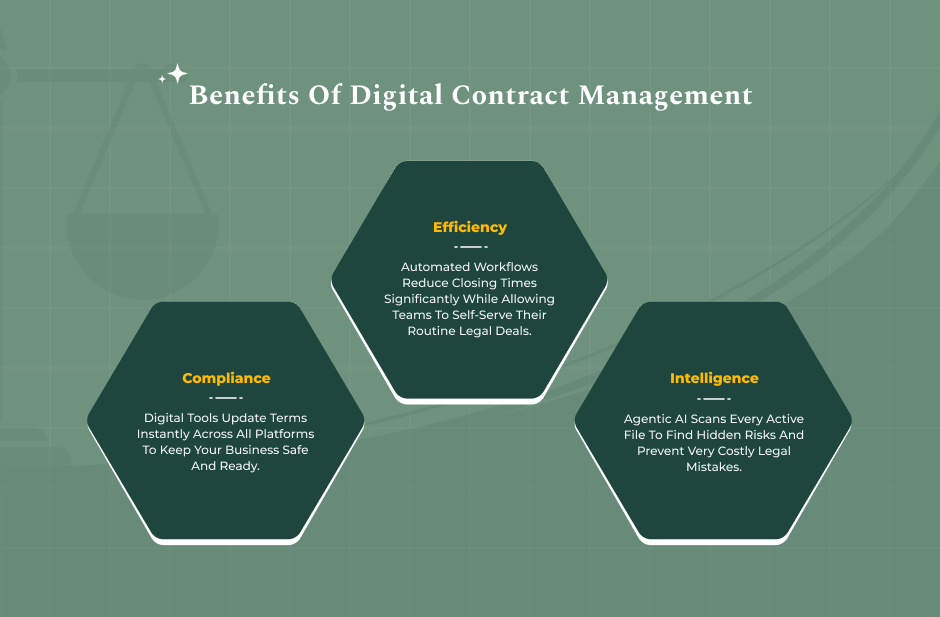
Here are some of the major benefits of using Digital Contract Management platforms that you must know about:
1. Automated Compliance And Audit Readiness
In 2026, compliance is a moving target. New standards require strict handling of sensitive data.
Businesses must offer a prominent opt-out tool. Digital contract management systems automate this work. Instead of manual updates, they utilize Global Versioning.
When privacy laws change, teams update terms in a central hub.
The technology pushes these updates to every user touchpoint immediately. This ensures every new signature follows the latest law. It provides real-time audit readiness.
If regulators ask, the business produces a “Certificate of Completion.” This proves which version the user accepted. Additionally, it also shows their current status.
2. Accelerating Revenue Velocity
Modern digital contract platforms also act as business accelerators. For instance, they offer more than just a legal shield. Experts see a clear link between these tools and the revenue velocity. (Source: GEP)
Firms that digitize their contract lifecycle reduce cycle times by 80%. They remove the friction of manual drafting and physical signatures. Deals that took weeks now close in hours.
These systems help Sales and HR teams self-serve routine deals. These agreements already have pre-approval from Legal. This decentralization removes the legal bottleneck.
3. Agentic AI And Predictive Risk
The biggest trend in 2026 is the shift to “Agentic” AI. Modern systems do more than store files. They “read” and “act” on them. According to Summize, Agentic AI systems scan portfolios to find risks early.
For example, a court might change how it interprets an “indemnification” clause. An AI-powered system flags every active contract with that language instantly.
For a firm with thousands of vendor deals, this is vital. Additionally, it prevents multi-million dollar fines for missed deadlines. It keeps operations running smoothly.
The Ethical Dimension Of Contract Tech
By the late 2020s, digital contract management will be the default for all contracts. The focus will shift to the ethics of these systems. As the underlying technology gets better, companies must stay transparent.
Industry leaders are moving toward “Ecosystem Integration.” Contract data now flows between CRM and Legal Ops platforms. (Source: Swiftwater)
Compliance is not a static paper. Rather, it is a living process. Besides, modern tools help businesses follow the law while building trust. They create a defensible architecture of consent in a scrutinized world.