The definition of de jure segregation is a practice whereby people are segregated into different groups according to the laws or legislation.
The term was commonly used in the United States to create practices based on the laws in place for many years.
With respect to the April 2026 date, there are numerous impacts created by the old mandates on the present civil rights movements and affirmative action programs.
As for now, there are several court filings on how the discriminatory zoning mandates affect the current period.
In states like Illinois and New York, there are several lawsuits filed on whether mandates should compel changes in legislation in the current day.
It is important for any individual who studies the history of civil rights legislation to understand the timeline.
This article will discuss the following topics:
- The legal de jure segregation definition and its origins.
- Constitutional frameworks and the “Separate but Equal” doctrine.
- Landmark Supreme Court cases that dismantled legal mandates.
- The transition from legal mandates to modern civil rights laws.
- Answers to common questions regarding current legal separation issues.
Defining The Concept Of De Jure Segregation In Law
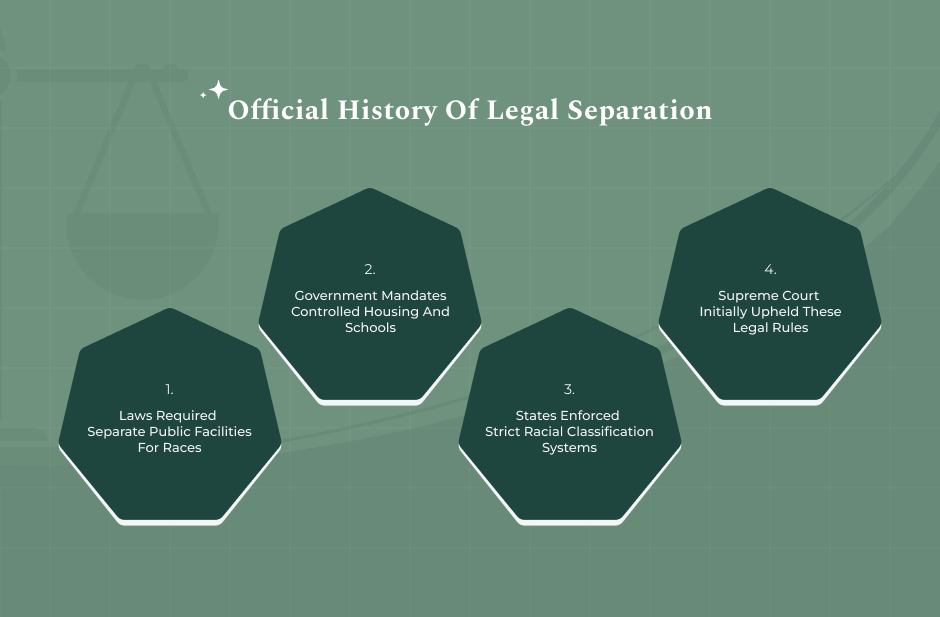
The term “de jure segregation” is a Latin phrase meaning “according to the law” or “by right.”
It refers directly to de facto segregation, which does not have anything to do with government actions but rather happens in society or on a personal level.
De Jure Segregation In America
To define the notion of de jure segregation, it is necessary to take a look at the exact state and city laws prior to the 1960s.
These rules prescribed that different races had to attend different hospitals, schools, and public transport.
Main Characteristics
The key feature of de jure segregation is that it was a governmental decision enforced in the territory of certain regions. As a result, individuals had to abide by this rule because there was a law stating so.
State Action Vs. Social Practice
Unlike de facto segregation, de jure segregation involved police action. Therefore, if an individual broke those rules, they were subject to jail or a fine.
The Role Of The Fourteenth Amendment And Legal Challenges
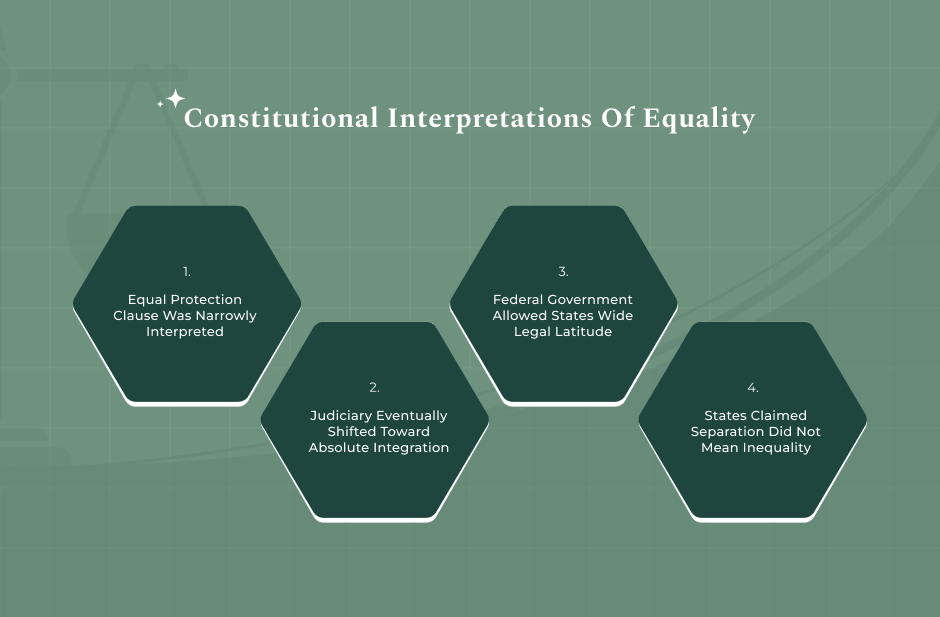
Although the Fourteenth Amendment had been created to ensure equality, the early interpretations facilitated the practice of de jure segregation.
The American legal system had operated under the contradictory assumption that separate institutions could be equal for almost six decades.
The Rise of Separate But Equal
Separate but equal was the principle that justified de jure segregation throughout the southern states. States were able to create different institutions on the condition that they would be equivalent in quality.
The Case of Plessy Vs. Ferguson in 1896
Here, the Supreme Court held that the law requiring train cars to be segregated in Louisiana was constitutional. This law became a foundation of Jim Crow laws for more than fifty years.
Financial Inefficiencies Related To Segregation Legislation
Therefore, a large sum of money was spent since there was a need for the construction of the different institutions in all states.
It is worth noting that the infrastructure offered to the minorities was poor compared to that of whites.
Important Supreme Court Decisions On Legal Segregation
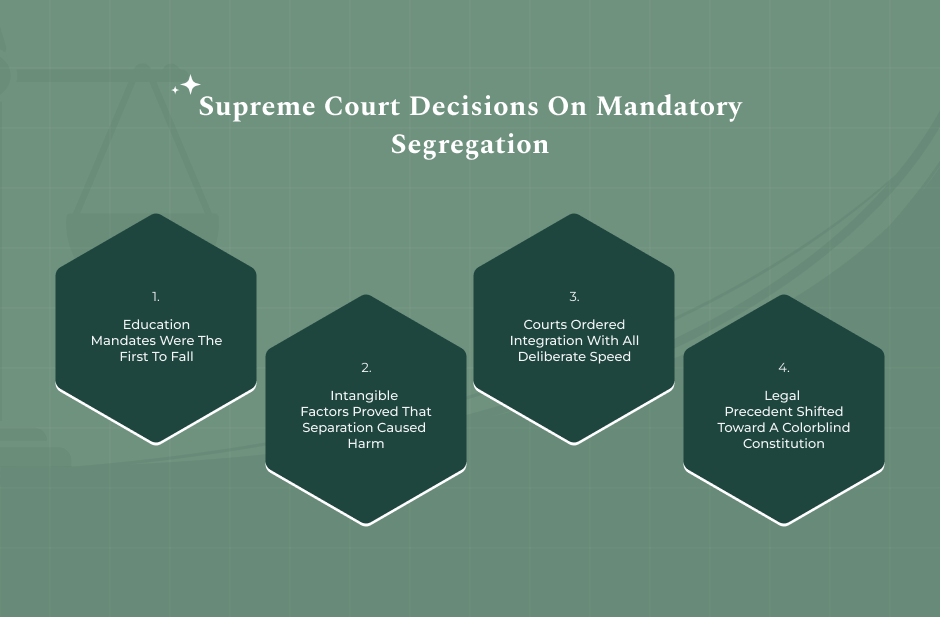
Nevertheless, the eradication of de jure segregation would be possible only via legal actions taken by civil rights movements until the Supreme Court admitted that segregation is discrimination per se.
Brown V. Board of Education (1954)
In the year 1954, there was a very important case challenging de jure segregation – Brown v. Board of Education (347 U.S. 483).
The Supreme Court declared that de jure segregation in schools violates the rights provided for by the Fourteenth Amendment (SagePub).
Sweatt V. Painter (1950)
There is one more significant case before the mentioned case – Sweatt v. Painter (339 U.S. 629).
The Supreme Court said that segregation can be considered to be de jure only under the condition that equal opportunities cannot be ensured, even when curricula were similar.
Bolling V. Sharpe (1954)
In 1954, there was another crucial case, Bolling v. Sharpe (347 U.S. 497). This case challenged the de jure segregation of schools in Washington D.C., which was considered to be a federal district.
Federal And State Laws For Civil Rights In 2026
The legal framework in 2026 has moved beyond merely ending de jure segregation to putting up safeguards against it using policies.
The federal regulations have taken charge of the conduct of the states and ensure that no hindrance comes out of such conduct in the form of laws.
Civil Rights Act Of 1964
This legislation brought about an end to de jure segregation in all facilities and services operated by the state.
Furthermore, the Act gave permission to the Department of Justice to sue states that did not segregate.
Title VI Prohibitions
It is necessary to point out the significance of Title VI, as it bans discrimination by any entity receiving funds from the government.
This implies that it makes sure that de jure segregation does not haunt present-day constructions and health care facilities.
The Fair Housing Act of 1968
The legislation focused on the “residential” element of de jure segregation. The act banned discrimination, including redlining, in which the government denied mortgages based on the color of skin from its maps.
State Constitutional Affirmations
States in 2026 have introduced anti-segregation statutes in their constitutions. Generally, such laws provide additional protection against discrimination beyond the federal rule and make the process of litigation quicker.
Frequently Asked Questions (FAQs):
Legal problems of segregation can confuse citizens about their rights in the modern world.
The problem lies in understanding the concept of de jure segregation and its difference from other segregation types.
De jure segregation refers to a form of segregation where the state sets up a particular statute or order. The main difference is that this segregation is different from others since it is mandatory.
While de jure segregation occurs legally, de facto segregation happens factually. De jure segregation is legally required, while de facto segregation normally as a result of high housing prices or personal preference.
There are currently no clear examples of de jure segregation; however, according to lawyers, the existing restrictive zoning laws and public school districts act as substitutes for de jure segregation in 2026.
Absolutely. If the legislation creates separate categories of people, then it would be unconstitutional. Most court cases deal with outdated laws and their implications that are still not constitutional.
It set out the doctrine of “separate but equal.” Under this rule, it was permitted for states to enforce separation among their citizens for a long period of time until the Supreme Court decided to overturn it decades later.
Yes. This is the most popular form of de jure segregation. This refers to the laws implemented in Southern states that required segregation.