Today’s topic: Sham trust.
Trusts serve as the cornerstone of sophisticated wealth management. For decades, high-net-worth individuals have utilized these vehicles for legitimate estate planning. They also use them for asset protection and charitable giving [Source: 26 U.S. Code §7201].
However, a growing trend in the financial world pushes the boundaries of these structures too far. When a trust crosses the line from aggressive planning to deliberate deception, it enters dangerous territory.
Specifically, it becomes a “sham trust.”
In simple terms, a sham trust refers to a legal structure created with the explicit intent to deceive third parties.
Creators also use them to evade legal obligations. On the surface, these instruments often appear perfectly legitimate.
They usually feature complex trust deeds, named beneficiaries, and appointed trustees. Yet, the actual administration of the trust actively undermines its legal validity.
Consequently, legal experts and tax authorities agree on a fundamental truth. Courts look at the content and substance of a trust, not just its written structure.
Therefore, individuals who attempt to hide money from legitimate creditors or tax authorities frequently find themselves facing severe civil and criminal penalties.
For this reason, understanding the mechanics of sham trusts is critical. Wealth advisors, corporate counsel, and high-net-worth individuals must know how the judiciary identifies them.
What Is A Sham Trust?
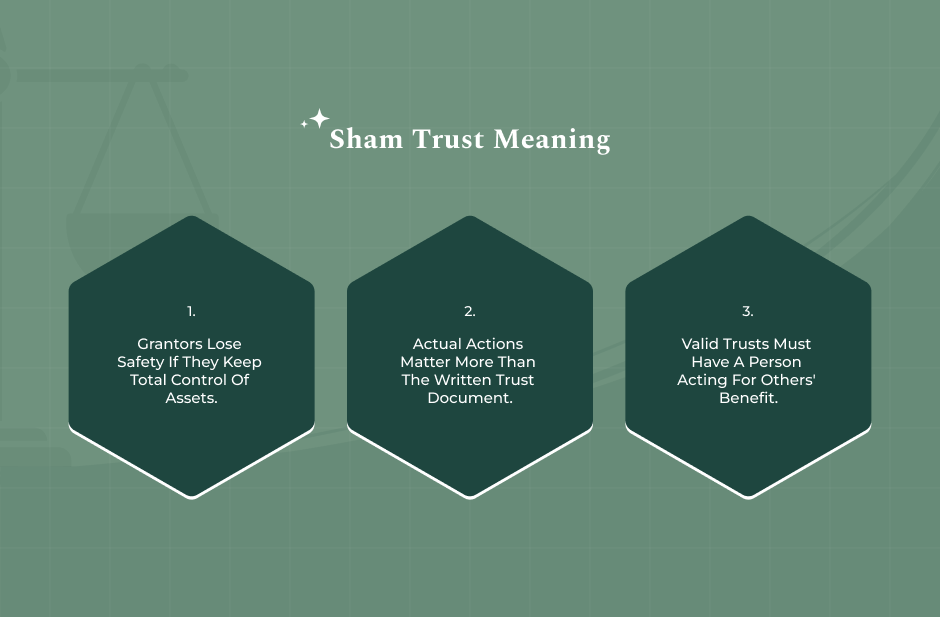
To understand how a trust becomes a sham, we must look at the core principles of trust law. A valid trust mandates that a trustee work independently. Furthermore, the trustee must act strictly in the best interests of the beneficiaries.
Conversely, a sham trust breaks these rules entirely. It lacks true intent or purpose. In practice, a sham exists when a grantor fails to distinguish between themselves and the trustee regarding the ownership and control of the assets.
According to Lexis Nexis, a sham trust is basically when “the settlor retains full beneficial entitlement and there is no intention that the apparent beneficiaries are to obtain any benefit.”
For instance, a trust deed may declare the structure to be “irrevocable.” Yet, the grantor may maintain unfettered, day-to-day access to the bank accounts.
Similarly, a trust may designate distant relatives as beneficiaries. However, the structure functions solely to benefit the original donor.
When determining whether a trust is a sham, courts consistently apply the doctrine of “substance over form.”
This principle dictates that the actual, real-world administration of the trust matters infinitely more than the words printed on the paper.
This legal doctrine is not new. However, courts are applying it today with unprecedented scrutiny.
For example, in the landmark Supreme Court case United States v. Estate of Grace (1969), the court emphasized that economic reality dictates tax and legal consequences.
Ultimately, if a grantor retains the economic benefits of ownership, the law will treat them as the owner. The court ignores whatever the trust document says.
How To Identify A Sham Trust?
A trained eye can easily spot the operational warning signs of a sham trust. Also, you can easily avoid falling into the pitfalls and dangers of a Sham Trust.
For instance, one of the things that you can do is drafting clear and transparent trust documents that define the roles and responsibilities of all parties.
But that is not all.
Analysts and forensic accountants look for several key indicators during asset investigations:
1. Lack Of Trustee Independence
In a legitimate trust, the trustee holds a fiduciary duty to manage the assets. In a sham trust, the trustee acts merely as a “straw man” or a passive agent.
Therefore, if the trustee simply rubber-stamps every demand of the grantor without exercising independent judgment, the trust is functionally a sham.
2. Retained Control And Use
A valid asset protection trust requires the grantor to give up control. Consequently, if the grantor continues to live in the trust-owned house rent-free, the trust fails the validity test.
The trust also fails if the grantor drives the trust-owned vehicles or spends trust cash on personal vacations.
3. The Intent To Deceive
Finally, a trust becomes a sham when the parties intend to create a false appearance for third parties.
In this case, the creators design the arrangement to mislead creditors or government agencies. They do this while knowing the trustee will never actually enforce the trust’s written terms.
4. Lack Of Actual Beneficiaries
A trust must benefit someone other than the grantor to justify its tax and asset protection advantages. Therefore, if the named beneficiaries receive no distributions and have no knowledge of the trust’s existence, the court will likely invalidate the entire structure.
Legal Consequences: Severe Tax And Fraud Penalties For Sham Trust
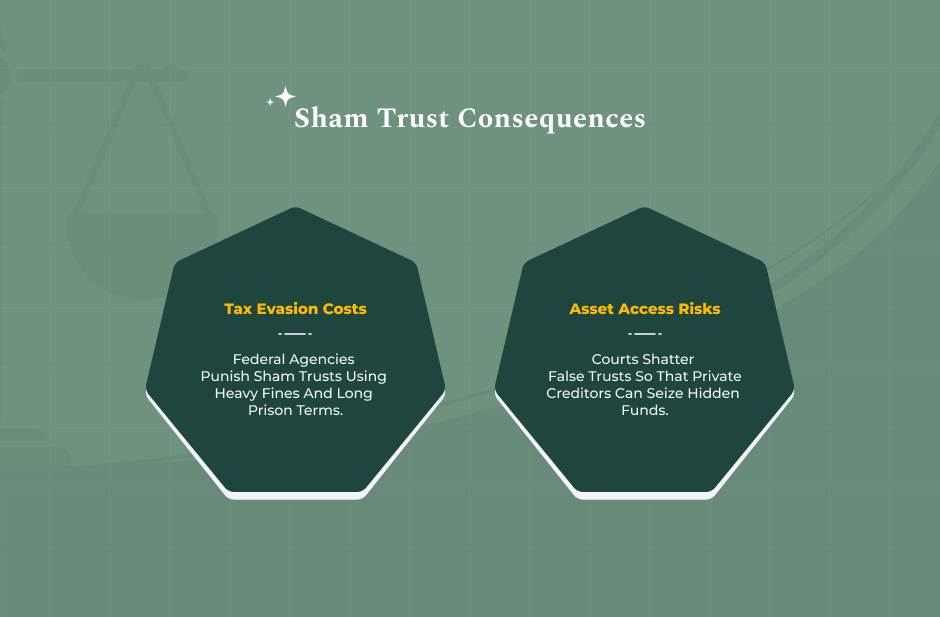
The consequences of utilizing or advising on a sham trust are severe. Regulatory bodies and courts do not view these arrangements as innocent planning mistakes. Instead, they treat them as deliberate fraud.
Tax Fraud And Evasion
People frequently use sham trusts to evade federal and state taxes by concealing income. Consequently, the Internal Revenue Service actively scrutinizes complex trust networks to identify non-compliant structures.
Under 26 U.S. Code §7201, proving willful tax fraud can result in heavy fines and significant terms of imprisonment. Beyond criminal charges, civil penalties are devastating. The IRS can disregard the trust’s existence entirely. (Source: Legal Information Institute)
This action forces the grantor to repay all unpaid taxes with compounding interest. Furthermore, the agency can levy additional civil fraud penalties amounting to a massive percentage of the evaded tax.
This aggressive stance directly aligns with historical precedent. In the Supreme Court case Commissioner v. Culbertson, the court established a vital rule. Judges must look at the true intent behind a financial arrangement to determine its legitimacy for tax purposes.
Creditor Fraud
Beyond tax authorities, private creditors also use the legal system to shatter sham trusts. When individuals hide assets to avoid paying legitimate debts, courts apply fraudulent transfer laws under the Uniform Voidable Transactions Act.
If a court determines a trust is a sham, it will simply reverse the transfer of assets into the trust. This grants creditors direct access to the seized funds. Furthermore, the court can impose heavy monetary damages on both the grantor and any co-conspirators.
For example, in the case Bank of America v. Weese, the court invalidated a trust specifically designed to shield assets from creditors. The ruling heavily emphasized the complete lack of operational legitimacy. (Source: Justia Law)
Sham Trust And Courts: How Courts Catch Fake Trusts
Today’s courts play a highly active role in hunting down sham trusts. Judges frequently apply the “step transaction” principle to uncover the true nature of complex financial webs.
This principle treats a series of separate, formal steps as a single integrated transaction to reveal the true economic reality.
This judicial approach mirrors the logic used in Gregory v. Helvering (1935). In that case, the Supreme Court disregarded a corporate reorganization because it served no legitimate business purpose other than tax avoidance.
Modern courts apply that exact same reasoning to trusts that lack a valid non-tax or non-creditor purpose.
Read Also: