The principle of preponderance of evidence is used as the major measure of justice in all civil lawsuits in America.
Contrary to the “beyond a reasonable doubt” principle used in criminal lawsuits, this principle enables a judge or jury to make a judgment based on whether the case has a higher likelihood of being correct or not.
Legal experts have described it as a principle that only needs to lean a little bit in a certain direction for judgment to take place.
In early 2026, people used the principle in large class-action lawsuits related to digital data privacy and lawsuits related to environmental damage heard in California and New York courts.
Currently, lawsuits filed against major social media organizations are putting to test whether the principle of preponderance of evidence is enough to establish that certain algorithms resulted in damage to minors. The lawsuits were filed in late 2024 and have reached the discovery phase in 2025.
Thus, it is an important issue for legal enthusiasts.
In this article, we will discuss the following:
- The legal preponderance of evidence means and its core application.
- The critical differences between civil and criminal burdens of proof.
- Federal and state laws that establish these evidentiary rules.
- Significant case laws that highlight the power of the 51% rule.
Defining The Concept Of Preponderance Of Evidence
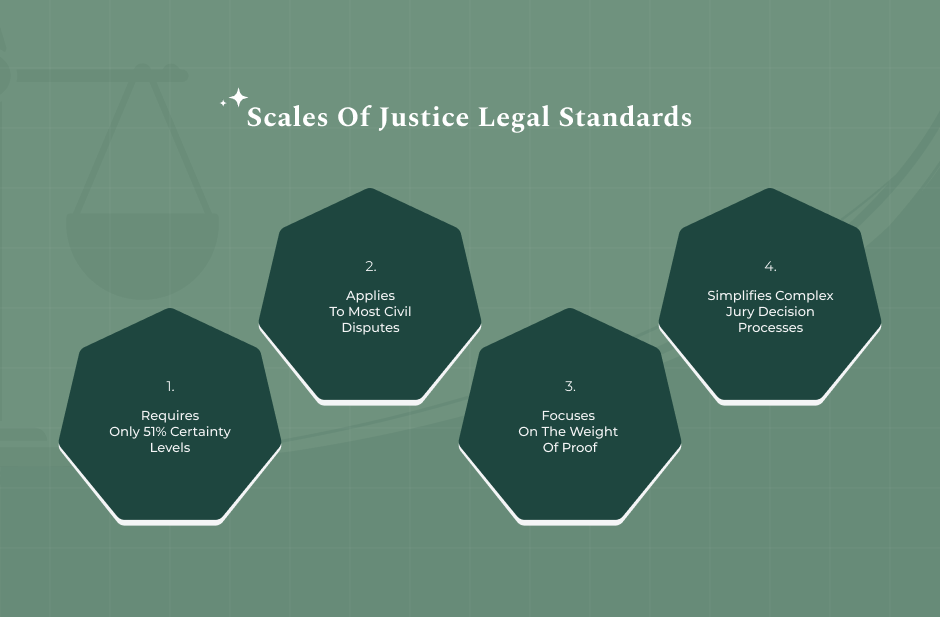
The preponderance of evidence definition is the lowest burden of proof in American law. It is a requirement for a party to prove their version of events is more likely to be true than not true.
What Does Preponderance Of Evidence Mean In Practice?
In order to answer the question of what does preponderance of evidence means, imagine a balance scale with the plaintiff’s story on one side and the defendant’s story on the other. If the plaintiff’s side is heavier, no matter by how small an amount, they win their case.
In other words, one does not need to convince the jurors completely. All they need to believe is that the plaintiff’s story is probably true, or at least probably truer than the defendant’s story.
Why The Standard Matters For Citizens
The reason for this is that, in a civil court, money or property is at stake, not a person’s freedom. The law aims to divide error equally between both parties.
If the evidence is a 50-50 split, the plaintiff loses their case because they fail to prove their side of events by a preponderance of the evidence.
Laws Regarding Burdens Of Proof
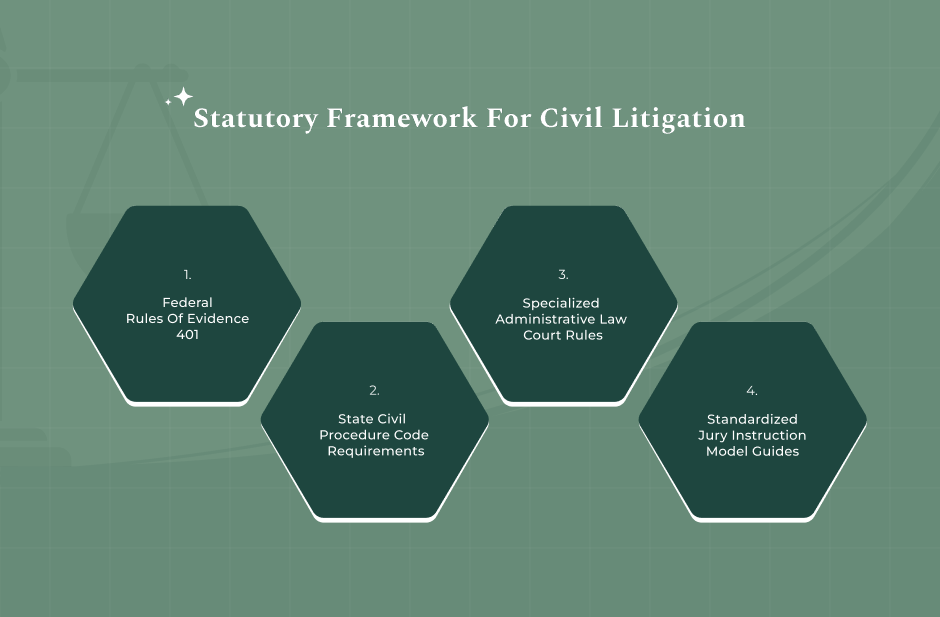
The federal and state governments have clearly outlined when to use the preponderance of evidence. This ensures a fair trial and that all citizens understand what they need to prove in order to win.
The Role Of The Federal Rules
The federal rules presume that all civil cases will involve the preponderance of evidence unless a particular case indicates otherwise.
This includes contracts, employment discrimination, and personal injury cases filed in federal court. This helps filter out evidence not meeting the 51% threshold requirement.
Variations In Civil Rules By The States
While all states follow federal rules in most cases, a few states raise the standard in situations such as terminating parental rights or committing an individual to a mental institution.
In such unusual situations, the preponderance of evidence standard changes to “clear and convincing evidence.”
In all other situations, such as a car accident or a small business case, the 51% standard applies universally in all fifty states.
Uniform Jury Instructions
States have “model jury instructions” that define preponderance of evidence in a way that is understandable to regular citizens who sit on a jury. These instructions are written in simple language to avoid confusion.
The instructions state the definition of preponderance of evidence as “the greater weight of the evidence.” This ensures that jurors do not mistakenly use this standard in a criminal case.
Administrative Law Applications
Most people have to deal with this standard in administrative law cases, such as social security or professional licensing boards.
These government agencies always use the preponderance of evidence in their decision-making processes. It is a faster and more efficient way to resolve cases that do not have jail time as a consequence.
Landmark Case Laws And Historic Rulings
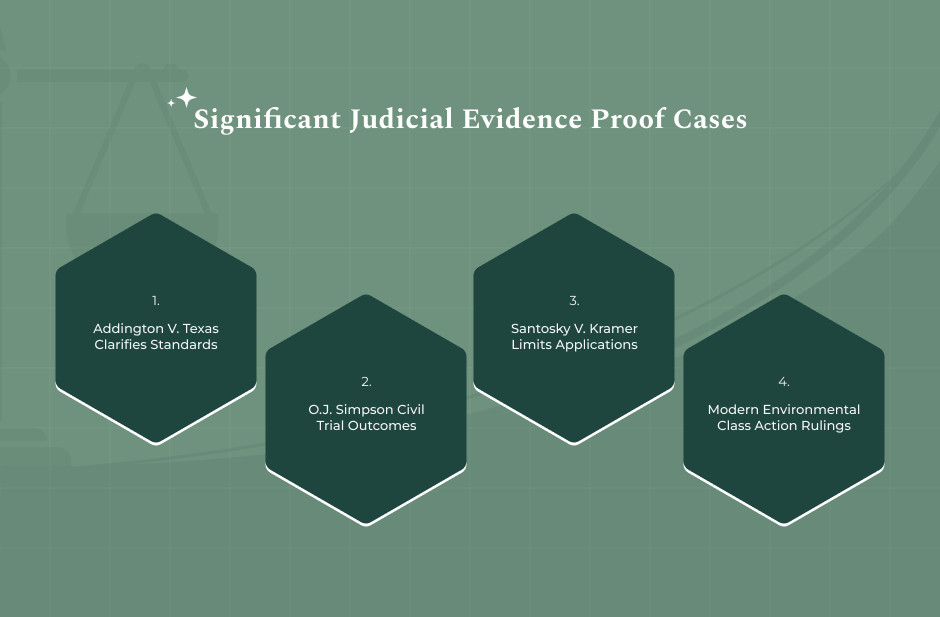
It has taken the judicial system decades to inform jurors, through a series of cases, how to apply the preponderance of evidence to their decision-making process.
These cases assist in providing context for ordinary citizens to grasp the concept of “more likely than not.”
Addington V. Texas (1979)
The Supreme Court used this case to inform jurors of the different levels of proof.
They were able to confirm the usage of the preponderance of evidence in ordinary civil cases, such as money damages.
In this case, they were able to confirm that the measure is a qualitative, rather than a quantitative, measure of evidence.
The O.J. Simpson Civil Trial (1997)
This is probably the most well-known example of the preponderance of evidence. Simpson was acquitted in a criminal court under a beyond a reasonable doubt theory.
In a civil court, however, a jury found him liable for the death of Ron Goldman and Nicole Brown Simpson. In this civil court, all they had to determine was the preponderance of evidence.
They were able to determine that Simpson was indeed responsible, so a multi-million dollar judgment ensued.
Proving Liability In Corporate Fraud
In many contemporary corporate fraud cases, the government or investors only need a preponderance of evidence to prove that a corporation has been deceiving the public.
This has been particularly important in corporate fraud cases against technology titans in 2025. By using email records and data tracking records, the plaintiff is able to demonstrate a trend that makes their case more probable than the defendant’s case. (Source: Justia)
Practical Impacts On Personal Injury And Contracts
The average individual deals with the concept of preponderance of evidence in personal injury lawsuits or breach of contract lawsuits. Understanding that you only need a 51% probability can change the way you live your life or make business deals.
Winning Personal Injury Cases
When you file a slip and fall case, you don’t necessarily have to prove that the store was definitely negligent. Instead, you only have to show the preponderance of evidence that they likely knew about the problem. Often, this is done by using security footage to show the preponderance of evidence.
Resolving Business Contract Disputes
When two businesses disagree on a contract, the courts will try to find the preponderance of evidence to determine which party was following the rules.
Communication is key in this case, as changes to a contract will give you the preponderance of evidence you need to win. In fact, a single email can give you the extra 1% you need to win a case.
Frequently Asked Questions
The preponderance of evidence is important for anyone who is entering a legal dispute. The following are some of the questions that people often ask regarding the preponderance of evidence. Please take a look at them:
It makes it easier to win a case because the plaintiff does not have to eliminate all doubt from the jury’s mind.
Yes, if the jury finds that the one witness is more credible than several other witnesses.
If the evidence is a 50-50 tie, the plaintiff loses because he or she did not offer a preponderance of evidence to sway the balance.
Read Also: