Mens rea is one of the most essential components in the domain of criminal justice. Mens rea is the name given to the mental state of an individual at the point of committing a crime.
During the latter part of 2025 and the beginning of 2026, the legal community has been dominated by the presence of mental intent in white-collar crimes and cyber fraud.
For example, there is a massive lawsuit in federal court presently taking place to establish whether a CEO had the necessary mens rea to defraud investors or if it was merely negligent.
In addition, the U.S. Supreme Court has recently ruled that the standards of intent in cases involving threats on social media require the prosecution to prove a particular mental state.
In this article, we will discuss the following:
- The historical roots and basic mens rea concept.
- Important distinction between actus reus and mens rea.
- The four major mental states: purpose, knowledge, recklessness, and negligence.
- The legal tests and examples that establish criminal responsibility.
What Mens Rea Really Means
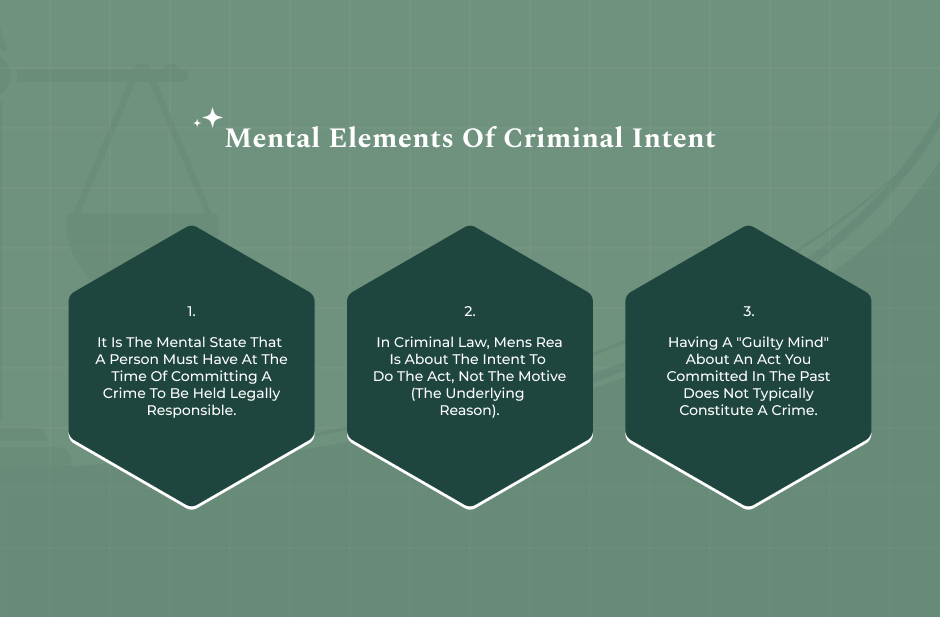
The mens rea is the “mental element” of a crime.
The historical background of the guilty mind has existed for several centuries. The guilty mind ensures that the government does not imprison people for all the harmful acts they do, no matter what their intentions are.
The guilty mind ensures that there is a fair system in place where the punishment suits the level of guilt of the offender.
History shows that the law in the past was mainly focused on the effect of an act. However, as time went by, the law evolved to take into consideration the intentions behind an act. This led to the standards that exist in courts today.
The origin of the maxim is rooted in the Latin phrase “actus non facit reum nisi mens sit rea.” This is translated to “an act does not make a person guilty unless the mind is also guilty.”
The maxim was adopted in English common law a few centuries ago to protect the guilty from accidentally committing crimes.
Mens Rea vs Actus Reus
To grasp how a crime is committed, one must consider both actus reus and mens rea. Although the keyword term stands for the mind, the other term stands for the action. A guilty plea usually involves both aspects happening simultaneously.
A comparison between mens rea vs actus reus shows that a person cannot be held liable for their thoughts. Again, they cannot be held liable for an action if they did not have the necessary mental component. This is the foundation of criminal justice.
Actus Reus: Physical Action
The actus reus is the physical action or the prohibited act itself. If the law states that it is illegal to steal, then the act of picking up the object is the actus reus. This is the part of the crime that the witnesses can see.
Mens Rea: Mental State
The mens rea is the internal state of the mind during the commission of that act. Did the person intend to steal the object, or did they actually believe that it was theirs? The law tries to answer this one question.
Core Mental States (Types Of Mens Rea)
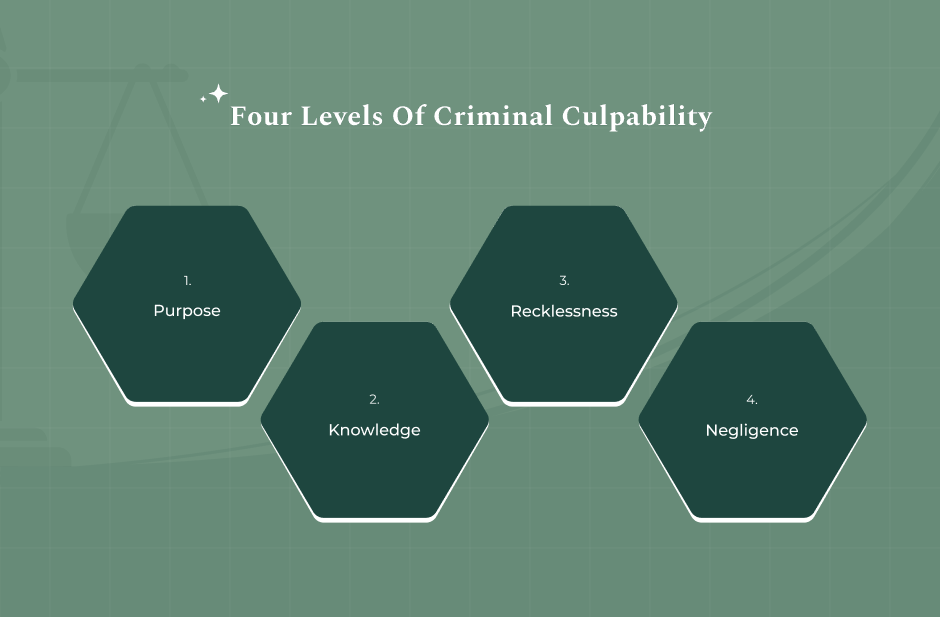
These levels of intent assist judges and jurors in determining the amount of blame to place on an individual. The greater the level of intent, the harsher the punishment will be.
Every state has a different level of awareness and desire. To understand what mens rea is, one must examine these particular definitions that are used in the United States by the Model Penal Code.
Intention (Purposeful)
Purposeful intent is the greatest level of guilt. In this case, the individual has a specific intention to cause a criminal act. When a person plans and commits a murder, they act with the intention of killing.
Knowledge
Knowledge is when the person knows that their actions will definitely cause a criminal act. They may not have a “desire” for the act, but they know it is going to happen. An example of this is selling stolen property when they know it has been stolen.
Recklessness
Recklessness is a deliberate disregard of a known risk. The actor knows about the risk but ignores it. They do not mean to cause the harm but gamble with the safety of other people, for example, drag racing on a busy road.
Negligence
Negligence is a failure to perceive a substantial risk that a reasonable person would have perceived. It happens when a person is not aware of the risk but should have been aware if they were paying attention.
Legal Tests for Mens Rea
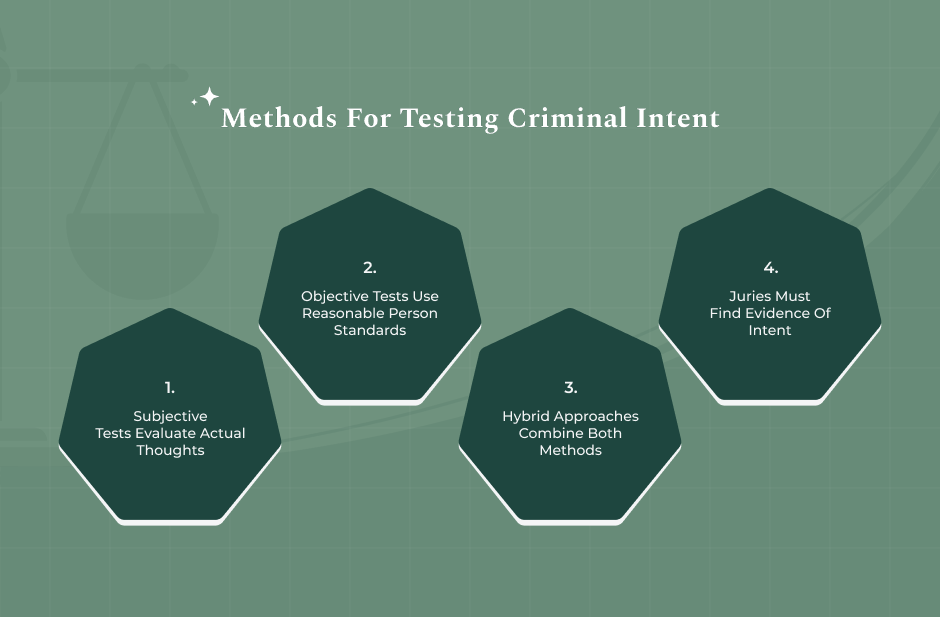
There has to be a way for the courts to determine what was going on in the mind of the defendant. Since we can’t read minds, there are tests used by the courts. These tests help the courts determine if the person actually intended to cause harm.
Some tests are used on the person, while others are used on how a normal person would react. These tests help the justice system make sense of the evidence.
Subjective Test
In a subjective test, the court examines the actual state of mind of the defendant at the time of the act. The jury asks, “What was this particular person thinking?” This test is usually used in crimes that require specific intent.
Objective Test
The objective test examines what a “reasonable person” would have foreseen. It doesn’t matter what the defendant was thinking. The court asks, “Would a normal, prudent person have known that the risk existed?”
Transferred Intent
Transferred intent is when a person intends to do harm to one victim but ends up doing harm to another person by mistake.
The law “transfers” the intent from the intended victim to the actual victim. If you shoot one person but hit another, you are still guilty of an intentional crime.
Motive vs Intent
It is very important to remember that the definition of mens rea does not include motive. Intent is when you want to commit the crime, and motive is why you committed the crime. Motive can be used to tell a story, but it is not usually part of the crime.
Exceptions & Strict Liability
There are times when the government chooses that the risk to the public is so great that the intent is not required. This is an exception to the rule of guilty mind. In these cases, you are guilty simply because you committed the crime.
Strict liability is usually used in “public welfare” crimes. These laws protect the public by requiring people to be very careful in dangerous or highly regulated activities.
- Public Safety: Traffic laws are the most common example of this.
- Environmental Protection: Corporations can be held liable for spills even if they did not mean to spill chemicals.
- Statutory Rape: Statutes often waive the intent requirement as far as the age of the victim is concerned.
- Food and Drug Laws: It is illegal to sell contaminated food even if the seller knew that the food was contaminated.
Jurisdictional Variations
How a court defines a “guilty mind” may differ from place to place. Each country and state has its own set of laws. This is why it is so important for lawyers to understand the local laws.
Of course, the concepts are similar, but the terminology is often very different. This is why an attorney must familiarize himself with the local codes.
Common Law vs Model Penal Code (MPC)
In the U.S., most states follow the Model Penal Code (MPC). This breaks down mental states into four groups. Some older common law states may still employ the terms “malice aforethought” or “willfulness”.
Civil Law Systems
In a nation like France or Japan, the law codes are organized in a different manner. They focus on “dolus” (intent) and “culpa” (fault). Although the words are different, the message is the same: to establish whether the offender has moral culpability for the crime.
Practical Importance In Criminal Justice
Why is mens rea so crucial? The answer is that we value human freedom. We would not want the law to treat someone who acted out of mistake the same way it treats a ruthless murderer.
Proving mens rea is significant in order to safeguard the innocent. It will prevent the government from misusing its power. It will also enable society to decide how much rehabilitation or punishment is required for each offender.
Expert Tips & Best Practices
If you are ever involved in a legal case, the mental state will be at the center of the fight. Lawyers for the defense will attempt to create “reasonable doubt” about what their client was thinking.
Prosecuting an individual’s intent is hard because you can’t see into their mind. The prosecution will have to base its case on what the individual did and said. The ability to move from one type of evidence to another is a valuable tool that any lawyer should know.
Emphasize Evidence
Use admissions, behavior, or expert opinion to prove what the defendant knew.
Examine Behavior
Hiding evidence or fleeing the area of a crime can be evidence of a guilty mind.
Examine Defenses
Determine if intoxication or mental illness prevented the defendant from forming the requisite intent.
Frequently Asked Questions (FAQs):
The field of criminal law can be very confusing for many people. The questions that follow are some of the most commonly asked questions regarding the application of mens rea in practical scenarios and important legal occurrences.
This is dependent on the crime. For “specific intent” crimes, such as theft, voluntary intoxication is a defense because you did not have specific intent.
For “general intent” or “recklessness” crimes, such as assault or DUI, being drunk is no defense. Voluntarily becoming intoxicated is considered to be reckless behavior.
No, in general. The legal system is based on the concept that all people have the responsibility to know the law.
“Mistake of fact” (for example, picking up the wrong overcoat) is a defense, but “mistake of law” (ignoring the fact that the behavior is illegal) is never a defense.
It is the responsibility of the citizen to remain informed of his or her obligations under the law.
As prosecutors can’t read minds, they resort to circumstantial evidence. They analyze your activities before, during, and after the incident.
If you purchased a mask and a weapon before entering a store, it indicates a deliberate mens rea. Juries form “reasonable inferences” from what a defendant says and does to ascertain their real mental state.