The topic of the day: Is it legal to drive barefoot?
You’ve probably heard it since you were a teenager: “Put your shoes on! It’s illegal to drive barefoot.”
You’ve probably heard it from someone – maybe a parent, a driving teacher, or a friend who knows someone it happened to. This idea has become a kind of myth that people keep talking about when it comes to cars.
So, is there really any truth to this claim? The simple answer is no, not at all.
In the US, UK, Canada, and Australia, you won’t find any laws that say you have to wear shoes while driving a car. This is true in all 50 states in the US – there’s no rule that says you need to have footwear on to drive. It’s pretty much the same in these other countries, too.
But that’s not the whole story. When it comes to driving with bare feet, there’s more to it than just a simple yes or no answer.
The decisions you make about what you wear on your feet can have a big impact on a lot of things, like:
- Whether or not you’re liable in an accident.
- What your insurance company will do.
Besides, it is also about your own safety on the road. For instance, according to Super Lawyers, “some states have noted safety hazards and risk of personal injury, advocating for safe driving practices at all times.”
In this blog, that is exactly what we will be talking about at length. Therefore, keep reading!
Is It Legal To Drive Barefoot In The USA?
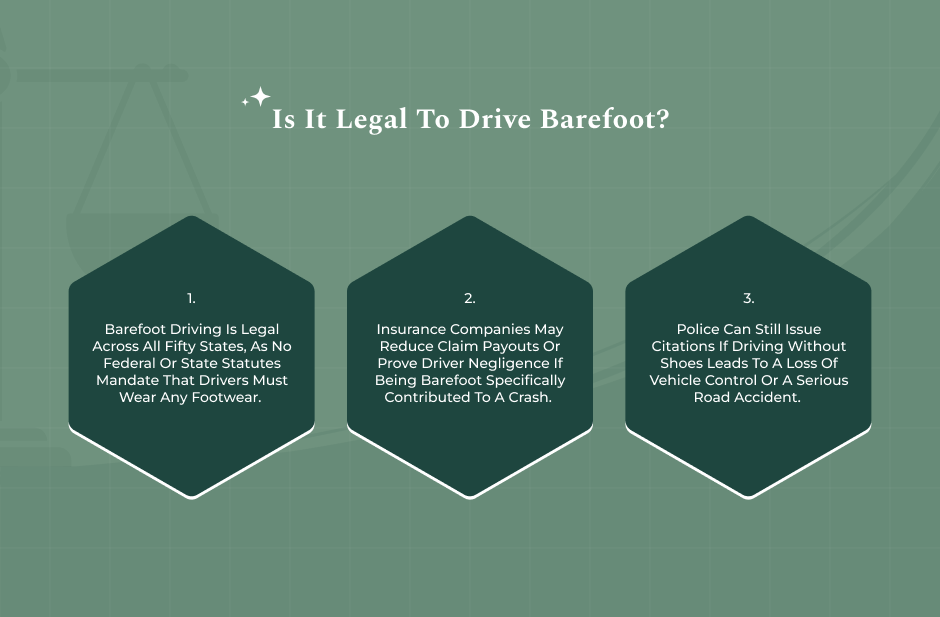
In the US, it is 100% legal to drive barefoot in all 50 states. Neither federal law nor state statutes require drivers to wear shoes when operating a vehicle.
It has been a widespread misconception that driving barefoot is punishable by law, but various departments of transportation and police in different states have clarified that no such law exists.
In fact, just because something is “legal” does not mean that there is no “risk” involved.
For instance, let’s say there is a car accident and the police find that the driver’s barefootness led to the driver losing control – like their foot slipping off the brake pedal. In that case, this person could get a ticket for not using proper care or for reckless driving.
Besides that, insurance companies might find the fact that the driver was barefoot a way to prove their negligence, thus leading to lesser payment of claims.
The Global Legal Landscape: What the Law Actually Says
The first thing to understand is that traffic laws are generally in place to regulate behavior and vehicle safety, not your wardrobe.
The United States
Without a single state banning driving barefoot in the United States, the legislation around the country is pretty clear.
Not a single federal law has been issued, nor has any state legislature ever been able to pass a bill mandating the wearing of shoes when driving.
The Motorcycle Clause: There is one significant detail. Take Alabama, for instance. There, it is a legal requirement for motorcyclists and their passengers to wear shoes.
The only reason for this is that a rider’s feet are far more exposed to the elements and heat from the vehicle’s mechanical parts than a car driver’s.
The United Kingdom
Similar to the US, the law in the UK is remarkably silent about shoes – but loud about control. According to Rule 97 of the Highway Code, a driver has to make sure that their “clothing and footwear do not prevent [them] using the controls in the correct manner”.
If you get pulled over by an officer and it is decided that you lack “proper control” due to slipping feet, you could be charged. For example, you could be fined for dangerous or careless driving.
Australia And Canada
Much like the UK, Australia, and Canada, which rely on broad “Careless Driving” or “Proper Control” statutes.
If an officer in New South Wales or Ontario sees you struggling with your pedals while barefoot, they won’t ticket you for “No Shoes.” Rather, they’ll ticket you for the resulting erratic driving.
Why Does Everyone Think It’s Illegal?
If there’s no law, why does almost everyone believe there is? The myth survives through a perfect storm of social norms and “fear-based” education.
- The “No Shoes, No Shirt, No Service” Sign: We see these signs in every convenience store and restaurant. Private businesses have the right to enforce dress codes for health and safety. So, many people assume these rules are actually public laws that extend to the road.
- Driving Schools: Many driving instructors tell students it’s illegal simply to discourage a habit they view as unsafe. It’s easier to say “it’s against the law” than to explain the nuances of “pedal feel” to a 16-year-old.
- The “60s Rebellion” Myth: Some historians of urban legends trace the myth back to the 1960s. The story goes that police would use “barefoot driving” as a pretext to stop “hippies” or teenagers they suspected were up to no good.
The Real Danger: Liability And Insurance
This is where the “it’s legal” argument hits a wall. Just because something isn’t a crime doesn’t mean it won’t cost you everything in a civil court or insurance claim.
The “Failure To Exercise Due Care” Trap
If you are involved in an accident, the police will investigate every factor.
If they find that your bare foot slipped off the brake – or that you couldn’t apply enough force because of a foot cramp or sweat – they might charge you for Failure to Exercise Due Care.
In the eyes of the law, you chose to operate a heavy machine in a way that reduced your control.
Insurance: The “Rash Driving” Ruling
Insurance companies have a reputation for being extremely tough on their expenses.
For example, let’s say that a claims adjuster discovers that the type of shoes you were wearing (or the lack thereof) played a part in a car crash. In that case, they might try to refuse your claim by blaming you for negligence.
But, there have been a few major changes happening, such as some significant court rulings, including one from the Supreme Court of India, that indicate insurance companies are not bound to pay for accidents that result from reckless or careless driving.
Perhaps, this change only covers a few locations. But it reveals a pattern that is unfolding everywhere. In case you are not at fault, you may not have a safety net to rely on.
What it means is that irresponsible people or those who do not respect traffic rules risk being without insurance coverage at times when they most need it.
It is a major change. Here, the question is whether it will affect our way of thinking about insurance and personal responsibility.
Why Is Driving Barefoot Discouraged?
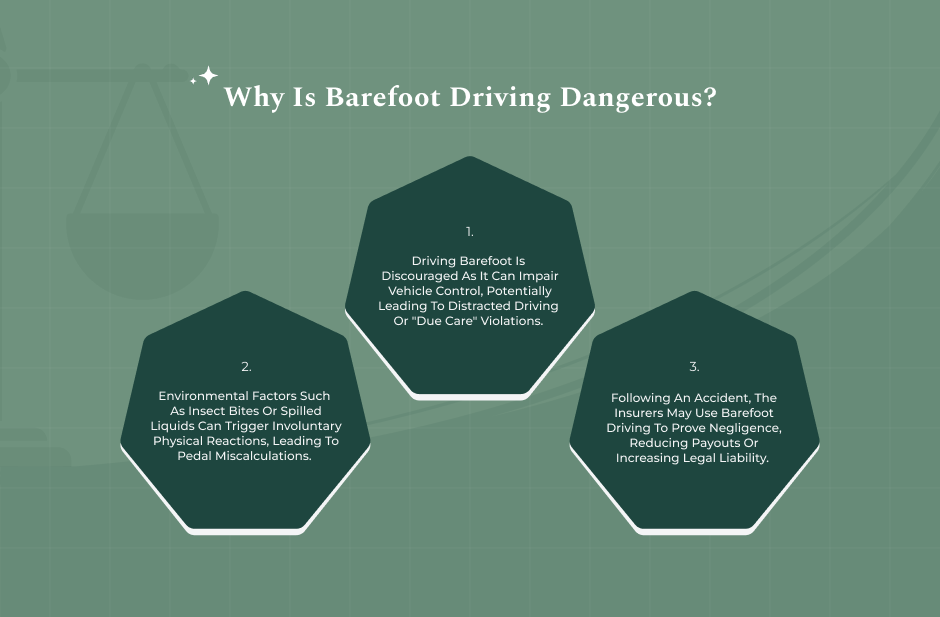
It is technically legal to drive without shoes. However, safety experts and law enforcement generally advise against it. And that’s mainly because barefoot driving can impair the driver’s control of the vehicle.
No state has made the mere act of driving without shoes a class of reckless driving. But, it could produce situations that are classified as distracted driving or failure to exercise due care.
Among the biggest concerns of driving without shoes is the possibility of coming in contact with outside elements.
There have been a few instances in which drivers have lost their attention when ants or other insects bite their bare feet.
In the same way, an instantaneous physical reaction to a scalding hot or ice-cold beverage dropped directly onto bare skin may lead to swerving or a loss of sense of the pedals. Especially if the driver is already driving by the roadside.
Potential Hazards Of Operating A Vehicle Without Shoes
The greatest risk associated with driving barefoot lies in the inability to apply uniform pressure to the pedals.
If a driver suddenly experiences a foot cramp or the foot slips on the pedal, an immediate and unintentional reaction could be to “slam” the brakes or the accelerator. This may result in a vehicle spinning out or skidding through several lanes of traffic.
Also, the law prohibits any kind of clothing that can hinder the safe control of the vehicle. (Source: Tom Kinley Law)
Just as one would not wear darkly tinted glasses at night or loose clothing that can get caught in the gear shift, one may be considered negligent for driving barefoot.
If a person’s lack of footwear causes an accident, they could be charged with reckless endangerment. This is a more serious charge.
Legal And Insurance Consequences After An Accident
Whenever a collision causes property damage, injuries, or fatalities, the person at fault could be criminally charged.
In the course of their inquiry, local law enforcement, and especially highway patrol, will record what the driver was wearing on their feet at the moment the accident occurred.
Although it’s not illegal, pedestrians going without shoes get referred to by police as “engaging in strange or unusual behavior.”
Generally speaking, insurers rely on such findings to keep track of the degree to which different parties share fault.
In case your bare feet were, by any chance, the major contributing factor to the mishap, you will be in trouble.
Your insurance company will have a good reason to reduce your compensation. Additionally, they can also unfairly accuse you of negligence while operating the vehicle.
Read Also: Is It Illegal To Drive With Headphones? Know The Legal Consequences!
Expert Tips: How To Drive Legally And Safely
So, is it legal to drive barefoot? Well, there are no laws that directly forbid barefoot driving. However, this often has a rather high level of legal and civil liability risks.
One can interpret this as a driver not being in control of the vehicle. That may lead to citations for reckless driving or careless endangerment – especially if there is a vehicle crash in the situation.
One of the ways to avoid this type of risk is for the drivers to tie up their loose footwear in the passenger area.
In that way, their pedals are not blocked. Additionally, they should always keep their feet dry so that they will have a good grip.
The responsibility for safety always lies with the driver. And being barefoot is one of the reasons for the lack of control, which in turn can cause insurance claims to be refused or even criminal negligence charges.