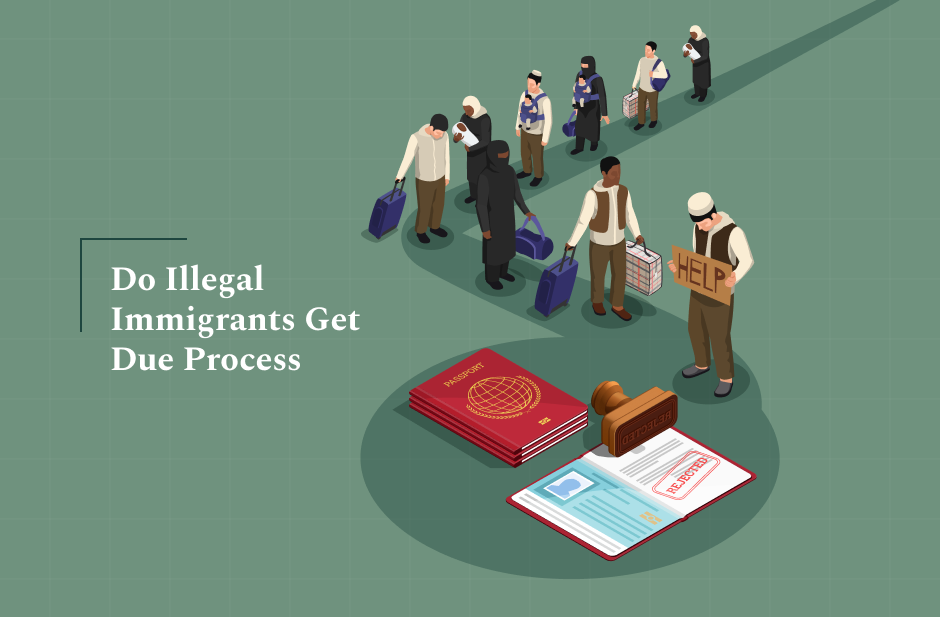
The Constitution provides specific due process rights to both citizens and noncitizens present on United States soil.
Historically, the U.S. immigration system has struggled to uphold these rights consistently and effectively.
Recently, there has been a marked escalation in actions that undermine the due process rights of immigrants.
Moreover, it highlights a growing concern for their legal protections. But do illegal immigrants get due process?
In this blog, we will find out if they do. Additionally, we will learn about the related legal nuances regarding the same.
What Is Due Process?
A fundamental principle of the U.S. government is the right of all individuals to receive fair treatment under the law. (Vera)
This principle, known as due process of law, is established in the Fifth and 14th Amendments of the Constitution.
Due process ensures that before the government can deprive a person of their life, liberty, or property, they must be given proper notice and an opportunity to present their case in court.
This legal protection serves as a safeguard against the arbitrary use of government power.
For instance, it requires law enforcement and prosecutors to demonstrate probable cause before making an arrest.
Additionally, it prevents the government from indiscriminately terminating public housing or food assistance.
In fact, it mandates that civil procedures be observed before the state can revoke a parent’s rights.
Do Illegal Immigrants Get Due Process In 2026?
The due process clauses of the Fifth and 14th Amendments protect all individuals within the borders of the United States.
This happens regardless of their immigration status.
Recently, the Supreme Court reinforced this principle.
It ruled that immigrants facing deportation under the Alien Enemies Act have the right to challenge the legality of their detention.
Additionally, the court mentioned that they can do so before being removed from the country.
This ruling referenced the 1993 case Reno v. Flores.
In this case, Justice Antonin Scalia emphasized that the Fifth Amendment guarantees due process for immigrants.
Consequently, individuals accused of unauthorized presence in the U.S. are entitled to a fair trial in immigration court.
This process allows them to confront and contest the evidence against them.
Additionally, this helps prevent potential injustices and curb the misuse of government authority in the detention and deportation of individuals.
Also, we must know that many of them are seeking safety. Therefore, they may have legitimate claims to remain in their communities.
How Have The Recent Policy Changes Impacted Due Process In 2026?
The period of 2024-2025 has marked a notable tightening of due process protections for undocumented immigrants in the United States. (Ilabaca Law)
In June 2024, the Biden administration introduced new asylum restrictions that largely curtailed eligibility for asylum for many individuals crossing the border.
Under these regulations, only those who received appointments through the CBP One mobile application will be able to seek asylum.
They need to apply for it during times of elevated border encounters.
In a significant legal development, the Board of Immigration Appeals issued a ruling in Matter of Yajure Hurtado in September 2025.
It holds that immigration judges lack the authority to conduct bond hearings for individuals who entered the U.S. without inspection.
This decision impacts over one million pending immigration cases.
Additionally, it leads to a situation where most undocumented immigrants are subject to mandatory detention throughout their legal proceedings.
In fact, this stands irrespective of their length of residence in the country or their connections to the community.
The transition to the second Trump administration has intensified these restrictions.
By March 2025, ICE arrest rates surged from 310 to 650 per day.
Also, the capacity for immigrant detention facilities increased from 41,500 to 54,500 beds.
Additionally, federal funding that supported legal services for unaccompanied minors was cut in March 2025.
Therefore, this leaves approximately 26,000 vulnerable children without legal representation.
What Due Process Looks Like in Deportation Proceedings?
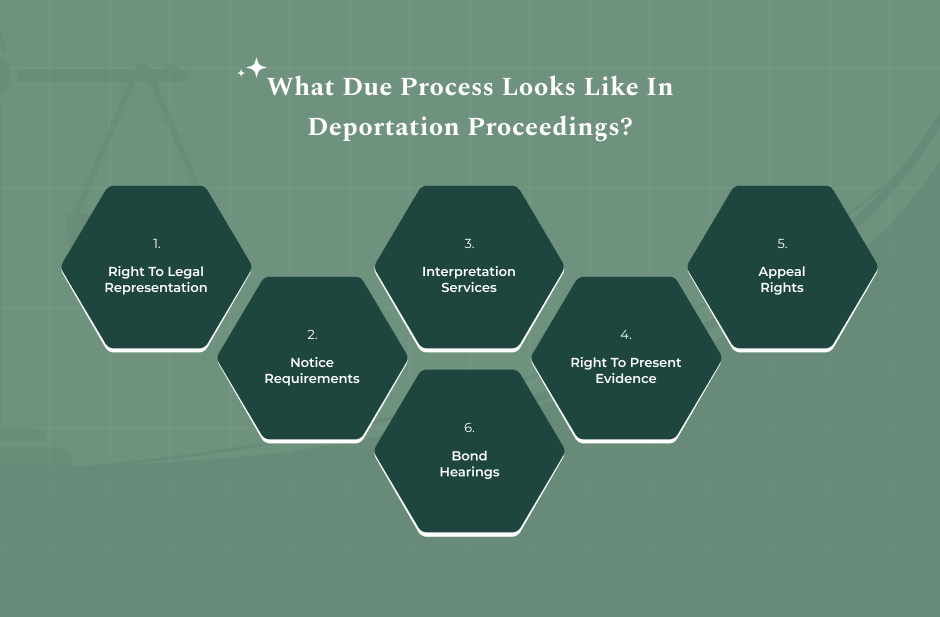
Immigration proceedings are classified as civil matters rather than criminal ones.
Therefore, this means the rights and protections available to individuals in these cases are more limited than in criminal courts.
Nevertheless, undocumented immigrants still possess several important due process rights.
It includes the following:
1. Right To Legal Representation
While immigrants have the option to hire an attorney at their own expense, there is no provision for government-appointed counsel, as in criminal proceedings.
This difference is significant.
In fact, recent studies indicate that immigrants with legal representation are 5 times more likely to secure relief from removal than those without legal assistance.
2. Notice Requirements
The government is obligated to provide proper notification through a Notice to Appear (Form I-862), which must detail specific charges, hearing dates, and the potential consequences of failing to appear.
This notification must be “reasonably calculated to reach the noncitizen” to fulfill legal requirements.
3. Interpretation Services
Immigration courts are required to offer qualified interpreters throughout all proceedings.
This ensures that there is oral interpretation during hearings, as well as certified English translations of any foreign-language documents relevant to the case.
4. Right to Present Evidence
Immigrants have the right to present their case by calling witnesses, submitting documentary evidence, cross-examining government witnesses, and testifying on their own behalf during individual hearings.
5. Appeal Rights
If a decision is unfavorable, it can be appealed to the Board of Immigration Appeals within 30 days.
Decisions may also be further appealed to the federal circuit courts for judicial review.
6. Bond Hearings
Many detained immigrants have the right to request release on bond while their cases are ongoing.
However, recent policy changes have significantly restricted this right.
Do Illegal Immigrants Get Due Process: Common Misconceptions To Avoid
Many Americans think that undocumented immigrants have no legal rights.
However, all people on U.S. soil have constitutional rights, though some benefits depend on immigration status.
Undocumented immigrants can stay silent, are protected from unreasonable searches, can receive emergency medical care, and can enroll their children in K-12 education.
There are important differences between immigration cases and criminal court.
Immigrants do not have the right to a government-appointed lawyer, cannot request a jury trial, and face different rules of evidence.
In immigration court, hearsay evidence can be used, which is not allowed in criminal cases.
Also, the rules that block illegally obtained evidence in criminal trials are not as strict in immigration court.
The label “illegal immigrants” shows a misunderstanding of legal status. Most immigration issues are civil matters, not crimes.
While entering the country unlawfully is a federal misdemeanor, most immigration enforcement actions are civil removal proceedings rather than criminal prosecutions.
The Expansion Of Expedited Removal Is A Huge Block For Due Process
Expedited removal, established by Congress in 1996, allows for the rapid deportation of undocumented noncitizens without the formal safeguards present in standard removal proceedings. (Forum)
In these standard proceedings, noncitizens are entitled to due process, including the opportunity to present evidence and challenge the government’s case before an immigration judge.
In contrast, expedited removal grants immigration officers the authority to determine removability, typically after only a brief interview, and without allowing individuals to consult with an attorney or gather evidence to defend themselves.
This raises significant due process concerns, particularly given the risk of wrongful removals of U.S. citizens or those eligible for protection.
The recent expansion of expedited removal requires noncitizens to prove they have been continuously present in the U.S. for at least 2 years, often on the spot, which can compel individuals to carry residency documentation at all times.
Lacking clear guidance on acceptable proof leaves individuals vulnerable to arbitrary treatment by immigration authorities.
Significance Of The Make the Road New York v. Huffman Lawsuit
Make the Road New York v. Huffman (D.D.C. 2025) is a lawsuit challenging the Trump administration’s January 2025 expansion of expedited removal.
It was filed by Make the Road New York, the ACLU, and the NYCLU.
The lawsuit argues that the new policy violates the Fifth Amendment by depriving noncitizens of essential procedural protections.
Plaintiffs claim the expansion denies individuals the right to a fair hearing and fails to provide adequate time to meet their burden of proof.
The plaintiffs face a significant legal hurdle stemming from a 2020 D.C. Circuit ruling upholding a prior expansion of expedited removal.
Additionally, it states that decisions made by the DHS Secretary are subject to “sole and unreviewable discretion” under 8 U.S.C. § 1225(b)(1)(A)(iii)(I).
However, unlike the earlier case, the current lawsuit may be able to raise due process claims under the INA and the U.S. Constitution.
Do Illegal Immigrants Get Due Process In 2026?
Removing immigrants from the country has serious consequences.
It permanently separates families, cuts off access to protection from danger, and often forces people back into life-threatening situations.
For many immigrants, these removal proceedings are the most important legal matters they will face, yet they often go through this life-changing process without legal help, which is something Americans have in criminal cases.
The promise of due process only holds true when immigrants can actually access and use their rights.
Even though the law provides certain protections, immigrants need knowledgeable legal representation, enough resources, and a fair system to ensure proper proceedings instead of just quick deportations.
Disclaimer: The information provided in this article is for general informational purposes only. It does not, and is not intended to, constitute legal advice. Please consult an attorney for legal help.